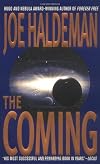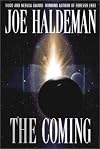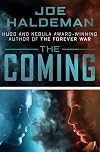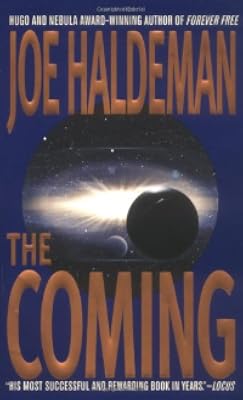
The Coming
by Joe Haldeman
On This Page
Description
A dystopian future Earth is thrown into fear and turmoil by the imminent arrival of extraterrestrials in this alien-contact classic from a sci-fi master. With The Coming, multiple Hugo and Nebula Award-winning science fiction Grand Master Joe Haldeman ingeniously combines a troubling dark vision of a dystopian near-future with an alien first-encounter tale as thrilling and thought-provoking as Carl Sagan's Contact and Steven Spielberg's Close Encounters of the Third Kind. Despite show more technological advancements designed to alleviate the stress of everyday life, Earth at the midpoint of the twenty-first century is plagued by environmental crisis and manmade catastrophe. Tensions among the nations of Europe bring the threat of World War III closer by the hour as their lands are also ravaged by devastating climatic upheaval, the result of centuries of unchecked ozone depletion and global warming. Meanwhile, in an America whose population has been sedated by DNA-specific drugs and virtual porn, homosexuality and free sexual expression have been outlawed by a repressive federal government led by an inept media-star president. But everything changes on October 1, 2054, when Professor Aurora Bell, an astrophysicist at the University of Florida, picks up a message from deep space: 'We're coming . . .' Ingeniously told from the viewpoints of a diverse cast of characters ranging from scientists, artists, and ordinary citizens to criminals, con men, and politicians, The Coming is a shockingly prescient work of speculative fiction from the multiple award-winning author of The Forever War and the acclaimed Worlds series, taking the alien invasion story to places it has never gone before. show lessTags
Recommendations

















Member Recommendations
by FoM
Member Reviews
"E.T." meets "Peyton Place" in a supposed First Contact novel that turns out to be a tawdry soap opera set among the kooks and creeps of Gainesville, Florida. There's the virtual reality porn star, the slimy mob enforcer, the crazy bag lady...and Haldeman throws in a few techno touches just to let us know everything takes place 30 years in the future: homosexuality is now an indictable offence and VR goggles come with a genital attachment. Relegated to the final few pages, the actual Coming itself turns out to be little more than a shaggy dog story which I suppose could be taken as satire were it not so clumsily presented. Some of the politics hit the mark however with D.C. coming across as a circus of incompetence while actual show more scientists are put on the back burner, and I liked how each chapter segued into next one with multiple POVs, but in the end it wasn't enough to save the story. show less
When I began rereading The Coming, I thought I recalled that it was a high-science, first-contact story. We do get some solid speculation on how we might use blue shift and parallax to distinguish incoming spacecraft from comets or asteroids. But I had forgotten how many subplots there were involving humanity’s irrational response to the news that aliens were inbound. The big reveal at the end was gimmicky but clever.
I could do without the blackmail and organized crime plots, but I did appreciate the barbs aimed at the spineless response of university administrators to government pressure. One should remember that Haldeman wrote The Coming while he was on the faculty at M.I.T.
Read this one if you are a fan of novels by Carl Sagan, show more Michael Crichton, and Peter Cawdron. show less
I could do without the blackmail and organized crime plots, but I did appreciate the barbs aimed at the spineless response of university administrators to government pressure. One should remember that Haldeman wrote The Coming while he was on the faculty at M.I.T.
Read this one if you are a fan of novels by Carl Sagan, show more Michael Crichton, and Peter Cawdron. show less
In the middle of the 21st Century, Aurora Bell is an Astronomy professor at the University of Florida in Gainesville. One day, she receives a message from outer space ("We're Coming") that seems to herald the arrival of alien visitors. The alien ship is traveling at just under the speed of light, and will arrive on New Year's Day, three months from now.
Earth of the mid-21st Century is not prepared for any sort of invasion. Global warming has begun to alter Earth's climate. Much of Long Island is under water, and in Florida, going outside for any length of time without sunscreen is a bad idea. Europe is again on the brink of war. The American President, Carlie LaSalle, is an airbrushed creation of the political consultants and media show more managers. She tends to look at everything in terms of a conspiracy against her; the general consensus is that she has approximately six working brain cells.
LaSalle orders the deployment of a space-based laser carried on a shuttle to destroy the alien ship if it starts firing on Earth. Such a laser could also be pointed downward, like at some European city, getting Europe very upset at America. If They (whoever they are) have light-speed space travel, and intetrstellar capabilities, won't they have defenses against orbiting laser systems? Even worse, if Earth gets them angry, won't they have the ability to severely damage, or destroy, the Earth? On the other hand, who ever heard of a one-ship "invasion?" Grayson Pauling, the President's Science Advisor, is totally opposed to LaSalle's plan, opposed enough to sneak several pounds of plastic explosive into a Cabinet meeting. Amid all this, Bell is less and less convinced that aliens are coming. A longer message, detailing just where and when they will land, is in present-day colloquial English. Something is heading for Earth, but what?
This is another solid, you-won't-go-wrong story from Haldeman. It is more about Earth several decades from now than about Alien Contact, but it is still a gem of a novel. show less
Earth of the mid-21st Century is not prepared for any sort of invasion. Global warming has begun to alter Earth's climate. Much of Long Island is under water, and in Florida, going outside for any length of time without sunscreen is a bad idea. Europe is again on the brink of war. The American President, Carlie LaSalle, is an airbrushed creation of the political consultants and media show more managers. She tends to look at everything in terms of a conspiracy against her; the general consensus is that she has approximately six working brain cells.
LaSalle orders the deployment of a space-based laser carried on a shuttle to destroy the alien ship if it starts firing on Earth. Such a laser could also be pointed downward, like at some European city, getting Europe very upset at America. If They (whoever they are) have light-speed space travel, and intetrstellar capabilities, won't they have defenses against orbiting laser systems? Even worse, if Earth gets them angry, won't they have the ability to severely damage, or destroy, the Earth? On the other hand, who ever heard of a one-ship "invasion?" Grayson Pauling, the President's Science Advisor, is totally opposed to LaSalle's plan, opposed enough to sneak several pounds of plastic explosive into a Cabinet meeting. Amid all this, Bell is less and less convinced that aliens are coming. A longer message, detailing just where and when they will land, is in present-day colloquial English. Something is heading for Earth, but what?
This is another solid, you-won't-go-wrong story from Haldeman. It is more about Earth several decades from now than about Alien Contact, but it is still a gem of a novel. show less
The editors of a literary magazine I'm a member of use an abbreviation that would apply to this novel: TLDGA (Too Long Doesn't Go Anywhere). You don't often see this kind of novel but when you do it's hard not to classify it as: author used text to put his own fascination and fetishes on paper. Sometimes this works to great effect, such as Portnoy's Complaint by Philip Roth, but in those cases the author knows to give the reader plenty of entertainment and other unrelated materials. Haldeman however foregoes that and just let's loose on his own fascinations from the get go. Roughly and vaguely this science fiction novel is about first contact. More specifically and more importantly this is a novel written by an author with an obsession show more of bodily functions.
Besides a litany of graphic scenes and paragraphs I could have done without, the author mainly experiments with narrative. Chapters are standalone points of view of a single character and the novel is chain of ever changing perspectives, or rather that's what it wants to be. Instead it reads as a rapid chaos fire. I could barely keep up trying to figure out who this character was I was reading about again since it only had a 1 page chapter about 10 chapters back.
I stopped reading this book because not only is it tedious, it's frustrating and insulting to the reader. In fact this novel made me angry since I felt stuck at the end of a fire hose that starts at the author's mind and which spouts personal sexual and body interaction preferences directly into my brain. show less
Besides a litany of graphic scenes and paragraphs I could have done without, the author mainly experiments with narrative. Chapters are standalone points of view of a single character and the novel is chain of ever changing perspectives, or rather that's what it wants to be. Instead it reads as a rapid chaos fire. I could barely keep up trying to figure out who this character was I was reading about again since it only had a 1 page chapter about 10 chapters back.
I stopped reading this book because not only is it tedious, it's frustrating and insulting to the reader. In fact this novel made me angry since I felt stuck at the end of a fire hose that starts at the author's mind and which spouts personal sexual and body interaction preferences directly into my brain. show less
This book doesn't offer much in the way of original SF ideas and the ending is a damp squib, but it's interesting for the way it is constructed. It is a First Contact story with a premise similar to that of Sagan's Contact.
There are multiple viewpoints but instead of rotating around the characters and giving each perspective over the whole time period of the story, time progresses continually. Viewpoint switches are like momentum transfer in collisions; one character bumps into another and then suddenly we are off somewhere else in that second person's head! Think a little about how hard it would be to construct a novel that way and yet tell a good story well! I think there are a couple of times Haldeman can't quite make it work and we show more have to leap across town but not very many. Haldeman carries it off with impressive skill and the narrative is easy to follow and understand - so: technically impressive but not the best Haldeman can do in terms of SF ideas. show less
There are multiple viewpoints but instead of rotating around the characters and giving each perspective over the whole time period of the story, time progresses continually. Viewpoint switches are like momentum transfer in collisions; one character bumps into another and then suddenly we are off somewhere else in that second person's head! Think a little about how hard it would be to construct a novel that way and yet tell a good story well! I think there are a couple of times Haldeman can't quite make it work and we show more have to leap across town but not very many. Haldeman carries it off with impressive skill and the narrative is easy to follow and understand - so: technically impressive but not the best Haldeman can do in terms of SF ideas. show less
The Coming is a near-future first-contact story. It begins with a message from an alien craft in deep space-- "We're coming."-- then follows a host of characters through the three months between the message and the arrival of the ship.
The problem is there isn't much of an idea here. The book is about the anticipation of an imminent first contact, but when it finally comes, it proves to be a minor plot twist that might, maybe, be interesting enough to support a short story. The sort of twist you might get at the end of a half-baked episode of the Twilight Zone. Worse, from the perspective of the last page, most of the many, many characters are revealed as irrelevant to the story. Were they added to pad the book up to novel length? That's show more how it feels.
Fortunately, the book is quick enough that its emptiness isn't painful. Haldeman's writing is always clear and pointed. The characters who get developed are interesting, and some aspects of his 50-year future are interesting. (Especially his vision of the near-future news media.) On the other hand, there are features of his near-future that are tantalizing but unexplained. Society is terribly homophobic. Why? How did we get there from here?
The structure of the book makes it a compulsive read. The narrator's eye transfers from character to character as they interact. So we might begin following an astronomer as she talks to her husband, and then follow him to his neighborhood bar, and then follow his bartender after he leaves, and so on. It makes the pacing feel whiplash-frantic while still allowing lots of detail. It's a neat technique I've never seen employed in quite this way.
Still, no amount of frantic pacing can make up for the lack of substance.
(An irrelevant aside: The President of the USA is eerily like Sarah Palin-- eerily because the book was published in 2000, when no one outside of Wasilla had heard of Palin.) show less
The problem is there isn't much of an idea here. The book is about the anticipation of an imminent first contact, but when it finally comes, it proves to be a minor plot twist that might, maybe, be interesting enough to support a short story. The sort of twist you might get at the end of a half-baked episode of the Twilight Zone. Worse, from the perspective of the last page, most of the many, many characters are revealed as irrelevant to the story. Were they added to pad the book up to novel length? That's show more how it feels.
Fortunately, the book is quick enough that its emptiness isn't painful. Haldeman's writing is always clear and pointed. The characters who get developed are interesting, and some aspects of his 50-year future are interesting. (Especially his vision of the near-future news media.) On the other hand, there are features of his near-future that are tantalizing but unexplained. Society is terribly homophobic. Why? How did we get there from here?
The structure of the book makes it a compulsive read. The narrator's eye transfers from character to character as they interact. So we might begin following an astronomer as she talks to her husband, and then follow him to his neighborhood bar, and then follow his bartender after he leaves, and so on. It makes the pacing feel whiplash-frantic while still allowing lots of detail. It's a neat technique I've never seen employed in quite this way.
Still, no amount of frantic pacing can make up for the lack of substance.
(An irrelevant aside: The President of the USA is eerily like Sarah Palin-- eerily because the book was published in 2000, when no one outside of Wasilla had heard of Palin.) show less
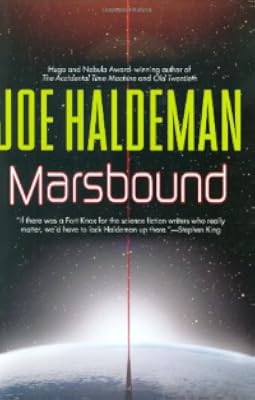
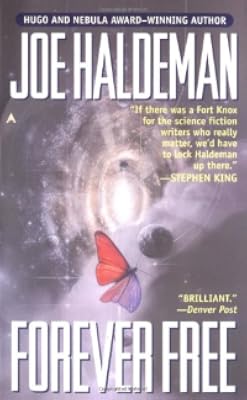
This book wasn't as good as I hoped it would be -- some of Joe's other work has been excellent (The Forever War, Forever Peace and Marsbound being examples). However, some of his other books are very weak, such as Forever Free and There Is No Darkness. This book is an interesting experiment in story telling style, where many different very short chapters are told by different characters. Each chapter follows on directly from the previous one. However, this style makes the story confusing to read until you can remember the names of all the characters. Worse than that though, the idea behind the story isn't terribly strong, and the resolution is weak as well.
Overall and ok read, but not Joe's best work and not a book I would recommend.
show more target="_top">http://www.stillhq.com/book/Joe_Haldeman/The_Coming.html show less
Overall and ok read, but not Joe's best work and not a book I would recommend.
show more target="_top">http://www.stillhq.com/book/Joe_Haldeman/The_Coming.html show less
Members
- Recently Added By
Author Information

191+ Works 30,899 Members
Joe Haldeman has uniquely blended a strong interest in astronomy and with his love for writing to publish numerous novels, anthologies and short stories over three decades. He holds a B.S. in astronomy from the University of Maryland (1967), and an M.F.A. in English from the Iowa Writers Workshop (1975). An adjunct professor at Massachusetts show more Institute of Technology, Haldeman has also taught at Michigan State, Larion West Seattle, SUNY Buffalo, Princeton, University of North Dakota, Kent State and the University of North Florida Haldeman's works include War Year (1972), The Forever War (1975), Worlds (1981), Worlds Apart (1983), Tools of the Trade (1987), and The Hemingway Hoax (1990). He has also co-authored and edited numerous works of science fiction. Born in Oklahoma on June 9, 1943, Haldeman grew up in Puerto Rico, New Orleans, Washington D.C., and Alaska. He was drafted into the military in 1967, fighting in the Central Highlands of Vietnam as a combat engineer with the 4th Division (1/22nd Airmobile Battalion), for which he received the Purple Heart, among other medals. (Bowker Author Biography) show less
Some Editions
Awards and Honors
Distinctions
Common Knowledge
- Original publication date
- 2000
- Blurbers
- King, Stephen; Brin, David; Straub, Peter
Classifications
Statistics
- Members
- 590
- Popularity
- 49,876
- Reviews
- 9
- Rating
- (3.06)
- Languages
- English, French, Spanish
- Media
- Paper, Audiobook, Ebook
- ISBNs
- 9
- ASINs
- 6