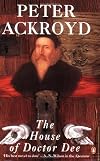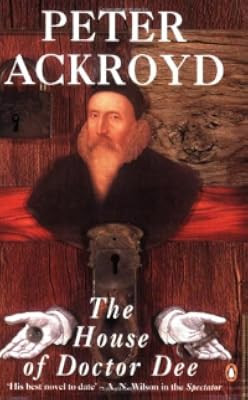
The House of Doctor Dee
by Peter Ackroyd
On This Page
Description
This novel centres on the famous 16th-century alchemist and astrologer John Dee. Reputedly a black magician, he was imprisoned by Queen Mary for allegedly attempting to kill her through sorcery. When Matthew Palmer inherits an old house in Clerkenwell, he feels that he has become part of its past.Tags
Recommendations














Member Recommendations

Member Reviews
If ever a book was written that reads like a dream, feels like a dream and which you will remember as a dream then it's this novel written by Peter Ackroyd. Instead of a dream I should say nightmare because after finishing the novel I felt like I had woken up from one. The first part of the book is claustrophobic and even boring but it is an important setup and devised mechanic. This mode of writing allows Ackroyd to slowly spin you into the stream of the story, something he never quite intended if I interpret the interviews correctly. According to the author this novel is about London as so many of his books are. Not many readers have interpreted it in such a way.
We start by reading a plain and rather claustrophobic stream of show more consciousness-like description of how the main character Matthew inherits an old and dilapidated building from his father in an area of London called Clerkenwell. Through the meanderings of Matthew through the streets surrounding his inheritance we learn slightly more about the setting and the zeitgeist of the area in the now. From a reader perspective something wasn't quite right, It didn't read like the real description of someone walking around a neighbourhood and that is exactly the intention, although I doubt Ackroyd ever realized himself how clever all of this turned out to be. The text reads as a diary entry where someone reminisces about an important place and time but using words and explanations that are too personal for anyone else to understand. Soon enough the perspective of the narrator switches to that of Doctor John Dee, a late medieval alchemist and early scientist who is becoming obsessed with constructing a homunculus, an artificial being made from chemicals and magic. Matthew and John's lives start to run parallel when Matthew becomes aware that his house is the house of the former Doctor Dee and when strangely enough Doctor Dee appears to become aware of a future and far earlier London in which there is a Matthew.
There are two ways in which an author can intertwine related narratives. Either everything is explained and put in order in a logical manner, or the author can use a more stream of consciousness or associative approach in which that what was before unrelated is now closely connected. An example of the logical twist for a purely psychological plot would be Fight Club by Chuck Palahniuk. An example of a novel where everything makes sense because of wild associations is Briefing for a Descent Into Hell by Doris Lessing or Watch the North Wind Rise by Robert Graves. Explaining and linking incidentally seems to work better for psychological thrillers and horror novels. Peter Ackroyd attempts to use both techniques, although he does not use straightforward logical explanations much, which is a shame because there is a very clever and innovative plot twist to be gleaned here.
I'm eager to explain the ending because Ackroyd has stumbled upon quite a novel story structure, but that would ruin the book for anyone else. A strong hint would be: who is really telling the narrative here? show less
We start by reading a plain and rather claustrophobic stream of show more consciousness-like description of how the main character Matthew inherits an old and dilapidated building from his father in an area of London called Clerkenwell. Through the meanderings of Matthew through the streets surrounding his inheritance we learn slightly more about the setting and the zeitgeist of the area in the now. From a reader perspective something wasn't quite right, It didn't read like the real description of someone walking around a neighbourhood and that is exactly the intention, although I doubt Ackroyd ever realized himself how clever all of this turned out to be. The text reads as a diary entry where someone reminisces about an important place and time but using words and explanations that are too personal for anyone else to understand. Soon enough the perspective of the narrator switches to that of Doctor John Dee, a late medieval alchemist and early scientist who is becoming obsessed with constructing a homunculus, an artificial being made from chemicals and magic. Matthew and John's lives start to run parallel when Matthew becomes aware that his house is the house of the former Doctor Dee and when strangely enough Doctor Dee appears to become aware of a future and far earlier London in which there is a Matthew.
There are two ways in which an author can intertwine related narratives. Either everything is explained and put in order in a logical manner, or the author can use a more stream of consciousness or associative approach in which that what was before unrelated is now closely connected. An example of the logical twist for a purely psychological plot would be Fight Club by Chuck Palahniuk. An example of a novel where everything makes sense because of wild associations is Briefing for a Descent Into Hell by Doris Lessing or Watch the North Wind Rise by Robert Graves. Explaining and linking incidentally seems to work better for psychological thrillers and horror novels. Peter Ackroyd attempts to use both techniques, although he does not use straightforward logical explanations much, which is a shame because there is a very clever and innovative plot twist to be gleaned here.
I'm eager to explain the ending because Ackroyd has stumbled upon quite a novel story structure, but that would ruin the book for anyone else. A strong hint would be: who is really telling the narrative here? show less
I’ll begin with a recommendation and warning: after reading the majority of this book in an evening, I had extremely vivid and unsettling dreams that were clearly inspired by it. There is very little fiction that genuinely manages to capture the feeling of dreaming, so this is a rare example to list with [b:The Unconsoled|40117|The Unconsoled|Kazuo Ishiguro|https://images.gr-assets.com/books/1342193138s/40117.jpg|6372970] and practically everything written by [a:Mervyn Peake|22018|Mervyn Peake|https://images.gr-assets.com/authors/1341040504p2/22018.jpg]. The narrative is split between Doctor Dee’s life in the 16th century and that of a man named Matthew who inherits Dee’s London house in the 1990s. Their worlds overlap in a show more peculiar, ghostly fashion. I found the style distinctive and atmospheric. It almost endeared London to me, despite my dislike of the place. Ackroyd depicts London as a city wreathed in history and mystery, rather than one homogenised by global capital. Although it was published 25 years ago, this still seems very apposite:
‘The House of Doctor Dee’ is not a plot-led novel and meanders around ambiguously without leading to any cathartic conclusion. In that respect, it is rather like [b:Picnic at Hanging Rock|791345|Picnic at Hanging Rock|Joan Lindsay|https://images.gr-assets.com/books/1356457483s/791345.jpg|1193116]. I found it entirely engrossing and highly evocative. The 16th century chapters present the past in vivid, sensual detail. Dee is a fascinatingly flawed character, while Matthew remains enigmatic. This a novel that conjures dreams, visions, and phantasms, so it isn't really surprising that they infected my sleep. The reading experience reminded me somewhat of [b:Imagica|437547|Imagica|Clive Barker|https://images.gr-assets.com/books/1174767956s/437547.jpg|1371342] by Clive Barker, one of my favourite works of fantasy. As a depiction of magic 'The House of Doctor Dee' is much briefer and vaguer, yet has a similar texture and atmosphere that will make it hard to forget. show less
I walked more quickly here, since in the porches and doorways along the street lay the army of the night. I was afraid of them, these men and women huddled in filthy blankets, but it is not simply the vagrant or the homeless who disturb me. I know very well that I turn away from any kind of human extremity. I turn away from suffering. Now as I crossed the street and glanced towards two piles of clothes stirring uneasily in the night air, I was afraid of dirt, and of disease, but I suppose that I was most afraid of being attacked. What had they got to lose? If I were like them, I would scream against the world and burn the city. I would want to destroy everything, and everyone, that had conspired against me. I would pillage the shops that denied me entrance, and break up the restaurants which denied me food. I would even rage against the street-lamps that displayed me to the enemy. Yes, as I walked by, none of them asked me for anything, or spoke, or looked at me; I might have been part of some other world. Were they truly resigned, patient, uncomplaining - or were they waiting for something, like the Moravians who met in the Seven Stars?
No, there was this difference. The city had grown immeasurably larger and, as it expanded in every direction, its inhabitants had become more passive and docile; these people who slept upon its streets were true and faithful citizens, but vast London had by some alchemy drained away their spirit. I looked down Tottenham Court Road and, not for the first time, noticed the silence and over-brightness of the city at night. Two centuries ago these streets would have been darker, more malodorous, more treacherous, and they would have been filled with cries, and screams, and laughter. But now as I stood with the homeless around me, all I could hear was the vague hum of neon street lamps and the gusting of the wind around Centre Point. Why was it that, in a place such as this, all the natural sounds seemed fabricated and unreal, while the artificial noise seemed most natural? This city was too bright because it was celebrating its own triumph. It had grown steadily larger by encroaching upon, and subduing, the energy of its inhabitants.
‘The House of Doctor Dee’ is not a plot-led novel and meanders around ambiguously without leading to any cathartic conclusion. In that respect, it is rather like [b:Picnic at Hanging Rock|791345|Picnic at Hanging Rock|Joan Lindsay|https://images.gr-assets.com/books/1356457483s/791345.jpg|1193116]. I found it entirely engrossing and highly evocative. The 16th century chapters present the past in vivid, sensual detail. Dee is a fascinatingly flawed character, while Matthew remains enigmatic. This a novel that conjures dreams, visions, and phantasms, so it isn't really surprising that they infected my sleep. The reading experience reminded me somewhat of [b:Imagica|437547|Imagica|Clive Barker|https://images.gr-assets.com/books/1174767956s/437547.jpg|1371342] by Clive Barker, one of my favourite works of fantasy. As a depiction of magic 'The House of Doctor Dee' is much briefer and vaguer, yet has a similar texture and atmosphere that will make it hard to forget. show less
I must admit to not being a Peter Ackroyd fan. I read his breakthrough novel Hawksmoor, quite a while ago and while I appreciated his ability to create tensions in time and space by the juxtaposition of two story threads: one in the past and one in the present, I felt that he was more concerned in creating a sense of place and an atmosphere of a part of London that fascinates him than he was in telling the story. I found some of his writing a little pedantic and struggled to maintain my interest through the novel. It just somehow didn’t work. I have also read his poetry collection The diversions of Purley, and other poems and found a similar difficulty in getting involved with the author. The House of Doctor Dee in my opinion is a show more step up in both the story telling aspects and his writing style, somehow his writing has lost some of its density, which made it much easier for me to become involved in the novel and to appreciate his ability to conjure up the links between two different periods of time.
It has to be said that Ackroyd plays fast and loose with historical accuracy. Dr John Dee’s main residence was at Mortlake in South West London and it was here at the turn of the sixteenth century that his prodigious library was vandalised, this fact does not get in Ackroyd’s way of wanting to maintain his love affair with the streets of East London and so he transpose Dee’s residence to Clerkenwell in East central London. He tells the story of John Dee’s obsession with magic and his relationship with Edward Kelly a shady character who is best described as a mountebank, Its a kind of master pupil relationship, but with hazy lines as to who is in control. with the aid of a crystal ball they are attempting to divine the future and Dr Dee who uses Kelly as a medium is also attempting to create a homunculus. The novel starts with a story from the present: Mathew Palmer has inherited a house in Clerkenwell, he is an archivist and historian and soon realises that it is the house of John Dee and it has a strange fascination from the moment he sees it. He has a friend Daniel Moore and both men are steeped in archival work and are a little solitary although Moore seems to be the more senior figure. The two stories are told in the first person and in alternate chapters and it is Dr Dee’s old house that makes the initial connection. Mathew feels a presence in the house at times he can almost see Dr Dee as he explores the basement where Dee did some of his work. Edward Kelly scrying with the crystal ball at one point says he sees two men in strange costumes calling each other Mathew and Daniel.
The relationships in both stories are fraught with difficulties. Dr Dee has implicit faith in Edward Kelly, but reluctantly starts to doubt his motives. His wife and servants both warn him that Kelly is a crook, only working with Dee to gain access to his work in alchemy, magic and the homunculus. Kelly is accused by the servants of poisoning Dr Dee’s wife. Dee himself becomes convinced that he is about to discover some sort of portal that will take him back to a time of London’s glorious past. Mathew Palmer glimpses his friend Daniel in a cross dressing establishment and then learns that he was his fathers lover and that he himself may have been molested by his father. He has an uneasy relationship with his mother only starting to realise the reasons for her estrangement from her husband. His mother cannot bear to be in the house in Clerkenwell sensing that it was a place where activities took place that she cannot face. A house then with many secrets that seems to give glimpses of a past and a future. Troubled relationships, magic, sex, murder provide a heady brew that permeates the house in Clerkenwell and the two stories describe a palimpsest, where a curtain between the past and the present quivers; always threatening to open up.
I like the way Ackroyd writes about Elizabethan times, he creates an atmosphere and feel for the period by using language and a style of writing that evokes those times. The reader usually knows when he is in the sixteenth century or more recent times, however Ackroyd does not quite achieve this with his present day story, his nostalgia for the past seems to carry him back to a London in the 1950’s. Troubled psyches perhaps tend to dream, even have visions and Ackroyd uses these to enhance the tension in the lives of his characters. Dr Dee and Mathew are both in fear of what they might find, but their quest for knowledge keeps them pushing for answers. Dr Dee has his religious faith to bolster his spirits, even when searching for angels, but this is something that Mathew lacks in present times and this is an interesting juxtaposition between the two stories.
Ghosts, visions, dreams in two parallel stories can provide novelists with difficulties to reconcile, but the reader is not disappointed in this book. Ackroyd lets his two stories speak for themselves and the reader can make the connections that the author clearly signposts. At the end of the book, Ackroyd can’t resist blurring the lines between himself and the first person character of John Dee that he has created. He asks:
“ And what is the past after all? is it that that is created in the formal act of writing, or does it have some substantial reality. Am I discovering it or inventing it? or could it be that I am Discovering it within myself, so that it bears both the authenticity of surviving evidence and the immediacy of present intuition? The House of Doctor Dee leads me to that conclusion……”
There is mystery, there is atmosphere and even a resolution of sorts and some brilliant evocative writing that kept this reader enthralled throughout the whole novel. The best thing that I have read by Peter Ackroyd (perhaps I need to do some re-reading) and so 4.5 stars. show less
It has to be said that Ackroyd plays fast and loose with historical accuracy. Dr John Dee’s main residence was at Mortlake in South West London and it was here at the turn of the sixteenth century that his prodigious library was vandalised, this fact does not get in Ackroyd’s way of wanting to maintain his love affair with the streets of East London and so he transpose Dee’s residence to Clerkenwell in East central London. He tells the story of John Dee’s obsession with magic and his relationship with Edward Kelly a shady character who is best described as a mountebank, Its a kind of master pupil relationship, but with hazy lines as to who is in control. with the aid of a crystal ball they are attempting to divine the future and Dr Dee who uses Kelly as a medium is also attempting to create a homunculus. The novel starts with a story from the present: Mathew Palmer has inherited a house in Clerkenwell, he is an archivist and historian and soon realises that it is the house of John Dee and it has a strange fascination from the moment he sees it. He has a friend Daniel Moore and both men are steeped in archival work and are a little solitary although Moore seems to be the more senior figure. The two stories are told in the first person and in alternate chapters and it is Dr Dee’s old house that makes the initial connection. Mathew feels a presence in the house at times he can almost see Dr Dee as he explores the basement where Dee did some of his work. Edward Kelly scrying with the crystal ball at one point says he sees two men in strange costumes calling each other Mathew and Daniel.
The relationships in both stories are fraught with difficulties. Dr Dee has implicit faith in Edward Kelly, but reluctantly starts to doubt his motives. His wife and servants both warn him that Kelly is a crook, only working with Dee to gain access to his work in alchemy, magic and the homunculus. Kelly is accused by the servants of poisoning Dr Dee’s wife. Dee himself becomes convinced that he is about to discover some sort of portal that will take him back to a time of London’s glorious past. Mathew Palmer glimpses his friend Daniel in a cross dressing establishment and then learns that he was his fathers lover and that he himself may have been molested by his father. He has an uneasy relationship with his mother only starting to realise the reasons for her estrangement from her husband. His mother cannot bear to be in the house in Clerkenwell sensing that it was a place where activities took place that she cannot face. A house then with many secrets that seems to give glimpses of a past and a future. Troubled relationships, magic, sex, murder provide a heady brew that permeates the house in Clerkenwell and the two stories describe a palimpsest, where a curtain between the past and the present quivers; always threatening to open up.
I like the way Ackroyd writes about Elizabethan times, he creates an atmosphere and feel for the period by using language and a style of writing that evokes those times. The reader usually knows when he is in the sixteenth century or more recent times, however Ackroyd does not quite achieve this with his present day story, his nostalgia for the past seems to carry him back to a London in the 1950’s. Troubled psyches perhaps tend to dream, even have visions and Ackroyd uses these to enhance the tension in the lives of his characters. Dr Dee and Mathew are both in fear of what they might find, but their quest for knowledge keeps them pushing for answers. Dr Dee has his religious faith to bolster his spirits, even when searching for angels, but this is something that Mathew lacks in present times and this is an interesting juxtaposition between the two stories.
Ghosts, visions, dreams in two parallel stories can provide novelists with difficulties to reconcile, but the reader is not disappointed in this book. Ackroyd lets his two stories speak for themselves and the reader can make the connections that the author clearly signposts. At the end of the book, Ackroyd can’t resist blurring the lines between himself and the first person character of John Dee that he has created. He asks:
“ And what is the past after all? is it that that is created in the formal act of writing, or does it have some substantial reality. Am I discovering it or inventing it? or could it be that I am Discovering it within myself, so that it bears both the authenticity of surviving evidence and the immediacy of present intuition? The House of Doctor Dee leads me to that conclusion……”
There is mystery, there is atmosphere and even a resolution of sorts and some brilliant evocative writing that kept this reader enthralled throughout the whole novel. The best thing that I have read by Peter Ackroyd (perhaps I need to do some re-reading) and so 4.5 stars. show less
This strange fictional biography about a strange man of the English Renaissance tries to focus on the actual elements of Doctor John Dee's life rather than the overwrought legends that have been perpetuated about him. While it is true he was deeply involved in occult investigations, specifically with reference to alchemy and scrying (crystal-gazing), his most ardent wish was to thereby get nearer to the presence of God rather than to the Devil as many have asserted.
Doctor John Dee (1527-1608) was one of the most learned men of his time. He was a book collector without equal, his collection, the largest nonacademic library in England at the time. He was an advisor to Queen Elizabeth I, and he had an international reputation as an show more astronomer, astrologer and navigator. But he also devoted himself to the study of alchemy and the Renaissance philosophy of Marsilio Ficino, Pico della Mirandola and Giordano Bruno. He was involved in both scientific and magical pursuits at the very time when they were becoming separate fields of knowledge. Such was his reputation that it is believed that the character Prospero in Shakespeare's The Tempest was modeled after him, and in modern times, the Aegypt tetralogy of John Crowley features Doctor Dee.
Ackroyd has attempted to arrive at a kind of truth that might be palatable to the tastes of modern readers who may or may not be captivated by the supernatural, by combining two stories that focus on the London house Doctor Dee owned in Clerkenwell. One is a first person account of Dee himself, much of it adapted from his own writings; the second, also in first person, brings us into the twentieth century and concerns a young man who inherits the house and finds himself absorbed by the mysteries surrounding the good doctor.
In a post-modern way, both stories eventually merge and reach a highly visionary and somewhat enigmatic conclusion, in keeping with the subject matter. One memorable chapter near the end called "The Garden" puts one in mind of either a dream vision or a directed meditation.
In the course of the book, Ackroyd considers the true nature of history. At one point he steps from behind the veil of author and injects himself in medias res, asking:
And what is the past, after all? Is it that which is created in the formal act of writing, or does it have some substantial reality? Am I discovering it, or inventing it? Or could it be that I am discovering it within myself, so that it bears both the authenticity of surviving evidence and the immediacy of present intuition?
One can easily relate to these questions because of the wide chasm that separates the pros and cons that have come down to us and continue to this day in both factual and fictional accounts of Doctor Dee. The question is: wherein lies the truth?
Ackroyd also seems fascinated with the imagination and how it impacts each individual person's perceptions of reality. He puts the following into the mouths of his characters:
It is true . . . that the imagination is immortal, and that thereby we each create our own eternity.
. . . though the blazing stars had gone for ever, the light of the imagination filled every corner and every quarter, every street and every house of this place . . . . The imagination is the spiritual body and exists eternally.
This book will probably not have a wide appeal because of its subject matter, but it does afford a fictional glimpse into the mind of a highly influential historical figure with a mystical turn of mind. show less
Doctor John Dee (1527-1608) was one of the most learned men of his time. He was a book collector without equal, his collection, the largest nonacademic library in England at the time. He was an advisor to Queen Elizabeth I, and he had an international reputation as an show more astronomer, astrologer and navigator. But he also devoted himself to the study of alchemy and the Renaissance philosophy of Marsilio Ficino, Pico della Mirandola and Giordano Bruno. He was involved in both scientific and magical pursuits at the very time when they were becoming separate fields of knowledge. Such was his reputation that it is believed that the character Prospero in Shakespeare's The Tempest was modeled after him, and in modern times, the Aegypt tetralogy of John Crowley features Doctor Dee.
Ackroyd has attempted to arrive at a kind of truth that might be palatable to the tastes of modern readers who may or may not be captivated by the supernatural, by combining two stories that focus on the London house Doctor Dee owned in Clerkenwell. One is a first person account of Dee himself, much of it adapted from his own writings; the second, also in first person, brings us into the twentieth century and concerns a young man who inherits the house and finds himself absorbed by the mysteries surrounding the good doctor.
In a post-modern way, both stories eventually merge and reach a highly visionary and somewhat enigmatic conclusion, in keeping with the subject matter. One memorable chapter near the end called "The Garden" puts one in mind of either a dream vision or a directed meditation.
In the course of the book, Ackroyd considers the true nature of history. At one point he steps from behind the veil of author and injects himself in medias res, asking:
And what is the past, after all? Is it that which is created in the formal act of writing, or does it have some substantial reality? Am I discovering it, or inventing it? Or could it be that I am discovering it within myself, so that it bears both the authenticity of surviving evidence and the immediacy of present intuition?
One can easily relate to these questions because of the wide chasm that separates the pros and cons that have come down to us and continue to this day in both factual and fictional accounts of Doctor Dee. The question is: wherein lies the truth?
Ackroyd also seems fascinated with the imagination and how it impacts each individual person's perceptions of reality. He puts the following into the mouths of his characters:
It is true . . . that the imagination is immortal, and that thereby we each create our own eternity.
. . . though the blazing stars had gone for ever, the light of the imagination filled every corner and every quarter, every street and every house of this place . . . . The imagination is the spiritual body and exists eternally.
This book will probably not have a wide appeal because of its subject matter, but it does afford a fictional glimpse into the mind of a highly influential historical figure with a mystical turn of mind. show less
This review contains spoilers, but I want you to read it anyway to make sure you never make the mistake of trying this horrible, horrible book.
As a history of John Dee, it gets the most basic facts wrong: for one example, it ends after the death of his first wife with his partner Kelley burning his library down and fleeing. Kelley did no such thing; they continued to work together for years after Dee remarried. They only split up after Kelley announced that the archangel Uriel had told him through a crystal ball that he and Dee should experiment with wife-swapping. (And not before they tried it. So yes, this is a book about John Dee that skips the most interesting thing about him.)
As a book on its own merits, it's equally bad. It's set show more up as a mystery, and mysteries tend to succeed or fail based on how well they wrap up their threads at the end. Here almost none of them are wrapped up, and those that are, unsatisfyingly. Again, just as one example: what happened to the Act III revelation that the protagonist's father sexually abused him? What was that for? He never mentions it again!
I gave [b:The Da Vinci Code|968|The Da Vinci Code (Robert Langdon, #2)|Dan Brown|http://photo.goodreads.com/books/1303252999s/968.jpg|2982101] two stars because while it's terrible history, it's at least effective junk food. This book gets nothing right. It's bad history and it's bad reading. I hate it. show less
As a history of John Dee, it gets the most basic facts wrong: for one example, it ends after the death of his first wife with his partner Kelley burning his library down and fleeing. Kelley did no such thing; they continued to work together for years after Dee remarried. They only split up after Kelley announced that the archangel Uriel had told him through a crystal ball that he and Dee should experiment with wife-swapping. (And not before they tried it. So yes, this is a book about John Dee that skips the most interesting thing about him.)
As a book on its own merits, it's equally bad. It's set show more up as a mystery, and mysteries tend to succeed or fail based on how well they wrap up their threads at the end. Here almost none of them are wrapped up, and those that are, unsatisfyingly. Again, just as one example: what happened to the Act III revelation that the protagonist's father sexually abused him? What was that for? He never mentions it again!
I gave [b:The Da Vinci Code|968|The Da Vinci Code (Robert Langdon, #2)|Dan Brown|http://photo.goodreads.com/books/1303252999s/968.jpg|2982101] two stars because while it's terrible history, it's at least effective junk food. This book gets nothing right. It's bad history and it's bad reading. I hate it. show less
"True books are filled with the power of the understanding which is the inheritance of the ages: you may take up a book in time, but you read it in eternity.”
Matthew Palmer inherits a house in a hidden part of Clerkenwell, London. When Matthew moves into the house, he begins to suffer visions in an escalating derangement of mind. Matthew delves into the history of the house and discovers that it had been owned in the Tudor era by Doctor John Dee, an infamous alchemist, mathematician and philosopher who was accused by some of using black magic.
The narrative consists of two first-person accounts, one Palmer’s, the other, Dee’s. For just as Palmer sees Dee, so Dee ‘scries’ Palmer, and the narratives of two men show more searching the past begin to interlock. Palmer researches old documents looking for the truth of his parenthood; Dee investigates the ancient city of London he believes to be buried underground. Both investigations lead to unexpected discoveries.
This is my second novel by the author having previously read 'The Lambs of London' so in some respects I knew what to expect. Doctor Dee was a real life person so this was going to be a biography, the real world colliding with the fictitious world, it is going to be a more of the dark and gloomy London than what the tourist of today is going to see with its Tudor smells and noises. In this respect this book doesn't disappoint.
However, it also has its flaws IMHO. Ackroyd adapts Dee’s own language to make it more accessible to the modern reader whilst retaining the rich style of the original. In comparison Matthew’s language seems rather dull in comparison meaning that whilst I enjoyed the Tudor half of this novel the half that takes place some 400+ years later held little interest for me. On the whole I found it rather muddled and this was particularly true of the final chapter. show less
Matthew Palmer inherits a house in a hidden part of Clerkenwell, London. When Matthew moves into the house, he begins to suffer visions in an escalating derangement of mind. Matthew delves into the history of the house and discovers that it had been owned in the Tudor era by Doctor John Dee, an infamous alchemist, mathematician and philosopher who was accused by some of using black magic.
The narrative consists of two first-person accounts, one Palmer’s, the other, Dee’s. For just as Palmer sees Dee, so Dee ‘scries’ Palmer, and the narratives of two men show more searching the past begin to interlock. Palmer researches old documents looking for the truth of his parenthood; Dee investigates the ancient city of London he believes to be buried underground. Both investigations lead to unexpected discoveries.
This is my second novel by the author having previously read 'The Lambs of London' so in some respects I knew what to expect. Doctor Dee was a real life person so this was going to be a biography, the real world colliding with the fictitious world, it is going to be a more of the dark and gloomy London than what the tourist of today is going to see with its Tudor smells and noises. In this respect this book doesn't disappoint.
However, it also has its flaws IMHO. Ackroyd adapts Dee’s own language to make it more accessible to the modern reader whilst retaining the rich style of the original. In comparison Matthew’s language seems rather dull in comparison meaning that whilst I enjoyed the Tudor half of this novel the half that takes place some 400+ years later held little interest for me. On the whole I found it rather muddled and this was particularly true of the final chapter. show less
I came to this book cautiously, thinking Ackroyd to be of grim and melancholic vision. I was seduced at once by the sublime language which was convincingly Tudor without ever being pastiche. Ackroyd reveals his hand at the end, in that wonderful, perhaps unique ending in which all characters suddenly become first person, and tells us that the words are those of Dee himself, from obscure documents. Dee has written his own novel – hence its historical inaccuracy, all forgiven in the light of its psychological truth. So I had a feast of good words, but it wasn’t all cake and pudding. There is revelatory truth here, about time and the unity of all beings. The House of Dr Dee has gone into my top ten and I’ve changed my mind about show more Peter Ackroyd. He’s a master. show less
Members
- Recently Added By
Published Reviews
The significance of the past in this case is that it would solve the mystery of Palmer's identity. Given that his identity is ultimately linguistic, the text of the past engenders the text of the present through the arbitrary privilege of the past as having a unilateral influence on making the present present. However, as we have said, the past is made past through its connection to the show more present. The past and the present depend on one another for their respective self-constitutions. This insight is illustrated imaginatively in the book when the past and present are destroyed, so to speak, when they begin to inhabit the same space, a space that could be understood simultaneously as mental, elemental, and linguistic. This event, the simultaneity of the past with the present, is rendered as either a transcendental, epiphantic experience, or madness. show less
added by KayCliff
At first it seemed as if The House of Doctor Dee was typical Ackroyd in the style of his Hawksmoor – creeping menace in a London the author loves so much that he becomes self-indulgent. However, as the novel progresses, and as matters regarding the soul, time and history are explored, and as we come to the magnificent, visionary ending, Ackroyd seems less possessed by Dr. Dee than by the show more spirit of William Blake. This, and the virtuoso use of language in The House of Doctor Dee, marks a new stage in Ackroyd’s powers. That Dee lived in Mortlake, not Clerkenwell, and that the plot is made to conform with that of a ghost story, perhaps for commercial reasons, are mere niggles. show less
added by KayCliff
Lists

Weird and Weirder Fiction
270 works; 35 members

Best Time Travel Novels
165 works; 123 members

Best Books Set in London
157 works; 42 members
Author Information

90+ Works 31,852 Members
Peter Ackroyd was born in London in 1949. He graduated from Cambridge University and was a Fellow at Yale (1971-1973). A critically acclaimed and versatile writer, Ackroyd began his career while at Yale, publishing two volumes of poetry. He continued writing poetry until he began delving into historical fiction with The Great Fire of London show more (1982). A constant theme in Ackroyd's work is the blending of past, present, and future, often paralleling the two in his biographies and novels. Much of Ackroyd's work explores the lives of celebrated authors such as Dickens, Milton, Eliot, Blake, and More. Ackroyd's approach is unusual, injecting imagined material into traditional biographies. In The Last Testament of Oscar Wilde (1983), his work takes on an autobiographical form in his account of Wilde's final years. He was widely praised for his believable imitation of Wilde's style. He was awarded the British Whitbread Award for biography in 1984 of T.S. Eliot, and the Whitbread Award for fiction in 1985 for his novel Hawksmoor. Ackroyd currently lives in London and publishes one or two books a year. He still considers poetry to be his first love, seeing his novels as an extension of earlier poetic work. (Bowker Author Biography) Peter Ackroyd is the award-winning author of four biographies, most recently the national bestseller "The Life of Thomas More", as well as ten novels, including "Chatterton" & "Hawksmoor". He lives in London, where he is at work on his next book, "London: The Biography. (Publisher Provided) Peter Ackroyd is a bestselling writer of both fiction and nonfiction. He lives in London. (Publisher Provided) show less
Some Editions
Awards and Honors
Notable Lists
Series
Belongs to Publisher Series
Иллюминатор (18)
Common Knowledge
- Canonical title
- The House of Doctor Dee
- Original title
- The House of Doctor Dee
- Original publication date
- 1993
- People/Characters
- John Dee; Matthew Palmer; Edward Kelley
- Important places
- Clerkenwell, London, England, UK; England, UK; London, England, UK
- First words
- I inherited the house from my father. That was how it all began.
- Quotations
- I had grown up in a world without love--a world of magic, of money, of possession--and so I had none for myself or for others.
There is no way to conquer time and live eternally except through vision. The vision, not the body, transcends this life.
I took ship [at Gravesend] and carried with me my own provisions for the journey, including biscuit, bread, beer, oil and vinegar; in my wallet I also had a good store of parchment, quill and ink (together with black powder t... (show all)o make more), so that I might keep a record of my travels into foreign lands.
My true glory lies within my books, printed or anciently written, bound or unbound ... all found and gathered by me ... For their exact copying, and for my own writings, I need a plentiful supply of pens and inks; so here, at... (show all) my left hand, are quills of all sorts. When the ink runs down the hollow truck of my pen, then on this writing-table, with all my notes scattered about me, I begin to chronicle marvels.
I left for the National Archive Centre in Chancery Lane. ... Most of the old parish registers and rate-books were now on microfiche, but I still preferred to consult the bound volumes which had been placed in the Blair Room..... (show all).. a quite protracted search led me to three leather-bound volumes which contained the records of the parish of St James, Clerkenwell, in the sixteenth century. I could hardly lift them from the shelves, and when I held them in my arms I savoured the stink of dust and age. It was as if I were lifting down corpses wrapped in their shrouds. And of course this was precisely what they contained - names, signatures, the long-dead set down in lists, lying one upon another just as they might have been buried under the ground. I am accustomed now to the peculiarities of sixteenth-century script, but even so it was hard to decipher some of the words scratched in an ink which had faded to the lightest brown.... All the time my hands were lying across a deed written on parchment; I could feel the texture of the paper beneath my fingers, and it was like earth baking in the heat of this modem city.
It has been said that books talk to one another when no one is present to hear them speak, but I know better than that: they are forever engaged in an act of silent communion which, if we are fortunate, we can overhear. I soo... (show all)n came to recognize the people who also understood this. They were the ones who always relaxed as they walked among the shelves, as if they were being comforted and protected by a thousand invisible presences. - Last words
- (Click to show. Warning: May contain spoilers.)Come closer, come towards me so that we may become one. Then will London be redeemed, now and for ever, and all those with whom we dwell - living or dead - will become the mystical city universal.
- Original language
- English
Classifications
Statistics
- Members
- 878
- Popularity
- 31,056
- Reviews
- 21
- Rating
- (3.37)
- Languages
- 6 — English, French, German, Lithuanian, Polish, Russian
- Media
- Paper
- ISBNs
- 10
- ASINs
- 1