The Medusa Frequency
by Russell Hoban
On This Page
Description
An inexplicable message flashing on the screen of his computer at 3 a.m. heralds the beginning of a startling quest for frustrated author Herman Orff. Taking up the offer of a cure for writer's block leads him 'to those places in your head that you can't get out of on your own,' and plunges him into a semi-dreamland inhabited by a bizarre combination of characters from myth and reality- the talking head of Orpheus; a lost love; the young girl of Vermeer's famous portrait--and a frequency of show more Medusas. show lessTags
Recommendations



































Member Reviews
What a charmer!
This is exactly the sort of novel that I find myself groaningly -- nay, head-strikingly -- slogging through, page after page, in a fruitless quest for plot or message. Typical first-novel junk: a blocked writer, who cannot get over the decade-old loss of a woman, is pushed into the process of self-discovery by external forces. Do new writers write about anything else?
But Russel Hoban is not a new writer, and this is not his first novel. More to the point, he is a good writer, and Medusa Frequency works. It works very, very well. While not a compelling page-turner, it lurks at the edge of the mind, waiting, a lyrical and playful retelling of an age-old story.
That story is, of course, the myth of Orpheus and Eurydice, which show more Hoban twists into an analogy for the creative process. Got art trouble? The head of Orpheus will turn it into heart trouble for no charge. Trapped in the singular worldview of a first-person narrative? Buy one of the supporting characters a beer, and see what happens.
All of this with Hoban's characteristic skewering of the arts. A viewing of an experimental film rings disturbingly true, and had me squirming in reminder of the seats at the Anthology Film Archives. "I don't think film people should be allowed near words, it's bad for everybody", Hoban says through the narrator, but clearly the opposite works out quite well.
In many ways, the novel is Proustian, if one refuses to take Proustian to mean "a long rambling meditation on the past" and instead defines it as "exploring the workings of the mind through narrative":
And if such mind-wandering fails to grab you, there are plenty of likeable-fellow moments as the main character languishes around the month-old coffee cups in his cluttered apartment:
Sounds like somebody's got a case of the -- well, you know. show less
This is exactly the sort of novel that I find myself groaningly -- nay, head-strikingly -- slogging through, page after page, in a fruitless quest for plot or message. Typical first-novel junk: a blocked writer, who cannot get over the decade-old loss of a woman, is pushed into the process of self-discovery by external forces. Do new writers write about anything else?
But Russel Hoban is not a new writer, and this is not his first novel. More to the point, he is a good writer, and Medusa Frequency works. It works very, very well. While not a compelling page-turner, it lurks at the edge of the mind, waiting, a lyrical and playful retelling of an age-old story.
That story is, of course, the myth of Orpheus and Eurydice, which show more Hoban twists into an analogy for the creative process. Got art trouble? The head of Orpheus will turn it into heart trouble for no charge. Trapped in the singular worldview of a first-person narrative? Buy one of the supporting characters a beer, and see what happens.
All of this with Hoban's characteristic skewering of the arts. A viewing of an experimental film rings disturbingly true, and had me squirming in reminder of the seats at the Anthology Film Archives. "I don't think film people should be allowed near words, it's bad for everybody", Hoban says through the narrator, but clearly the opposite works out quite well.
In many ways, the novel is Proustian, if one refuses to take Proustian to mean "a long rambling meditation on the past" and instead defines it as "exploring the workings of the mind through narrative":
You know how you'll hear a sound while you're asleep and there comes a whole dream to account for it and in the dream there are things that happen before and after the sound
And if such mind-wandering fails to grab you, there are plenty of likeable-fellow moments as the main character languishes around the month-old coffee cups in his cluttered apartment:
In the morning I came awake as I always do, like a man trapped in a car going over a cliff.
Sounds like somebody's got a case of the -- well, you know. show less
The Medusa Frequency is so multilayered it is difficult to know where to begin.
Its protagonist and narrator Herman Orff has some vague notion that it might serve as a kind of vade mecum, a handbook for overcoming creative block.
At the same time, it may be a prescription for dealing with lost love.
Some might find it to be an interesting psychological case study.
Some might merely view it as a thinly veiled case study of one way to write a novel.
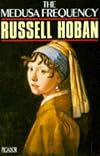
Others will see it as a fantastic head trip fraught with such hallucinatory elements as a talking kraken in the computer monitor, the head of Orpheus in the form of — successively — a cabbage, a football and a world globe; and finally, the climactic head of Medusa, which evolves out of our show more hero's mild obsession with Vermeer's Head of a Young Girl (aka The Girl with a Pearl Earring).
In any case, all of these possibilities are cleverly woven together into a highly imaginative, witty, quirky in the extreme, dreamy novella that is all of the above. But be forewarned: it takes some effort to gather the threads and see where they lead. Weighing in at a mere 140 pages, this is not a novel to be trifled with. It is not a quick read by any means; skipping through and leaving out bits will leave the reader confused, so it is best read when the mind is clear, receptive and prepared to be dazzled.
If all of this sounds like too much, this is not the book for you.
On the other hand, it is a tribute to the author that he was able to manipulate the myth of Orpheus and Eurydice into wearing all these hats.
The author Russell Hoban alternates between a breezy tongue-in-cheek brand of dialogue and an elevated, almost Joycean prose. The contrast is jarring, but those high-sounding passages slow down the momentum and often contain important clues to what Hoban is trying to achieve.
A psychologist I once knew used to say, "Dialogue with your demons and they will go away and not bother you anymore." It is as if Hoban had constructed a whole novel around this idea. In dialoguing with Orpheus, Herman Orff — whose name, by the way, is a combination of Hermes and Orpheus — learns what he needs to know to get on with both his life and his writing.
At some time in the past, Herman had published two singularly unsuccessful novels and since then has been making his living as a writer for "Classic Comics," a publisher of graphic novels. His job is to boil down a classic work into the word bubbles around which an artist would then create the visuals. It was obvious that he could write, but he wanted to write novels, not cartoons. So in that sense, he was suffering a creative blockage.
Also, nine years before, the love of his life had left him — it is implied for his infidelity — and he has suffered deeply ever since in his attempt to find and keep a new girlfriend.
Enter Orpheus, who comes to Herman after he has undergone a very questionable and quacky sort of electric shock treatment — 36 electrodes attached to the head (a seriously important part of the aforementioned "head trip") — and who says to Herman, "Do you know who I am to you? I am the first of your line." Thus, the self-styled first storyteller helps Herman see that his life parallels that of Orpheus, who suffered the loss of Eurydice and even traveled to the underworld to retrieve her — unsuccessfully as we all know — but he was able to transform his grief into gorgeous song that dazzled even the birds, the trees and the stones. "The songs I sang in my misery were easy and the beauty of them broke the heart."
As with all good myths containing aspects of magical realism, a suspension of disbelief is required for the larger-than-life effects of this book to sink in. Despite the humorous high jinx, this is not a story to be read literally, but mythically. It contains certain select keys to understanding if one wants to find them. show less
Its protagonist and narrator Herman Orff has some vague notion that it might serve as a kind of vade mecum, a handbook for overcoming creative block.
At the same time, it may be a prescription for dealing with lost love.
Some might find it to be an interesting psychological case study.
Some might merely view it as a thinly veiled case study of one way to write a novel.
Others will see it as a fantastic head trip fraught with such hallucinatory elements as a talking kraken in the computer monitor, the head of Orpheus in the form of — successively — a cabbage, a football and a world globe; and finally, the climactic head of Medusa, which evolves out of our show more hero's mild obsession with Vermeer's Head of a Young Girl (aka The Girl with a Pearl Earring).
In any case, all of these possibilities are cleverly woven together into a highly imaginative, witty, quirky in the extreme, dreamy novella that is all of the above. But be forewarned: it takes some effort to gather the threads and see where they lead. Weighing in at a mere 140 pages, this is not a novel to be trifled with. It is not a quick read by any means; skipping through and leaving out bits will leave the reader confused, so it is best read when the mind is clear, receptive and prepared to be dazzled.
If all of this sounds like too much, this is not the book for you.
On the other hand, it is a tribute to the author that he was able to manipulate the myth of Orpheus and Eurydice into wearing all these hats.
The author Russell Hoban alternates between a breezy tongue-in-cheek brand of dialogue and an elevated, almost Joycean prose. The contrast is jarring, but those high-sounding passages slow down the momentum and often contain important clues to what Hoban is trying to achieve.
A psychologist I once knew used to say, "Dialogue with your demons and they will go away and not bother you anymore." It is as if Hoban had constructed a whole novel around this idea. In dialoguing with Orpheus, Herman Orff — whose name, by the way, is a combination of Hermes and Orpheus — learns what he needs to know to get on with both his life and his writing.
At some time in the past, Herman had published two singularly unsuccessful novels and since then has been making his living as a writer for "Classic Comics," a publisher of graphic novels. His job is to boil down a classic work into the word bubbles around which an artist would then create the visuals. It was obvious that he could write, but he wanted to write novels, not cartoons. So in that sense, he was suffering a creative blockage.
Also, nine years before, the love of his life had left him — it is implied for his infidelity — and he has suffered deeply ever since in his attempt to find and keep a new girlfriend.
Enter Orpheus, who comes to Herman after he has undergone a very questionable and quacky sort of electric shock treatment — 36 electrodes attached to the head (a seriously important part of the aforementioned "head trip") — and who says to Herman, "Do you know who I am to you? I am the first of your line." Thus, the self-styled first storyteller helps Herman see that his life parallels that of Orpheus, who suffered the loss of Eurydice and even traveled to the underworld to retrieve her — unsuccessfully as we all know — but he was able to transform his grief into gorgeous song that dazzled even the birds, the trees and the stones. "The songs I sang in my misery were easy and the beauty of them broke the heart."
As with all good myths containing aspects of magical realism, a suspension of disbelief is required for the larger-than-life effects of this book to sink in. Despite the humorous high jinx, this is not a story to be read literally, but mythically. It contains certain select keys to understanding if one wants to find them. show less
cyber punk
*note to self. Copy from A.
*note to self. Copy from A.
Ratings
Members
- Recently Added By
Lists

Reading LIst
648 works; 1 member
Author Information

110+ Works 30,512 Members
Russell Hoban was born in Lansdale, Pennsylvania on February 4, 1925. He attended art school in Philadelphia and during World War II, he served in the Army and earned a Bronze Star. He taught art in New York and Connecticut, and also worked as an advertising copywriter and a freelance illustrator before beginning his career as a writer. He began show more publishing children's books in the late 1950s, including What Does It Do and How Does It Work?, Bedtime for Frances and the six other books featuring Frances, The Story of Hester Mouse Who Became a Writer, What Happened When Jack and Daisy Tried to Fool the Tooth Fairies, and The Mouse and His Child, which was adapted as an animated film in 1977. In 1973, he published his first adult novel, The Lion of Boaz-Jachin and Jachin-Boaz. His other books for adults include Turtle Diary, Pilgermann, and Ridley Walker. He received the John W. Campbell Memorial Award and the Australian Science Fiction Achievement Award for Ridley Walker. He died on December 13 at the age of 86. In 2015 he made the Kate Greenaway Medal shortlist for his title Jim's Lion wth illlustrator Alexis Deacon. (Bowker Author Biography) show less
Awards and Honors
Distinctions
The Guardian Book of the Day (2021-05-04)
Work Relationships
Is contained in
Common Knowledge
- Original publication date
- 1987
- Epigraph
- ZIP ... POW ... LOVES ME
George Herriman, 'Krazy Kat'
Same old story, same old song;
it goes all right till it goes all wrong.
Will Jennings, 'Same Old Story (Same Old Song)' - Dedication
- To Gundel
- First words
- I was shocked but I can't honestly say I was surprised when Istvan Fallock told me about Gosta Kraken
- Last words
- (Click to show. Warning: May contain spoilers.)'Right,' I said, 'no more Klage,' and when I looked up at the Vermeer girl it was Medusa Isaw, flickering and friendly, trusting me with the idea of her.
Classifications
Statistics
- Members
- 361
- Popularity
- 86,878
- Reviews
- 3
- Rating
- (3.62)
- Languages
- Dutch, English, German
- Media
- Paper, Ebook
- ISBNs
- 11
- ASINs
- 3