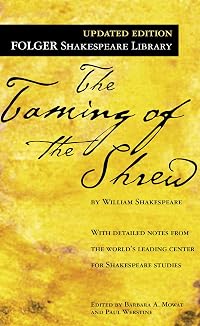
The Taming of the Shrew
by William Shakespeare
On This Page
Description
The Taming of the Shrew is perhaps one of Shakespeare's most controversial plays by modern standards. Hinging on the courtship between the arrogant Petruchio and the "shrew" of the title Katherina, it is unclear whether Shakespeare's blatantly misogynistic themes were in earnest or tongue in cheek. The charming and tender Bianca is forbidden to marry until her elder sister, Katherine is spoken for. Bianca's suitors enlist Petruchio to woo Katherina for her dowry. Petruchio embarks on his own show more brand of psychological torture and in so doing manages to "tame" the stubborn Katherine who morphs into the faultless submissive wife.. show less
Tags
Recommendations










Member Reviews
"Now, by the world, it is a lusty wench! I love her ten times more than e'er I did. O, how I long to have some chat with her!" (pg. 52)
"He hath some meaning in his mad attire." (pg. 66)
We don't deserve Shakespeare. We really don't. As with the later The Merchant of Venice, the Bard has, in The Taming of the Shrew, given to us an astute, ironical satire of shabby conduct (there anti-Semitism, here misogyny) that seems to raise up such people, the better to send them plummeting to earth. And what do we do, in our limp-brained culture, with our pseudo-academic meathead scholars, our peddlers in the doctrinaire, our po-faced theatricals? We label it a 'problem play'. We tie ourselves in knots over whether Shakespeare was a misogynist and show more must be cancelled, or rationalized, or patronisingly reworked to 'be better' and 'empower'. The only thing that stops me going crazy is that there's a sort of schadenfreude in getting a joke that seems to pass everybody else over.
Let's take it from the top. No, Shakespeare was not a misogynist. And before you think this is the typical contemporary sleight-of-hand that spouts casuistries like 'people can be racist without being a racist', let me further say that, no, The Taming of the Shrew is not a misogynist play. Just as Shakespeare was not an anti-Semite, and The Merchant of Venice was not an anti-Semitic play. (I go into greater length about that in my review of Merchant elsewhere on this website.)
Consider that strange opening to The Taming of the Shrew, commonly called the 'Induction'. A lousy drunk named Christopher Sly is thrown out of a tavern into the muddy street by a female hostess. Note the gender. (I'm sorry to be leading you by the hand, but a lot of people, it seems, are unwilling to duck as they walk under a low doorway.) There, a passing lord has an impish fancy to dress the passed-out drunk in fine clothes where, upon waking, the unfortunate Sly will not know whether he is coming or going. He is waited on hand and foot by servants, who put on a play called The Taming of the Shrew. Tudor audiences walk into a London theatre to see the upstart Crow's new bawd. They get it.
Leaving aside the play-within-a-play for a moment, consider that the useless Sly, cast out by a woman, is tricked into believing he is a lord. He then watches a play which seems to reinforce the idea that men are to be served meekly by women, while he is waited on by servants. (There is a further thread in the play, which requires an essay in itself, where, just as men treat women with a high hand, the lords in the play treat their male servants with a similar lack of grace. "Help, masters, help! My master is mad!" is said by the male servant Grumio (pg. 40), though it could just as easily be one of Kate's lines.)
It is here where productions that cut the Christopher Sly stuff do a disservice to their audience. This is about a surly man inconvenienced by a woman hostess, who, while lying in the gutter feeling sorry for himself, fantasises a story in which women do men's bidding and all is right with the world. I strongly recommend reading a version of The Taming of the Shrew which includes the other, unofficial Sly stuff (my Wordsworth Classic edition has it as an Appendix, with the Ludlum-esque title 'The Christopher Slie Material'). In this material, Sly, now awake, asks whether he was not a lord after all. Heading for home, and no doubt the wrath of his wife, he tells a passing Tapster that he's not worried because now he knows how to tame a woman properly (pg. 110). Good luck, Sly, you'll need it. The Tapster, no doubt with a secret smile on his face, asks to come home with him and witness the scene. We, too, would like to be a fly on that wall.
I know I've not even discussed The Taming of the Shrew proper yet – Petruchio and Kate, Bianca and her suitors – but you see now how the play ought to be – and was intended to be – framed. As with the later The Merchant of Venice, The Taming of the Shrew is a clever, satirical subversion of what the more boneheaded still claim it indulges. The lord who bamboozles the hapless Sly even says this mockery is there to "abate the over-merry spleen, Which otherwise would grow into extremes" (pg. 28). Laugh, Shakespeare says to men, at how we often grasp the wrong end of the stick, of how dependent we often are on women, of how we dress in motley to imitate women (female roles were performed by boys on the Tudor stage – the above quotation comes immediately after a line about such a thing). Because the alternative is extreme; it is misogyny, or at least boorishness. Smile, you po-faced scholars! Some of it is genuinely amusing – I'm thinking of the initial 'courtship' scene between Petruchio and Kate ("Say she be mute and will not speak a word, Then I'll commend her volubility, And say she uttereth piercing eloquence. If she do bid me pack, I'll give her thanks, As though she bid me stay by her a week" (pg. 53)). When, in this scene, an exasperated Kate says her father seems to want her "wed to one half-lunatic" (pg. 56), we think back to the sad-sack Christopher Sly, and what words his wife will have for him when he stumbles home with some ideas in his head about who is man of the house. Surely there can't be any doubt where Shakespeare's sympathies lie, for those willing to look beyond the superficial?
The Taming of the Shrew is, admittedly, not as measured as the later Merchant of Venice. That play seemed honed and completely unambiguous in its ambiguity (as I argue in my review of it, the play only works if our sympathy is with Shylock), whereas Shrew does have one or two elements out of balance that can cause unease, even when not viewed through the lens of the boneheaded. Some of the crucial Sly stuff is missing and, without it – and with an unforgivingly modern audience – some of the treatment of Kate in particular seems harsh. Note the scene where Petruchio berates his new wife, and "she (poor soul) Knows not which way to stand, to look, to speak" (pg. 75). Without Merchant's more robust sophistication and form, Shrew takes a few punches behind its guard. But perhaps it wouldn't matter anyway, considering critics still attack the more accomplished Merchant.
As I said, we really don't deserve Shakespeare. An artist who was both popular and thematically astute; who could make crowd-pleasers that also relished in ambiguity of character, structure and morality. The introduction to my Wordsworth edition quotes the critic Benedict Nightingale, who wrote that The Taming of the Shrew is "a funny, touching, coarse, romantic, morally confusing mix of sexism and sophistication", something that is much "better than a politically correct nothing-very-much" (pg. 13). Amen. Even if you don't get the joke, it's always better to have rich colours than a dull, doctrinaire grey. "Here's some good pastime tóward; That wench is stark mad, or wonderful fróward" (pg. 35). Shakespeare delights in ambiguity; an appetite that, alas, seems to be lost in some of his readers. show less
"He hath some meaning in his mad attire." (pg. 66)
We don't deserve Shakespeare. We really don't. As with the later The Merchant of Venice, the Bard has, in The Taming of the Shrew, given to us an astute, ironical satire of shabby conduct (there anti-Semitism, here misogyny) that seems to raise up such people, the better to send them plummeting to earth. And what do we do, in our limp-brained culture, with our pseudo-academic meathead scholars, our peddlers in the doctrinaire, our po-faced theatricals? We label it a 'problem play'. We tie ourselves in knots over whether Shakespeare was a misogynist and show more must be cancelled, or rationalized, or patronisingly reworked to 'be better' and 'empower'. The only thing that stops me going crazy is that there's a sort of schadenfreude in getting a joke that seems to pass everybody else over.
Let's take it from the top. No, Shakespeare was not a misogynist. And before you think this is the typical contemporary sleight-of-hand that spouts casuistries like 'people can be racist without being a racist', let me further say that, no, The Taming of the Shrew is not a misogynist play. Just as Shakespeare was not an anti-Semite, and The Merchant of Venice was not an anti-Semitic play. (I go into greater length about that in my review of Merchant elsewhere on this website.)
Consider that strange opening to The Taming of the Shrew, commonly called the 'Induction'. A lousy drunk named Christopher Sly is thrown out of a tavern into the muddy street by a female hostess. Note the gender. (I'm sorry to be leading you by the hand, but a lot of people, it seems, are unwilling to duck as they walk under a low doorway.) There, a passing lord has an impish fancy to dress the passed-out drunk in fine clothes where, upon waking, the unfortunate Sly will not know whether he is coming or going. He is waited on hand and foot by servants, who put on a play called The Taming of the Shrew. Tudor audiences walk into a London theatre to see the upstart Crow's new bawd. They get it.
Leaving aside the play-within-a-play for a moment, consider that the useless Sly, cast out by a woman, is tricked into believing he is a lord. He then watches a play which seems to reinforce the idea that men are to be served meekly by women, while he is waited on by servants. (There is a further thread in the play, which requires an essay in itself, where, just as men treat women with a high hand, the lords in the play treat their male servants with a similar lack of grace. "Help, masters, help! My master is mad!" is said by the male servant Grumio (pg. 40), though it could just as easily be one of Kate's lines.)
It is here where productions that cut the Christopher Sly stuff do a disservice to their audience. This is about a surly man inconvenienced by a woman hostess, who, while lying in the gutter feeling sorry for himself, fantasises a story in which women do men's bidding and all is right with the world. I strongly recommend reading a version of The Taming of the Shrew which includes the other, unofficial Sly stuff (my Wordsworth Classic edition has it as an Appendix, with the Ludlum-esque title 'The Christopher Slie Material'). In this material, Sly, now awake, asks whether he was not a lord after all. Heading for home, and no doubt the wrath of his wife, he tells a passing Tapster that he's not worried because now he knows how to tame a woman properly (pg. 110). Good luck, Sly, you'll need it. The Tapster, no doubt with a secret smile on his face, asks to come home with him and witness the scene. We, too, would like to be a fly on that wall.
I know I've not even discussed The Taming of the Shrew proper yet – Petruchio and Kate, Bianca and her suitors – but you see now how the play ought to be – and was intended to be – framed. As with the later The Merchant of Venice, The Taming of the Shrew is a clever, satirical subversion of what the more boneheaded still claim it indulges. The lord who bamboozles the hapless Sly even says this mockery is there to "abate the over-merry spleen, Which otherwise would grow into extremes" (pg. 28). Laugh, Shakespeare says to men, at how we often grasp the wrong end of the stick, of how dependent we often are on women, of how we dress in motley to imitate women (female roles were performed by boys on the Tudor stage – the above quotation comes immediately after a line about such a thing). Because the alternative is extreme; it is misogyny, or at least boorishness. Smile, you po-faced scholars! Some of it is genuinely amusing – I'm thinking of the initial 'courtship' scene between Petruchio and Kate ("Say she be mute and will not speak a word, Then I'll commend her volubility, And say she uttereth piercing eloquence. If she do bid me pack, I'll give her thanks, As though she bid me stay by her a week" (pg. 53)). When, in this scene, an exasperated Kate says her father seems to want her "wed to one half-lunatic" (pg. 56), we think back to the sad-sack Christopher Sly, and what words his wife will have for him when he stumbles home with some ideas in his head about who is man of the house. Surely there can't be any doubt where Shakespeare's sympathies lie, for those willing to look beyond the superficial?
The Taming of the Shrew is, admittedly, not as measured as the later Merchant of Venice. That play seemed honed and completely unambiguous in its ambiguity (as I argue in my review of it, the play only works if our sympathy is with Shylock), whereas Shrew does have one or two elements out of balance that can cause unease, even when not viewed through the lens of the boneheaded. Some of the crucial Sly stuff is missing and, without it – and with an unforgivingly modern audience – some of the treatment of Kate in particular seems harsh. Note the scene where Petruchio berates his new wife, and "she (poor soul) Knows not which way to stand, to look, to speak" (pg. 75). Without Merchant's more robust sophistication and form, Shrew takes a few punches behind its guard. But perhaps it wouldn't matter anyway, considering critics still attack the more accomplished Merchant.
As I said, we really don't deserve Shakespeare. An artist who was both popular and thematically astute; who could make crowd-pleasers that also relished in ambiguity of character, structure and morality. The introduction to my Wordsworth edition quotes the critic Benedict Nightingale, who wrote that The Taming of the Shrew is "a funny, touching, coarse, romantic, morally confusing mix of sexism and sophistication", something that is much "better than a politically correct nothing-very-much" (pg. 13). Amen. Even if you don't get the joke, it's always better to have rich colours than a dull, doctrinaire grey. "Here's some good pastime tóward; That wench is stark mad, or wonderful fróward" (pg. 35). Shakespeare delights in ambiguity; an appetite that, alas, seems to be lost in some of his readers. show less
Was Shakespeare a misogynist? He certainly agreed with the patriarchal hierarchy of his day, as is evidenced through the trials and travails of his female characters. One can argue that characters like Lady Macbeth, Ophelia, Juliet and Desdemona are punished for stepping outside of their roles prescribed by society. Some of their infractions are so minor as to be unnoticeable to a modern audience; what, after all, was Ophelia's crime? Her devotion to Hamlet? Her naivete? Do some of these characters resemble the ingenues in horror movies, whose only crime seems to be their virginal womanhood and budding sexuality?
Kate is the titular Shrew in this comedy, and she meets her comeuppance through her marriage to the manipulative and show more psychologically abusive Petruchio. His one saving grace is that he does not physically abuse Kate (which would have been acceptable to Shakespeare's audience), but some of the methods he uses to break her will (starvation, sleep deprivation) would do our "enhanced interrogators" at Gitmo proud.
While Kate eventually disavows her shrewishness (ie independence), her sister Bianca is shown to be disobedient to her new husband Lucentio. Through this tidy bit of irony, we get the impression that humans are not really "tameable" - and through the frame story involving the drunken and ingenuous Sly, we see that men are not necessarily deserving of their place at the top of the patriarchy. show less
Kate is the titular Shrew in this comedy, and she meets her comeuppance through her marriage to the manipulative and show more psychologically abusive Petruchio. His one saving grace is that he does not physically abuse Kate (which would have been acceptable to Shakespeare's audience), but some of the methods he uses to break her will (starvation, sleep deprivation) would do our "enhanced interrogators" at Gitmo proud.
While Kate eventually disavows her shrewishness (ie independence), her sister Bianca is shown to be disobedient to her new husband Lucentio. Through this tidy bit of irony, we get the impression that humans are not really "tameable" - and through the frame story involving the drunken and ingenuous Sly, we see that men are not necessarily deserving of their place at the top of the patriarchy. show less
How do you rate a play like this?!? It so heavily depends upon one’s interpretation! A straight-up literal read of the text delivers a monstrously misogynistic view of marriage, which you’ll either find hilarious if you believe women need to be trained into subservience like hawks, or harrowing if you feel like the ending celebrates the victory of an abusive prick. However, the case can certainly be made that Kate’s subservience by the end is so completely over the top that it is mocking the idea that her husband would ever be able to control her. Is it making fun of men for wanting to have bland obedient wives à la Stepford wives? Is she telling him what he wants to hear while rolling her eyes? Does she love him, and if so, how show more does being in love change our behaviour?
Anyway, I can see why this is known as one of Shakespeare’s “problem” plays. It’s a confusing play for a contemporary viewer, but there’s so much delightful content in the first three acts of this play that I am not willing to throw out the baby with the bathwater for this one :) show less
Anyway, I can see why this is known as one of Shakespeare’s “problem” plays. It’s a confusing play for a contemporary viewer, but there’s so much delightful content in the first three acts of this play that I am not willing to throw out the baby with the bathwater for this one :) show less
It sounds like an extreme and ludicrous statement, but I don't actually know that Shakespeare has a more polyinterpretable play. It all comes down to that moment at the end: Katherine's gonna come out and deliver her closing speech (and for those who still somehow see this as straight-up misogyny, consider all the past versions that haven't done so, and that the ultimate power of meaningmaking is here in Kate's hands--okay, and those of her director--which is easy enough to see as a definitive repudiation of Petruchio's efforts to take away her reality and signifying power with all the no-no-the-sun-is-the-moon stuff earlier). And I mean, relations between the sexes? A friend of mine says about class relations (which are also, show more naturally, at play here, and what is Kate from one perspective but another tinker, an overturner of the social order? A hero?), he says, "of course it's complicated, it's a gas, baby, you dig?" You can play the speech totally straight--but even then, like, what does Shakespeare think about it? Has Kate found strong manlove or been broken by a sadist?--and you can play it ironically, in about a billion permutations.
So well done, Shakespeare. (You're suuuuuch a good writer. I'm sooooo impressed.) But here's what came to me watching this guy the other day at Bard on the Beach, not about that director's interpretation--which was basically "two stong-willed eccentrics find each other, embrace, and turn their rapier tongues on the rest of the world"--not about any interpretation at all, but about what the last scene says about real life. Because you can have your single simple reading of a play if you wanna and walk away and not have any problems come of it, but when you do that with real life there's that certain excess that'll always trip you up and mug you and leave you unsure where it all went wrong.
So what came out at me was the way both things are true. Petruchio can king-of-the-castle Katherine around all he wants and it will always be repulsive, to our sensibilities as well as (it has been convincingly argued) those of the Elizabethans. That doesn't mean it's the whole story here. In that final scene, when Kate is the only obedient wife, what we see is a dark shadow over the future of these marriages--and leaving aside for the moment whether that includes Kate and Petruchio's and what the implications of that are, think about the others. Lucentio's marriage to Bianca and Hortensio's to the Widow may be under threat because the wives are not obedient--or maybe they're just gonna make their husbands into buffoons and that's in the normal way of things--but what is it that makes either of those eventualities a problem? It's that they're weaklings. And calling them out on that doesn't make Petruchio any less of a bully. But forget the bully thing for a second: he's also a man who knows what he wants and won't settle for any less. And in this milieu, Katherine doesn't have the same privilege--she has to be a shrew or a possession. But are the other wives much happier with their carping men? Not at all. The men still have all the power on paper, but their sense of manhood depends on a submission they're not going to be able to secure.
And I hope we've left all the submission stuff behind. What we need in our relationships is to be responsible for ourselves. Kate's paradox is that in submitting completely to her husband she has total freedom to move--he kisses her hand rather than step on it. It's repulsive. But they're strong people who (perhaps? depending on your interpretation?) respect each other. And I think there's something to be said for a partner who just rides out your storms, who has themself enough in hand to make their expectations clear (thankfully, today this is a mutual process). And I have spent a lot of time trying to please people I was with and needing to protect them to feel okay myself, and that that's emotional brinksmanship and will never actually help them feel better, and then I'll feel distress too. The great thing about The Taming of the Shrew is to see a marriage without any tally of needs and catalogue of fears and litany of resentments and haunting cloud of failures--where whatever anyone does it'll be laughed off in the end. The question it leaves me with is whether the only way to have that is for marriage to be something even worse--a chattel relationship instead of one between messy, needy, hypersensitive equals. show less
So well done, Shakespeare. (You're suuuuuch a good writer. I'm sooooo impressed.) But here's what came to me watching this guy the other day at Bard on the Beach, not about that director's interpretation--which was basically "two stong-willed eccentrics find each other, embrace, and turn their rapier tongues on the rest of the world"--not about any interpretation at all, but about what the last scene says about real life. Because you can have your single simple reading of a play if you wanna and walk away and not have any problems come of it, but when you do that with real life there's that certain excess that'll always trip you up and mug you and leave you unsure where it all went wrong.
So what came out at me was the way both things are true. Petruchio can king-of-the-castle Katherine around all he wants and it will always be repulsive, to our sensibilities as well as (it has been convincingly argued) those of the Elizabethans. That doesn't mean it's the whole story here. In that final scene, when Kate is the only obedient wife, what we see is a dark shadow over the future of these marriages--and leaving aside for the moment whether that includes Kate and Petruchio's and what the implications of that are, think about the others. Lucentio's marriage to Bianca and Hortensio's to the Widow may be under threat because the wives are not obedient--or maybe they're just gonna make their husbands into buffoons and that's in the normal way of things--but what is it that makes either of those eventualities a problem? It's that they're weaklings. And calling them out on that doesn't make Petruchio any less of a bully. But forget the bully thing for a second: he's also a man who knows what he wants and won't settle for any less. And in this milieu, Katherine doesn't have the same privilege--she has to be a shrew or a possession. But are the other wives much happier with their carping men? Not at all. The men still have all the power on paper, but their sense of manhood depends on a submission they're not going to be able to secure.
And I hope we've left all the submission stuff behind. What we need in our relationships is to be responsible for ourselves. Kate's paradox is that in submitting completely to her husband she has total freedom to move--he kisses her hand rather than step on it. It's repulsive. But they're strong people who (perhaps? depending on your interpretation?) respect each other. And I think there's something to be said for a partner who just rides out your storms, who has themself enough in hand to make their expectations clear (thankfully, today this is a mutual process). And I have spent a lot of time trying to please people I was with and needing to protect them to feel okay myself, and that that's emotional brinksmanship and will never actually help them feel better, and then I'll feel distress too. The great thing about The Taming of the Shrew is to see a marriage without any tally of needs and catalogue of fears and litany of resentments and haunting cloud of failures--where whatever anyone does it'll be laughed off in the end. The question it leaves me with is whether the only way to have that is for marriage to be something even worse--a chattel relationship instead of one between messy, needy, hypersensitive equals. show less
This is a deeply troubling and often frankly misogynistic play, and I'm not here to defend those aspects of it. However I saw a version of it years ago that turned the misogyny on its head in a way that I thought was interesting, and perhaps truer to the many levels on which Shakespeare worked. It was a "Shakespeare in the Park" production, in New York, starring Morgan Freeman and Tracey Ullman, and you can imagine how fantastic that was. The best part was how they did the end of the play--that long, troubling speech by Kate where she prostrates herself before Petruchio and declares her obedience. What the director of that production realized, brilliantly, is that the speech goes on way, way too long! In fact, it becomes self-parody, a show more way for Kate to mock Petruchio with the words he wants to hear. Tracey Ullman played it to perfection. She kept pausing in the speech, goading Morgan Freeman into thinking she was done, and then she piled on some more, and then kept pausing and piling on until it was clear she was making fun of him, thereby undermining everything she was saying. It was utterly brilliant and has become my "gold standard" for how to perform--and understand--the play. show less
I always pick these up if I plan to see the play performed, and I put this down for several weeks when my plans changed. Reading and giggling at the first two acts and hearing good buzz about a local production convinced me to finish it and see it performed.
It’s…not my favorite, read or performed, although the performance I saw, with only five actors playing multiple roles, certainly showcased their talents. For me, there’s just no getting past that last monologue, even if there are multiple ways to interpret it. Is Kate “tamed”, or is she just playing along to get along? The way the actors performed it, it was almost like Kate and Petruchio were sharing a private joke. Whatever the interpretation is, the play just wasn’t show more as funny to me after the first couple of acts.
As always, the Folger’s edition helped me better understand the language, with facing pages explaining unfamiliar words and expressions. show less
It’s…not my favorite, read or performed, although the performance I saw, with only five actors playing multiple roles, certainly showcased their talents. For me, there’s just no getting past that last monologue, even if there are multiple ways to interpret it. Is Kate “tamed”, or is she just playing along to get along? The way the actors performed it, it was almost like Kate and Petruchio were sharing a private joke. Whatever the interpretation is, the play just wasn’t show more as funny to me after the first couple of acts.
As always, the Folger’s edition helped me better understand the language, with facing pages explaining unfamiliar words and expressions. show less
I've been slowly making my way back through Shakespeare's canon in the amazing Folio Letterpress editions. I pretty much read them all in high school but it's been so long that I have forgotten the lesser known plays. However, I bumped this one up in the reading queue because I just discovered the new Hogarth Shakespeare series. The project pairs acclaimed and bestselling novelists with the plays to re-imagine and retell them. So I'll be reading Vinegar Girl by Anne Tyler as soon as it arrives from Powell's. But enough of that...
While the play was enjoyable for the battle of wills between Kate and Petruchio, and made for some comedy, great passages, and quotes, the ally in me exited the "theater" with disgust. Kate's last speech might show more have been what was pushed as the norm in the Bard's time, and some people might wish it was the "family value" way still. But that speech didn't sit well with this feminist; rather, it almost pushed me over the edge of forgetting the play was written 450 years ago.
Nevertheless, it is Shakespeare, and I wouldn't pass up an opportunity to see the Shrew staged. Nor am I ever sorry to read one of his plays in this particular edition. So thumbs up on the wit and artistry of Shakespeare; thumbs down on Kate's transformation. show less
While the play was enjoyable for the battle of wills between Kate and Petruchio, and made for some comedy, great passages, and quotes, the ally in me exited the "theater" with disgust. Kate's last speech might show more have been what was pushed as the norm in the Bard's time, and some people might wish it was the "family value" way still. But that speech didn't sit well with this feminist; rather, it almost pushed me over the edge of forgetting the play was written 450 years ago.
Nevertheless, it is Shakespeare, and I wouldn't pass up an opportunity to see the Shrew staged. Nor am I ever sorry to read one of his plays in this particular edition. So thumbs up on the wit and artistry of Shakespeare; thumbs down on Kate's transformation. show less
Members
- Recently Added By
Lists

Favorite Shakespeare plays?
37 works; 45 members

Authors from England
147 works; 4 members

School Made Us Read It
380 works; 196 members

Plays I Saw / 2025
37 works; 1 member

My Play Collection
769 works; 3 members

Recommended Reading : 600 Classics Reviewed, Editors of Salem Press, 2015
634 works; 6 members

'Books You Can't Live Without: The Top 100', The Guardian, 2007
156 works; 7 members
Essential/Recognized Stage Plays
115 works; 4 members

Greatest Books, allegedly
484 works; 9 members
1:28 p.m.'s 350 Stage Plays Challenge
94 works; 3 members
Books Mentioned in The Wedding Planner's Daughter series
107 works; 2 members
Stage Plays/Screenplays/Dialogues/Anything Dialogue-Storytelling Related
81 works; 2 members
Books available on Open Library
171 works; 4 members

Favourite Love Stories
53 works; 1 member
Animals in the Title
498 works; 11 members

Unread books
1,063 works; 87 members

Western World's Greatest Books - Project Gutenberg
295 works; 15 members

100 Books to Read in a Lifetime (That Are Older Than 200 Years)
415 works; 175 members
Early Modern (Shakesperean)
64 works; 2 members
Blue Pyramid 1,276 Best Books of All Time
1,248 works; 32 members
100 World Classics
99 works; 15 members

CCE 1000 Good Books List
1,033 works; 12 members

University literature
145 works; 5 members

Bibliography for How to be a Heroine
148 works; 12 members

Ambleside Books
459 works; 18 members

Great Books Favorites
71 works; 6 members

Books Set in Italy
167 works; 19 members
Books You Read During High School (For School)
301 works; 53 members
Plays I Like
230 works; 31 members

el
1,139 works; 1 member
Author Information

6,135+ Works 443,010 Members
William Shakespeare, 1564 - 1616 Although there are many myths and mysteries surrounding William Shakespeare, a great deal is actually known about his life. He was born in Stratford-Upon-Avon, son of John Shakespeare, a prosperous merchant and local politician and Mary Arden, who had the wealth to send their oldest son to Stratford Grammar School. show more At 18, Shakespeare married Anne Hathaway, the 27-year-old daughter of a local farmer, and they had their first daughter six months later. He probably developed an interest in theatre by watching plays performed by traveling players in Stratford while still in his youth. Some time before 1592, he left his family to take up residence in London, where he began acting and writing plays and poetry. By 1594 Shakespeare had become a member and part owner of an acting company called The Lord Chamberlain's Men, where he soon became the company's principal playwright. His plays enjoyed great popularity and high critical acclaim in the newly built Globe Theatre. It was through his popularity that the troupe gained the attention of the new king, James I, who appointed them the King's Players in 1603. Before retiring to Stratford in 1613, after the Globe burned down, he wrote more than three dozen plays (that we are sure of) and more than 150 sonnets. He was celebrated by Ben Jonson, one of the leading playwrights of the day, as a writer who would be "not for an age, but for all time," a prediction that has proved to be true. Today, Shakespeare towers over all other English writers and has few rivals in any language. His genius and creativity continue to astound scholars, and his plays continue to delight audiences. Many have served as the basis for operas, ballets, musical compositions, and films. While Jonson and other writers labored over their plays, Shakespeare seems to have had the ability to turn out work of exceptionally high caliber at an amazing speed. At the height of his career, he wrote an average of two plays a year as well as dozens of poems, songs, and possibly even verses for tombstones and heraldic shields, all while he continued to act in the plays performed by the Lord Chamberlain's Men. This staggering output is even more impressive when one considers its variety. Except for the English history plays, he never wrote the same kind of play twice. He seems to have had a good deal of fun in trying his hand at every kind of play. Shakespeare wrote 154 sonnets, all published on 1609, most of which were dedicated to his patron Henry Wriothsley, The Earl of Southhampton. He also wrote 13 comedies, 13 histories, 6 tragedies, and 4 tragecomedies. He died at Stratford-upon-Avon April 23, 1616, and was buried two days later on the grounds of Holy Trinity Church in Stratford. His cause of death was unknown, but it is surmised that he knew he was dying. (Bowker Author Biography) show less
Some Editions
Awards and Honors
Notable Lists
Series
Belongs to Publisher Series
Burgess and Bowes Pocket Classics (the taming of the shrew)
New Penguin Shakespeare (NS10)
Penguin Shakespeare (B22)
Little Blue Books (254)
Centopaginemillelire (269)
Work Relationships
Is contained in
The Works of William Shakespeare: The Henry Irving Shakespeare: Volume 3: King Henry VI Pt. 3, King Henry Vi Condensed, The Taming of the Shrew, A Midsummer Night's Dream by William Shakespeare
4 Plays: The Merchant of Venice; A Midsummer Night's Dream; The Taming of the Shrew; Twelfth Night by William Shakespeare
The complete works of William Shakespeare : reprinted from the First Folio (volume 4) by William Shakespeare
5 Plays: The Comedy of Errors; Love's Labours Lost; A Midsummer Night's Dream; The Taming of the Shrew; The Two Gentlemen of Verona by William Shakespeare
4 Plays: A Midsummer Night's Dream; The Taming of the Shrew; The Tempest; Twelfth Night by William Shakespeare
4 Plays: As You Like It; A Midsummer Night's Dream; The Taming of the Shrew; Twelfth Night by William Shakespeare
4 Plays: The Comedy of Errors; The Merry Wives of Windsor; A Midsummer Night's Dream; The Taming of the Shrew by William Shakespeare
Is retold in
Has the adaptation
Is replied to in
Inspired
Has as a study
Has as a supplement
Has as a commentary on the text
Common Knowledge
- Canonical title
- The Taming of the Shrew
- Original title
- The Taming of the Shrew
- Alternate titles*
- Kunst über alle Künste, ein bös Weib gut zu machen, Vormahls von einem italiänischen Cavalier practicieret: jetzo aber von einem Teutschen Edelmann glücklich nachgeahmet und in einem sehr lustigen Possenvollen Freuden-Spiele fürgestellet….
- Original publication date
- 1623
- People/Characters
- Katherina Minola (Kate); Bianca Minola; Baptista Minola; Petruchio; Gremio; Lucentio (show all 18); Hortensio; Grumio; Tranio; Biondello; Vincentio; Nathaniel; Joseph; Peter; Nicholas; Philip; Christopher Sly; Bartholomew
- Important places
- Padua, Italy; Italy
- Related movies
- Kiss Me Kate (1953 | IMDb); 10 Things I Hate About You (1999 | IMDb); The Taming of the Shrew (1967 | IMDb)
- First words
- Tranio, since for the great desire I had
To see fair Padua, nursery of arts,
I am arrived for fruitful Lombardy,
The pleasant garden of great Italy;
And by my father's love and leave am arm'd
With his good will... (show all) and thy good company,
My trusty servant, well approved in all,
Here let us breathe and haply institute
A course of learning and ingenious studies.
Sly. I’ll pheeze you, in faith.
Hostess. A pair of stocks, you rogue!
Sly. Y’are a baggage; the Slys are no rogues. Look in the
chronicles: we came in with Richard Conqueror.
Therefore, paucas pallabris; let t... (show all)he world slide. Sessa! - Quotations
- He that runs fastest gets the ring.
Signior Hortensio, 'twixt such friends as we
Few words suffice; and therefore, if thou know
One rich enough to be Petruchio's wife,
As wealth is burden of my wooing dance,
Be she as foul as was Florentius' love,
As Socrates' Xanthippe, or a worse,
She moves me not, or not removes, at least,
Affection's edge in me, were she as rough
As are the swelling Adriatic seas:
I come to wive it wealthily in Padua;
If wealthily, then happily in Padua.
Think you a little din can daunt mine ears?
Have I not in my time heard lions roar?
Have I not heard the sea puff'd up with winds
Rage like an angry boar chafed with sweat?
Have I not heard great ordnance in the f... (show all)ield,
And heaven's artillery thunder in the skies?
Have I not in a pitched battle heard
Loud 'larums, neighing steeds, and trumpets' clang?
And do you tell me of a woman's tongue,
That gives not half so great a blow to hear
As will a chestnut in a farmer's fire?
Tush, tush! fear boys with bugs.
Father, and wife, and gentlemen, adieu;
I will to Venice; Sunday comes apace:
We will have rings and things and fine array;
And kiss me, Kate, we will be married o'Sunday.
Why, Petruchio is coming in a new hat and an old
jerkin, a pair of old breeches thrice turned, a pair
of boots that have been candle-cases, one buckled,
another laced, an old rusty sword ta'en out of the
town-armo... (show all)ry, with a broken hilt, and chapeless;
with two broken points: his horse hipped with an
old mothy saddle and stirrups of no kindred;
besides, possessed with the glanders and like to mose
in the chine; troubled with the lampass, infected
with the fashions, full of wingdalls, sped with
spavins, rayed with yellows, past cure of the fives,
stark spoiled with the staggers, begnawn with the
bots, swayed in the back and shoulder-shotten;
near-legged before and with, a half-chequed bit
and a head-stall of sheeps leather which, being
restrained to keep him from stumbling, hath been
often burst and now repaired with knots; one girth
six time pieced and a woman's crupper of velure,
which hath two letters for her name fairly set down
in studs, and here and there pieced with packthread.
I see a woman may be made a fool,
If she had not a spirit to resist.
Why, sir, I trust I may have leave to speak;
And speak I will; I am no child, no babe:
Your betters have endured me say my mind,
And if you cannot, best you stop your ears.
My tongue will tell the anger of my hear... (show all)t,
Or else my heart concealing it will break,
And rather than it shall, I will be free
Even to the uttermost, as I please, in words.
For 'tis the mind that makes the body rich;
And as the sun breaks through the darkest clouds,
So honour peereth in the meanest habit.
What is the jay more precious than the lark,
Because his feathers are more beau... (show all)tiful?
Or is the adder better than the eel,
Because his painted skin contents the eye?
O, no, good Kate; neither art thou the worse
For this poor furniture and mean array.
Then, God be bless'd, it is the blessed sun:
But sun it is not, when you say it is not;
And the moon changes even as your mind.
What you will have it named, even that it is;
And so it shall be so for Katharina.
Fie, fie! unknit that threatening unkind brow,
And dart not scornful glances from those eyes,
To wound thy lord, thy king, thy governor:
It blots thy beauty as frosts do bite the meads,
Confounds thy fame as whirl... (show all)winds shake fair buds,
And in no sense is meet or amiable.
A woman moved is like a fountain troubled,
Muddy, ill-seeming, thick, bereft of beauty;
And while it is so, none so dry or thirsty
Will deign to sip or touch one drop of it.
Thy husband is thy lord, thy life, thy keeper,
Thy head, thy sovereign; one that cares for thee,
And for thy maintenance commits his body
To painful labour both by sea and land,
To watch the night in storms, the day in cold,
Whilst thou liest warm at home, secure and safe;
And craves no other tribute at thy hands
But love, fair looks and true obedience;
Too little payment for so great a debt.
Such duty as the subject owes the prince
Even such a woman oweth to her husband;
And when she is froward, peevish, sullen, sour,
And not obedient to his honest will,
What is she but a foul contending rebel
And graceless traitor to her loving lord?
I am ashamed that women are so simple
To offer war where they should kneel for peace;
Or seek for rule, supremacy and sway,
When they are bound to serve, love and obey.
Why are our bodies soft and weak and smooth,
Unapt to toil and trouble in the world,
But that our soft conditions and our hearts
Should well agree with our external parts?
Come, come, you froward and unable worms!
My mind hath been as big as one of yours,
My heart as great, my reason haply more,
To bandy word for word and frown for frown;
But now I see our lances are but straws,
Our strength as weak, our weakness past compare,
That seeming to be most which we indeed least are.
Then vail your stomachs, for it is no boot,
And place your hands below your husband's foot:
In token of which duty, if he please,
My hand is ready; may it do him ease.
Come on, and kiss me, Kate.
'Twas I won the wager, though you hit the white;
And, being a winner, God give you good night! - Last words
- (Click to show. Warning: May contain spoilers.)'Tis a wonder, by your leave, she will be tamed so.
(Click to show. Warning: May contain spoilers.)Petruchio. Come, Kate, we’ll to bed.
We three are married, but you two are sped.
[To Lucentio] ‘Twas I won the wager,
though you hit the white;
And being a winner, God give you good night!
[Exeunt Petruchio and Katharina]
Hortensio. Now go your ways; you have tamed a cursed shrew.
Lucentio. ’Tis a wonder, by your leave, she will be tamed so. - Publisher's editor
- Hibbard, G. R. (New Penguin Shakespeare); Harrison, G. B. (Penguin Popular Classics)
- Original language
- English
- Disambiguation notice
- This work is for the complete The Taming of the Shrew only. Do not combine this work with abridgements, adaptations or simplifications (such as "Shakespeare Made Easy"), Cliffs Notes or similar study guides, or anythin... (show all)g else that does not contain the full text. Do not include any video recordings. Additionally, do not combine this with other plays.
*Some information comes from Common Knowledge in other languages. Click "Edit" for more information.
Classifications
Statistics
- Members
- 10,017
- Popularity
- 1,000
- Reviews
- 99
- Rating
- (3.70)
- Languages
- 21 — Catalan, Chinese, Czech, Danish, Dutch, English, Esperanto, Finnish, French, German, Greek, Hungarian, Italian, Norwegian (Nynorsk), Norwegian (Bokmål), Polish, Russian, Croatian, Spanish, Turkish, Portuguese (Portugal)
- Media
- Paper, Audiobook, Ebook
- ISBNs
- 451
- UPCs
- 9
- ASINs
- 166