On This Page
Description
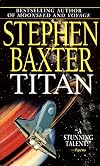
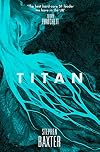
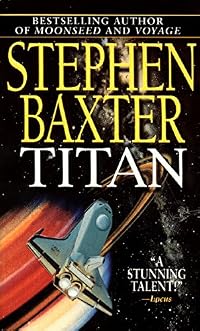
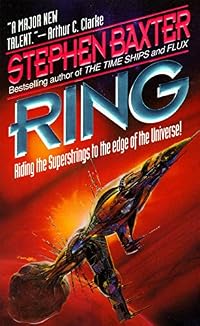
Humankind's greatest--and last--adventure! Possible signs of organic life have been found on Titan, Saturn's largest moon. A group of visionaries led by NASA's Paula Benacerraf plan a daring one-way mission that will cost them everything. Taking nearly a decade, the billion-mile voyage includes a "slingshot" transit of Venus, a catastrophic solar storm, and a constant struggle to keep the ship and crew functioning. But it is on the icy surface of Titan itself that the true adventure
show more begins. In the orange methane slush the astronauts will discover the secret of life's origins and reach for a human destiny beyond their wildest dreams. Tags
Recommendations


































Member Recommendations

jseger9000 The stories have many similarities (mainly a manned expedition to Saturn), though Baxter's story is much darker.
Member Reviews
Reading this book is a real experience. It’s not always comfortable — there are some very intense moments in the story, not everything goes well, and in fact some things go very, very bad. But to Baxter’s credit, the detail he provides, and the pacing of the story, make it real. Just be prepared.
Titan might be the most fascinating object in our solar system (besides Earth). It has a geography, it has rain, it has lakes, it has chemistry. Who knows what it has. And that’s what drew me to the book in the first place — the promise of a “hard” science fiction story about Titan and the investigation of possible life on Titan.
And that is a big part of the premise behind the book. Baxter takes off on an alternative history, show more taking as context the Cassini mission to Saturn, its Huygens probe’s landing on Titan, and the discoveries made about Titan’s geography and its chemistry.
That part of the story dovetails with a desperate time for NASA, US space exploration, and the country as a whole. The shuttle program has suffered a major disaster, and enthusiasm for space exploration is dying down. A prospective new President is not science friendly and will undoubtedly take the program away from scientific objectives, toward military and commercial ones. And he is leading the country into a potentially catastrophic confrontation with China.
The old time NASA, both old timers and younger people who have signed on with NASA to pursue old time objectives, are desperate. The possibility of hacking together a Titan mission represents a big gamble and possibly one last hurrah.
The same can be said of the gambles taken by Baxter’s main characters, notably astronaut Paula Benacerraf and scientist Isaac Rosenberg. For Rosenberg, nothing could be more important than the investigation of Titan, both personally and from a strategic standpoint for the continued exploration of the solar system. And his life is singly focused on scientific exploration. For Benacerraf, it’s a chance to do something of great and lasting value, as opposed to a life defined as “ex-astronaut” and survivor of a shuttle disaster, as heavy as the personal cost may be.
Desperation looms throughout the book. The mission is desperate, the agency that launches it is desperate, the country behind it is desperate, and things only get more desperate as the story unfolds.
There’s not a whole lot of light stuff here. It’s a hard story, but completely engaging. The reader fortunately takes on the lives of its characters from the safety of a reader’s perspective.
Baxter also builds the story on a lot of science, some of it real and some of it speculative. The Huygens probe actually landed on Titan in 2005, well after the book was written, so some of the facts, and the resulting experience of the mission’s crew, are different than they would be in reality. But I don’t think that detracts from the detailed realism of Baxter’s story.
It’s a story you can fall into and feel as though you are really living through it. Just don’t expect it to be a bed of roses. But . . . it won’t spoil the ending if I say there really is life at the end of the tunnel. show less
Titan might be the most fascinating object in our solar system (besides Earth). It has a geography, it has rain, it has lakes, it has chemistry. Who knows what it has. And that’s what drew me to the book in the first place — the promise of a “hard” science fiction story about Titan and the investigation of possible life on Titan.
And that is a big part of the premise behind the book. Baxter takes off on an alternative history, show more taking as context the Cassini mission to Saturn, its Huygens probe’s landing on Titan, and the discoveries made about Titan’s geography and its chemistry.
That part of the story dovetails with a desperate time for NASA, US space exploration, and the country as a whole. The shuttle program has suffered a major disaster, and enthusiasm for space exploration is dying down. A prospective new President is not science friendly and will undoubtedly take the program away from scientific objectives, toward military and commercial ones. And he is leading the country into a potentially catastrophic confrontation with China.
The old time NASA, both old timers and younger people who have signed on with NASA to pursue old time objectives, are desperate. The possibility of hacking together a Titan mission represents a big gamble and possibly one last hurrah.
The same can be said of the gambles taken by Baxter’s main characters, notably astronaut Paula Benacerraf and scientist Isaac Rosenberg. For Rosenberg, nothing could be more important than the investigation of Titan, both personally and from a strategic standpoint for the continued exploration of the solar system. And his life is singly focused on scientific exploration. For Benacerraf, it’s a chance to do something of great and lasting value, as opposed to a life defined as “ex-astronaut” and survivor of a shuttle disaster, as heavy as the personal cost may be.
Desperation looms throughout the book. The mission is desperate, the agency that launches it is desperate, the country behind it is desperate, and things only get more desperate as the story unfolds.
There’s not a whole lot of light stuff here. It’s a hard story, but completely engaging. The reader fortunately takes on the lives of its characters from the safety of a reader’s perspective.
Baxter also builds the story on a lot of science, some of it real and some of it speculative. The Huygens probe actually landed on Titan in 2005, well after the book was written, so some of the facts, and the resulting experience of the mission’s crew, are different than they would be in reality. But I don’t think that detracts from the detailed realism of Baxter’s story.
It’s a story you can fall into and feel as though you are really living through it. Just don’t expect it to be a bed of roses. But . . . it won’t spoil the ending if I say there really is life at the end of the tunnel. show less
This is the story of a manned trip to Titan in the early years of the 21st century, from the same writer that gave us the somewhat depressing, but grippingly realistic and compelling Voyage.
Where shall I start? With the bioengineered anthrax that only attacks Han Chinese? With the ammonia-based beings who manage to revive Our Heroes four billion years after their deaths, with their memories intact?
No.
I'll start with a U.S. Air Force pilot, acting on orders of an Air Force general, attempting to shoot down Endeavor as it takes Our Heroes into orbit to board Discovery and begin the trip to Titan. Not only is nobody court-martialed for this; the effect is to sour the sheeplike public's brief enthusiasm for NASA. It produces no bad effects show more for the Air Force whatsoever, and only minimally impedes the career of the pilot involved.
There's an impressively lifeless caricature of a right-wing, militaristic, super-patriot politician, whose election we're supposed to believe was inevitable nearly four years out. (When, exactly, was the last time that the "obvious front-runner" immediately after one presidential election was even his party's nominee in the next election? When was the last time one of these "obvious front-runners" was elected in the following election?) He is not given any attractive features whatsoever, and all the characters, both for and against him, treat him like a force of nature. Everyone seems to be terrified of him; no one seems to consider simply voting against him. No other candidates are so much as mentioned. Not even the possibility of other candidates is mentioned.
One character, Jake Hadamard, makes casual reference to "the extension of the Communications Decency Act", which completely shut down the internet until, somewhat later in the book, it is reopened under extremely tight censorship. The shutdown and censored reopening of the net is significant for the background of the book, and it's treated explicitly as an extension of currently-existing law. Now, it might be unfair to expect Baxter to have incorporated the fact of the Supreme Court's June 1997 decision striking down the CDA [his afterword is dated January 1997], but the lower court decision against it was in 1996. Still cutting things unfairly close? Not fair to expect him to incorporate 1996 material in a book turned in no later than January 1997? Well, remember, we're talking about the Communications Decency Act of 1996. It only required minimal attention to what was going on in the country he was writing about to note that the CDA was in trouble almost immediately upon passage and unlikely to survive, and only a few lines needed to be rewritten to attribute the post-2000 shutdown of the internet to some post-1996 law.
The right-wing caricature referred to above, Xavier MacLachlan, gets elected on schedule in 2008. He's a super-patriot, as mentioned above. One of his earliest actions, one year after the launch of the Titan mission [which can't get back on its own; it has to wait for pick-up], is to shut down not only the retrieval mission plans, but also the unmanned resupply launches. This is a popular decision because, of course, Americans are now bored with the Titan mission. Can I have a show of hands on who thinks either the decision or the popular reception of it is plausible? Remember, we're talking about deliberately abandoning five American astronauts in deep space, while they're still transmitting both sound and pictures.
Even though MacLachlan was so popular that his election was inevitable, almost immediately after he takes office parts of the US start seceding. There are some border skirmishes, but no real effort to prevent the secessions. MacLachlan and crew are far too busy, building up the US military in order to confront America's enemies, the Red Chinese, to waste time on secessionists...Uh-huh. Right.
It's not that MacLachlan is a bad guy. It's not that he's a right-wing bad guy. It's not that he's a stupid right-wing bad guy. If that were well done, I'd enjoy it. It's that he's stupid about everything, in wildly implausible ways. It's that he does the stupid or evil thing even when blindly following the hard-right ideology that he is supposed to be completely devoted to would lead him to do something at least different, and probably much smarter. Hard-right ideologues, having gained control of Washington, are not going to be happily indifferent to various pieces of the USA deciding to secede. That's a potential left-wing idiocy, not a right-wing one. MacLachlan's xenophobia is one of his plausible right-wing idiocies; this indifference to secession isn't. It's as if Baxter knows nothing about American politics except that the American political right is Bad Bad Bad. And yet this is not the impression I had after reading Voyage, where the politics seemed depressingly realistic. It's as if Baxter forgot everything that he knew then, and tried to fill the gap by reading the British tabloids' accounts of American politics and popular culture.
In 2012, the Chinese decide that the USA is no longer a major threat, and they attack Taiwan. The US responds (in fact, the secession-fragmented former USA makes a unified, fully integrated military response), there's a war, the Americans are sneakier than the Chinese and have better technology; the Americans win. I had the nagging feeling all through this that something was missing. I finally pinned it down. Japan. The Chinese invade a large offshore island that they claim is historically theres, and no one even mentions the possibility that the Japanese might perhaps express an opinion on the matter. Japan is completely irrelevant to this confrontation. Sure thing.
It seems almost petty to complain about the Chinese being dumb enough to pull the stunt with the asteroid, or to miscalculate and use one that's too big, or to not notice the danger of miscalculating the trajectory. I'm certain it's petty to complain about a portrait of Generation X that identifies as one of its more productive members a young man who produces "art" by gnawing dried shit with his teeth. It would be petty beyond belief to point out that we're told that this is his only skill immediately after he's produced an excellent dinner for eight. Only the small-minded would deign to notice that the noble ammonia-beings of Titan, who decide as their world is about to be destroyed by the still-expanding sun to seed the planets of other stars with both Earth life and Titan life--unlike ignoble humans, who just destroyed everything--almost certainly got the idea from the last two survivors of the Titan mission, who deliberately seeded a water-ice lake with all the organic material from Earth that they had.
I could go on much longer, but why bother? Ignore this one, and hope that Baxter gets back to writing far-future stories. show less
Where shall I start? With the bioengineered anthrax that only attacks Han Chinese? With the ammonia-based beings who manage to revive Our Heroes four billion years after their deaths, with their memories intact?
No.
I'll start with a U.S. Air Force pilot, acting on orders of an Air Force general, attempting to shoot down Endeavor as it takes Our Heroes into orbit to board Discovery and begin the trip to Titan. Not only is nobody court-martialed for this; the effect is to sour the sheeplike public's brief enthusiasm for NASA. It produces no bad effects show more for the Air Force whatsoever, and only minimally impedes the career of the pilot involved.
There's an impressively lifeless caricature of a right-wing, militaristic, super-patriot politician, whose election we're supposed to believe was inevitable nearly four years out. (When, exactly, was the last time that the "obvious front-runner" immediately after one presidential election was even his party's nominee in the next election? When was the last time one of these "obvious front-runners" was elected in the following election?) He is not given any attractive features whatsoever, and all the characters, both for and against him, treat him like a force of nature. Everyone seems to be terrified of him; no one seems to consider simply voting against him. No other candidates are so much as mentioned. Not even the possibility of other candidates is mentioned.
One character, Jake Hadamard, makes casual reference to "the extension of the Communications Decency Act", which completely shut down the internet until, somewhat later in the book, it is reopened under extremely tight censorship. The shutdown and censored reopening of the net is significant for the background of the book, and it's treated explicitly as an extension of currently-existing law. Now, it might be unfair to expect Baxter to have incorporated the fact of the Supreme Court's June 1997 decision striking down the CDA [his afterword is dated January 1997], but the lower court decision against it was in 1996. Still cutting things unfairly close? Not fair to expect him to incorporate 1996 material in a book turned in no later than January 1997? Well, remember, we're talking about the Communications Decency Act of 1996. It only required minimal attention to what was going on in the country he was writing about to note that the CDA was in trouble almost immediately upon passage and unlikely to survive, and only a few lines needed to be rewritten to attribute the post-2000 shutdown of the internet to some post-1996 law.
The right-wing caricature referred to above, Xavier MacLachlan, gets elected on schedule in 2008. He's a super-patriot, as mentioned above. One of his earliest actions, one year after the launch of the Titan mission [which can't get back on its own; it has to wait for pick-up], is to shut down not only the retrieval mission plans, but also the unmanned resupply launches. This is a popular decision because, of course, Americans are now bored with the Titan mission. Can I have a show of hands on who thinks either the decision or the popular reception of it is plausible? Remember, we're talking about deliberately abandoning five American astronauts in deep space, while they're still transmitting both sound and pictures.
Even though MacLachlan was so popular that his election was inevitable, almost immediately after he takes office parts of the US start seceding. There are some border skirmishes, but no real effort to prevent the secessions. MacLachlan and crew are far too busy, building up the US military in order to confront America's enemies, the Red Chinese, to waste time on secessionists...Uh-huh. Right.
It's not that MacLachlan is a bad guy. It's not that he's a right-wing bad guy. It's not that he's a stupid right-wing bad guy. If that were well done, I'd enjoy it. It's that he's stupid about everything, in wildly implausible ways. It's that he does the stupid or evil thing even when blindly following the hard-right ideology that he is supposed to be completely devoted to would lead him to do something at least different, and probably much smarter. Hard-right ideologues, having gained control of Washington, are not going to be happily indifferent to various pieces of the USA deciding to secede. That's a potential left-wing idiocy, not a right-wing one. MacLachlan's xenophobia is one of his plausible right-wing idiocies; this indifference to secession isn't. It's as if Baxter knows nothing about American politics except that the American political right is Bad Bad Bad. And yet this is not the impression I had after reading Voyage, where the politics seemed depressingly realistic. It's as if Baxter forgot everything that he knew then, and tried to fill the gap by reading the British tabloids' accounts of American politics and popular culture.
In 2012, the Chinese decide that the USA is no longer a major threat, and they attack Taiwan. The US responds (in fact, the secession-fragmented former USA makes a unified, fully integrated military response), there's a war, the Americans are sneakier than the Chinese and have better technology; the Americans win. I had the nagging feeling all through this that something was missing. I finally pinned it down. Japan. The Chinese invade a large offshore island that they claim is historically theres, and no one even mentions the possibility that the Japanese might perhaps express an opinion on the matter. Japan is completely irrelevant to this confrontation. Sure thing.
It seems almost petty to complain about the Chinese being dumb enough to pull the stunt with the asteroid, or to miscalculate and use one that's too big, or to not notice the danger of miscalculating the trajectory. I'm certain it's petty to complain about a portrait of Generation X that identifies as one of its more productive members a young man who produces "art" by gnawing dried shit with his teeth. It would be petty beyond belief to point out that we're told that this is his only skill immediately after he's produced an excellent dinner for eight. Only the small-minded would deign to notice that the noble ammonia-beings of Titan, who decide as their world is about to be destroyed by the still-expanding sun to seed the planets of other stars with both Earth life and Titan life--unlike ignoble humans, who just destroyed everything--almost certainly got the idea from the last two survivors of the Titan mission, who deliberately seeded a water-ice lake with all the organic material from Earth that they had.
I could go on much longer, but why bother? Ignore this one, and hope that Baxter gets back to writing far-future stories. show less
This dystopian space tale was out of date shortly after it was published, but it's still a good story with an important message - space travel is bigger than short-term interests, and politics will always nuke expensive programs. The Apollo moon landings were a freak, needed to put the commies in their place, so to speak.
In the early 21st century, the dying days of the space program are in sight. The possibility of life is discovered on Titan, one of Saturns moons. A new NASA director gets the idea to sneak in a mission to Titan before the space program is dismantled by the incoming president. (I found this one a little hard to swallow - how often is is a presidential race years in the future that certain?)
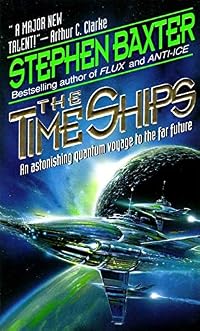
The scope of the novel is show more expansive, focusing on world affairs for much of it, and progressing to humanity's future in the universe. I enjoyed it, and am reading Mr. Baxter's novel The Time Ships, picked up on the strength of this book. show less
In the early 21st century, the dying days of the space program are in sight. The possibility of life is discovered on Titan, one of Saturns moons. A new NASA director gets the idea to sneak in a mission to Titan before the space program is dismantled by the incoming president. (I found this one a little hard to swallow - how often is is a presidential race years in the future that certain?)
The scope of the novel is show more expansive, focusing on world affairs for much of it, and progressing to humanity's future in the universe. I enjoyed it, and am reading Mr. Baxter's novel The Time Ships, picked up on the strength of this book. show less
So humans go to Titan after discovering life there. All this done using leftover hardware from the STS & Apollo programs.
A very good book if quite quite depressing at the end. As always with Baxter the science is interesting and well presented, but unlike normal Baxter I found myself caring for the characters, he seems here to have cracked his normal Achilles heel of being unable to write characters.
Spoiler Warning:
I just found the end too depressing and marginally improbable and forced to give it the full 5 star recommendation. I can see why he did what he did, trying to give the exploration of space as humanity's only hope of survival and pointing out just how stupid mankind often is, however i think he really did take it too far to show more make this point and to make this disaster that was the outcome of the mission actually a success beyond anything else mankind has achieved. A good idea, just slightly forced and certainly improbable how they were brought back to life. show less
A very good book if quite quite depressing at the end. As always with Baxter the science is interesting and well presented, but unlike normal Baxter I found myself caring for the characters, he seems here to have cracked his normal Achilles heel of being unable to write characters.
Spoiler Warning:
I just found the end too depressing and marginally improbable and forced to give it the full 5 star recommendation. I can see why he did what he did, trying to give the exploration of space as humanity's only hope of survival and pointing out just how stupid mankind often is, however i think he really did take it too far to show more make this point and to make this disaster that was the outcome of the mission actually a success beyond anything else mankind has achieved. A good idea, just slightly forced and certainly improbable how they were brought back to life. show less
Reading this on the Kindle, I'm not sure how long it was, but it felt like it took a long time to get through. Part of that, though, was that some of this was pretty slow reading. There's a detailed, and pessimistic description of NASA going forward in here as well as very detailed space journeys. I like that, it's detail I like to see, but it also does make it harder (slower) to read.
Overall, the book definitely seemed pretty pessimistic, and that's ok, but then the ending jumped us into something completely different and left before explaining it. I'll be curious to see what the next book in the series does.
Overall, the book definitely seemed pretty pessimistic, and that's ok, but then the ending jumped us into something completely different and left before explaining it. I'll be curious to see what the next book in the series does.
Interesting idea of going to Titan on the cheap, using 80s and 90s technology, but I found this book to be less engaging than Baxter's other similar works such as Voyage and Moonseed. I also found the ending to be weak. Nonetheless the characters and setup were strong and if you like Baxter's other work I'd recommend giving it a try.
A little too much pontification for my taste. The author basically uses this book as a vehicle for an extended anti-conservative, anti-Christian, anti-military rant.
If you are rabidly anti-conservative, anti-Christian, anti-military, and you enjoy reading such rants, maybe you will enjoy this. Otherwise, you probably won't.
If you are rabidly anti-conservative, anti-Christian, anti-military, and you enjoy reading such rants, maybe you will enjoy this. Otherwise, you probably won't.
Members
- Recently Added By
Lists

Arthur C. Clarke Award Winners and Shortlisted Books
219 works; 14 members
Author Information

260+ Works 43,820 Members
Some Editions
Awards and Honors
Awards
Series

Common Knowledge
- Original publication date
- 1979
- Important places
- Houston, Texas, USA; Titan
- Dedication
- For Tony, Christine, and Catherine
- Blurbers
- Clarke, Arthur C.
Classifications
Statistics
- Members
- 945
- Popularity
- 27,899
- Reviews
- 15
- Rating
- (3.46)
- Languages
- English, French, German
- Media
- Paper, Audiobook, Ebook
- ISBNs
- 16
- ASINs
- 6