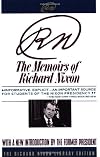
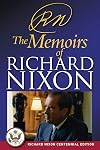
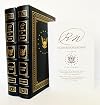
RN: The Memoirs of Richard Nixon
by Richard Nixon
On This Page
Description
The autobiography of the thirtyseventh President of the United States.Tags
Recommendations




















Member Reviews
I have always intensely dislike Richard Nixon, both as a person and as a President. I read the book hoping to come to a more nuanced view; instead I came to feel he was even more profoundly depraved.
Still, I was one of the few in my senior year of high school class to support his pardon. I did not feel then that "piling on" was in the American tradition.
Still, I was one of the few in my senior year of high school class to support his pardon. I did not feel then that "piling on" was in the American tradition.
The Memoirs of Richard Nixon by Richard Nixon
BIBLIOGRAPHIC DETAILS
-PRINT: COPYRIGHT: January 1, 1978: ISBN 978-0333230213; PUBLISHER: Grosset & Dunlap; First Edition; LENGTH: 1120 pages [Hardbound Info from Amazon]
-*DIGITAL: COPYRIGHT: (1978) January 8, 2013; PUBLISHER: Simon & Schuster; LENGTH: 1713 pages [Kindle Info from Libby version, LAPL & Amazon]
FILM: No.
SERIES: No
SUMMARY/ EVALUATION:
-SELECTION: President Nixon had a few book signings after publishing this book and I was fortunate enough to be invited to one, via the fact that my Dad and President Nixon shared the same Barber. President Nixon spoke to everyone present. He shook my hand and asked about my studies. At the time, I’d known of his fall from grace, of course, show more but, aside from knowing he had a home in San Clemente where I too lived during his presidency, I knew very little about him. I was fresh out of high school and had had very little exposure to politics. Not even yet understanding the value of a signed copy of anyone’s autobiography, let alone a former president, I gave this copy away as a gift to someone special who was more politically savvy…and have since regretted it, not even so much because of the potential value, but because it was a memento of the moment, and after FINALLY reading it, I regret it all the more, because it turns out I feel so terribly sad for him. I wish I’d known then how much he’d gone through; how much he’d done for the country; how dear his family was to him; and more. I like to think that I’d have been so much more compassionate, engaged, and thrilled to be in his presence.
A person writing about themselves might, of course, paint themselves in the best light possible, but I have learned that one must at least know what it is to be a good person to do that. President Nixon knew, and I believe he was in fact, a good person. I even find myself wondering if he may have been harder on himself than circumstances warranted. Vague statements about having made mistakes leaves too much to the imagination of those who’d like to think the worst.
-ABOUT: Well, obviously, it’s about the life of President Nixon; show less
BIBLIOGRAPHIC DETAILS
-PRINT: COPYRIGHT: January 1, 1978: ISBN 978-0333230213; PUBLISHER: Grosset & Dunlap; First Edition; LENGTH: 1120 pages [Hardbound Info from Amazon]
-*DIGITAL: COPYRIGHT: (1978) January 8, 2013; PUBLISHER: Simon & Schuster; LENGTH: 1713 pages [Kindle Info from Libby version, LAPL & Amazon]
FILM: No.
SERIES: No
SUMMARY/ EVALUATION:
-SELECTION: President Nixon had a few book signings after publishing this book and I was fortunate enough to be invited to one, via the fact that my Dad and President Nixon shared the same Barber. President Nixon spoke to everyone present. He shook my hand and asked about my studies. At the time, I’d known of his fall from grace, of course, show more but, aside from knowing he had a home in San Clemente where I too lived during his presidency, I knew very little about him. I was fresh out of high school and had had very little exposure to politics. Not even yet understanding the value of a signed copy of anyone’s autobiography, let alone a former president, I gave this copy away as a gift to someone special who was more politically savvy…and have since regretted it, not even so much because of the potential value, but because it was a memento of the moment, and after FINALLY reading it, I regret it all the more, because it turns out I feel so terribly sad for him. I wish I’d known then how much he’d gone through; how much he’d done for the country; how dear his family was to him; and more. I like to think that I’d have been so much more compassionate, engaged, and thrilled to be in his presence.
A person writing about themselves might, of course, paint themselves in the best light possible, but I have learned that one must at least know what it is to be a good person to do that. President Nixon knew, and I believe he was in fact, a good person. I even find myself wondering if he may have been harder on himself than circumstances warranted. Vague statements about having made mistakes leaves too much to the imagination of those who’d like to think the worst.
-ABOUT: Well, obviously, it’s about the life of President Nixon; show less
Ratings
Members
- Recently Added By
Published Reviews
ThingScore 50
Richard Nixon’s Memoirs have been issued in a format that would do credit to any undertaker. It is a shiny coffin of a book, and it should be sold with some small Meccano-ish form of hearse, fitted with an attachment which plays a recording of the Dead March in “Saul.” This is entirely misleading, for the great value of the work, extracts from which appeared in The Sunday Telegraph, is show more its demonstration of resilience. It gives the readers hope that should they fall from the top of the Eiffel Tower a short stay in hospital will set matters right...
It was also all to the bad that Mr. Nixon had allowed his aides to choose a White House staff which were bizarre beyond belief. They resembled Bret Harte goldminers, O. Henry’s Broadway types, and, indeed, characters out of science fiction. Sitting among these grotesques, which makes anything Downing Street has suffered from of late years seem normality itself, Mr. Nixon offended all standards, not only in Washington, but anywhere else in the world where one could possibly be. show less
It was also all to the bad that Mr. Nixon had allowed his aides to choose a White House staff which were bizarre beyond belief. They resembled Bret Harte goldminers, O. Henry’s Broadway types, and, indeed, characters out of science fiction. Sitting among these grotesques, which makes anything Downing Street has suffered from of late years seem normality itself, Mr. Nixon offended all standards, not only in Washington, but anywhere else in the world where one could possibly be. show less
added by SnootyBaronet
Nixon knew American society and politics from the ground up. Kennedy had the shallowness of the man who starts at the top. Nixon has his gaucheries, but they have always been part of the whole man. The Kennedy clan thought that Nixon lacked class. It was never strictly true, but even if it had been, there are worse things to lack. In the long view corn looks better than chic. Kennedy pretended show more to admire Casals. Nixon honestly thought that Richard Rodgers's score for Victory at Sea was great music. Nixon was the one who could actually play the piano...
Nixon's book is one long act of self-justification. To a remarkable degree the attempt succeeds. At the end his enemies are plausibly made to sound hysterical victims of what he calls 'liberal chic'... The book is well enough done to establish Nixon as a tragic figure and turn the tide of sympathy. It might even put him on the come-back trail. But we ought to keep our heads. The real tragic figures are all in Chile, Vietnam and Cambodia. It is ridiculous to class Nixon with the great villains of modern history, but not so ridiculous to be more angry with him than with them. He should have known better. show less
Nixon's book is one long act of self-justification. To a remarkable degree the attempt succeeds. At the end his enemies are plausibly made to sound hysterical victims of what he calls 'liberal chic'... The book is well enough done to establish Nixon as a tragic figure and turn the tide of sympathy. It might even put him on the come-back trail. But we ought to keep our heads. The real tragic figures are all in Chile, Vietnam and Cambodia. It is ridiculous to class Nixon with the great villains of modern history, but not so ridiculous to be more angry with him than with them. He should have known better. show less
added by SnootyBaronet
Lists

Presidential Autobiographies
37 works; 3 members

Books in the Bibliography of The Cold War by John Lewis Gaddis
192 works; 1 member
Author Information

Born in California in 1913, Richard Milhouse Nixon had an excellent record at Whittier College and Duke University Law School before beginning to practice law. During World War II, Nixon served as a Navy lieutenant commander in the Pacific. After he left the service, Nixon was elected to Congress and in 1950, won a Senate seat. Two years later, show more General Eisenhower selected Nixon, age 39, to be his running mate. They won, and Nixon learned much in the Vice Presidency. In 1960 he was nominated for President, but lost by a narrow margin to John F. Kennedy. In 1968, he again won his party's nomination, and went on to defeat Vice President Hubert H. Humphrey and third-party candidate George C. Wallace for the Presidency. His accomplishments while in office included revenue sharing, the end of the draft, new anticrime laws, and a broad environmental program. One of the most dramatic events of his first term occurred in 1969, when American astronauts made the first landing on the moon. In 1972, his administration was in turmoil as the Watergate Scandal was discovered and linked to officials of the Committee to Re-elect the President. As a result, Vice President Spiro T. Agnew resigned in 1973 and Nixon nominated, and Congress approved, House Minority Leader Gerald R. Ford as his new Vice President. Nixon himself felt it also prudent to resign rather than face impeachment, and so on August 8, 1974, he announced that he would resign the next day. At the time of Nixon's death, he had written several books on his experiences in public life and on foreign policy. Richard M. Nixon died on April 22, 1994. (Bowker Author Biography) show less
Some Editions
Awards and Honors
Distinctions
Work Relationships
Common Knowledge
- Canonical title
- RN: The Memoirs of Richard Nixon
- Original title
- RN: The Memoirs of Richard Nixon
- Original publication date
- 1978 (1e édition originale américaine) (1e édition originale américaine); 1979 (1e traduction et édition française, Stanké) (1e traduction et édition française, Stanké)
- People/Characters
- Richard M. Nixon
- Important events
- Vietnam War; Watergate Scandal
- First words
- I was born in the house my father built ....
- Original language
- English
Classifications
- Genres
- Biography & Memoir, Nonfiction, History, General Nonfiction
- DDC/MDS
- 973.924 — History & geography History of North America United States 1901- Cold War, Vietnam War, Digital Age (1953-2001) Richard Nixon (1969-1974) Watergate Scandal, U.S. withdrawal from Vietnam
- LCC
- E856 .A35 — History of the United States United States Later twentieth century, 1961-2000 Nixon's administrations, 1969-August 9, 1974
- BISAC
Statistics
- Members
- 723
- Popularity
- 39,403
- Reviews
- 3
- Rating
- (3.60)
- Languages
- English, French, German
- Media
- Paper, Ebook
- ISBNs
- 15
- ASINs
- 17