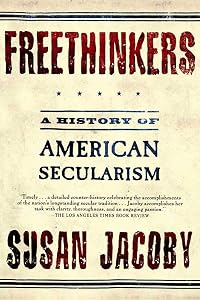
Freethinkers: A History of American Secularism
by Susan Jacoby
On This Page
Description
Chronicles two centuries of secularism in the United States, exploring this rich thread in American life and history and speculating on its continual role in society.Tags
Recommendations
Member Recommendations
Member Reviews
A fascinating book so far, though very thorough and incredible detail.
Founding Fathers rode a brief window of secularism that enabled them to implement the separation of church & state in the Constitution. And the fight has been on ever since..
Lincoln chapter was ironic in that people remade history in their memories of his religious convictions, and how he invoked more biblical imagery in his speeches as he progressed in his presidency.
Interesting remarks on the Catholic church during the history of the US, and she really made me think about it. Her best point is that the Catholic Church is the only religion that has it's own country(Vatican).
Founding Fathers rode a brief window of secularism that enabled them to implement the separation of church & state in the Constitution. And the fight has been on ever since..
Lincoln chapter was ironic in that people remade history in their memories of his religious convictions, and how he invoked more biblical imagery in his speeches as he progressed in his presidency.
Interesting remarks on the Catholic church during the history of the US, and she really made me think about it. Her best point is that the Catholic Church is the only religion that has it's own country(Vatican).
If anything, this book is a bit dated (it was published in 2004), but the issues the author details about debates regarding the separation of church and state are still relevant today. As someone who often aligns more with a secular approach to most issues, this book is refreshing and inspiring in its journey through the secular history of the United States and its focus on the well-known (like Jefferson and Lincoln) and the less well-know (like Thomas Paine and Robert Ingersoll) as a very American story of secularism emerges. This volume is by no means a definitive history and I would argue several topics and figures deserve a more thorough examination, but it is a example of applying a secular lens on American history and through show more that, telling a new story about the country's past. show less
The history of America is the history of American secularism.
In FREETHINKERS: A HISTORY OF AMERICAN SECULARISM, author Susan Jacoby traces the origins and development of freethought in America – and demonstrates how the history of America is intimately intertwined with the history of American secularism.
Starting with the American Revolution and working through American history up to the present day Bush administration, Jacoby offers a concise - but colorful! – overview of secularism, freethought, and the separation of church and state. Though she does discuss the secular roots of the Constitution, only a small portion of FREETHINKERS focuses on the Founding Fathers and their religious beliefs (or lack thereof). Indeed, FREETHINKERS show more is not a treatise on the First Amendment; it does not claim to be. Volumes have been written on what sort of “wall” Jefferson, Adams, Madison, et.al., sought to erect; rather than add to the library, Jacoby offers her view and then moves on. What follows is an analysis of various social movements, such as abolition, women’s suffrage, labor rights and civil rights, with an emphasis on the role in which secularists and freethinkers played in each. Especially interesting are Jacoby’s accounts of abolition and women’s suffrage, what with all the wheeling, dealing and backstabbing that went on behind the scenes. It’s refreshing (or perhaps just downright depressing) to see how much contemporary political maneuvering resembles that of the golden days of freethought and radicalism.
As I devoured FREETHINKERS, I found myself wishing that I had been introduced to similar works during high school. Like many high school students, I found the sanitized, inoffensive history textbooks (both American and global) B-O-R-I-N-G. It wasn’t until I graduated from college and again had time for leisure reading that I discovered uncensored, true-to-life historical nonfiction – and actually took an interest in American history and politics. History doesn’t have to be boring, kids! In fact, it’s almost always as exciting, if not more so, than the latest flick that Hollywood has regurgitated onto the big screen.
Perhaps if books such as FREETHINKERS (as well as James W. Loewen’s Lies My Teacher Told Me and Michael Farquhar's A Treasury of Great American Scandals) were introduced into high school curriculums, we’d raise a new generation of politically engaged and active young citizens – knowledgeable voters who, armed with a profound respect for science, empiricism, and secularism, not to mention a healthy dose of skepticism, would not have elected dubya to office (twice!), and allowed him to wage a war based on 935+ “false statements”.
http://www.easyvegan.info/2008/01/29/freethinkers-by-susan-jacoby/ show less
In FREETHINKERS: A HISTORY OF AMERICAN SECULARISM, author Susan Jacoby traces the origins and development of freethought in America – and demonstrates how the history of America is intimately intertwined with the history of American secularism.
Starting with the American Revolution and working through American history up to the present day Bush administration, Jacoby offers a concise - but colorful! – overview of secularism, freethought, and the separation of church and state. Though she does discuss the secular roots of the Constitution, only a small portion of FREETHINKERS focuses on the Founding Fathers and their religious beliefs (or lack thereof). Indeed, FREETHINKERS show more is not a treatise on the First Amendment; it does not claim to be. Volumes have been written on what sort of “wall” Jefferson, Adams, Madison, et.al., sought to erect; rather than add to the library, Jacoby offers her view and then moves on. What follows is an analysis of various social movements, such as abolition, women’s suffrage, labor rights and civil rights, with an emphasis on the role in which secularists and freethinkers played in each. Especially interesting are Jacoby’s accounts of abolition and women’s suffrage, what with all the wheeling, dealing and backstabbing that went on behind the scenes. It’s refreshing (or perhaps just downright depressing) to see how much contemporary political maneuvering resembles that of the golden days of freethought and radicalism.
As I devoured FREETHINKERS, I found myself wishing that I had been introduced to similar works during high school. Like many high school students, I found the sanitized, inoffensive history textbooks (both American and global) B-O-R-I-N-G. It wasn’t until I graduated from college and again had time for leisure reading that I discovered uncensored, true-to-life historical nonfiction – and actually took an interest in American history and politics. History doesn’t have to be boring, kids! In fact, it’s almost always as exciting, if not more so, than the latest flick that Hollywood has regurgitated onto the big screen.
Perhaps if books such as FREETHINKERS (as well as James W. Loewen’s Lies My Teacher Told Me and Michael Farquhar's A Treasury of Great American Scandals) were introduced into high school curriculums, we’d raise a new generation of politically engaged and active young citizens – knowledgeable voters who, armed with a profound respect for science, empiricism, and secularism, not to mention a healthy dose of skepticism, would not have elected dubya to office (twice!), and allowed him to wage a war based on 935+ “false statements”.
http://www.easyvegan.info/2008/01/29/freethinkers-by-susan-jacoby/ show less
A fascinating walk through American history from the perspective of "infidels, atheists, freethinkers, agnostics, deists, heretics." Made me think once again of how people are defined in terms of religion (e.g. "people of faith," "believers," etc.) and how "freethinkers" are thus defined most often in negative terms (unbelievers, heretics, "people of no faith,"--I think Obama might even have said that).
Also, the way religions tend to whitewash their histories so that it seems like they've always been on the "right" side of peoples' movements.
And reminded me of the great danger in tying morality/ethics to (someone's conception of) God.
Also, the way religions tend to whitewash their histories so that it seems like they've always been on the "right" side of peoples' movements.
And reminded me of the great danger in tying morality/ethics to (someone's conception of) God.
The great tradition of American Freethought is sadly neglected. I'm not sure I read about Darrow or Paine in school -- maybe Paine, in passing -- but certainly not Ingersoll. If I hadn't sought out Darrow, after seeing "Inherit the Wind" as a youngster, or gone off on my own to read Twain beyond Huck Finn, I'm not sure how I would've even know to look for this sort of history. Jacoby effectively conveys both how ignored, maligned, and absolutely crucial to the health of our democracy our heritage of freethought is. It's unlikely my kids will get assigned reading from this book in school, but I'm glad I have it to help fill in the gaps.
(posted on my blog: davenichols.net)
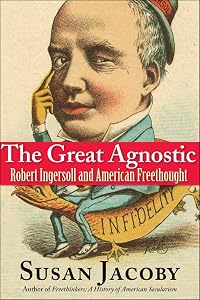
Journalist and scholar Susan Jacoby offers a history of American secular icons, trends, and controversies. From early political and cultural icons like Thomas Jefferson and Thomas Paine, to the golden days of the Great Agnostic Col. Robert Ingersoll and Elizabeth Stanton, as well as many others, Jacoby weaves a narrative of struggle and fortitude worthy of digesting.
Early American secularists were primarily concerned with keeping religion out of government and vice versa. There can be no doubt about the will of men like Jefferson in establishing a clear wall between church and state matters. Often, as Jacoby narrates, church leaders even supported this stance, understanding that a separation protected show more all flavors of religion.
The struggle of secularists did not end with church and state matters, especially when the abolitionist and feminist movements began to gain steam. Secular leaders such as Elizabeth Cady Standon and William Lloyd Garrison led charges against the clerical nature of religion and forwarded the rights movements with the help of many other secular proponents.
For me, the highlights of the book include the histories of the anti-evolution, anti-feminism, and prayer-in-school movement. The past anti-evolution movement closely mirrors the intelligent design ignorance movement of the modern age. Jacoby destroys that often-espoused sectarian notion that religion championed women's rights, abolition, and other rights (see debate points by apologist Dinesh D'Souza, for instance). While some religious leaders did in fact champion these progressive causes, there were uncountable religious forced allied against them. Slavery, in particular, was often justified by bible-thumping Christians as ordained by God himself. The hatred and bile spewed by conservative Christian leaders over the centuries does not reflect well on the role of religion at all.
Anyone who wants to understand the fight for free speech, free religion, and freethinking should read this book. While it does not delve deeply into most of the people or events involved, it offers a broad history with many key stories that make clear how important, and fragile, the pursuit of secular, freethinking goals are in America. Four stars. show less
Journalist and scholar Susan Jacoby offers a history of American secular icons, trends, and controversies. From early political and cultural icons like Thomas Jefferson and Thomas Paine, to the golden days of the Great Agnostic Col. Robert Ingersoll and Elizabeth Stanton, as well as many others, Jacoby weaves a narrative of struggle and fortitude worthy of digesting.
Early American secularists were primarily concerned with keeping religion out of government and vice versa. There can be no doubt about the will of men like Jefferson in establishing a clear wall between church and state matters. Often, as Jacoby narrates, church leaders even supported this stance, understanding that a separation protected show more all flavors of religion.
The struggle of secularists did not end with church and state matters, especially when the abolitionist and feminist movements began to gain steam. Secular leaders such as Elizabeth Cady Standon and William Lloyd Garrison led charges against the clerical nature of religion and forwarded the rights movements with the help of many other secular proponents.
For me, the highlights of the book include the histories of the anti-evolution, anti-feminism, and prayer-in-school movement. The past anti-evolution movement closely mirrors the intelligent design ignorance movement of the modern age. Jacoby destroys that often-espoused sectarian notion that religion championed women's rights, abolition, and other rights (see debate points by apologist Dinesh D'Souza, for instance). While some religious leaders did in fact champion these progressive causes, there were uncountable religious forced allied against them. Slavery, in particular, was often justified by bible-thumping Christians as ordained by God himself. The hatred and bile spewed by conservative Christian leaders over the centuries does not reflect well on the role of religion at all.
Anyone who wants to understand the fight for free speech, free religion, and freethinking should read this book. While it does not delve deeply into most of the people or events involved, it offers a broad history with many key stories that make clear how important, and fragile, the pursuit of secular, freethinking goals are in America. Four stars. show less
An excellent examination of US secular protagonists of the 18th to the 20th century that loses steam as modern issues are approached. The chapter on abolitionism and early feminism is outstanding as is the examination of the (non-)religiosity of Abraham Lincoln. Unfortunately, conservatives and fundamentalists will probably refrain from studying the mistaken ideas of their spiritual ancestors and reexamine their own positions.
Members
- Recently Added By
Published Reviews
ThingScore 88
Ardent and insightful, Ms. Jacoby seeks to rescue a proud tradition from the indifference of posterity.
added by jlelliott
The great virtue of Susan Jacoby’s book is that it succeeds so well in its own original intent: showing that secularism, agnosticism and atheism are as American as cherry pie. Indeed, this is the first and only country to adopt a Constitution that specifically excludes all reference to a higher power...
In lucid and witty prose, Jacoby has uncovered the hidden history of secular America, and show more awarded it a large share of credit in every movement for social and political reform... If the book has a fault, it is the near-axiomatic identification of the secular cause with the liberal one. Susan Jacoby has what might be called ACLU politics. To read her, you would not know that two of the most prominent intellectual gurus of American conservatism — Ayn Rand and Leo Strauss — were both determined nonbelievers. H.L. Mencken, who if not exactly a conservative was certainly not a liberal, had vast contempt for religion but is cited only briefly here for his role in the Scopes trial in Tennessee. show less
In lucid and witty prose, Jacoby has uncovered the hidden history of secular America, and show more awarded it a large share of credit in every movement for social and political reform... If the book has a fault, it is the near-axiomatic identification of the secular cause with the liberal one. Susan Jacoby has what might be called ACLU politics. To read her, you would not know that two of the most prominent intellectual gurus of American conservatism — Ayn Rand and Leo Strauss — were both determined nonbelievers. H.L. Mencken, who if not exactly a conservative was certainly not a liberal, had vast contempt for religion but is cited only briefly here for his role in the Scopes trial in Tennessee. show less
added by SnootyBaronet
Lists

Top Five Books of 2017
757 works; 230 members

Atheism, humanism, freethought, &c. — Best nonfiction books in favour of
167 works; 14 members

Books Read in 2017
4,249 works; 129 members

Books in the Bibliography of Freethinkers by Susan Jacoby
155 works; 1 member
Author Information

16+ Works 3,626 Members
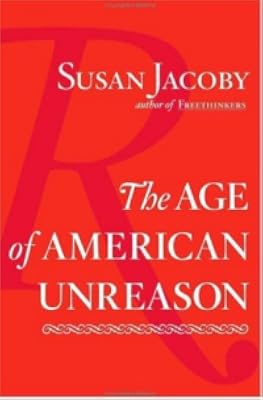
Susan Jacoby began her writing career as a reporter for The Washington Post. Her first book, Moscow Conversations, was based on the articles she contributed to the Post from Moscow between 1969 and 1971. Her other books include Wild Justice: The Evolution of Revenge, The Possible She, Half-Jew: A Daughter's Search for Her Family's Buried Past, show more Freethinkers: A History of American Secularism, The Age of American Unreason, The Great Agnostic: Robert Ingersoll and American Freethought, and Strange Gods: A Secular History of Conversion. (Bowker Author Biography) show less
Some Editions
Common Knowledge
- Original publication date
- 2004
- People/Characters
- John Adams; Samuel Adams; Jane Addams; Felix Adler; Louis Agassiz; Louisa May Alcott (show all 215); Ethan Allen; Frederick Lewis Allen; John Peter Altgeld; Susan B. Anthony; Isaac Backus; Roger Nash Baldwin; Bruce Barton; Newton Bateman; Philo D. Beckwith; Henry Ward Beecher; Lyman Beecher; Francis Bellamy; D. M. Bennett; William Bentley; Alexander Berkman; Catherine H. Birney; Hugo Black; Harry A. Blackmun; Elizabeth Blackwell; James G. Blaine; Paul L. Blakely; Paul Blanshard; Amelia Bloomer; Julian Bond; Marguerite de Bonneville; William Cowper Brann; John Breckinridge; Heywood Broun; Susan Brownmiller; Thomas E. Buckley; Edmund Burke; Andrew Carnegie; Jimmy Carter; Stephen L. Carter; W. J. Cash; Carrie Chapman Catt; George Chainey; Martha Weston Chapman; Salmon P. Chase; Ellen Chesler; Bill Clinton; William Cobbett; Samuel Colgate; Moncure Daniel Conway; Thomas Cooper; Charles Coughlin; Donald F. Crosby; Clarence Darrow; Charles Darwin (Charles Robert: 1809-1882); Eugene V. Debs; John Dewey; Frederick Douglass; Robert F. Drinan; W. E. B. Du Bois; Timothy Dwight; Thomas Edison; Jonathan Edwards; Dwight D. Eisenhower; Havelock Ellis; Morris Ernst; John Fiske; Elizabeth Gurley Flynn; William J. Flynn; John W. Francis; Felix Frankfurter; Benjamin Franklin; Betty Friedan; Matilda Joslyn Gage; Helen H. Gardener; William Lloyd Garrison; Harry Golden; Emma Goldman; Robert Goldstein; Andrew Goodman; Al Gore; Stephen Jay Gould; Ulysses S. Grant; Rebecca Gratz; Asa Gray; Elizabeth Griffith; James Harlan; Patrick Hayes; Rutherford B. Hayes; Patrick Henry; Henry Holt; William H. Herndon; Watson Heston; Ezra H. Heywood; Gertrude Himmelfarb; Josiah Gilbert Holland; Julia Ward Howe; Charles Evans Hughes; John Hughes; Thomas Henry Huxley; Robert Green Ingersoll; Robert H. Jackson; William James; Thomas Jefferson; Pope John XXIII; Lyndon Baines Johnson; Richard M. Johnson; Albert Jones; John F. Kennedy; Robert F. Kennedy; Edward King; Martin Luther King, Jr.; Marquis de Lafayette; Robert M. LaFollette; Jean-Baptiste Lamarck; Ward Hill Lamon; Meridel LeSueur; Stanley Levison; Sinclair Lewis; Abraham Lincoln; Joseph Lister; Viola Liuzzo; Daniel A. Lord; Joseph McCarthy; Vashti McCollum; George E. MacDonald; James Francis McIntyre; James Madison; Marie Antoinette; Othniel C. Marsh; Martin E. Marty; John M. Mason; Cotton Mather; Samuel Mather; Henry Mayer; William Meade; H. L. Mencken; Gregor Mendel; Maynard M. Metcalf; James Monroe; Truman Moon; Charles C. Moore; J. P. Morgan; Thomas J. Morgan; Gouverneur Morris; Jedidiah Morse; James Mott; Lucretia Mott; Verle Muhrer; Allan Nevins; Michael Newdow; Friedrich Nietzsche; William Douglas O'Connor; Kenneth O'Donnell; Benjamin Offen; Richard Oglesby; Robert Dale Owen; Thomas Paine; Elihu Palmer; Alison M. Parker; Louis Pasteur; Harry Thurston Peck; Leo Pfeffer; Wendell Phillips; Jeanette Rankin; Oscar Riddle; Eleanor Roosevelt; Franklin Delano Roosevelt; Theodore Roosevelt; Ernestine Rose; Roberto Rossellini; Jean-Jacques Rousseau (1712-1778); Joseph F. Rummel; John A. Ryan; Margaret Sanger; George Schilling; Marc Schneier; Michael Schwerner; Rita Schwerner; William Seward; William Shakespeare; Fulton J. Sheen; Al Smith; Francis J. Spellman; Elizabeth Cady Stanton; Henry Stanton; Gloria Steinem; Ezra Stiles; Lucy Stone; Norman Thomas; Henry David Thoreau; J. H. Thornwell; Elizabeth Tilton; Theodore Tilton; Harry S. Truman; Samuel Langhorne Clemens; Constantin François de Chassebœuf, comte de Volney (Constantin Volney); Voltaire; Sojourner Truth; Harriet Tubman; Earl Warren; Booker T. Washington; George E. Webb; Richard D. Webb; Ronald C. White; Fred Whitehead; Walt Whitman; Frances Willard; Alexander Winchell; Arnold Jacob Wolf; William Wolf; Victoria Woodhull; Mary Wooley; Frances Wright; Andrew Young
- Important places
- Delaware, USA; Europe; France; Georgia, USA; Ingersoll Birthplace Museum; Massachusetts, USA (show all 12); New England, USA; New York, New York, USA; Philadelphia, Pennsylvania, USA; Salem, Massachusetts, USA; South Carolina, USA; Virginia, USA
- Epigraph
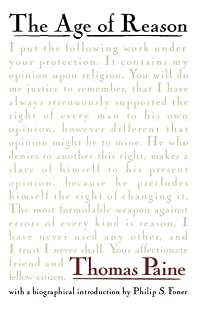
- The most formidable weapon against
errors of any kind is reason.
—Thomas Paine, 1794 - Dedication
- For Robert and Irma Broderick Jacoby
- First words
- On the centennial anniversary of the signing of the Declaration of Independence, Robert Ingersoll, the foremost champion of freethought and the most famous orator in late-nineteenth-century America, paid tribute in his hometo... (show all)wn of Peoria, Illinois, to "the first secular government that was ever founded in this world."
- Last words
- (Click to show. Warning: May contain spoilers.)The combination of free and thought embodies every ideal that secularists still hold out to a nation founded not on dreams of justice in heaven but on the best human hopes for a more just earth.
- Publisher's editor
- Bershtel, Sara; Schloss, Roslyn
- Blurbers
- Roth, Philip; Dorsen, Norman; Miller, Arthur; Gay, Peter; Hochschild, Adam; Brownmiller, Susan
Classifications
- Genres
- History, Nonfiction, General Nonfiction, Religion & Spirituality, Philosophy
- DDC/MDS
- 211.4097 — Religion Philosophy & theory of religion Concepts of God Free Thought
- LCC
- BL2760 .J33 — Philosophy, Psychology and Religion Religions. Mythology. Rationalism Religions. Mythology. Rationalism Rationalism
- BISAC
Statistics
- Members
- 1,365
- Popularity
- 17,510
- Reviews
- 27
- Rating
- (4.13)
- Languages
- English
- Media
- Paper, Audiobook, Ebook
- ISBNs
- 3
- UPCs
- 1
- ASINs
- 4