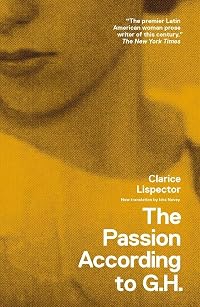
The Passion According to G.H.
by Clarice Lispector
On This Page
Description
G.H., a well-to-do Rio sculptress, enters her maid's room, sees a cockroach crawling out of the wardrobe, and, panicking, slams the door on it. The sight of the dying insect provokes a mystical crisis, at the height of which comes one of the most famous and genuinely shocking scenes in Latin American literature. Clarice Lispector wrote that of all of her works this novel was the one that "best corresponded to her demands as a writer."Tags
Recommendations
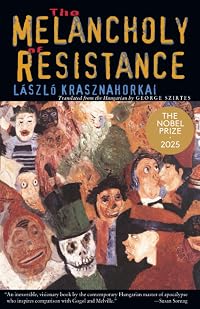
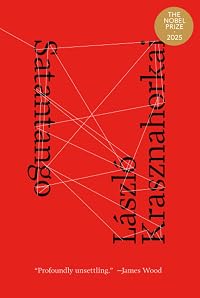
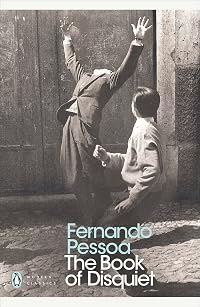
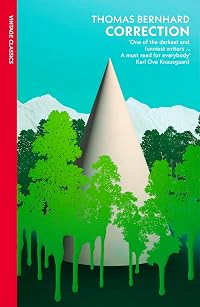







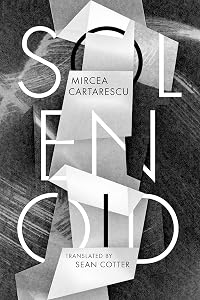
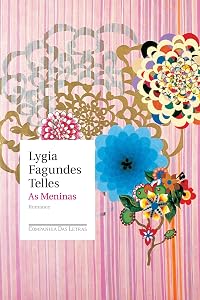
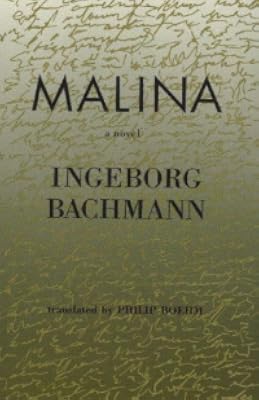
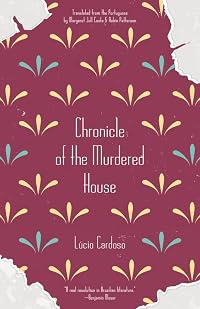




Member Recommendations


Member Reviews
You know, I was a little nervous about returning to Lispector. Reading Agua Viva and Hour of the Star in my early 20s changed my life and I was worried that now 8 years later I'd be less spellbound somehow. Nope. This is one of the best books I've read and the best Lispector I've read yet. I don't want to deliver a review or rather, I don't know that I can. This book even more than her other works is very explicitly a work of theology as much as philosophy. Not just because she uses the word God a lot, but because of the way it dives into this hyper-Spinozan universe and then spends its time deconstructing what it means to think of the world as the All, as G-d in an abstract (and, to me, very Jewish) sense. And as it turns out, show more confronting the All is absolutely horrifying and fundamentally impossible. But the impossibility is the point. show less
It is a deeply unsettling and introspective novel. The story follows GH, a sculptor, who enters her maid’s room to clean it after she quits. In the empty room, she encounters a cockroach, which ignites her fear of pests. Out of fear, she kills it, and this single act sends her spiraling into an existential and spiritual crisis. Throughout this journey, she addresses the reader as a “hand holding hers,” guiding us through an experience that simultaneously destroys and fulfills her.
Clarice Lispector’s writing is extraordinary. Her style is wonderfully unique and convoluted, like a maze she guides you through, word by word, line by line. It’s a dagger that lodges itself in your mind and heart - a dagger you welcome. From the show more first line to the last, this novel felt like a deep hallucination, and the hallucinogen was her writing.
The themes are vast and profound, requiring time to fully digest. I need the book to marinate in my head before I can makes sense of the entirety of what it said. In essence, the novel delves into the very core of what it means to be human, stripped of the perceptions shaped by society and culture. It asks the haunting question: Who are you when you are alone?
I marked and underlined so many passages in this book that I ran out of post-it flags. Each sentence felt like it demanded to be revisited, contemplated, and absorbed.
If you find joy in existential torment, self-reflection, and stream-of-consciousness writing with unique sentence structures and no plot, this book is for you. It’s disturbing - GH eats a part of the cockroach, after all - but it’s a journey worth taking.
By the end, I felt everything. I felt fulfilled, I felt seen, I felt shaken, and I felt consumed. Clarice Lispector never disappoints. Much more than a book, it felt like an experience that I will never forget. show less
Clarice Lispector’s writing is extraordinary. Her style is wonderfully unique and convoluted, like a maze she guides you through, word by word, line by line. It’s a dagger that lodges itself in your mind and heart - a dagger you welcome. From the show more first line to the last, this novel felt like a deep hallucination, and the hallucinogen was her writing.
The themes are vast and profound, requiring time to fully digest. I need the book to marinate in my head before I can makes sense of the entirety of what it said. In essence, the novel delves into the very core of what it means to be human, stripped of the perceptions shaped by society and culture. It asks the haunting question: Who are you when you are alone?
I marked and underlined so many passages in this book that I ran out of post-it flags. Each sentence felt like it demanded to be revisited, contemplated, and absorbed.
If you find joy in existential torment, self-reflection, and stream-of-consciousness writing with unique sentence structures and no plot, this book is for you. It’s disturbing - GH eats a part of the cockroach, after all - but it’s a journey worth taking.
By the end, I felt everything. I felt fulfilled, I felt seen, I felt shaken, and I felt consumed. Clarice Lispector never disappoints. Much more than a book, it felt like an experience that I will never forget. show less
Life *is* me.
A woman is having breakfast, in her white suburban kitchen, a perfectly arranged home around a perfectly arranged life, "the witty elegance of my home comes from everything here being within quotation marks, I quote the world because it's neither me or mine." She has just gone through the end of an affair and some other stuff that will be mentioned later on, she's just fired her maid because she's realised that she loves cleaning, but everything's fine, really. She's an adult, she's experienced, she's become what she's supposed to be, she has power over her own life. In fact, let's spend the day cleaning out the maid's room. And she walks into her maid's room, an ordinary day in an ordinary life, and right there, in the show more middle of the room, she meets it.
A cockroach. A huge, disgusting (in the Sartreian sense) cockroach, there since the dawn of time, since before the dinosaurs, in her perfectly formed life. She tries to kill it - realising in the middle of it that she's KILLING, taking another life - but only manages to wound it. And so she drops onto the maid's bed and sits there, for hours, watching the animal struggle to die, going through existential shock as she realises just how different they're not. Just how much of what is her has been imposed without thinking, without seeing the layers of what she is. She sees herself from the outside, and she sees an insect who dreams it is human.
I watched it, the cockroach; I hated it so much that I went over to its side out of solidarity, because I couldn't stand being alone with my aggression.
It's tempting to make the obvious comparison with another giant of Jewish modernist literature and call it a Metamorphosis in reverse; right down to the bit where the woman only identifies herself by her initials, because how fucking Kafkaesque is that? At the same time, this is another age, another climate, and much like she does in (the even better novel) Agua viva Lispector is in no hurry to tell a story here. The entire novel takes place over one morning, with only one character in it (if you don't count the cockroach, and the reader to whom the novel is, by necessity, addressed), all of it written in a feverish, impressionistic language that doesn't try to pass itself off as a finished argument but as one in the making, trying to put words on things that we refuse to acknowledge.
Oh, what if we weren't human to start with? but became human over time, out of practical necessity?
G.H. goes from surprise to disgust, from disgust to existential crisis to Nietzschean freedom to religious ecstasy to either salvation or damnation (as if there was a difference) in the now over 200 pages. Yes, Lispector rambles at times, but she does so to get to a point which cannot be put into words without putting the entire process into it. The very fact that it's such an exhuberant novel, quite honestly, makes it more disturbing - and more rewarding.
It's not dangerous. I promise you, it's not dangerous. show less
A woman is having breakfast, in her white suburban kitchen, a perfectly arranged home around a perfectly arranged life, "the witty elegance of my home comes from everything here being within quotation marks, I quote the world because it's neither me or mine." She has just gone through the end of an affair and some other stuff that will be mentioned later on, she's just fired her maid because she's realised that she loves cleaning, but everything's fine, really. She's an adult, she's experienced, she's become what she's supposed to be, she has power over her own life. In fact, let's spend the day cleaning out the maid's room. And she walks into her maid's room, an ordinary day in an ordinary life, and right there, in the show more middle of the room, she meets it.
A cockroach. A huge, disgusting (in the Sartreian sense) cockroach, there since the dawn of time, since before the dinosaurs, in her perfectly formed life. She tries to kill it - realising in the middle of it that she's KILLING, taking another life - but only manages to wound it. And so she drops onto the maid's bed and sits there, for hours, watching the animal struggle to die, going through existential shock as she realises just how different they're not. Just how much of what is her has been imposed without thinking, without seeing the layers of what she is. She sees herself from the outside, and she sees an insect who dreams it is human.
I watched it, the cockroach; I hated it so much that I went over to its side out of solidarity, because I couldn't stand being alone with my aggression.
It's tempting to make the obvious comparison with another giant of Jewish modernist literature and call it a Metamorphosis in reverse; right down to the bit where the woman only identifies herself by her initials, because how fucking Kafkaesque is that? At the same time, this is another age, another climate, and much like she does in (the even better novel) Agua viva Lispector is in no hurry to tell a story here. The entire novel takes place over one morning, with only one character in it (if you don't count the cockroach, and the reader to whom the novel is, by necessity, addressed), all of it written in a feverish, impressionistic language that doesn't try to pass itself off as a finished argument but as one in the making, trying to put words on things that we refuse to acknowledge.
Oh, what if we weren't human to start with? but became human over time, out of practical necessity?
G.H. goes from surprise to disgust, from disgust to existential crisis to Nietzschean freedom to religious ecstasy to either salvation or damnation (as if there was a difference) in the now over 200 pages. Yes, Lispector rambles at times, but she does so to get to a point which cannot be put into words without putting the entire process into it. The very fact that it's such an exhuberant novel, quite honestly, makes it more disturbing - and more rewarding.
It's not dangerous. I promise you, it's not dangerous. show less
Don't expect a systematic review of this book from me, however brief it may be. Also a synthesis is not possible, because there is hardly a story line in it. It was clearly an overwhelming reading experience for me, as is apparent from the exceptionally high rating to my standards. The Brazilian writer Lispector (1920-1977) offers a disjointed internal monologue of a woman who is apparently undergoing a deep existential experience; I can't put it more concisely than that. The sentences follow each other in an almost opaque manner, with constant contradictions and paradoxes, and references to situations and persons that cannot always be placed. Deep philosophical and existential musings about the universe, God, death, love, and so on, show more alternate with horrific acts and surrealistic performances, which are mainly triggered by the discovery of a cockroach. I was especially touched by the apt description of the universe (and therefore also God) as indifferent/neutral, a process of dehumanization that is seen by the story telling protagonist as a liberating experience, culminating in a vitalistic confession.
These few reviewing lines really don’t do justice to this book, I know, so I’ll throw in some references that were perhaps not consciously intended by Lispector (in her autobiographical book 'The Discovery of the World' she indicates that she hardly read other 'great' books): Fyodor Dostoevsky, Samuel Beckett, Virigina Woolf, Frans Kafka, etc., all these great ones come to mind as you read this intriguing text. For me – but every reader will probably see something different in it – I experienced this book essentially as a process of purification, of a (Brazilian) woman in a midlife crisis, exposing fundamental existential truths. I'm sure I'll return to this book to deepen the mind-blowing reading experience it offers. show less
These few reviewing lines really don’t do justice to this book, I know, so I’ll throw in some references that were perhaps not consciously intended by Lispector (in her autobiographical book 'The Discovery of the World' she indicates that she hardly read other 'great' books): Fyodor Dostoevsky, Samuel Beckett, Virigina Woolf, Frans Kafka, etc., all these great ones come to mind as you read this intriguing text. For me – but every reader will probably see something different in it – I experienced this book essentially as a process of purification, of a (Brazilian) woman in a midlife crisis, exposing fundamental existential truths. I'm sure I'll return to this book to deepen the mind-blowing reading experience it offers. show less
Exceptional. I originally tried to read at the beginning of quarantine and could not handle it. On the face -- it is the story of a woman who walks into her maids room and kills a cockroach. But it was so much more than that, and the horror goes all the way down. I got so close to where she wanted me to go. I have never read prose like this in my life.
In the words of the author, I adore it. A weaved text with rich language and a compelling philosophy about what it is to be human, told by the powerful voice of Lispector in a novel where very little actions transpire, but the stream of the protagonists thoughts present varied views on religion, belief, and choice.
This book had so much potential in the beginning. The introduction, although somewhat dense right away, was interesting and I enjoyed the ideas that were being presented by the author. It felt very reminiscent of some of my all-time favourite works, such as Evangelion (defining and accepting your own identity, hedgehog dilemma), Mr. Robot (dissociation, stream of consciousness), and some others. Then came the very first plot-points, and I was fully invested! I loved the idea of the maid, and how G.H. never truly "saw her", or understood the maid. The narrator who once belonged to the lower-class and now belonged to the upper-class could no longer relate to, or heed any attention to the low- or middle-class - they were invisible to her. show more Their struggles, their way of being, they were considered unworthy of her time. And the same is how I understood the cockroach, a symbol for the unclean and a memory, or confrontation rather, of her distant past. She had to embrace this past and her identity.
Then, of course, the most insane loss of potential ever happened.
Gibberish. Nonsense. Wish-wash. The most awful things I've ever read.
Desert. God. Sabbath. Dinosaurs. Endless stream of consciousness and half-baked ideas. They wouldn't stop. And for who? Who was actually reading this and getting anything out of it?
The pretentious. That's what I seriously believe.
I understand that I am not a literary genius, or even anywhere close. Clarice Lispector probably is. But does that mean that her writing about whatever she feels like for 60ish% of the book makes a good book? No. I don't think so. There has to be some level of accessibility, and this sadly just doesn't have that. I followed a read-along forum on reddit from 2021, and I just hate to say that the things they brought up just didn't do much for me.
A lot of the ideas were spread out too thin, and a lot of them don't really make sense, and a lot of them don't have any meaningful conclusion. I say "a lot of them", because I am not sure what this book really even was to be honest. One thing I saw in one of the reddit forums was this comment:
I saw some reviews on Storygraph (therefore mostly from GoodReads) ranging from "This is weird and I didn't understand a thing (1 star)" to "This is weird and I don't think I've managed to understand all of it (5 stars)"
I think the latter is so insincere. And if there is anything you SHOULD have learnt from reading this book, it is to be sincere! So I am going to apply my understanding of this book as best I can and give it a bad rating, as well.
TL;DR - I liked the start of this book, and the plot elements were interesting, but with the middle-to-end sections of the book (the majority) being gibberish, I believe this might be the biggest loss of potential in a book I've ever read. My personal pick for biggest letdown in fiction. show less
Then, of course, the most insane loss of potential ever happened.
Gibberish. Nonsense. Wish-wash. The most awful things I've ever read.
Desert. God. Sabbath. Dinosaurs. Endless stream of consciousness and half-baked ideas. They wouldn't stop. And for who? Who was actually reading this and getting anything out of it?
The pretentious. That's what I seriously believe.
I understand that I am not a literary genius, or even anywhere close. Clarice Lispector probably is. But does that mean that her writing about whatever she feels like for 60ish% of the book makes a good book? No. I don't think so. There has to be some level of accessibility, and this sadly just doesn't have that. I followed a read-along forum on reddit from 2021, and I just hate to say that the things they brought up just didn't do much for me.
A lot of the ideas were spread out too thin, and a lot of them don't really make sense, and a lot of them don't have any meaningful conclusion. I say "a lot of them", because I am not sure what this book really even was to be honest. One thing I saw in one of the reddit forums was this comment:
I saw some reviews on Storygraph (therefore mostly from GoodReads) ranging from "This is weird and I didn't understand a thing (1 star)" to "This is weird and I don't think I've managed to understand all of it (5 stars)"
I think the latter is so insincere. And if there is anything you SHOULD have learnt from reading this book, it is to be sincere! So I am going to apply my understanding of this book as best I can and give it a bad rating, as well.
TL;DR - I liked the start of this book, and the plot elements were interesting, but with the middle-to-end sections of the book (the majority) being gibberish, I believe this might be the biggest loss of potential in a book I've ever read. My personal pick for biggest letdown in fiction. show less
Members
- Recently Added By
Lists

Experimental Literature
141 works; 18 members

Latin American Literature
50 works; 11 members

Elena Ferrante's 40 favourite books by female authors
40 works; 10 members

1,001 BYMRBYD Concensus
723 works; 27 members

Blackwell's Five Foot Bookshelf
72 works; 4 members

Schwob Nederland
207 works; 2 members

Tablet Magazine's List of 101 Great Jewish Books
103 works; 9 members

Stuff from Bard
70 works; 1 member

Books for Birute
39 works; 1 member

Greatest brazilian novels of 20th century
50 works; 2 members
Author Information

151+ Works 12,884 Members
Clarice Lispector was born in the Ukraine and was taken to Brazil as a young child. She was a law student, editor, translator, and newswriter, who traveled widely, spending eight years in the United States. "Family Ties" (1960) is a collection of short stories revealing Lispector's existentialist view of life and demonstrating that even family show more ties and social relationships are temporary. Although tied to each other and to the outside world, the characters are finally totally alone and separate. Lispector received praise from American critics for "The Apple in the Dark" (1967), a novel about a guilt-ridden man's search for the ultimate knowledge (Eve's apple), which he believes will bring him hope. Lispector's books are being translated into various languages in Europe, especially in France, where the critic Helene Cixous is one of her great admirers and a promoter of her works. (Bowker Author Biography) show less
Some Editions
Awards and Honors
Series
Belongs to Publisher Series
Common Knowledge
- Canonical title
- The Passion According to G.H.
- Original title
- A Paixão segundo G.H.
- Original publication date
- 1964
- First words
- I keep looking, looking. Trying to understand.
- Original language
- Portuguese
Classifications
- Genres
- Fiction and Literature, General Fiction
- DDC/MDS
- 869.3 — Literature & rhetoric Spanish Literature Literatures of Portuguese and Galician languages Portuguese fiction
- LCC
- PQ9697 .L585 .P313 — Language and Literature French, Italian, Spanish and Portuguese literatures Portuguese literature Provincial, local, colonial, etc. Brazil
- BISAC
Statistics
- Members
- 1,607
- Popularity
- 14,111
- Reviews
- 29
- Rating
- (3.96)
- Languages
- 15 — Catalan, Dutch, English, Finnish, French, German, Hebrew, Indonesian, Italian, Japanese, Norwegian (Bokmål), Portuguese, Spanish, Swedish, Turkish
- Media
- Paper, Audiobook, Ebook
- ISBNs
- 49
- ASINs
- 14