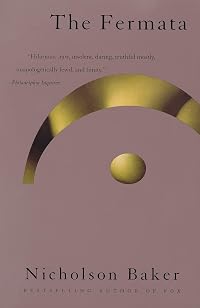
The Fermata
by Nicholson Baker
On This Page
Description
Having turned phone sex into the subject of an astonishing national bestseller in Vox, Baker now outdoes himself with an outrageously arousing, acrobatically stylish "X-rated sci-fi fantasy that leaves Vox seeming more like mere fiber-optic foreplay" (Seattle Times). "Sparkling."--San Francisco Chronicle.Tags
Recommendations

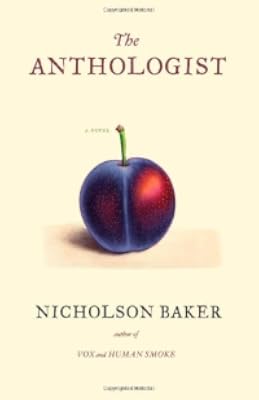
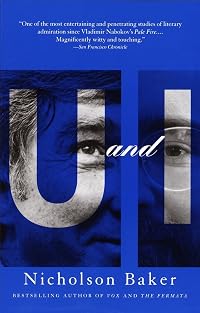
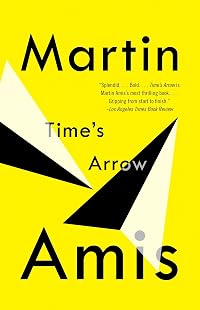
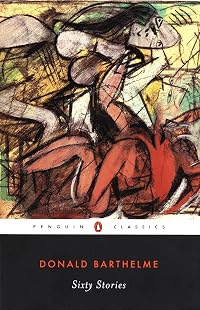





Member Recommendations

anonymous user Timeparadox described
chellerystick I feel The Fermata was as much about the manipulation of the women as about the manipulation of time, which maybe was the point but was not exactly a relaxing read. On the other hand, The Time Traveler's Wife was more of a love story.
Member Reviews
http://culturalsnow.blogspot.com/2008/12/naked-truth.html
I've been reading The Fermata, by Nicholson Baker. I think I've read most of Baker's fiction over the years, but for some reason this had slid between the cracks; a phrase that seems fairly appropriate because Baker has two obsessions - sex and language. "Between the cracks" would probably send him off on a twelve-page discursion about metaphor, cliché and some woman whose bum he accidentally groped, or thought about accidentally groping, in a Dairy Queen on the outskirts of Baltimore in 1979. Perhaps with footnotes.
The Fermata is the peculiar tale of Arno Strine, who discovers a talent for stopping time. (Those of you who've seen Heroes will know what I mean, and will also have show more further evidence as to how startlingly unoriginal - yet strangely enjoyable - this mash-up of The X Files and The Tomorrow People really is.) Strine uses his gift for two purposes: to get his work done in apparently superfast time (he's a temp typist); and to look at women's bodies.
This makes Strine sound like a pervert, and he is, but (by his own perception) a fundamentally decent, thoughtful pervert. He does actually like women, and would be mortified if anything he did upset them. He looks at their bodies; touches them; even masturbates in their presence; but then ensures that everything is returned to normal when time restarts, so that they never feel violated. Sometimes he seems to overstep his self-defined mark, mysteriously introducing sex toys into the lives of strangers, but his motive is always to bring happiness. Sick he may be, Patrick Bateman he ain't.
Baker adds to the moral confusion by having Strine write pornography, which is offered to us in the course of the narrative. We're distanced from it (it's fiction within a fiction) and Strine's motivation is supposedly honourable; he offers it to the women he sees, to excite them, to bring him joy, although he also masturbates while writing it. But it's definitely porn, not erotica (don't ask me what the difference is, it just is) and can be read as such. Should a reader appreciate Baker's gift for aping the tropes of Hustler and Penthouse? Or enjoy a discreet hand shandy of his/her own? (Incidentally, Mary Gaitskill in the back-cover blurb describes The Fermata as "Rabelaisian" which is one of those glorious critical references that's taken on a life of its own; people who've never read a comma of Rabelais know what he's like because of all the other writers who've been described as Rabelaisian; essentially, people who write about morally suspect things with such joy that you can't hold it against them. There's a similar phenomenon in rock journalism; everything the Stooges and Captain Beefheart ever recorded could be permanently wiped, and their reputations would be unaffected. But we're veering into Baudrillard territory there, and I did promise you a holiday from that.)
The crucial thread throughout the story is that Strine keeps his gift a secret, so none of his 'victims' (and I debated long and hard - ooh, there he goes again - about whether or not to use those quotation marks) know they've been spied on, undressed, fondled. Which, of course, raises all manner of questions about supposedly victimless crimes. If you never know that a man across the road is watching you undress through the curtains, is there a problem? If I don't know that the CIA is reading my e-mails, is there a problem? Because his gift is so bizarre, Strine can only discuss it with his acquaintances as a hypothesis, a parlour game, a piece of conversational fantasy; I know it's crazy, but what would you do if you could stop time? Even in its theoretical state, they tend to be repulsed by the potential invasion of privacy, so he keeps the secret from everyone but the reader until the end of the narrative. And when he does genuinely attempt to persuade someone that it's true, there are unexpected consequences.
The only thing that Baker doesn't address is the notion that maybe everybody has these powers. Since nobody knows when Strine stops time, how would Strine know when someone else stopped time and undressed him? And stepping back a little into the realm that we desperately call 'reality', Baker has constructed a fictional possibility. How would it be if everyone in the world knew that possibility wasn't a fiction; except for Baker? He's merrily playing with the creative possibilities of time, unaware that everyone else in the world is groping his bum. show less
I've been reading The Fermata, by Nicholson Baker. I think I've read most of Baker's fiction over the years, but for some reason this had slid between the cracks; a phrase that seems fairly appropriate because Baker has two obsessions - sex and language. "Between the cracks" would probably send him off on a twelve-page discursion about metaphor, cliché and some woman whose bum he accidentally groped, or thought about accidentally groping, in a Dairy Queen on the outskirts of Baltimore in 1979. Perhaps with footnotes.
The Fermata is the peculiar tale of Arno Strine, who discovers a talent for stopping time. (Those of you who've seen Heroes will know what I mean, and will also have show more further evidence as to how startlingly unoriginal - yet strangely enjoyable - this mash-up of The X Files and The Tomorrow People really is.) Strine uses his gift for two purposes: to get his work done in apparently superfast time (he's a temp typist); and to look at women's bodies.
This makes Strine sound like a pervert, and he is, but (by his own perception) a fundamentally decent, thoughtful pervert. He does actually like women, and would be mortified if anything he did upset them. He looks at their bodies; touches them; even masturbates in their presence; but then ensures that everything is returned to normal when time restarts, so that they never feel violated. Sometimes he seems to overstep his self-defined mark, mysteriously introducing sex toys into the lives of strangers, but his motive is always to bring happiness. Sick he may be, Patrick Bateman he ain't.
Baker adds to the moral confusion by having Strine write pornography, which is offered to us in the course of the narrative. We're distanced from it (it's fiction within a fiction) and Strine's motivation is supposedly honourable; he offers it to the women he sees, to excite them, to bring him joy, although he also masturbates while writing it. But it's definitely porn, not erotica (don't ask me what the difference is, it just is) and can be read as such. Should a reader appreciate Baker's gift for aping the tropes of Hustler and Penthouse? Or enjoy a discreet hand shandy of his/her own? (Incidentally, Mary Gaitskill in the back-cover blurb describes The Fermata as "Rabelaisian" which is one of those glorious critical references that's taken on a life of its own; people who've never read a comma of Rabelais know what he's like because of all the other writers who've been described as Rabelaisian; essentially, people who write about morally suspect things with such joy that you can't hold it against them. There's a similar phenomenon in rock journalism; everything the Stooges and Captain Beefheart ever recorded could be permanently wiped, and their reputations would be unaffected. But we're veering into Baudrillard territory there, and I did promise you a holiday from that.)
The crucial thread throughout the story is that Strine keeps his gift a secret, so none of his 'victims' (and I debated long and hard - ooh, there he goes again - about whether or not to use those quotation marks) know they've been spied on, undressed, fondled. Which, of course, raises all manner of questions about supposedly victimless crimes. If you never know that a man across the road is watching you undress through the curtains, is there a problem? If I don't know that the CIA is reading my e-mails, is there a problem? Because his gift is so bizarre, Strine can only discuss it with his acquaintances as a hypothesis, a parlour game, a piece of conversational fantasy; I know it's crazy, but what would you do if you could stop time? Even in its theoretical state, they tend to be repulsed by the potential invasion of privacy, so he keeps the secret from everyone but the reader until the end of the narrative. And when he does genuinely attempt to persuade someone that it's true, there are unexpected consequences.
The only thing that Baker doesn't address is the notion that maybe everybody has these powers. Since nobody knows when Strine stops time, how would Strine know when someone else stopped time and undressed him? And stepping back a little into the realm that we desperately call 'reality', Baker has constructed a fictional possibility. How would it be if everyone in the world knew that possibility wasn't a fiction; except for Baker? He's merrily playing with the creative possibilities of time, unaware that everyone else in the world is groping his bum. show less
What would you do if you could pause time on a whim, freezing everyone and everything, while you wander around, without anyone seeing or hearing anything? What a fab premise for a story.
Image: Frozen time (Source.)
Cher famously sang that If I Could Turn Back Time, she’d strive to change and so win back her lover.
In Groundhog Day, another rewinding scenario, weatherman Phil (who wakes to Cher (and Sonny) singing “I Got You Babe” each morning), tries various silly, selfish, funny, and dangerous things, before turning to good deeds and new skills (play the piano, speak Italian, sculpt ice) to earn the affections of Rita.
I asked a group of friends the opening question about pausing time. Their answers included:
• Crime-fighting show more superhero;
• Rob banks;
• (A third person said the first two options are not mutually exclusive)
• Switch people's hats;
• Get more work done;
• Stealer of unsecured trifles;
• Stare at people's faces longer than is socially acceptable;
• Get perfect composition, light, and focus for photography (which is itself a way of freezing time);
• Go to Africa and steal all the poachers’ ammunition;
• Work through a political hit list;
• Think of a great comeback or make minor adjustments, for good or evil;
• Get Trump’s tax returns to NYT and WashPo;
• Take selfies with celebs;
• Jump queues;
• Swap neighbours' mail so they have to meet/talk to each other;
• Try on clothes without needing the dressing room;
• Put the roulette ball on their number;
• Tie people's shoelaces together - but not prevent unrelated accidents, as “that would be playing God” (huh?).
None of my friends suggested checking up on a partner, prying into personal stuff of family, friends, enemies, colleagues, or celebrities, nor cheating in quizzes or tests. Nothing sexual, either, though I expect some thought of it, and then thought better of it. One did suggest debagging (pulling down the trousers) of an obnoxious colleague, but that was for revenge, rather than titillation.
My favourite was: “Squish everyone’s faces into smiles, on the underground / subway. When time re-started they’d all be smiling at each other.”
If only this book had a dash of such creativity, humour, and compassion. Even the political hit list is arguably better than what unfolds.
Why DNF? (= Did Not Finish)
This is supposedly comical literary erotica. It also has Baker’s trademark, almost pathological, attention to tiny details of movement, touch, and texture. (See my review of The Mezzanine, HERE.)
Arno Strine doesn’t want to use his power for riches, revenge, love, nor even sex, and has no aspirations to do good. He flicks into what he calls the Fermata or Fold to undress women with more than his eyes, and touch them intimately. Yes, you read that right - or maybe I should say wrong. Very wrong. He figures that as they don’t know, there’s no harm in it.
I kept going for a third of it (95 pages - hence no rating), in the hope of finding the promised humour or eroticism, or just to see Arno develop as a character. Also, I had been told there was a twist, and I’ve enjoyed other books by Baker, including the very sexual Vox (see my review HERE). I’m not a prude. I understand the temptation to use such an ability for smutty ends, but to do it so invasively, for more than twenty years, without any real reflection, let alone remorse… Nope.
I hope karma eventually whacks Arno like a ten ton truck, but I don’t want to continue reading. Yes, it was published a generation ago, before #MeToo, and yes, Arno occasionally has a few thoughts about boundaries, but it’s just too horrid and repetitive. Even when he puts sex toys in unexpected places it’s more creepy than funny.
Consent
Consent should be freely given, unambiguous, keen, and continuous.
Maybe Arno eventually learns that, but in case he doesn’t, may I offer you a cup of tea?
My effort and expectations, the quality of my tea and crockery, and your past enjoyment of tea are no guarantee you want a cup with me right now - even if you warmly accepted my invitation. If I want tea and you don’t, I can always have some by myself later - as could you if I withdraw my invitation.
Image: “But you wanted tea last night” (Source, Buzzfeed article.)
Animation of the cup of tea analogy, 2.5 minutes, HERE.
It’s a bit simplistic: in particular, it ignores cultural expectations and other unequal power dynamics that might make someone say they consent, when they don’t really. Nevertheless, it’s a useful starting point to explore the subject.
Film adaptation?!
I was amazed to see that imdb lists a 2015 film, with a cast of four and running time of 66 minutes. However, there are no release details, nor a single rating. Maybe it never happened. A film in the 1990s (the book was published in 1994), perhaps, but in the twenty-teens? Surely not. I hope not.
What would I do?
If I could pause time, I’d regain what I wasted on this and use it to read something better. Then I’d squish some faces, switch some hats, and restart time. (I’m not going to admit to anything else here!) show less
Image: Frozen time (Source.)
Cher famously sang that If I Could Turn Back Time, she’d strive to change and so win back her lover.
In Groundhog Day, another rewinding scenario, weatherman Phil (who wakes to Cher (and Sonny) singing “I Got You Babe” each morning), tries various silly, selfish, funny, and dangerous things, before turning to good deeds and new skills (play the piano, speak Italian, sculpt ice) to earn the affections of Rita.
I asked a group of friends the opening question about pausing time. Their answers included:
• Crime-fighting show more superhero;
• Rob banks;
• (A third person said the first two options are not mutually exclusive)
• Switch people's hats;
• Get more work done;
• Stealer of unsecured trifles;
• Stare at people's faces longer than is socially acceptable;
• Get perfect composition, light, and focus for photography (which is itself a way of freezing time);
• Go to Africa and steal all the poachers’ ammunition;
• Work through a political hit list;
• Think of a great comeback or make minor adjustments, for good or evil;
• Get Trump’s tax returns to NYT and WashPo;
• Take selfies with celebs;
• Jump queues;
• Swap neighbours' mail so they have to meet/talk to each other;
• Try on clothes without needing the dressing room;
• Put the roulette ball on their number;
• Tie people's shoelaces together - but not prevent unrelated accidents, as “that would be playing God” (huh?).
None of my friends suggested checking up on a partner, prying into personal stuff of family, friends, enemies, colleagues, or celebrities, nor cheating in quizzes or tests. Nothing sexual, either, though I expect some thought of it, and then thought better of it. One did suggest debagging (pulling down the trousers) of an obnoxious colleague, but that was for revenge, rather than titillation.
My favourite was: “Squish everyone’s faces into smiles, on the underground / subway. When time re-started they’d all be smiling at each other.”
If only this book had a dash of such creativity, humour, and compassion. Even the political hit list is arguably better than what unfolds.
Why DNF? (= Did Not Finish)
This is supposedly comical literary erotica. It also has Baker’s trademark, almost pathological, attention to tiny details of movement, touch, and texture. (See my review of The Mezzanine, HERE.)
Arno Strine doesn’t want to use his power for riches, revenge, love, nor even sex, and has no aspirations to do good. He flicks into what he calls the Fermata or Fold to undress women with more than his eyes, and touch them intimately. Yes, you read that right - or maybe I should say wrong. Very wrong. He figures that as they don’t know, there’s no harm in it.
I kept going for a third of it (95 pages - hence no rating), in the hope of finding the promised humour or eroticism, or just to see Arno develop as a character. Also, I had been told there was a twist, and I’ve enjoyed other books by Baker, including the very sexual Vox (see my review HERE). I’m not a prude. I understand the temptation to use such an ability for smutty ends, but to do it so invasively, for more than twenty years, without any real reflection, let alone remorse… Nope.
I hope karma eventually whacks Arno like a ten ton truck, but I don’t want to continue reading. Yes, it was published a generation ago, before #MeToo, and yes, Arno occasionally has a few thoughts about boundaries, but it’s just too horrid and repetitive. Even when he puts sex toys in unexpected places it’s more creepy than funny.
Consent
Consent should be freely given, unambiguous, keen, and continuous.
Maybe Arno eventually learns that, but in case he doesn’t, may I offer you a cup of tea?
My effort and expectations, the quality of my tea and crockery, and your past enjoyment of tea are no guarantee you want a cup with me right now - even if you warmly accepted my invitation. If I want tea and you don’t, I can always have some by myself later - as could you if I withdraw my invitation.
Image: “But you wanted tea last night” (Source, Buzzfeed article.)
Animation of the cup of tea analogy, 2.5 minutes, HERE.
It’s a bit simplistic: in particular, it ignores cultural expectations and other unequal power dynamics that might make someone say they consent, when they don’t really. Nevertheless, it’s a useful starting point to explore the subject.
Film adaptation?!
I was amazed to see that imdb lists a 2015 film, with a cast of four and running time of 66 minutes. However, there are no release details, nor a single rating. Maybe it never happened. A film in the 1990s (the book was published in 1994), perhaps, but in the twenty-teens? Surely not. I hope not.
What would I do?
If I could pause time, I’d regain what I wasted on this and use it to read something better. Then I’d squish some faces, switch some hats, and restart time. (I’m not going to admit to anything else here!) show less
this is a damn, dirty book. but in spite of it's pornograpic content, it maintains a kind of innocence which makes it somewhat literary and definitely nerdtastic -- the main character has the ability to stop time to play with unwitting women and does so in inventive and strange ways. what i found very interesting is that although the book is very male-oriented in its descriptive manner, lots of women i know who have read it have found it equally tantalizing, if not more so. (one girl told me: "ah, the Fermata. clitty hardons on the bus." the best word for this book is: juicy.
What would you do if you had the ability to stop time in a way that still allowed you—and only you—to move around at will? Some of us would think of how to change history in an attempt to make the world a better place, while others would be content to increase their own wealth in “real time” (e.g., steal, alter the outcome of gambling or sporting events) or take the opportunity to exact revenge on enemies and former lovers. However, to the extent that any of us actually do day-dream about such things, I suspect that we dwell on ultimate outcomes and not on the myriad details involved in exercising that power.
Arno Strine, the protagonist of Nicholson Baker’s The Fermata, has this time-stopping ability, but he also has extremely show more modest ambitions when it comes to using that gift. Instead of acquiring financial riches, Arno is content to simply remove the clothes of women—both those he knows and total strangers—and look at their naked bodies. Although a pathological voyeur, Arno does have a rigid set of ethics that keeps him from committing more severe violations when he has “Dropped” into the Fermata, as he calls it. He gradually increases the extent of his intrusions, setting up elaborate schemes to find a soul-mate that he hopes will come to fruition when he turns real time back on. By the end of the novel, Arno finds that one of these schemes does come true, but with surprising and unanticipated results.
I had a decidedly mixed reaction to this book. On one hand, Baker delivers a richly (and minutely) imagined alternative reality. If nothing else, the author has clearly thought very deeply about what Dropping would really be like and many of his detailed observations are fascinating and occasionally very funny. Additionally, Baker does not shy away from the obvious moral ramifications of the story he tells; Arno is conflicted about the effect that his abilities has on others and, when not in self-denial, he adheres to a complex set of behavioral standards. Conversely, there are two extended sections in the novel that can only be described as pure pornography (think of some of the better-written Penthouse Letters submissions you might have read). The problem with these passages is not the subject matter per se (although the scatological nature of them was unexpected and off-putting), but the fact that they are gratuitous and completely unnecessary to the main plot line.
So, how do you rate a book like this? Do you give it four stars for its creativity and imagination or just two stars for its excessively prurient character? For me, splitting the difference seemed to be about right. show less
Arno Strine, the protagonist of Nicholson Baker’s The Fermata, has this time-stopping ability, but he also has extremely show more modest ambitions when it comes to using that gift. Instead of acquiring financial riches, Arno is content to simply remove the clothes of women—both those he knows and total strangers—and look at their naked bodies. Although a pathological voyeur, Arno does have a rigid set of ethics that keeps him from committing more severe violations when he has “Dropped” into the Fermata, as he calls it. He gradually increases the extent of his intrusions, setting up elaborate schemes to find a soul-mate that he hopes will come to fruition when he turns real time back on. By the end of the novel, Arno finds that one of these schemes does come true, but with surprising and unanticipated results.
I had a decidedly mixed reaction to this book. On one hand, Baker delivers a richly (and minutely) imagined alternative reality. If nothing else, the author has clearly thought very deeply about what Dropping would really be like and many of his detailed observations are fascinating and occasionally very funny. Additionally, Baker does not shy away from the obvious moral ramifications of the story he tells; Arno is conflicted about the effect that his abilities has on others and, when not in self-denial, he adheres to a complex set of behavioral standards. Conversely, there are two extended sections in the novel that can only be described as pure pornography (think of some of the better-written Penthouse Letters submissions you might have read). The problem with these passages is not the subject matter per se (although the scatological nature of them was unexpected and off-putting), but the fact that they are gratuitous and completely unnecessary to the main plot line.
So, how do you rate a book like this? Do you give it four stars for its creativity and imagination or just two stars for its excessively prurient character? For me, splitting the difference seemed to be about right. show less
I got this book because I read Baker's non-fiction book, "Double Fold" in library school, and thought it was very interesting and well-written. 'The Fermata' is quite different! Basically, it's porn. But not porn that I found appealing. It's written in the form of a memoir of a seemingly ordinary man who works as a temp transcriptionist - who has the ability to stop time. Rather than using this power to do any of the obvious possibilities (heists, assassinations, blackmail(?)), he uses his time in 'the fermata' pretty much exclusively to molest women. Morally, he tries to justify himself by saying that he's not hurting anyone - the women are totally unaware about what's been done to their frozen, unresponsive bodies, so what's the show more problem? The character has an ex-girlfriend, who broke up with him because she was disturbed and repelled by what she believed were his fantasies regarding these actions - and I'm totally with her: the exciting thing about sex is the seduction, the interaction. Molesting mannequin-like, unmoving bodies is thoroughly unexciting. Later in the book, when the narrator decides to try his hand at writing erotica (and placing it for women to read), the stories presented as his writing aren't terribly my cup of tea, either. This is undeniably a well-done book, but it is just meant to appeal to people with different fantasies than mine. show less
A novel like The Fermata asks some important questions, most important of which is of course: "Does writing literary prose mean your novel about a guy stopping time to perv about is anything other than porn?" And it's a very good question too, one I haven't yet been able to fully answer. On the one hand there's a lot more to Baker's novel than a simple sex story. His protagonist is complex, troubled and off-kilter although he feels himself a paragon of normality in a world that simply does not and would not understand him. And yet there seems to be a definite "let's see how much porn I can write before someone catches on." And when I say porn, I don't mean the sultry covert eroticism sometimes present in novels, but stories in stories show more about women bouncing to orgasm with dildoes in every hole in the back of UPS trucks. Anyway, this is a story about a dysfunctional human being and as such it fascinates, porn or no porn. I just wish it would decide which way to go: smut story or novel. show less
Baker's The Fermata tiptoes the line between pornography and, well, a very literary work. That it becomes both genres very well is testament to its quality and the uniqueness of its message.
And that message, put simply, concerns a man who has the ability to stop time. Whether through the snap of his fingers, or the use of a washing machine, he is able to control time and to do as he so wishes therein. As he (named Arno) points out early on, he is aware that he could, if he wished, use this power to snoop on government secrets, or even to better the world. Yet he opts for the voyeuristic act of undressing women. Women that he loves (and he admits that he falls in love easily and frequently).
This is an uncomfortable book; it shouldn't show more not be, as throughout it Baker -as I said- tiptoes that line between aesthetics and straight obscenity. Some reviews that I have read, however, berate him unfairly; they say that this is simply pornography (!), or that it is ridiculous that Arno does not choose to save the world with his spectacular temporal powers.
That he does not save the world, however, is the most interesting thing about The Fermata.
Arno, like other of Baker's characters, is both thoughtful and mediocre; he is a product of the modern world, of the reproduction of capital and cafes, noodle restaurants and law firms. His wry, carefully modulated narration is a retrospective on the world, and Arno really believes that he acts in an ethical manner. He claims to love women. Yet he also degrades them. Arno is pathetic and considerate, he is dangerous an he is pleasant. We wonder how normal he really is. We never really receive an answer to where this ability to stop time comes from, but that isn't really ever a flaw to the work.
Baker has written a study in obsession, an essay on the realisation of desire. Set against the backdrop of that same, capital driven world (the world where we are told that mere money will grant us whatever we so wish!), Arno's pleasure seems actually quite banal and ridiculous. He is the logical extension of Modern Man. He has embodied, literally, the power to control the world through a simple, exchangeable currency -the power to halt time.
Within Baker's novel are two interpolated texts. These are two works of 'straight' pornography written by Arno in order to gift to other readers. He delights in watching them read his smutty works.
This device, of the text within the text, is old as Cervante's Don Quixote, isn't it? And there, Cervantes lovingly reproduces and satires the Romance novel. Baker, too, is lovingly reproducing and satirising the pornographic novel.
The device is even more intriguing when we realise what the text within the text does. Arno writes one such work and buries it in the sand next to a beach sun bather. The bather finds it in the sand and reads. Arno watches, becoming more excited as he studies her reaction. I found this moment to be the most powerful in the text, as the very next chapter features that interpolated text itself; we, the reader, replace the bathing woman, reading the text, and our knowledge that Arno watches her makes us aware that he is actually watching us. We become the subject of the author, the repository of his sexual fantasies and expectations. Reading, external subject becomes reading, internal object. And so, as we read the text, we study our own reactions to it.
Baker's (or Arno's) The Fermata is a study in fantasy and, importantly, it is a study of the fantasising subject. Those readers who dismiss Baker for smuttiness are not really dismissing the book at all -they are actually playing to it. They are the bather who rejects the book with a disgusted look. If we like the book, we play a role in Baker's game, and we open up the idea of fantasy and repression that is central to his poetic world.
As a novelist, Baker is extreme and brilliant at drawing the reader into that world.
There are problems with the text; perhaps it is a bit clunky at times, or even repetitive, yet the overall impression of discomfort and fantasy is especially interesting and powerful. Baker doesn't want us to say, "oh, pornography is equal to the best of literature", but he does want us to have a meaningful reaction to it. show less
And that message, put simply, concerns a man who has the ability to stop time. Whether through the snap of his fingers, or the use of a washing machine, he is able to control time and to do as he so wishes therein. As he (named Arno) points out early on, he is aware that he could, if he wished, use this power to snoop on government secrets, or even to better the world. Yet he opts for the voyeuristic act of undressing women. Women that he loves (and he admits that he falls in love easily and frequently).
This is an uncomfortable book; it shouldn't show more not be, as throughout it Baker -as I said- tiptoes that line between aesthetics and straight obscenity. Some reviews that I have read, however, berate him unfairly; they say that this is simply pornography (!), or that it is ridiculous that Arno does not choose to save the world with his spectacular temporal powers.
That he does not save the world, however, is the most interesting thing about The Fermata.
Arno, like other of Baker's characters, is both thoughtful and mediocre; he is a product of the modern world, of the reproduction of capital and cafes, noodle restaurants and law firms. His wry, carefully modulated narration is a retrospective on the world, and Arno really believes that he acts in an ethical manner. He claims to love women. Yet he also degrades them. Arno is pathetic and considerate, he is dangerous an he is pleasant. We wonder how normal he really is. We never really receive an answer to where this ability to stop time comes from, but that isn't really ever a flaw to the work.
Baker has written a study in obsession, an essay on the realisation of desire. Set against the backdrop of that same, capital driven world (the world where we are told that mere money will grant us whatever we so wish!), Arno's pleasure seems actually quite banal and ridiculous. He is the logical extension of Modern Man. He has embodied, literally, the power to control the world through a simple, exchangeable currency -the power to halt time.
Within Baker's novel are two interpolated texts. These are two works of 'straight' pornography written by Arno in order to gift to other readers. He delights in watching them read his smutty works.
This device, of the text within the text, is old as Cervante's Don Quixote, isn't it? And there, Cervantes lovingly reproduces and satires the Romance novel. Baker, too, is lovingly reproducing and satirising the pornographic novel.
The device is even more intriguing when we realise what the text within the text does. Arno writes one such work and buries it in the sand next to a beach sun bather. The bather finds it in the sand and reads. Arno watches, becoming more excited as he studies her reaction. I found this moment to be the most powerful in the text, as the very next chapter features that interpolated text itself; we, the reader, replace the bathing woman, reading the text, and our knowledge that Arno watches her makes us aware that he is actually watching us. We become the subject of the author, the repository of his sexual fantasies and expectations. Reading, external subject becomes reading, internal object. And so, as we read the text, we study our own reactions to it.
Baker's (or Arno's) The Fermata is a study in fantasy and, importantly, it is a study of the fantasising subject. Those readers who dismiss Baker for smuttiness are not really dismissing the book at all -they are actually playing to it. They are the bather who rejects the book with a disgusted look. If we like the book, we play a role in Baker's game, and we open up the idea of fantasy and repression that is central to his poetic world.
As a novelist, Baker is extreme and brilliant at drawing the reader into that world.
There are problems with the text; perhaps it is a bit clunky at times, or even repetitive, yet the overall impression of discomfort and fantasy is especially interesting and powerful. Baker doesn't want us to say, "oh, pornography is equal to the best of literature", but he does want us to have a meaningful reaction to it. show less
Members
- Recently Added By
Published Reviews
ThingScore 25
The Fermata is not concerned with human dignity, or even the loss of it [...] this unsettling concoction of gentle observation and moral indifference is served, politely, over and over again to the reader.
By literally objectifying women, he courts contemporary disapproval, but he is also partaking of a centuries-long tradition of serious writers trying their hand at a stroker [...] The Fermata show more is not really about Arno Strine. It’s a long, dreary, dirty note scrawled in the margins of Nicholson Baker’s work. show less
By literally objectifying women, he courts contemporary disapproval, but he is also partaking of a centuries-long tradition of serious writers trying their hand at a stroker [...] The Fermata show more is not really about Arno Strine. It’s a long, dreary, dirty note scrawled in the margins of Nicholson Baker’s work. show less
added by Widsith
Lists

Read These Too
458 works; 9 members
Author Information

30+ Works 14,350 Members
Nicholson Baker lives in Maine. Nicholson Baker was born in New York City on January 7, 1957. He briefly attended the Eastman School of Music before receiving a B.A. in philosophy from Haverford College. He is the author of both fiction and nonfiction works including The Mezzanine (1988); Room Temperature (1990); Vox (1992); The Fermata (1994); show more The Everlasting Story of Nory (1998); Checkpoint (2004); and The Anthologist (2009). His nonfiction work, Double Fold: Libraries and the Assault on Paper, won a National Book Critics Circle Award in 2001. (Bowker Author Biography) show less
Series
Belongs to Publisher Series
Common Knowledge
- Canonical title
- The Fermata
- Original title
- Fermata
- Original publication date
- 1994
- People/Characters
- Arno Strine
- Important places
- Boston, Massachusetts, USA
- Dedication
- FOR MY FATHER
- First words
- I am going to call my autobiography The Fermata, even though "fermata" is only one of the many names I have for the Fold.
- Quotations
- Now drive - oh fuck, just drive the fucking truck.
- Last words
- (Click to show. Warning: May contain spoilers.)The Fermata, my Fermata, the keeper of all my secrets, will be a secret no longer.
Classifications
Statistics
- Members
- 1,692
- Popularity
- 13,183
- Reviews
- 34
- Rating
- (3.51)
- Languages
- 9 — Czech, Danish, Dutch, English, French, German, Italian, Spanish, Portuguese (Portugal)
- Media
- Paper, Audiobook, Ebook
- ISBNs
- 32
- ASINs
- 10