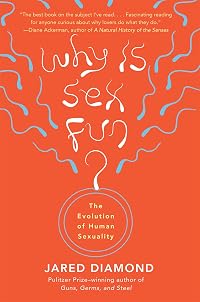
Why Is Sex Fun?: The Evolution of Human Sexuality
by Jared Diamond
On This Page
Description
To us humans the sex lives of many animals seem weird. In fact, by comparison with all the other animals, we are the ones with the weird sex lives. How did that come to be? Just count our bizarre ways. We are the only social species to insist on carrying out sex privately. Stranger yet, we have sex at any time, even when the female can't be fertilized (for example, because she is already pregnant, post-menopausal, or between fertile cycles). A human female doesn't know her precise time of show more fertility and certainly doesn't advertise it to human males by the striking color changes, smells, and sounds used by other female mammals. Why do we differ so radically in these and other important aspects of our sexuality from our closest ancestor, the apes? Why does the human female, virtually alone among mammals go through menopause? Why does the human male stand out as one of the few mammals to stay (often or usually) with the female he impregnates, to help raise the children that he sired? Why is the human penis so unnecessarily large? There is no one better qualified than Jared Diamond-renowned expert in the fields of physiology and evolutionary biology and award-winning author-to explain the evolutionary forces that operated on our ancestors to make us sexually different. With wit and a wealth of fascinating examples, he explains how our sexuality has been as crucial as our large brains and upright posture in our rise to human status. show lessTags
Recommendations







Member Reviews
FINALLY! THE ANSWER TO THE QUESTION EVERYONE'S BEEN ASKING!
And the answer is... we don't know. That's also the answer to a lot of related sexual questions from menopause to penis size. Humans are outliers and we don't really have any definitive answers. What we do get however is a hell of a lot of speculation. Now some of this is based solidly in research science, such as the glamorous collecting of monkey piss to try and analyze which monkey is in estrus and when. The remainder is unfortunately a lot of "just so" storytelling, using evolutionary theories and sexual selection and a dash of social science findings to create plausible scienc-y sounding narratives for why humans are an outlier. Diamond's books often stumble as they try to show more answer the big questions on this very same step. One illustration of the problem with this is exemplified in the book as he describes two competing theories for why human females have "hidden" fertile periods and not a gigantic glowing ass. One theory says this is to create defensive monogamous relationships, the other says it's creating a society where everyone's sleeping around which protects women and children as any male could possibly have fathered the kids. Diamond tries to synthesize the view by saying it's a bit of one and a bit of the other. The only real hard science here is a comparative view of other primates and their evolutionary strategies.
It's not so much the evolution of human sexuality as it is "some plausible sounding evolutionary explanatory models that might explain" human sexuality. How satisfying that ends up being depends a bit on what you went into the book wanting and how much you like asking "how do you actually know that". show less
And the answer is... we don't know. That's also the answer to a lot of related sexual questions from menopause to penis size. Humans are outliers and we don't really have any definitive answers. What we do get however is a hell of a lot of speculation. Now some of this is based solidly in research science, such as the glamorous collecting of monkey piss to try and analyze which monkey is in estrus and when. The remainder is unfortunately a lot of "just so" storytelling, using evolutionary theories and sexual selection and a dash of social science findings to create plausible scienc-y sounding narratives for why humans are an outlier. Diamond's books often stumble as they try to show more answer the big questions on this very same step. One illustration of the problem with this is exemplified in the book as he describes two competing theories for why human females have "hidden" fertile periods and not a gigantic glowing ass. One theory says this is to create defensive monogamous relationships, the other says it's creating a society where everyone's sleeping around which protects women and children as any male could possibly have fathered the kids. Diamond tries to synthesize the view by saying it's a bit of one and a bit of the other. The only real hard science here is a comparative view of other primates and their evolutionary strategies.
It's not so much the evolution of human sexuality as it is "some plausible sounding evolutionary explanatory models that might explain" human sexuality. How satisfying that ends up being depends a bit on what you went into the book wanting and how much you like asking "how do you actually know that". show less
As Jared Diamond notes here, sex is more than about gratification. It is, above all, an oddity with considerable repercussions upon who we are -physiologically, and socially.
There's a lot to explain indeed! Why does it exist in the first place (e.g. why don't we clone each other)? Why women, when they are ovulating, are not parading around in heat as is common among many other species? What about paternity? Why are men not breastfeeding their progenies? Why is menopause only affecting women? Why puberty? Why sex for pleasure too, and not for reproduction purpose only? And on. And on. And on... Including, even, penis size!
We can be surprised by the absence of some topics (homosexuality, incest), but, basic, it's because this book just show more purports to be an introduction. The author presents the big hypotheses without going into details (he merely compares us to other species), which makes for an excellent starting point for the curious. For those wanting to delve further, there is, in fact, a short yet straightforward and relevant bibliography...
It's engrossing, funny, accessible... In a word: fascinating! show less
There's a lot to explain indeed! Why does it exist in the first place (e.g. why don't we clone each other)? Why women, when they are ovulating, are not parading around in heat as is common among many other species? What about paternity? Why are men not breastfeeding their progenies? Why is menopause only affecting women? Why puberty? Why sex for pleasure too, and not for reproduction purpose only? And on. And on. And on... Including, even, penis size!
We can be surprised by the absence of some topics (homosexuality, incest), but, basic, it's because this book just show more purports to be an introduction. The author presents the big hypotheses without going into details (he merely compares us to other species), which makes for an excellent starting point for the curious. For those wanting to delve further, there is, in fact, a short yet straightforward and relevant bibliography...
It's engrossing, funny, accessible... In a word: fascinating! show less
Much of what we take for granted about human sexuality - sort of monogamous, co-parenting, menopause, non-procreative sex - is downright weird by the standards of the rest of the animal kingdom. This book tries to look at why and how these practices evolved.
It's an interesting how others might see us account. The book dates from 1997 and it particularly shows when talking about sex that cannot result in procreation such as during pregnancy etc., without any mention of homosexuality in our and other species.
It's an interesting how others might see us account. The book dates from 1997 and it particularly shows when talking about sex that cannot result in procreation such as during pregnancy etc., without any mention of homosexuality in our and other species.
I have read a number of Jared Diamond’s books and am a great fan. After reading this book I felt like the title was chosen by someone in his publisher’s marketing department. Mr. Diamond was probably chagrined by it. He’s a scientist, and he spends a lot of time discussing animal behavior and speculating about how the distinctive features of human sexuality evolved. There’s not much talk about why it’s so fun.
The basic points he discusses are: 1. Males and females have different investments in reproduction and that determines their behavior—males take a few seconds to discharge semen while females have 9 months of pregnancy and years of lactation; 2. Males could breast-feed but that didn’t evolve because of that low show more investment, 3. Female humans conceal their ovulation for two reasons, originally to hide who the father was (new dominant males kill the offspring that aren’t theirs) then later to keep the man around to help raise children, 4. What are men good for? He struggles to find a good reason (see below), 5. Why does human menopause exist? Many other female animals are fertile in old age, and 6. Evolution of sexual body signals—breasts and big hips in women, and in men, penis size. A seventh point that he discussed in the first chapter, that humans have sex in private unlike almost all other animals, didn’t get an explanation.
I thought male sexual body signals were facial hair and low voice—not penis size. Mr. Diamond suggests that the penis has evolved as a sexual signal, like the peacock’s tail, a body part that is longer than necessary to advertise genetic strength and health. “The length of the erect penis is only about 1¼ inches in gorillas and 1½ inches in orangutans but 5 inches in humans, even though males of the two apes have much bigger bodies than men.” Why? Could it be all the positions humans have sex in? “[T]he 1½ inch penis of the male orangutan permits it to perform in a variety of positions that rival ours, and to outperform us by executing all those positions while hanging from a tree. As for the possible utility of a large penis in sustaining prolonged intercourse, orangutans top us in that regard too (mean duration fifteen minutes, versus a mere four minutes for the average American man.)” Ouch.
Then he describes what the penis would look like if men designed it, using the phallocarp of New Guinea men as an example—a penis sheath up to two feet long, four inches in diameter, brightly colored, and erect (google it!). They say they feel naked without it, even though, other than the sheath, they are completely naked.
The discussion of the importance of men was surprising. I always assumed that the male role in hunter-gatherer societies was obvious: the men hunted. A female anthropologist, Kristen Hawkes of the University of Utah, decided to test this assumption. She had people test the caloric yields of the men’s hunting catches and the women’s foraging yield in tribes in Paraguay and Tanzania.
In the Northern Ache people of Paraguay, the men hunted large animals such as peccaries and deer, and collected honey. The women pounded starch from palm trees and gathered fruits and insect larvae (in addition to caring for children). On average the man brought home nothing 25% of the time, whereas the women produced a consistent amount every day. The man’s average calorie return was 9, 634, where a woman’s was 10, 356.
You may argue that the men’s protein was more valuable than the women’s starch, but in other places women gather high-protein staples: the Kalahari San women gather mongongo nuts, and in New Guinea the women fish, and catch rats, grubs, and spiders.
Mr. Diamond asked, why don’t the men turn their energy to securing high-protein food that is easier to obtain and thus a more predictable source of nutrition? Turns out that women want to mate with men who are successful hunters, even if it doesn’t really mean that much for the overall nutrition of the group. Women today still want to be with the most powerful and successful man; it’s clearly a deeply-wired aspiration.
The other section that was of particular interest to me, an aging woman, was the one on menopause. The current thinking in anthropology is that older women are a very important component of society, and that cessation of fertility helps increase the longevity of women. The theory goes like this: because of humans’ long childhood, and the risk of death in childbirth, a woman risking her life at 45 to have one more child wouldn’t make sense, because it would mean her existing children would lose their mother and have a lower chance of survival. Much better to stop having children and put your energy into helping your children be successful in having children. In other words, non-fertile grandmothers are a very successful survival strategy for the human race.
In addition, old women are a storehouse of knowledge for the whole tribe; old people are the “tribe’s library.” I love what Mr. Diamond says about being “postreproductive”: “No human, except a hermit, is ever truly postreproductive in the sense of being unable to benefit the survival and reproduction of other people bearing one’s genes.” Today this is less true than for pre-literate peoples, and with books and the internet we don’t think of any one person being the repository of knowledge. “We find it impossible to conceive of the overwhelming importance of elderly people in preliterate societies as repositories of information and experience.”
In conclusion, Mr. Diamond says, “That importance to society of the memories of old women is what I see as a major driving force behind the evolution of human female menopause.” show less
The basic points he discusses are: 1. Males and females have different investments in reproduction and that determines their behavior—males take a few seconds to discharge semen while females have 9 months of pregnancy and years of lactation; 2. Males could breast-feed but that didn’t evolve because of that low show more investment, 3. Female humans conceal their ovulation for two reasons, originally to hide who the father was (new dominant males kill the offspring that aren’t theirs) then later to keep the man around to help raise children, 4. What are men good for? He struggles to find a good reason (see below), 5. Why does human menopause exist? Many other female animals are fertile in old age, and 6. Evolution of sexual body signals—breasts and big hips in women, and in men, penis size. A seventh point that he discussed in the first chapter, that humans have sex in private unlike almost all other animals, didn’t get an explanation.
I thought male sexual body signals were facial hair and low voice—not penis size. Mr. Diamond suggests that the penis has evolved as a sexual signal, like the peacock’s tail, a body part that is longer than necessary to advertise genetic strength and health. “The length of the erect penis is only about 1¼ inches in gorillas and 1½ inches in orangutans but 5 inches in humans, even though males of the two apes have much bigger bodies than men.” Why? Could it be all the positions humans have sex in? “[T]he 1½ inch penis of the male orangutan permits it to perform in a variety of positions that rival ours, and to outperform us by executing all those positions while hanging from a tree. As for the possible utility of a large penis in sustaining prolonged intercourse, orangutans top us in that regard too (mean duration fifteen minutes, versus a mere four minutes for the average American man.)” Ouch.
Then he describes what the penis would look like if men designed it, using the phallocarp of New Guinea men as an example—a penis sheath up to two feet long, four inches in diameter, brightly colored, and erect (google it!). They say they feel naked without it, even though, other than the sheath, they are completely naked.
The discussion of the importance of men was surprising. I always assumed that the male role in hunter-gatherer societies was obvious: the men hunted. A female anthropologist, Kristen Hawkes of the University of Utah, decided to test this assumption. She had people test the caloric yields of the men’s hunting catches and the women’s foraging yield in tribes in Paraguay and Tanzania.
In the Northern Ache people of Paraguay, the men hunted large animals such as peccaries and deer, and collected honey. The women pounded starch from palm trees and gathered fruits and insect larvae (in addition to caring for children). On average the man brought home nothing 25% of the time, whereas the women produced a consistent amount every day. The man’s average calorie return was 9, 634, where a woman’s was 10, 356.
You may argue that the men’s protein was more valuable than the women’s starch, but in other places women gather high-protein staples: the Kalahari San women gather mongongo nuts, and in New Guinea the women fish, and catch rats, grubs, and spiders.
Mr. Diamond asked, why don’t the men turn their energy to securing high-protein food that is easier to obtain and thus a more predictable source of nutrition? Turns out that women want to mate with men who are successful hunters, even if it doesn’t really mean that much for the overall nutrition of the group. Women today still want to be with the most powerful and successful man; it’s clearly a deeply-wired aspiration.
The other section that was of particular interest to me, an aging woman, was the one on menopause. The current thinking in anthropology is that older women are a very important component of society, and that cessation of fertility helps increase the longevity of women. The theory goes like this: because of humans’ long childhood, and the risk of death in childbirth, a woman risking her life at 45 to have one more child wouldn’t make sense, because it would mean her existing children would lose their mother and have a lower chance of survival. Much better to stop having children and put your energy into helping your children be successful in having children. In other words, non-fertile grandmothers are a very successful survival strategy for the human race.
In addition, old women are a storehouse of knowledge for the whole tribe; old people are the “tribe’s library.” I love what Mr. Diamond says about being “postreproductive”: “No human, except a hermit, is ever truly postreproductive in the sense of being unable to benefit the survival and reproduction of other people bearing one’s genes.” Today this is less true than for pre-literate peoples, and with books and the internet we don’t think of any one person being the repository of knowledge. “We find it impossible to conceive of the overwhelming importance of elderly people in preliterate societies as repositories of information and experience.”
In conclusion, Mr. Diamond says, “That importance to society of the memories of old women is what I see as a major driving force behind the evolution of human female menopause.” show less
Wow. It seemed impossible for a book about sex to be this dull, and yet Mr Diamond managed. It was pure stubbornness that got me through this one, and while I'm sure I picked up some interesting evolutionary information, I doubt I will remember much as it was couched in such dry terms.
In the past, I've had a very hard time reading his books so perhaps his writing style just doesn't work for me. How this could account for all of the naps this book provided are beyond me though!
In the past, I've had a very hard time reading his books so perhaps his writing style just doesn't work for me. How this could account for all of the naps this book provided are beyond me though!
This is THE book that would get the most eyeballs while reading in public. The title is that catchy. Fortunately, I have a Kindle for such reading. The book itself was surprisingly disappointing as far as answers to my questions go. Namely, I'm curious about the specifics of the evolutionary processes for the apparati involved in the human connection. Those are not offered here, perhaps because the answers are currently speculative. However, Jared Diamond is a consistently fantastic enlightener and asks wonderful questions with illuminating hypotheticals. When he speaks in absolutes, he knows of what he speaks. He is a pleasure, though this book fell a little bit short of his lofty, revelatory standards.
A short, simple & very clear discussion of the evolutionary basis of human sex. Wonderful writing and clear science. But I am such a Diamond fan that I would enjoy train timetables written by this man. :)
Read in Samoa July 2002
Read in Samoa July 2002
Members
- Recently Added By
Author Information

83+ Works 50,663 Members
Jared Mason Diamond is a physiologist, ecologist, and the author of several popular science books. Born in Boston in 1937, Diamond earned his B.A. at Harvard and his Ph.D. from Cambridge. A distinguished teacher and researcher, Diamond is well-known for the columns he contributes to the widely read magazines Natural History and Discover. Diamond's show more book The Third Chimpanzee: The Evolution and Future of the Human Animal was heralded for its accessibility and for its blending of science and social science. The interdisciplinary Guns, Germs and Steel--Diamond's examination of the relationship between scientific technology and economic disparity--won the 1997 Pulitzer Prize. Diamond has won a McArthur Foundation Fellowship in addition to several smaller awards for his science and writing. (Bowker Author Biography) show less
Some Editions
Series
Belongs to Publisher Series
Common Knowledge
- Canonical title
- Why Is Sex Fun?: The Evolution of Human Sexuality
- Original title
- Why Is Sex Fun?: The Evolution of Human Sexuality
- Alternate titles*
- L'evoluzione della sessualità umana
- Original publication date
- 1997-06-01
- Dedication
- To Marie, My best friend, coparent, lover and wife.
- First words
- If your dog had your brain and could speak, and if you asked it what it thought of your sex life, you might be surprised by its response.
- Last words
- (Click to show. Warning: May contain spoilers.)Thus, even the most familiar and seemingly most transparent piece of human sexual equipment surprises us with unsolved evolutionary questions.
*Some information comes from Common Knowledge in other languages. Click "Edit" for more information.
Classifications
- Genres
- Anthropology, Science & Nature, Nonfiction, General Nonfiction
- DDC/MDS
- 301 — Society, government, & culture Social sciences, sociology & anthropology Sociology and anthropology
- LCC
- HQ21 .D48 — Social sciences The family. Marriage, Women and Sexuality The Family. Marriage. Women Sexual life Sexual behavior and attitudes. Sexuality
- BISAC
Statistics
- Members
- 1,326
- Popularity
- 18,188
- Reviews
- 23
- Rating
- (3.59)
- Languages
- 15 — Czech, Dutch, English, Finnish, French, German, Greek, Hungarian, Italian, Russian, Serbian, Spanish, Swedish, Turkish, Portuguese (Portugal)
- Media
- Paper, Audiobook, Ebook
- ISBNs
- 35
- ASINs
- 11