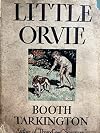
Little Orvie
by Booth Tarkington
On This Page
Tags
Recommendations











Member Reviews
This book is an unappreciated treasure -- I am SO glad I read it. Readers who enjoyed Booth Tarkington's Penrod will love this work, and those unfamiliar with Tarkington have a heartwarming treat in store. Little Orvie is 7, going on 8 , and suffers the travails of a childhood in Midwestern suburbia in the early 1930s (when this book was written). He is awkward, lonely, and starved for attention, and filled with frustration and sometimes an anger that's hard to control; what's more, his mother and father are too preoccupied with adult issues to try to understand him, and he has no friends. Worst of all, he yearns deeply for a puppy dog of his very own, yet his parents are adamantly against the idea. And as a further annoyance, there's show more Little Marie from Kansas City, a perfect little girl whom all the parents in the neighborhood dote on, and Orvie and the other neighborhood children resent.
The book's tone is affectionate and gentle, with good humor that comes from understanding. Tarkington's genius is in having the reader see the world through Orvie's eyes. It's a world in which logic has no place, and adult authority is arbitrarily enforced. In his various escapades, Orvie is routinely blamed for mischief he didn't cause despite his protestations, and inexplicably (to him) not held accountable for things he did do. And when Orvie smuggles a stray puppy into his bedroom in hopes of secretly keeping it, it leads to a hilarious series of events in which he becomes the happiest little boy in the world. I don't think I'm all that sensitive, but the ending brought tears to my eyes.
Reflecting the fact that this book was written nearly over 80 years ago, the author's dealings with race and ethnicity are extremely dated, with "negro" dialect and depictions that are unenlightened, by modern standards. Nevertheless, it is the kind- hearted African- American cook Corbena who best understands Orvie, and who intervenes on his behalf with his parents. The book rewards the reader with a funny and heartwarming story, full of life and humor, and offering a window on what it's like to be a small boy in a perplexing world in which the only true friend to be found is a hungry, needy puppy. show less
The book's tone is affectionate and gentle, with good humor that comes from understanding. Tarkington's genius is in having the reader see the world through Orvie's eyes. It's a world in which logic has no place, and adult authority is arbitrarily enforced. In his various escapades, Orvie is routinely blamed for mischief he didn't cause despite his protestations, and inexplicably (to him) not held accountable for things he did do. And when Orvie smuggles a stray puppy into his bedroom in hopes of secretly keeping it, it leads to a hilarious series of events in which he becomes the happiest little boy in the world. I don't think I'm all that sensitive, but the ending brought tears to my eyes.
Reflecting the fact that this book was written nearly over 80 years ago, the author's dealings with race and ethnicity are extremely dated, with "negro" dialect and depictions that are unenlightened, by modern standards. Nevertheless, it is the kind- hearted African- American cook Corbena who best understands Orvie, and who intervenes on his behalf with his parents. The book rewards the reader with a funny and heartwarming story, full of life and humor, and offering a window on what it's like to be a small boy in a perplexing world in which the only true friend to be found is a hungry, needy puppy. show less
Ratings
Members
- Recently Added By
Lists

1970s
657 works; 23 members

Best Books of 1926-1935
403 works; 10 members

EGBERTINA'S List of childhood books worthy of merit or unspeakable delight
155 works; 6 members
Author Information

109+ Works 6,587 Members
Newton Booth Tarkington was born in Indianapolis, Indiana on July 29, 1869. He was educated at Phillips Exeter Academy, than spent his first two years of college at Purdue University and his last two at Princeton University. When his class graduated in 1893, he lacked sufficient credits for a degree. Upon leaving Princeton, he returned to Indiana show more determined to pursue a career as a writer. Tarkington was an early member of The Dramatic Club, founded in 1889, and often wrote plays and directed and acted in its productions. After a five-year apprenticeship full of publishers' rejection slips, Tarkington enjoyed a huge commercial success with The Gentleman from Indiana, which was published in 1899. He produced a total of 171 short stories, 21 novels, 9 novellas, and 19 plays along with a number of movie scripts, radio dramas, and even illustrations over the course of a career that lasted from 1899 until his death in 1946. His novels included Monsieur Beaucaire, The Flirt, Seventeen, Gentle Julia, and The Turmoil. He won the Pulitzer Prize in fiction in 1919 and 1922 for his novels The Magnificent Ambersons and Alice Adams. He used the political knowledge he acquired while serving one term in the Indiana House of Representatives in the short story collection In the Arena. In collaboration with dramatist Harry Leon Wilson, Tarkington wrote The Man from Home, the first of many successful Broadway plays. He wrote children's stories in the final phase of his career. He died on May 19, 1946 after an illness. (Bowker Author Biography) show less
Classifications
Statistics
- Members
- 31
- Popularity
- 903,791
- Reviews
- 1
- Rating
- (4.50)
- Media
- Paper
- ASINs
- 3