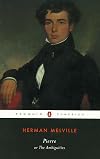
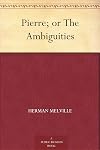
Pierre; or, The Ambiguities
by Herman Melville 
On This Page
Description
Pierre Glendinning, a nineteen-year-old heir to a manor in upstate New York, encounters the dark and mysterious Isabel Banford, who claims to be his half-sister. Driven by his magnetic attraction to Isabel, Pierre devises a remarkable scheme to give her a proper share of the estate.Tags
Recommendations















Member Reviews
How do you parody lurid melodrama? By going even more over the top, and seemingly nobody told Melville that sarcasm and hyperbole are a volatile and sometimes toxic mix. Taken in isolation, some of the tortuous metaphorizing--love's mouth is chambered like a bugle, and entails covering one another in peach juice, and also sinking mine shafts into your lover's eyes, and that's all on the same page--is inspired, but altogether it's cloying and ludicrous, and that would be fine if this was pure parody like The Rape of the Lock or something, but Melville has a serious, sad story to tell under here.
It's about a young, ever-so-slightly-bladish American aristocrat named Pierre Glendinning, whose life is but a dream, rapidly turning nightmarish show more after he meets his illegitimate sister (dark-complexioned) and leaves his WASPy fiancee (fair, naturally) and goes away to live with the sister and a disgraced village girl in an existence too squalid to ever become bohemian, with much talk about familial duty in the face of cruel and hypocritical social mores, an imperfectly sublimated sexual undercurrent (which Melville has great fun with, talking about how different this all would have been if the sister hadn't been hot), and, eventually, the arrival of the fiancee too. And of course it all ends in tears, and Melville's polemic against the emptiness of conventional religious belief and harmfulness of contemporary religious values is undermined by the telescoped timeframe on which everybody works themselves up to fever pitch (lots of dropping dead of sheer despair in this). And there's the usual metaphysical dithering, made worse somehow when taken out of the open air of the Pequod and sealed up in a boarding-house. By the end, though, Melville has loosened up a lot and some of his sardonic quips are genuinely funny in an off-the-cuff way, refreshing after the foregoing ponderosity: the thing about "two ceaseless steeds for a man to ride" (you laugh mockingly, merrily, but without the condescension that comes through in so many of Melville's prior japes at Pierre's expense); the leering sailor (a rare example of Melville's nautical Tourette's coming off successfully in non-nautical context).
A partial success, wheat amongst chaff. show less
It's about a young, ever-so-slightly-bladish American aristocrat named Pierre Glendinning, whose life is but a dream, rapidly turning nightmarish show more after he meets his illegitimate sister (dark-complexioned) and leaves his WASPy fiancee (fair, naturally) and goes away to live with the sister and a disgraced village girl in an existence too squalid to ever become bohemian, with much talk about familial duty in the face of cruel and hypocritical social mores, an imperfectly sublimated sexual undercurrent (which Melville has great fun with, talking about how different this all would have been if the sister hadn't been hot), and, eventually, the arrival of the fiancee too. And of course it all ends in tears, and Melville's polemic against the emptiness of conventional religious belief and harmfulness of contemporary religious values is undermined by the telescoped timeframe on which everybody works themselves up to fever pitch (lots of dropping dead of sheer despair in this). And there's the usual metaphysical dithering, made worse somehow when taken out of the open air of the Pequod and sealed up in a boarding-house. By the end, though, Melville has loosened up a lot and some of his sardonic quips are genuinely funny in an off-the-cuff way, refreshing after the foregoing ponderosity: the thing about "two ceaseless steeds for a man to ride" (you laugh mockingly, merrily, but without the condescension that comes through in so many of Melville's prior japes at Pierre's expense); the leering sailor (a rare example of Melville's nautical Tourette's coming off successfully in non-nautical context).
A partial success, wheat amongst chaff. show less
For my money this is every bit as good as Moby Dick, especially once the protagonists arrive in New York City. There's action, some very clever humour, HM's trademark oracular and rhapsodic outbursts, and a touching tragic ending. It is true that Melville's female characters aren't as thoroughly portrayed as , say, Samuel Richardson's or Henry James' but I still cared about Mary Glendinning, Lucy Tartan, and Isabel the mystical guitarist and femme fatale. And with so much candid sharing of HM's own creative aims and processes! This reminded me of Gissing's New Grub Street - minus the politics of publishing and enmities of editors.
Melville decided to write a parody on the literature of his day. Unfortunately, it doesn't quite work.
Pierre, the protagonist, makes very ludicrous decisions and arrives at extremely ridiculous conclusions. This makes any type of empathy for Pierre nearly impossible. I know that Melville may have been poking fun at the ridiculous scenarios of other melodramas, but goes WAY too far.
The dialogue is atrocious. The best way I know how to describe the dialogue is to use a comparison with which not everyone will be familiar. But it is the best I've got. You know the dialogue in the Star Wars Prequels? Compared with the dialogue in Pierre, that dialogue is sheer genius.
Enough of the negatives, now I shall mention some positive aspects.
Melville show more does give some very insightful thoughts at various points. Some of the streams of consciousness become very philosophical. Those parts I rather enjoyed.
When the characters are simply described by their actions without directly speaking to one another (i.e. when there is no dialogue), it is possible to get a bit absorbed into the story.
The ending is quite unpredictable. Although Melville does end it in a bit of a deus ex machina fashion, it does come as a bit of a shock. Furthermore, after reading the final sentence, I did have to take pause for a bit to reflect on everything. This is something that does not happen when I read a book that is completely superficial. So the book must've contained some depth. show less
Pierre, the protagonist, makes very ludicrous decisions and arrives at extremely ridiculous conclusions. This makes any type of empathy for Pierre nearly impossible. I know that Melville may have been poking fun at the ridiculous scenarios of other melodramas, but goes WAY too far.
The dialogue is atrocious. The best way I know how to describe the dialogue is to use a comparison with which not everyone will be familiar. But it is the best I've got. You know the dialogue in the Star Wars Prequels? Compared with the dialogue in Pierre, that dialogue is sheer genius.
Enough of the negatives, now I shall mention some positive aspects.
Melville show more does give some very insightful thoughts at various points. Some of the streams of consciousness become very philosophical. Those parts I rather enjoyed.
When the characters are simply described by their actions without directly speaking to one another (i.e. when there is no dialogue), it is possible to get a bit absorbed into the story.
The ending is quite unpredictable. Although Melville does end it in a bit of a deus ex machina fashion, it does come as a bit of a shock. Furthermore, after reading the final sentence, I did have to take pause for a bit to reflect on everything. This is something that does not happen when I read a book that is completely superficial. So the book must've contained some depth. show less
Prose style like no other author (that I have heard of yet Of course, there are a host of nineteenth-century American authors whom I have not read yet, so I am certain that there would be some of them that would be remeniscent of Melville, or vice versa. At first I want to say that the sentences are cumbersome, but that would be false, as there are no superfluous words. It is very disciplined prose and nothing is wasted.
The story is a bit strange, but what is there under the sun that we think we have never heard of yet, that can exist somewhere, somehow, in someone's imigination, or in reality, or both. (Both are really the same thing after all, reality and imagination, that is.)
The story is a bit strange, but what is there under the sun that we think we have never heard of yet, that can exist somewhere, somehow, in someone's imigination, or in reality, or both. (Both are really the same thing after all, reality and imagination, that is.)
The Kraken Edition
Ratings
Members
- Recently Added By
Lists

Unread books
1,063 works; 87 members

Fiction (Mostly) in Selective Bibliography of American Literature 1775-1900
431 works; 3 members
Talk Discussions
Past Discussions
Pierre: or, Bucolic Reading in Le Salon Littéraire du Peuple pour le Peuple (December 2009)
Author Information

657+ Works 78,338 Members
Herman Melville (August 1, 1819 - September 28, 1891) was born into a seemingly secure, prosperous world, a descendant of prominent Dutch and English families long established in New York State. That security vanished when first, the family business failed, and then, two years later, in young Melville's thirteenth year, his father died. Without show more enough money to gain the formal education that professions required, Melville was thrown on his own resources and in 1841 sailed off on a whaling ship bound for the South Seas. His experiences at sea during the next four years were to form in part the basis of his best fiction. Melville's first two books, Typee (1846) and Omoo (1847), were partly romance and partly autobiographical travel books set in the South Seas. Both were popular successes, particularly Typee, which included a stay among cannibals and a romance with a South Sea maiden. During the next several years, Melville published three more romances that drew upon his experiences at sea: Redburn (1849) and White-Jacket (1850), both fairly realistic accounts of the sailor's life and depicting the loss of innocence of central characters; and Mardi (1849), which, like the other two books, began as a romance of adventure but turned into an allegorical critique of contemporary American civilization. Moby Dick (1851) also began as an adventure story, based on Melville's experiences aboard the whaling ship. However, in the writing of it inspired in part by conversations with his friend and neighbor Hawthorne and partly by his own irrepressible imagination and reading of Shakespeare and other Renaissance dramatists Melville turned the book into something so strange that, when it appeared in print, many of his readers and critics were dumbfounded, even outraged. By the mid-1850s, Melville's literary reputation was all but destroyed, and he was obliged to live the rest of his life taking whatever jobs he could find and borrowing money from relatives, who fortunately were always in a position to help him. He continued to write, however, and published some marvelous short fiction pieces Benito Cereno" (1855) and "Bartleby, the Scrivener" (1853) are the best. He also published several volumes of poetry, the most important of which was Battle Pieces and Aspects of the War (1866), poems of occasionally great power that were written in response to the moral challenge of the Civil War. His posthumously published work, Billy Budd (1924), on which he worked up until the time of his death, became Melville's last significant literary work, a brilliant short novel that movingly describes a young sailor's imprisonment and death. Melville's reputation, however, rests most solidly on his great epic romance, Moby Dick. It is a difficult as well as a brilliant book, and many critics have offered interpretations of its complicated ambiguous symbolism. Darrel Abel briefly summed up Moby Dick as "the story of an attempt to search the unsearchable ways of God," although the book has historical, political, and moral implications as well. Melville died at his home in New York City early on the morning of September 28, 1891, at age 72. The doctor listed "cardiac dilation" on the death certificate. He was interred in the Woodlawn Cemetery in The Bronx, New York, along with his wife, Elizabeth Shaw Melville. (Bowker Author Biography) show less
Herman Melville has a Legacy Library. Legacy libraries are the personal libraries of famous readers, entered by LibraryThing members from the Legacy Libraries group.
Some Editions
Work Relationships
Is contained in
Has the adaptation
Has as a reference guide/companion
Has as a commentary on the text
Common Knowledge
- Canonical title
- Pierre; or, The Ambiguities
- Original title
- Pierre; or, The Ambiguities
- Original publication date
- 1852
- People/Characters
- Pierre Glendinning; Pierre Glendinning, Sr. (mentioned); Lucy Tartan; Isabel Banford; Delly Ulver; Plotinus Plinlimmon (show all 7); Stanley Glendinning
- Dedication
- To Greylock's Most Excellent Majesty.
In old times authors were proud of the privilege of
dedicating their works to Majesty. A right noble
custom, which we of Berkshire must revive. For
whether we will or no, M... (show all)ajesty is all around us here
in Berkshire, sitting as in a grand Congress of Vienna
of majestical hill-tops, and eternally challenging
our homage.
But since the majestic mountain, Greylock--my own
more immediate sovereign lord and king--hath now,
for innumerable ages, been the one grand dedicatee of
the earliest rays of all the Berkshire mornings, I know
not how his Imperial Purple Majesty (royal-born:
Porphyrogenitus) will receive the dedication of my
own poor solitary ray.
Nevertheless, forasmuch as I, dwelling with my loyal
neighbors, the Maples and the Beeches, in the
amphitheater over which his central majesty presides,
have received his most bounteous and instinted
fertilizations, it is but meet, that I here devoutly kneel,
and render up my gratitude, whether, thereto, The
Most Excellent Purple Majesty of Greylock
benignantly incline his hoary crown or no.
Pittsfield, Mass. - First words
- There are some strange summer mornings in the country, when he who is but a sojourner from the city shall early walk forth into the fields, and be wonder-smitten with the trance-like aspect of the green and golden world.
- Last words
- (Click to show. Warning: May contain spoilers.)"All's o'er, and ye know him not!" came gasping from the wall; and from the fingers of Isabel dropped an empty vial--as it had been a run-out sand-glass--and shivered upon the floor; and her whole form sloped sideways, and she fell upon Pierre's heart, and her long hair ran over him, and arbored him in ebon vines.
- Original language*
- Anglais
*Some information comes from Common Knowledge in other languages. Click "Edit" for more information.
Classifications
Statistics
- Members
- 844
- Popularity
- 32,381
- Reviews
- 5
- Rating
- (3.83)
- Languages
- 7 — English, French, German, Italian, Russian, Spanish, Turkish
- Media
- Paper, Audiobook, Ebook
- ISBNs
- 72
- ASINs
- 34