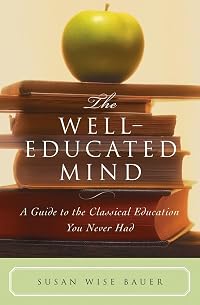
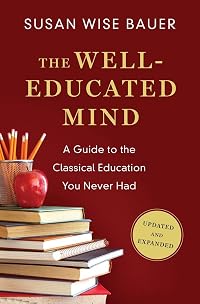
The Well-Educated Mind: A Guide to the Classical Education You Never Had
by Susan Wise Bauer
On This Page
Description
Provides a road map for adult readers who want to gain enjoyment and self-improvement from the time they spend reading, discussing how different genres should be read to get the most out of them.Tags
Recommendations
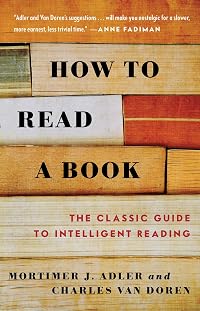
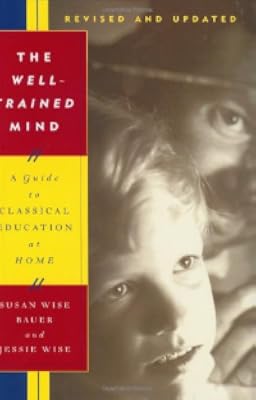
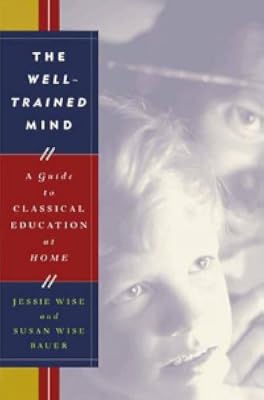
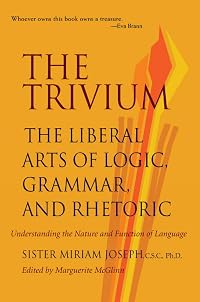
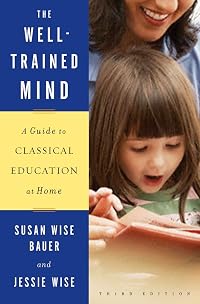


Member Recommendations
Member Reviews
I listened to this as I exercised, mainly, and found it a little - mm - conservative, but that is what one would expect from this kind of book. It led me to some holes in my own reading, and was easy to listen to while doing other non-verbal things. I intend to look at the lists at the end of each chapter to help me fill those holes in. (One of them is DeToqueville's Democracy in America. How did I manage to skip that one??)
The last section on poetry has gotten me revved up to return to all my poetry books, stored in boxes.
The last section on poetry has gotten me revved up to return to all my poetry books, stored in boxes.
I read this book as the organizing preamble to a meetup book group. In that capacity, it was a pretty useful guide. After all, how many book groups have you been to that devolve into gab fests for people who eventually don't even bother to read the book and focus solely on the pot luck portion of the occasion? So, stars for the idea behind the book and for encouraging people to focus on the tools necessary for reading a text closely and studying without a professional guide.
That's where the stars end, however. Susan Wise Bauer comes off as a sort of arrogant, evangelical, anti-education, yutz. Eventually, the condescension comes to a head and you just want to put the book down and flip her off. Look, if you didn't go to college and for show more whatever reason (there are many) you can't go to college, the ideas in this book (there are like 3 solid ideas that take about as many pages to explain) are useful. It's worthwhile to gain the confidence that you are reading "correctly." For everyone else, even those of us who had a pretty good high school education, there is absolutely nothing of value here. You get a few obvious points about reading carefully, then you get her strange and often questionable list of books to read (Mein Kampf? Really? Of all the books to choose from? Was that important?). The majority of the pages are dedicated to horribly reductive synopses of her list of book.
Also there's no index, or pages listing her recommended reading lists by title only. You pretty much have to slog through her pages of commentary to see which books in each category of literature you would like to read. No thanks.
Overall, I would NOT recommend this book, though there may be some cases when parts of it are useful. show less
That's where the stars end, however. Susan Wise Bauer comes off as a sort of arrogant, evangelical, anti-education, yutz. Eventually, the condescension comes to a head and you just want to put the book down and flip her off. Look, if you didn't go to college and for show more whatever reason (there are many) you can't go to college, the ideas in this book (there are like 3 solid ideas that take about as many pages to explain) are useful. It's worthwhile to gain the confidence that you are reading "correctly." For everyone else, even those of us who had a pretty good high school education, there is absolutely nothing of value here. You get a few obvious points about reading carefully, then you get her strange and often questionable list of books to read (Mein Kampf? Really? Of all the books to choose from? Was that important?). The majority of the pages are dedicated to horribly reductive synopses of her list of book.
Also there's no index, or pages listing her recommended reading lists by title only. You pretty much have to slog through her pages of commentary to see which books in each category of literature you would like to read. No thanks.
Overall, I would NOT recommend this book, though there may be some cases when parts of it are useful. show less
I picked up this book because I wanted to work on my book reviewing and critiquing skills, and for this purpose I liked it. Bauer does a good job of providing a systematic self-study approach to reading that really does help organize one's reactions and impressions, and makes it easier to get more out of reading a book than just "I liked it" or "I hated it." Bauer provides a 3-step process, with a first read-through and then 2 additional passes which allow the reader to evaluate the book's structure and content through the use of various useful questions.
I was a bit annoyed at how mired in 'dead white guys' the reading lists are in the annotated reading list segments of the second part of each chapter. There were a couple female show more authors, and even a couple non-white ones, but the focus is still toward traditional Western classical education, with all the elitist, paternalist biases that tradition contains. But as a guide to get readers started reading more thoroughly, this book definitely works, and it is easy to use the framework Bauer provides to read other books not included in her lists. In fact Bauer does suggest adding in and taking out books from her lists as the readers feels is necessary. I have already read 50% of the books in her fiction list, so I am not quite her target audience anyway; the point of this book is really to help adults who did not get a solid classical education catch up through their own self-study (and through discussing their readings with a friend who is also reading the same books, but since I have no willing friend around who could keep up with my reading that is not likely to happen soon). show less
I was a bit annoyed at how mired in 'dead white guys' the reading lists are in the annotated reading list segments of the second part of each chapter. There were a couple female show more authors, and even a couple non-white ones, but the focus is still toward traditional Western classical education, with all the elitist, paternalist biases that tradition contains. But as a guide to get readers started reading more thoroughly, this book definitely works, and it is easy to use the framework Bauer provides to read other books not included in her lists. In fact Bauer does suggest adding in and taking out books from her lists as the readers feels is necessary. I have already read 50% of the books in her fiction list, so I am not quite her target audience anyway; the point of this book is really to help adults who did not get a solid classical education catch up through their own self-study (and through discussing their readings with a friend who is also reading the same books, but since I have no willing friend around who could keep up with my reading that is not likely to happen soon). show less
I read this book as the organizing preamble to a meetup book group. In that capacity, it was a pretty useful guide. After all, how many book groups have you been to that devolve into gab fests for people who eventually don't even bother to read the book and focus solely on the pot luck portion of the occasion? So, stars for the idea behind the book and for encouraging people to focus on the tools necessary for reading a text closely and studying without a professional guide.
That's where the stars end, however. Susan Wise Bauer comes off as a sort of arrogant, evangelical, anti-education, yutz. Eventually, the condescension comes to a head and you just want to put the book down and flip her off. Look, if you didn't go to college and for show more whatever reason (there are many) you can't go to college, the ideas in this book (there are like 3 solid ideas that take about as many pages to explain) are useful. It's worthwhile to gain the confidence that you are reading "correctly." For everyone else, even those of us who had a pretty good high school education, there is absolutely nothing of value here. You get a few obvious points about reading carefully, then you get her strange and often questionable list of books to read (Mein Kampf? Really? Of all the books to choose from? Was that important?). The majority of the pages are dedicated to horribly reductive synopses of her list of book.
Also there's no index, or pages listing her recommended reading lists by title only. You pretty much have to slog through her pages of commentary to see which books in each category of literature you would like to read. No thanks.
Overall, I would NOT recommend this book, though there may be some cases when parts of it are useful. show less
That's where the stars end, however. Susan Wise Bauer comes off as a sort of arrogant, evangelical, anti-education, yutz. Eventually, the condescension comes to a head and you just want to put the book down and flip her off. Look, if you didn't go to college and for show more whatever reason (there are many) you can't go to college, the ideas in this book (there are like 3 solid ideas that take about as many pages to explain) are useful. It's worthwhile to gain the confidence that you are reading "correctly." For everyone else, even those of us who had a pretty good high school education, there is absolutely nothing of value here. You get a few obvious points about reading carefully, then you get her strange and often questionable list of books to read (Mein Kampf? Really? Of all the books to choose from? Was that important?). The majority of the pages are dedicated to horribly reductive synopses of her list of book.
Also there's no index, or pages listing her recommended reading lists by title only. You pretty much have to slog through her pages of commentary to see which books in each category of literature you would like to read. No thanks.
Overall, I would NOT recommend this book, though there may be some cases when parts of it are useful. show less
The organization of this book is wonderful. I especially love the historical background of the basic genres of literature. The booklists are challenging and fun. The only negatives I give this book is the redundancy in some of her "how to read a book" suggestions and the slight insults to intelligence throughout. For example, her advive to take a remedial phonics course as an adult while she is in the same breath suggesting we read Cervantes verges on ridiculous. Her attitude of smarter than thou throughout can get a bit tiresome. Her ideas for book analysis are interesting but left me feeling like if I followed her every suggestion the love of reading would be sucked dry. Good booklist and good background info.
I found this thought-provoking. Bauer challenges the reader to consider how s/he interacts with printed text and offers ideas for new avenues of approach.
I read Mortimer Adler's "How to Read a Book" a few months ago and decided to see if Susan Wise Bauer had anything else to say on the matter, so picked up this book. The Well-Educated Mind is a how-to guide for reading books the way an academic scholar would, i.e by making use of the trivium: grammar, logic and rhetoric. The second section of the book provides a list of recommended texts in five categories (novels, autobiography, history, drama and poetry, and history of science).
Both these book compliment each other, but the Adler book is more comprehensive and detailed. However, unlike Adler, Bauer doesn't assume you already know how to read a book and gives some direction on the mechanics of reading a book (how to move your eyes and show more remedial reading and vocabulary help). There are some differences between the method as provided by Bauer and that of Adler, so it is a case of determining which method works better for the reader. I was also disappointed by the lack of attention Bauer gives to scientific reading material. She covers the history of science in a superficial manner, but generally ignores other scientific works. show less
Both these book compliment each other, but the Adler book is more comprehensive and detailed. However, unlike Adler, Bauer doesn't assume you already know how to read a book and gives some direction on the mechanics of reading a book (how to move your eyes and show more remedial reading and vocabulary help). There are some differences between the method as provided by Bauer and that of Adler, so it is a case of determining which method works better for the reader. I was also disappointed by the lack of attention Bauer gives to scientific reading material. She covers the history of science in a superficial manner, but generally ignores other scientific works. show less
Members
- Recently Added By
Published Reviews
Bauer's The Well-Trained Mind (which she co-wrote with Jessie Wise) taught parents how to educate kids; her latest is designed for adults seeking self-education in the classical tradition. Reading—sustained, disciplined and structured—is her core methodology, so she starts with tips on improving reading skills and setting up a reading schedule (start with half-hour sessions four mornings a show more week, with daily journal writing). Reading is a discipline, like meditating or running, she says, and it needs regular exercise. To grow through reading—to reach the "Great Conversation" of ideas—Bauer outlines the three stages of the classical tradition: first, read for facts; then evaluate them; finally, form your own opinions. After explaining the mechanics of each stage (e.g., what type of notes to take in the book itself, or in the journal), Bauer begins the list section of the book, with separate chapters for her five major genres: fiction, autobiography/memoir, history/politics, drama and poetry. She introduces each category with a concise discussion of its historical development and the major scholarly debates, clearly defining all important terms (e.g., postmodernism, metafiction). And then, the pièce de résistance: lists, in chronological order, of some 30 major works in each genre, complete with advice on choosing the edition and a one-page synopsis. Bauer has crafted a timeless, intelligent book.
Forecast: Bauer's book has a large potential readership. For serious self-educators, it's a well-balanced, long-lasting reading program. For book-clubbers, it's a brilliant guide on to how to analyze any given literary work—even if it's not on Bauer's list. And for college students in trouble, it's a quick gloss of books there wasn't time to read, plus sound advice on spotting critical fallacies. show less
Forecast: Bauer's book has a large potential readership. For serious self-educators, it's a well-balanced, long-lasting reading program. For book-clubbers, it's a brilliant guide on to how to analyze any given literary work—even if it's not on Bauer's list. And for college students in trouble, it's a quick gloss of books there wasn't time to read, plus sound advice on spotting critical fallacies. show less
added by VivienneR
Lists

Check
18 works; 1 member
Talk Discussions
Past Discussions
How is Everyone Doing on their Well-Educated Mind reading? in The Well-Educated Mind by Susan Wise-Bauer (February 2025)
Just starting out in The Well-Educated Mind by Susan Wise-Bauer (July 2024)
The Well-Educated Mind List in The Well-Educated Mind by Susan Wise-Bauer (September 2021)
New to the Group in The Well-Educated Mind by Susan Wise-Bauer (October 2014)
Ack! I started this group. Then, I forgot about it. in The Well-Educated Mind by Susan Wise-Bauer (September 2011)
Author Information

115+ Works 24,791 Members
Susan Wise Bauer is the author of The Well-Educated Mind: A Guide to the Classical Education You Never Had (revised edition, Norton, 2016) and co-author with her mother, Jessie Wise, of The Well-Trained Mind: A Guide to Classical Education at Home (4th edition, Norton, 2016), a book which has become an educational standard. Susan has taught show more literature and writing at The College of William and Mary in Virginia. Visit her home page at susanwisebauer.com. show less
Common Knowledge
- Canonical title
- The Well-Educated Mind: A Guide to the Classical Education You Never Had
- Epigraph
- All civilization comes through literature now, especially in our country. A Greek got his civilization by talking and looking, and in some measure a Parisian may still do it. But we, who live remote from history and monumen... (show all)ts, we must read or we must barbarise.
-- WILLIAM DEAN HOWELLS, The Rise of Silas Lapham - Dedication
- For my mother
who taught me to read,
and my father
who gave me all my favorite books - First words
- The year I turned thirty, I decided to go back to graduate school.
- Disambiguation notice
- Updated and expanded in 2015
Classifications
- Genres
- Nonfiction, Literature Studies and Criticism
- DDC/MDS
- 028.9 — Computer science, information & general works Library & information sciences Reading and use of other information media Character of reading in libraries
- LCC
- Z1003 .B324 — Bibliography, Library Science and Information Resources General bibliography Biography of bibliographers
- BISAC
Statistics
- Members
- 2,159
- Popularity
- 9,508
- Reviews
- 29
- Rating
- (4.02)
- Languages
- English, Spanish, Portuguese (Portugal)
- Media
- Paper, Audiobook, Ebook
- ISBNs
- 11
- UPCs
- 1
- ASINs
- 9