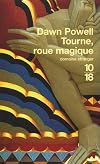
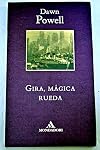
Turn, Magic Wheel
by Dawn Powell
On This Page
Description
In this hilarious skewering of the New York literary scene, a scheming writer has stolen the life story of his friend -- the wife of a famous, Hemingway-like novelist -- to use in his own novel. And that's only one of the betrayals in this sharp lampoon of the cosmopolitan literati.Tags
Recommendations

































Member Reviews
She thought of how many times guests would have to drink to Baby's birthday before she went crazy with boredom, and she thought this is the good-wife feeling, this teeth clenched, controlled screaming-boredom feeling. The guilty-wife feeling is better for the whole family, she reflected, that remorseful tender understanding, the seeing all his good traits because your badness has canceled his bad ones. The bad wife was far pleasanter around the home, she could stand a lot from a husband because it eased her conscience.
Dawn Powell has been a revelation to me. I hadn't heard of her at all before Turn, Magic Wheel was mentioned somewhere as a clever novel about the New York publishing industry. Powell was a contemporary with the Algonquin show more Round Table writers, and her writing has a quick, biting wit that Dorothy Parker would recognize, although Powell tempers it with a broad compassion for all her characters. Powell was little known during her career, and she was never able to make a living from her writing. She was quickly forgotten, but has been enthusiastically rediscovered by a few people, enough to have her novels and memoirs reissued.
Turn, Magic Wheel tells the story of a young author whose novel is just being published. He's written a book about a woman whose famous husband left her long ago, but who lives on as if they are simply briefly apart, basking in his reputation. It's about his good friend, who is understandably crushed by his portrayal of her. Meanwhile, the author juggles his experiences with his publisher, his mistress and his complex feelings for the friend he hurt so badly.
Powell is a master of description, creating vivid characters who she describes without pity, but somehow also with a deep understanding. This was a delight to read and I'll be hunting down her other novels. show less
Dawn Powell has been a revelation to me. I hadn't heard of her at all before Turn, Magic Wheel was mentioned somewhere as a clever novel about the New York publishing industry. Powell was a contemporary with the Algonquin show more Round Table writers, and her writing has a quick, biting wit that Dorothy Parker would recognize, although Powell tempers it with a broad compassion for all her characters. Powell was little known during her career, and she was never able to make a living from her writing. She was quickly forgotten, but has been enthusiastically rediscovered by a few people, enough to have her novels and memoirs reissued.
Turn, Magic Wheel tells the story of a young author whose novel is just being published. He's written a book about a woman whose famous husband left her long ago, but who lives on as if they are simply briefly apart, basking in his reputation. It's about his good friend, who is understandably crushed by his portrayal of her. Meanwhile, the author juggles his experiences with his publisher, his mistress and his complex feelings for the friend he hurt so badly.
Powell is a master of description, creating vivid characters who she describes without pity, but somehow also with a deep understanding. This was a delight to read and I'll be hunting down her other novels. show less
I am always curious about good authors whose books I’ve missed over the years. In a Wall Street Journal article (“A Celebrated Unknown”) about composer Harold Shapero (January 15, 2015), Terry Teachout mentioned Dawn Powell as someone who “wrote some of the wittiest comic novels of the 20th century but has yet to become truly popular.” When Powell died in 1965, her novels were out of print and remained so until the 1990’s. I browsed some of her books on Amazon and decided to read “Turn, Magic Wheel” (1936), a biting satire of the rarified world of authors, publishers, businessmen and socialites in Manhattan during the 1930’s. In the first chapter, we are introduced to Dennis Orphen, a writer who has just completed a show more novel using his good friend Effie’s egotistical ex-husband and author Andy Callingham as undisguised fodder for his book. Andy has left Effie and another woman named Marian before Powell’s novel even gets started. In fact, we don’t actually meet Andy until the end of the book. Effie spends much of the novel denying her life alone and waiting for Andy to return to her (hence the title from Theocritus: “Turn, magic wheel, bring homeward him I love”). Effie is a good friend and confidante to Orphen, who meanwhile carries on an affair with Corrine, the wife of a successful businessman. In fact, it seems like a lot of the characters in this book are carrying on affairs with the spouses of their friends and business associates. Effie is the only character in the book to experience any emotional growth. She finally gives up her romantic memory of Andy when he shows up at Marian’s death bed and Effie realizes he is a stranger to her both physically and emotionally. Powell has a ruthless, sarcastic sense of humor. The book is full of wit, but it’s hard to take any of the characters too seriously except perhaps Effie (at least by the end of the book). For example, Orphen is very curious about the lives of others, but he has little insight into his own behavior and is blind to the flesh-and-blood woman (Effie) standing right in front of him. Only when Effie goes missing because she is spending all her time at the hospital with the dying Marian does Orphen come to realize what Effie means to him. His insight however is transient and, as the novel ends, Dennis is taking up once again with Corrine who has turned up on his doorstep. This novel is not big on plot, and the characters are hard to like, but it’s an entertaining send-up of these Manhattan high rollers of the 1930’s and their cynical superficial lives. show less
Powell creates such interesting characters, however, this wasn't my favorite of her books. This one is about a woman who is married to an author who dumps her so easily when his hormones get lit up by someone new, and then he becomes famous. She carries the flame for him for years afterwards, and another author, her "friend," uses her story for fodder for his next book. I couldn't relate; someone who I care for starts being unresponsive to me, I go cold turkey with my feelings for the pendejo, until I'm cured.
I received this book from a coworker as a gift nearly three years ago. Respecting both her and her taste, I was ready for a literary gem. Well, unsurprisingly, I intended to read it right away and then three years went by before it popped into my head for some reason or another (most likely because of the rather delightful cover which is rather memorable in my mind), and I started reading it without glancing at the back cover for a reminder as to its topic. My opinion holds firm -- this was quite a delightful book.
Turn, Magic Wheel is one of Dawn Powell's New York novels and she personally considered this her best work. The plot is this: Dennis Orphen has written a novel about a woman, left by her famous author husband -- cannibalizing show more the life of his friend, Effie Callingham, to do so. Effie is the first wife of Andy Callingham, who has since become a rising star in the literary world, and he left her several years before the start of our story. Despite that, Effie still lives in a world where she is still addressed as "Mrs. Callingham," though no one is deceived, except for Effie. Dennis takes few pains to conceal that his novel is about Effie and Andy Callingham, and our story almost immediately opens with Effie discovering his advance copy of the book, realizing that now the reality of her abandonment will be made public knowledge. This betrayal is one of many in the novel, and arguably, it isn't even the worst thing that one person does to another. A poignant and lovely novel, Turn, Magic Wheel is also a delightfully witty and wicked look at the New York literary scene.
The title of the book comes from Theocritus: "Turn, magic wheel / Bring homeward him I love" which vaguely outlines a bit of what is to be expected in this book. The action hinges on the fact that we spend a great deal of time talking about Andy Callingham, the famous writer (and modeled on Hemingway), but we're all waiting for him to appear, for only with his arrival can we sort anything out.
Powell has created wonderful characters, painfully and beautifully real. One frequently wishes to slap some sense into Dennis; he can be so curious about the lives of others, still be completely wrapped up in his own, and find himself totally flummoxed when the reality of someone else's life actually dawns on him. Somehow, this novel is both a biting satire and yet still an unconventional... I hesitate to use the phrase "love story," but there are elements of that, too.
Certainly, for anyone who loves New York and literature, I think they'll enjoy this novel. Dawn Powell writes about New York as if it's more than just a setting... it's another character, living and breathing around the others, with a life and hum and energy. I'm certainly looking forward to discovering more of Dawn Powell's work, and I'm quite in the debt of my former co-worker for exposing me to her writing.
Also, I might also direct you to a New York Times review of this book, published in 1936: http://www.nyt.net/books/98/11/15/specia...
I don't know why this delights me so... perhaps it's simply the idea of the NY Times actually bothering to put its book reviews from the 30s online, but it makes me quite happy. show less
Turn, Magic Wheel is one of Dawn Powell's New York novels and she personally considered this her best work. The plot is this: Dennis Orphen has written a novel about a woman, left by her famous author husband -- cannibalizing show more the life of his friend, Effie Callingham, to do so. Effie is the first wife of Andy Callingham, who has since become a rising star in the literary world, and he left her several years before the start of our story. Despite that, Effie still lives in a world where she is still addressed as "Mrs. Callingham," though no one is deceived, except for Effie. Dennis takes few pains to conceal that his novel is about Effie and Andy Callingham, and our story almost immediately opens with Effie discovering his advance copy of the book, realizing that now the reality of her abandonment will be made public knowledge. This betrayal is one of many in the novel, and arguably, it isn't even the worst thing that one person does to another. A poignant and lovely novel, Turn, Magic Wheel is also a delightfully witty and wicked look at the New York literary scene.
The title of the book comes from Theocritus: "Turn, magic wheel / Bring homeward him I love" which vaguely outlines a bit of what is to be expected in this book. The action hinges on the fact that we spend a great deal of time talking about Andy Callingham, the famous writer (and modeled on Hemingway), but we're all waiting for him to appear, for only with his arrival can we sort anything out.
Powell has created wonderful characters, painfully and beautifully real. One frequently wishes to slap some sense into Dennis; he can be so curious about the lives of others, still be completely wrapped up in his own, and find himself totally flummoxed when the reality of someone else's life actually dawns on him. Somehow, this novel is both a biting satire and yet still an unconventional... I hesitate to use the phrase "love story," but there are elements of that, too.
Certainly, for anyone who loves New York and literature, I think they'll enjoy this novel. Dawn Powell writes about New York as if it's more than just a setting... it's another character, living and breathing around the others, with a life and hum and energy. I'm certainly looking forward to discovering more of Dawn Powell's work, and I'm quite in the debt of my former co-worker for exposing me to her writing.
Also, I might also direct you to a New York Times review of this book, published in 1936: http://www.nyt.net/books/98/11/15/specia...
I don't know why this delights me so... perhaps it's simply the idea of the NY Times actually bothering to put its book reviews from the 30s online, but it makes me quite happy. show less
She might have been New York's answer to Evelyn Waugh, and the writing's lovely, but in this book, she makes the mistake of trying to create one wholly sympathetic character. That never works!
Hilarious and heartbreaking - sometimes in turns, sometimes simultaneously. It's the second Dawn Powell novel I've read this month, and I loved it so much I started a third the same day.
Commercial success in the 1940s, obscure and out-of-print by the 1970s, and heralded by the likes of Gore Vidal and Steerforth Press to be put back in print by the 1990s. She is satirical and witty, but not shallow. If Dorothy Parker wrote novels, she would have been Dawn Powell. Powell was one of the Hemingway's fave writers and she was edited by the infamous Max Perkins. Discover her... or else!! -Monica
Members
- Recently Added By
Author Information

30+ Works 3,142 Members
Work Relationships
Is contained in
Common Knowledge
- Dedication
- To my sister Phyllis
- First words
- What Morry heard above the Lamptown night noises was a woman's high voice rocking on mandolin notes far far away.
Classifications
Statistics
- Members
- 166
- Popularity
- 196,656
- Reviews
- 7
- Rating
- (3.84)
- Languages
- English, French, German, Spanish
- Media
- Paper, Ebook
- ISBNs
- 7
- ASINs
- 2