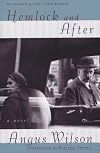
Hemlock and After
by Angus Wilson
On This Page
Description
On its appearance in 1952 the Times Literary Supplement called Hemlock and After 'a novel of remarkable power and literary skill which deserves to be judged by the highest standards'. Angus Wilson's first novel is concerned with the hypocrisies of middle-class society. The protagonist, Bernard Sands, is a novelist and an intellectual who tries to found a centre for young writers. However, Sands is a secret homosexual and in the post-war Britain of the time his liberal ideas cause much show more anxiety to those in charge. Surrounded by false friends and scheming enemies Sands has to come to terms with his emotions and is forced to decide where his loyalties lie. A compassionately written novel Hemlock and After explores the conflict of duty and love in one man's life and the consequences of our choices. Written at a time when homosexuality was still an offence Hemlock and After is a brilliantly handled novel from a writer who was described by John Betjeman as 'mercilessly accurate and never dull.' show lessTags
Recommendations















Member Reviews
This is a book which seems almost Dickensian in its scope, though fortunately not in its length. It follows the stories of a network of characters, all intricately linked by some path to the central figure; his story, his decline and fall, impacts on them all. It's not a book for leisurely reading; it requires concentration to follow the many characters and subplots. But through it we are given a portrait of the society at the time, and the survey is comprehensive: it includes writers, politicians, public servants, academics, cockneys, and a procuress, a faded hostess, a credulous intellectual; the successful, the failing, the evil, the mercenary and the idealistic. Continued
Seems a bit tame now, but was groundbreaking when first published. It shows the reader a snippet in time which resembles our own (because we are still dealing with many of the same issues).
Ratings
Members
- Recently Added By
Lists

Backlisted
109 works; 9 members

Books Read in 2019
4,052 works; 108 members
Author Information

38+ Works 2,881 Members
Angus Wilson was born in Sussex, the youngest of six sons, and spent several of his childhood years in South Africa. A series of odd jobs was followed by a position in the Department of Printed Books in the British Museum, where he worked on replacing as many as possible of the 300,000 books destroyed during the bombing, and later as deputy show more superintendent of the reading room. Writing short stories on weekends, he was immediately successful. In 1955 he left the museum to become a full-time writer. James Gindin has, with some exaggeration, declared that "Angus Wilson is the best contemporary English novelist." Anglo Saxon Attitudes (1956) is a long, intricate, and witty novel that satirizes, none too gently, such sacred British institutions as the church, the universities, and Her Majesty's Government. The Middle Age of Mrs. Eliot (1958) won the James Tait Black Memorial Award for fiction in 1959. The Old Men at the Zoo (1961) is a story of conflict and conscience in a microcosm, the London Zoo in the 1970s. In Late Call (1965), a retired couple face problems of readjustment when they go to live with their widowed son. No Laughing Matter (1967) traces the fortunes of a British family throughout half a century beginning in 1912. In addition to short stories and novels, Wilson wrote Emile Zola: An Introductory Study of His Novels (1952), Tempo: The Impact of Television on the Arts (1966), The Strange Ride of Rudyard Kipling (1977), and The World of Charles Dickens (1970). (Bowker Author Biography) show less
Awards and Honors
Distinctions
Common Knowledge
- Original publication date
- 1952
- People/Characters
- Bernard Sands; Ella Sands; Mrs. Curry; James Sands; Sonia Sands; Hubert Rose (show all 25); Mrs. Rankine; Nicholas; Berthe; Eric Craddock; Ron Wrigley; Mrs. Wrigley; Elizabeth Sands; Bill Pendlebury; Isobel Sands; Louie Randall; Celia Craddock; Alan Craddock; Terence Lambert; Sherman Winter; Evelyn Ramage; Charles Murley; Sir Lionel Dowding; Reverend Bill MacGrath; Mr. Greenlees
- Dedication
- TO ANTHONY
most gratefully - First words
- Of all the communications that Bernard Sands received on the day of his triumph the one which gave him the greatest satisfaction was the Treasury's final confirmation of official financial backing.
- Last words
- (Click to show. Warning: May contain spoilers.)It was really easier to concentrate on the clouds moving above and below like great golden snowdrifts.
Classifications
Statistics
- Members
- 269
- Popularity
- 120,693
- Reviews
- 2
- Rating
- (3.37)
- Languages
- 5 — English, French, Italian, Spanish, Swedish
- Media
- Paper, Ebook
- ISBNs
- 11
- ASINs
- 16