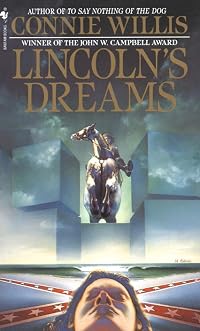
Lincoln's Dreams
by Connie Willis
On This Page
Description
Fantasy. Fiction. Literature. Historical Fiction. HTML:"A novel of classical proportions and virtues...humane and moving."–The Washington Post Book World"A love story on more than one level, and Ms. Willis does justice to them all. It was only toward the end of the book that I realized how much tension had been generated, how engrossed I was in the characters, how much I cared about their fates."–The New York Times Book Review
For Jeff Johnston, a young historical reseacher for a Civil show more War novelist, reality is redefined on a bitter cold night near the close of a lingering winter. He meets Annie, an intense and lovely young woman suffering from vivid, intense nightmares. Haunted by the dreamer and her unrelenting dreams, Jeff leads Annie on an emotional odyssey through the heartland of the Civil War in search of a cure. On long-silenced battlefields their relationship blossoms–two obsessed lovers linked by unbreakable chains of history, torn by a duty that could destroy them both. Suspenseful, moving, and highly compelling, Lincoln's Dreams is a novel of rare imaginative power. show less
Tags
Recommendations



Member Reviews
I had a few problems with this book, but not because the American Civil War is an unfamilar subject (being British, I am far more familiar with the English Civil War which took place in the 17th century).
The male protagonist is Jeff, an historical researcher who works for a somewhat eccentric novelist called Broun. Broun is currently reworking a novel about a young man called Ben who was a participant in a Civil War battle. Broun can't let the novel go and is reworking it despite it being set in galleys (this being the pre-digital publishing days, changes at this stage were very expensive and could be charged to the author). Meanwhile he also shows interest in rekindling an old project around Abraham Lincoln, and he sets Jeff various show more tasks: to find out about Lincoln's supposed presient dreams about his own assassination and to find out where Lincoln's young son was buried before his body was disinterred to be buried alongside Lincoln after the latter's death.
Broun invites an old room-mate of Jeff's to the prelaunch party for his novel, wanting to question him about dreams. Richard is now a doctor specialising in sleep disorders and he brings with him a young woman called Annie, passing her off as his girlfriend when really she is his patient. It soon transpires that he has been committing various breaches of professional conduct, by sleeping with her among other things. Annie comes across from her first appearance as rather a basket case and didn't win my sympathy when she systematically destroyed an African violet. She is in Richard's "care" because she has been having disturbing dreams, and when she tells Jeff about them, he recognises elements pertaining to General Robert E Lee. Soon it transpires that she is having dreams for Lee who suffered from insomnia, somehow between time periods or -more unbelievably - that she is helping him dream and therefore atone or somehow come to terms with his having led so many young men to their deaths. But he is having these dreams after he is dead. And this ends up being linked with Lincoln, in the sense that his dead son was sending him dreams it seems. .
Apart from the unconvincing nature of the underlying premis, another major problem is the characters, especially Annie who is by turns irritating and a doormat. She is not only subservient to Richard who has been drugging her without her permission - and with disastrous results it later transpires - but also to General Lee, when she later refuses to stop dreaming for him out of some inexplicable loyalty. In the scenes between her and Jeff, I found her reminiscient of an emotional vampire, as he falls for her but ends up as a caregiver rather than lover. Richard meanwhile inexplicably veers from one self-serving and beligerent stance to another, with no real explanation of why, other than he is fanatically determined, for no given reason, to stop Annie dreaming at all costs. This is the plot device that drives Jeff to take Annie on the run to get away from him, but the whole thing remains very unbelievable.
Another major issue with the story is the elephant in the room: slavery. Even I know that the American Civil War was fought over that, with the North opposing it and the South wanting to retain it, presumably for economic reasons. Despite the whole novel revolving around the Civil War - including extracts from Broun's novel slotted in when Jeff and Annie spend part of their time away proofreading it (!) - there isn't one single reference to the subject. No slaves are shown in the novel within a novel even in scenes where they might be expected to appear such as when Ben is being treated in a southern states hospital. The complete absence of the reason why the whole war was being fought was akin to writing a novel set in WWII Germany without showing a single Jewish character. So I found that extremely odd. Presumably it is because showing slavery would intefere with the portrayal of Lee as a sympathetic character, given that he is leading a fight to retain such an awful system. Instead he is portrayed as loyal, dutiful and someone who inspires deep loyalty from his troops, plus is kind to horses.
Each chapter is prefaced with some information about Lee's favourite horse, Traveller, and I did find that interesting though the horse's ultimate fate is sad. However it is downright odd that at the end of the book Jeff is viewing himself as Traveller and Annie as Lee. It was a very odd ending. It is also very odd that the book disappoints expectation by not really being about Lincoln's Dreams at all, but about Lee's.
So given all these problems, I can only rate this as a rather disappointing 'OK' read - 2 stars. show less
The male protagonist is Jeff, an historical researcher who works for a somewhat eccentric novelist called Broun. Broun is currently reworking a novel about a young man called Ben who was a participant in a Civil War battle. Broun can't let the novel go and is reworking it despite it being set in galleys (this being the pre-digital publishing days, changes at this stage were very expensive and could be charged to the author). Meanwhile he also shows interest in rekindling an old project around Abraham Lincoln, and he sets Jeff various show more tasks: to find out about Lincoln's supposed presient dreams about his own assassination and to find out where Lincoln's young son was buried before his body was disinterred to be buried alongside Lincoln after the latter's death.
Broun invites an old room-mate of Jeff's to the prelaunch party for his novel, wanting to question him about dreams. Richard is now a doctor specialising in sleep disorders and he brings with him a young woman called Annie, passing her off as his girlfriend when really she is his patient. It soon transpires that he has been committing various breaches of professional conduct, by sleeping with her among other things. Annie comes across from her first appearance as rather a basket case and didn't win my sympathy when she systematically destroyed an African violet. She is in Richard's "care" because she has been having disturbing dreams, and when she tells Jeff about them, he recognises elements pertaining to General Robert E Lee. Soon it transpires that she is having dreams for Lee who suffered from insomnia, somehow between time periods or -
Apart from the unconvincing nature of the underlying premis, another major problem is the characters, especially Annie who is by turns irritating and a doormat. She is not only subservient to Richard who has been drugging her without her permission - and with disastrous results it later transpires - but also to General Lee, when she later refuses to stop dreaming for him out of some inexplicable loyalty. In the scenes between her and Jeff, I found her reminiscient of an emotional vampire, as he falls for her but ends up as a caregiver rather than lover. Richard meanwhile inexplicably veers from one self-serving and beligerent stance to another, with no real explanation of why, other than he is fanatically determined, for no given reason, to stop Annie dreaming at all costs. This is the plot device that drives Jeff to take Annie on the run to get away from him, but the whole thing remains very unbelievable.
Another major issue with the story is the elephant in the room: slavery. Even I know that the American Civil War was fought over that, with the North opposing it and the South wanting to retain it, presumably for economic reasons. Despite the whole novel revolving around the Civil War - including extracts from Broun's novel slotted in when Jeff and Annie spend part of their time away proofreading it (!) - there isn't one single reference to the subject. No slaves are shown in the novel within a novel even in scenes where they might be expected to appear such as when Ben is being treated in a southern states hospital. The complete absence of the reason why the whole war was being fought was akin to writing a novel set in WWII Germany without showing a single Jewish character. So I found that extremely odd. Presumably it is because showing slavery would intefere with the portrayal of Lee as a sympathetic character, given that he is leading a fight to retain such an awful system. Instead he is portrayed as loyal, dutiful and someone who inspires deep loyalty from his troops, plus is kind to horses.
Each chapter is prefaced with some information about Lee's favourite horse, Traveller, and I did find that interesting though the horse's ultimate fate is sad. However it is downright odd that at the end of the book Jeff is viewing himself as Traveller and Annie as Lee. It was a very odd ending. It is also very odd that the book disappoints expectation by not really being about Lincoln's Dreams at all, but about Lee's.
So given all these problems, I can only rate this as a rather disappointing 'OK' read - 2 stars. show less
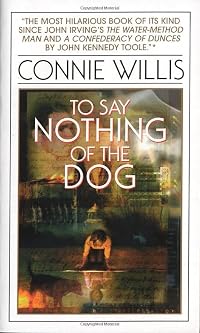
I wasn't sure what to expect from this book from Connie Willis. I had previously read a couple of her science fiction time-travel novels (Doomsday Book and To Say Nothing of the Dog) and enjoyed them even while not being entirely sure what was going on. This book is very different.
Jeff is a young man who works as an assistant to a historical novelist gets tangled up in the life of a young woman who is haunted by the dreams she is having. He slowly realizes that Annie's dreams are actually those of Confederate General Robert E. Lee. As Jeff and Annie travel to various Civil War battlefields in search of a way to end her nightmares, their relationship deepens even as their travels bring up more questions than answers.
I've read a few show more reviews that were puzzled why the book is called Lincoln's Dreams instead of Lee's Dreams, since it is really the general's dreams that are the main plot point. It's a fair question, and I don't have an answer. There is a minor subplot regarding Jeff's employer's quest to understand Lincoln's Dreams, and some of what he learns helps Jeff solve the mystery of Annie's dreams, but it's still an odd choice of title.
There are some of what I consider classic Willis touches in this novel, including the way the narrative jumps back and forth between plotlines — now following Jeff and Annie, now jumping to Jeff's novelist boss, now jumping to Annie's fiancé and his search for Jeff and Annie. The transitions are not often smooth between the segments and way too many plotlines hang on miscommunication and missed messages, but I forgave Willis for the awkwardness simply because the story was so intriguing. This book isn't for everyone, but Civil War buffs and readers unbothered by Willis' known idiosyncrasies will find it worthwhile. show less
Jeff is a young man who works as an assistant to a historical novelist gets tangled up in the life of a young woman who is haunted by the dreams she is having. He slowly realizes that Annie's dreams are actually those of Confederate General Robert E. Lee. As Jeff and Annie travel to various Civil War battlefields in search of a way to end her nightmares, their relationship deepens even as their travels bring up more questions than answers.
I've read a few show more reviews that were puzzled why the book is called Lincoln's Dreams instead of Lee's Dreams, since it is really the general's dreams that are the main plot point. It's a fair question, and I don't have an answer. There is a minor subplot regarding Jeff's employer's quest to understand Lincoln's Dreams, and some of what he learns helps Jeff solve the mystery of Annie's dreams, but it's still an odd choice of title.
There are some of what I consider classic Willis touches in this novel, including the way the narrative jumps back and forth between plotlines — now following Jeff and Annie, now jumping to Jeff's novelist boss, now jumping to Annie's fiancé and his search for Jeff and Annie. The transitions are not often smooth between the segments and way too many plotlines hang on miscommunication and missed messages, but I forgave Willis for the awkwardness simply because the story was so intriguing. This book isn't for everyone, but Civil War buffs and readers unbothered by Willis' known idiosyncrasies will find it worthwhile. show less
A long-time research assistant for a man who writes Civil War fiction becomes entangled with a young woman who is apparently having Robert E. Lee's dreams (despite the title). Jeff thinks he can help her because he knows a LOT about the events, and, being in Virginia, they are surrounded by the battlefields. As the dreams get worse and Annie starts to have physical symptoms, Jeff races against time to find the reason for the dreams before they do her permanent damage.
I devoured this story, although there were one or two things I questioned. Most unconvincing was that Jeff seemed to do most of his research in small public libraries, often dragging along his own sources to use. There's no way he wouldn't have known about the major show more libraries in the area, including collections at the battlefield national parks. (The book was written in the 1980s, so the Internet isn't mentioned.) When Jeff meets Annie she's living with and under the care of an old college roommate of his who is theoretically treating her for the dreams. The man is completely unprofessional, and I really couldn't get a grip on why he did the things he did. Also, there are numerous excerpts from the novel Jeff's employer is writing, and I didn't get that at all. As far as I could tell, before I starting skipping them, they add nothing to the story.
Still, the book certainly kept my interest, and while the ending is not what I expected or hoped for, it made a lot of sense within the storyline. show less
I devoured this story, although there were one or two things I questioned. Most unconvincing was that Jeff seemed to do most of his research in small public libraries, often dragging along his own sources to use. There's no way he wouldn't have known about the major show more libraries in the area, including collections at the battlefield national parks. (The book was written in the 1980s, so the Internet isn't mentioned.) When Jeff meets Annie she's living with and under the care of an old college roommate of his who is theoretically treating her for the dreams. The man is completely unprofessional, and I really couldn't get a grip on why he did the things he did. Also, there are numerous excerpts from the novel Jeff's employer is writing, and I didn't get that at all. As far as I could tell, before I starting skipping them, they add nothing to the story.
Still, the book certainly kept my interest, and while the ending is not what I expected or hoped for, it made a lot of sense within the storyline. show less
Loved this. Absolutely *loved* it. You can see the research that went into this book. I've always been fascinated by the Civil War and this book made me want to go out and read everything I could get my hands on.
It was also heartbreaking. The ending. It felt so *inevitable*. As though free will had no place in the narrative. As though these people were - I hate to use the word 'doomed' - when I think I really mean 'there was this inexorable pull towards destiny'.
It was also heartbreaking. The ending. It felt so *inevitable*. As though free will had no place in the narrative. As though these people were - I hate to use the word 'doomed' - when I think I really mean 'there was this inexorable pull towards destiny'.
Very Connie Willis, and a surprisingly powerful little book. I read it when I was living in rural northern Virginia and spending a lot of time pretending to be knowledgeable about local history at my public library job, so the Civil War trivia and depictions of small town Virginia made me smile.
This is the 6th book I've read by Connie Willis and it was, by far, my least favorite. It felt like it was missing Willis' cheerful frenetic style that I love. Instead it was dark and rambling and a bit dull, frankly. I'm still glad I read it as I work my way through Willis' catalog. I just wish it was better.
I found this to be an enjoyable and quick read. It is very typical Connie Willis - the characters are engaging, and the novel explores some big questions about what it means to be human. More specifically, it asks what dreams mean, and whether dreams connect us with other people, living or dead. As always, Willis's research is impeccable, not only about dreams and what the scientific community thinks about them, but also about the Civil War and the lives of Abraham Lincoln and Robert E. Lee. Willis also has an amazing knack for writing subplots from the point of view of the main character, yet the main character is totally unaware of the subplots. The reader knows a lot more about what is going on than the main characters do, and this show more adds interesting dimensions to the story.
I don't really have anything bad to say about the book, but it's still only a 4-star book - it was very good, but didn't quite have that extra dazzle that makes a book worth 5 stars. show less
I don't really have anything bad to say about the book, but it's still only a 4-star book - it was very good, but didn't quite have that extra dazzle that makes a book worth 5 stars. show less
Members
- Recently Added By
Lists

Top Five Books of 2015
811 works; 241 members

Speculative Fiction to Read
706 works; 32 members

Books Read in 2014
2,343 works; 89 members

Ten Unforgettable Dreams in Literature
10 works; 4 members

BingoDOG - Prophecy, Signs, or Portents are part of the plot
18 works; 9 members

KayStJ's to-read list
1,616 works; 11 members

Allie's Wishlist
217 works; 2 members

Books Read in 2018
4,360 works; 110 members
Author Information

97+ Works 40,854 Members
Connie Willis lives in Greeley, Colorado, with her family. (Publisher Provided) Connie Willis was born on December 31, 1945. She graduated from Colorado State College in 1967. Her first story, The Secret of Santa Titicaca, was published in Worlds of Fantasy in 1971. After receiving an NEA grant in 1982, she left her teaching job to become a show more full-time writer. Her works include Doomsday Book, Lincoln's Dreams, Bellwether, To Say Nothing of the Dog, Fire Watch, Blackout, and All Clear. She has received 10 Hugo Awards, 11 Locus Poll Awards and 6 Nebula Awards. In 2009, she was inducted into the Science Fiction Hall of Fame. (Bowker Author Biography) show less
Some Editions
Awards and Honors
Awards
Notable Lists
Series
Belongs to Publisher Series
Work Relationships
Common Knowledge
- Canonical title*
- Il sogno di Lincoln
- Original publication date
- 1987
- People/Characters
- Jeff Johnston; Annie; Broun; Richard Madison; Robert E. Lee; Abraham Lincoln (show all 7); Traveller
- Important places
- Arlington, Virginia, USA; Fredricksburg; Antietam; Gettysburg, Pennsylvania, USA
- Important events
- American Civil War; Battle of Antietam
- Epigraph
- It may be that life is not man's most precious possession, after all. Certainly men can be induced to give it away very freely at times, and the terms hardly seem to make sense unless there is something about the whole busine... (show all)ss that we don't understand. Lives are spent for very insignificant things which benefit the dead not at all - a few rods of ground in a cornfield for instance, or temporary ownership of a little hill or a piece of windy pasture; and now and then they are simply wasted outright, with nobody gaining anything at all.
Bruce Catton
Mr Lincoln's Army - Dedication
- To Courtney and Cordelia
- First words
- Traveller died of lockjaw two years after Robert E. Lee died.
- Last words
- (Click to show. Warning: May contain spoilers.)"I have picked up a nail."
- Original language
- English
*Some information comes from Common Knowledge in other languages. Click "Edit" for more information.
Classifications
Statistics
- Members
- 1,494
- Popularity
- 15,547
- Reviews
- 39
- Rating
- (3.58)
- Languages
- English, German, Italian, Spanish
- Media
- Paper, Audiobook, Ebook
- ISBNs
- 9
- UPCs
- 1
- ASINs
- 8