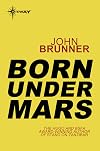
Born under Mars
by John Brunner
On This Page
Description
When mankind colonized the stars, they travelled out from Earth in two directions - to Centaurus and its Southern Hemisphere neighbours and to Ursa Major and the constellations around Polaris. And strange to say the humans who settled on those various worlds began to develop into two differing antagonistic types. For Ray Mallin, born under the surface of Mars in the sparse colony of Earth's inhospitable old neighbour, neither the anarchic 'bears' nor the autocratic 'Centaurs' commanded his show more loyalty. So when secret agents of both galactic groupings suddenly focus their unwelcome attention on his most recent star-piloting mission, he knew only that something of vast significance was up - and that he unknowingly was the key to it. show lessTags
Recommendations













Member Reviews
review of
John Brunner's Born Under Mars
by tENTATIVELY, a cONVENIENCE - February 25, 2013
This is the 5th Brunner bk I've read & reviewed in quick succession. The 1st 4 were The World Swappers ( http://www.goodreads.com/book/show/2398747.The_World_Swappers ), Times Without Number ( http://www.goodreads.com/book/show/6343227-times-without-number ), The Whole Man ( http://www.goodreads.com/book/show/8699522-the-whole-man ), & The Long Result ( http://www.goodreads.com/book/show/3116771-the-long-result ). I've gone from being someone who was vaguely interested in his work to someone intending to read as much of it as I can find (affordably, ie). Given that he wrote something like 97 bks, that shd keep me busy (as if I'm not already busy show more enuf, eh?!).
This was the shortest one I've read so far & the tautest one. [atmospheric interpolation: It's 6AM as I write this, this is the beginning of the 6th day of a juice fast, & I'm listening to Tony Scott & Shiniche Yuize & Hozan Yamamoto's "Music for Zen Meditation" - did you know that Yuize studied w/ Henry Cowell?!!] It had the descriptive detail that I've come to expect from Brunner: "It was a faint peevish resentment at the drag of obsolete habit: the notion of calibrating oxygen partial pressure in terms of another planet's atmosphere after literally centuries, in modern times when the heralds claimed to be able to trace upwards of twelve Martian-born generations within a single continuing family. We might have trimmed it to a bare number - two, five, ten - but the old qualification still stood in black symbols across the face of every pressure meter on the planet: "Thousands of feet above sea-level." And how many millions of miles from any sea?" (p 22)
I have 2 bks near my bed that I started to read before I got distracted by other things: Iannis Xenakis' Formalized Music & my friend Anna McCarthy's Ambient Television - both eminently worthy & ponderous tomes.. &.. yet, I'm reading pulp science fiction.. wch I love. Why is it a 'guilty pleasure'? Brunner, certainly, is both visionary & entertaining. & I agree w/ his politics. But I agree w/ the politics of Philip K. Dick too (mostly) & I thoroughly enjoy watching the movie Total Recall - but it was made starring Arnold Schwarzenegger, a man who became a Republican Governor of California. Do I TRUST Schwarzenegger?! Certainly not! Why wd Schwarzenegger make a movie based on a story by a notorious 'leftist' SF writer? B/c it's good business.. & it's escapism. People enjoying Total Recall can put even more money into Schwarzenegger's pocket & then go back to their normal wage-slave lives. In other words, BEWARE of leading a life of passive escapist fantasy. [atmospheric interpolation: I'm listening to Andre Szervanszky's "Szerenád klarinétra és zenekarra" (1950) ("Serenade for Clarinet and Orchestra") now - on the great Hungaraton label - from one clarinetist to another.] But it's not always so bad - right now it's helping distract me from financial woes & keeping me in a more-or-less good mood.
IS this a review? Well, yes, also a bit of a personal memoir. Some day, my total deterioration into a turtle will be quasi-documented here. [OK, I'm just 'seeing' if you're paying attn.] Given that I have the highest respect for creative people who come up w/ dramatically new ideas for every work, I was a tad disappointed that Born Under Mars recycled ideas already prominent in The Long Result: viz: the eventual desire to break from free from Earth's control by colonists of another planet, in this case Mars, coupled w/ 2 conflicting philosophical tendencies, in this case the Bears & the Centaurs, in the case of Born Under Mars the Starhomers & the Viridians. But, what the hey!, it's a common & major conflict in life & one worth revisiting. I can relate, I was raised by staunch Republican Missionary Robopaths & I'm a natural-born Anarchist. These things happen.
"I'd cling dogmatically to the principle that no Martian should take sides between Centaur and Bear, especially not to copy the standard Earthside prejudice; how I'd assigned my own preponderant preference for working in Bear space to the Bears' own greater willingness to hire Old System crewmen. It was doubtless true that all human beings were human, but how they behaved made a hell of a lot of difference. bears tended to be happy-go-lucky, individualistic, great improvisors, and keen gamblers. Centaurs were formal, disciplined, great organizers, and used even their leisure time to improve themselves, studying or engaging in elaborate well-analysed games designed to encourage intellection." (p 31-32)
But the only Centaur characters we 'meet' are just cruel & dysfunctional brutes. There's not much "intellection" there. & we don't get a much better taste of the Bears. & this is part of Brunner's point. Still, while the Bear & Centaur characters of underdeveloped as secondary to the Martian ones, there's still interesting analysis of their cultures:
"Hmmm . . . In a cockeyed fashion this ancient symbolic language could be extremely informative. No wonder the Centaurs, with their emphasis on kinship and their vast network of patronage, had taken it up in such a big way, And, come to that, no wonder the Bears tended to look on it as silly. They were so completely the reverse of the Centaurs. Why, I was sure that half the children of my Bear friends weren't the offspring of their mother's husband, and nobody gave a damn. A child was a child was a child, to Bears. Paternity was more or less irrelevant." (p 71)
"I added another to the list of distinctions one could make between Centaur and Bear culture: Centaurs were shame-oriented and didn't basically care what they did provided they could do it without others finding out and their social standing being undermined, whereas Bears constituted a guilt-culture and carried their own moral standards around in their consciences." (p 100)
&, while I won't give it away, there's a romantic ending that shd clinch it for tear-jerkable heteromantics like myself. All in all, a great bk - but don't get addicted! There're better things to do in life than read Sci-Fi. & worse things. show less
John Brunner's Born Under Mars
by tENTATIVELY, a cONVENIENCE - February 25, 2013
This is the 5th Brunner bk I've read & reviewed in quick succession. The 1st 4 were The World Swappers ( http://www.goodreads.com/book/show/2398747.The_World_Swappers ), Times Without Number ( http://www.goodreads.com/book/show/6343227-times-without-number ), The Whole Man ( http://www.goodreads.com/book/show/8699522-the-whole-man ), & The Long Result ( http://www.goodreads.com/book/show/3116771-the-long-result ). I've gone from being someone who was vaguely interested in his work to someone intending to read as much of it as I can find (affordably, ie). Given that he wrote something like 97 bks, that shd keep me busy (as if I'm not already busy show more enuf, eh?!).
This was the shortest one I've read so far & the tautest one. [atmospheric interpolation: It's 6AM as I write this, this is the beginning of the 6th day of a juice fast, & I'm listening to Tony Scott & Shiniche Yuize & Hozan Yamamoto's "Music for Zen Meditation" - did you know that Yuize studied w/ Henry Cowell?!!] It had the descriptive detail that I've come to expect from Brunner: "It was a faint peevish resentment at the drag of obsolete habit: the notion of calibrating oxygen partial pressure in terms of another planet's atmosphere after literally centuries, in modern times when the heralds claimed to be able to trace upwards of twelve Martian-born generations within a single continuing family. We might have trimmed it to a bare number - two, five, ten - but the old qualification still stood in black symbols across the face of every pressure meter on the planet: "Thousands of feet above sea-level." And how many millions of miles from any sea?" (p 22)
I have 2 bks near my bed that I started to read before I got distracted by other things: Iannis Xenakis' Formalized Music & my friend Anna McCarthy's Ambient Television - both eminently worthy & ponderous tomes.. &.. yet, I'm reading pulp science fiction.. wch I love. Why is it a 'guilty pleasure'? Brunner, certainly, is both visionary & entertaining. & I agree w/ his politics. But I agree w/ the politics of Philip K. Dick too (mostly) & I thoroughly enjoy watching the movie Total Recall - but it was made starring Arnold Schwarzenegger, a man who became a Republican Governor of California. Do I TRUST Schwarzenegger?! Certainly not! Why wd Schwarzenegger make a movie based on a story by a notorious 'leftist' SF writer? B/c it's good business.. & it's escapism. People enjoying Total Recall can put even more money into Schwarzenegger's pocket & then go back to their normal wage-slave lives. In other words, BEWARE of leading a life of passive escapist fantasy. [atmospheric interpolation: I'm listening to Andre Szervanszky's "Szerenád klarinétra és zenekarra" (1950) ("Serenade for Clarinet and Orchestra") now - on the great Hungaraton label - from one clarinetist to another.] But it's not always so bad - right now it's helping distract me from financial woes & keeping me in a more-or-less good mood.
IS this a review? Well, yes, also a bit of a personal memoir. Some day, my total deterioration into a turtle will be quasi-documented here. [OK, I'm just 'seeing' if you're paying attn.] Given that I have the highest respect for creative people who come up w/ dramatically new ideas for every work, I was a tad disappointed that Born Under Mars recycled ideas already prominent in The Long Result: viz: the eventual desire to break from free from Earth's control by colonists of another planet, in this case Mars, coupled w/ 2 conflicting philosophical tendencies, in this case the Bears & the Centaurs, in the case of Born Under Mars the Starhomers & the Viridians. But, what the hey!, it's a common & major conflict in life & one worth revisiting. I can relate, I was raised by staunch Republican Missionary Robopaths & I'm a natural-born Anarchist. These things happen.
"I'd cling dogmatically to the principle that no Martian should take sides between Centaur and Bear, especially not to copy the standard Earthside prejudice; how I'd assigned my own preponderant preference for working in Bear space to the Bears' own greater willingness to hire Old System crewmen. It was doubtless true that all human beings were human, but how they behaved made a hell of a lot of difference. bears tended to be happy-go-lucky, individualistic, great improvisors, and keen gamblers. Centaurs were formal, disciplined, great organizers, and used even their leisure time to improve themselves, studying or engaging in elaborate well-analysed games designed to encourage intellection." (p 31-32)
But the only Centaur characters we 'meet' are just cruel & dysfunctional brutes. There's not much "intellection" there. & we don't get a much better taste of the Bears. & this is part of Brunner's point. Still, while the Bear & Centaur characters of underdeveloped as secondary to the Martian ones, there's still interesting analysis of their cultures:
"Hmmm . . . In a cockeyed fashion this ancient symbolic language could be extremely informative. No wonder the Centaurs, with their emphasis on kinship and their vast network of patronage, had taken it up in such a big way, And, come to that, no wonder the Bears tended to look on it as silly. They were so completely the reverse of the Centaurs. Why, I was sure that half the children of my Bear friends weren't the offspring of their mother's husband, and nobody gave a damn. A child was a child was a child, to Bears. Paternity was more or less irrelevant." (p 71)
"I added another to the list of distinctions one could make between Centaur and Bear culture: Centaurs were shame-oriented and didn't basically care what they did provided they could do it without others finding out and their social standing being undermined, whereas Bears constituted a guilt-culture and carried their own moral standards around in their consciences." (p 100)
&, while I won't give it away, there's a romantic ending that shd clinch it for tear-jerkable heteromantics like myself. All in all, a great bk - but don't get addicted! There're better things to do in life than read Sci-Fi. & worse things. show less
I had little in the way of expectations for this book and it managed to exceed these. This isn't a long novel, but it still managed to feel stretched out in various places. The first half of the book is the much better half, as a space engineer from Mars returns home under less than ideal conditions and suddenly finds himself a wanted man merely because of the ship he worked on - or so it seems. We have a mystery here that managed to disappoint in the second half of the work. This is mostly a future society interplanetary political conflict type of story with all sorts of little bits thrown in as the story evolves. For me the best parts of the book are the descriptions of future Mars and living and adapting to the conditions there. I'll show more rate this an OK read on the low end, but not one I'd recommend. show less
A good story, told from the point of view of the main character. Humanity has faster than light travel among the stars and is divided in four groups, the Bears, the Centaurians, Martians and Earthlings. Politics and intrigue between these factions are the basis of the plot.
The science fiction background adds a bit of interest to a story that could be set on Earth and be quite common.
The science fiction background adds a bit of interest to a story that could be set on Earth and be quite common.
This is a poor work by Brunner. Just didn't work for me. I have read several of his books and with mixed results.
Ratings
Members
- Recently Added By
Author Information

Legendary science fiction author John Brunner was the winner of the Hugo award and two-time winner of the British Science Fiction Award. He was perhaps the first science fiction author to predict the Internet and coined the term "worm" to descibe computer viruses. Mr. Brunner died in 1995
Some Editions
Series
Belongs to Publisher Series
Work Relationships
Common Knowledge
- Canonical title
- Born under Mars
- Original title
- Born under Mars
- Original publication date
- 1966-12 (magazine) (magazine); 1967-10 (book) (book)
- People/Characters*
- Ray Mallin; Lugath; Peter Nizam; Lilith Choy; Yuma; Thoder (show all 11); Quaison; Housk; Jives; Yetta Drefos; Dr. Snell
- Important places
- Mars
- First words
- I would tell it as it happened to me.
- Last words
- (Click to show. Warning: May contain spoilers.)And she was.
- Blurbers
- Wollheim, Donald A.
- Original language*
- Englisch
*Some information comes from Common Knowledge in other languages. Click "Edit" for more information.
Classifications
Statistics
- Members
- 316
- Popularity
- 101,104
- Reviews
- 4
- Rating
- (3.17)
- Languages
- English, German, Polish
- Media
- Paper, Ebook
- ISBNs
- 6
- ASINs
- 19