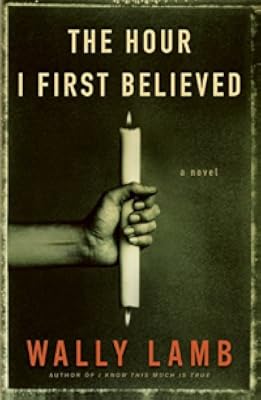
The Hour I First Believed
by Wally Lamb
On This Page
Description
Relocating to a family farm in Connecticut after surviving the Columbine school shootings, Caelum and Maureen discover a cache of family memorabilia dating back five generations, which reveals to Caelum unexpected truths about painful past events.Tags
Recommendations



Member Recommendations
Member Reviews
Do you ever go to a buffet that's so full of good food that you take some of everything and end up eating so much that you make yourself sick? Imagine that you've gone to an intellectual buffet with Wally Lamb who insists on loading your plate with idea after idea, digression after digression. Everything is good and tasty, but there's just too much. Lamb doesn't know when to stop. He thinks he has access to so much information he just has to share with the reader who, after all, may have no other books to read so no way to get a taste of all the delightful knowledge he's gained throughout years of research. Lucky readers, he has fed us, and fed us all too well. Only half way through the book my nausea began to rise. PTSD, school show more shootings, bullying, war, homosexuality, sibings,substance abuse, marriage, man-woman relationships, prison reform, the civil war, slavery, the history of Bavaria, Rheingold beer, creative writing, sculpting, suffragettes, donuts vs bagels, corn mazes, life quests, religion, psychiatry - now that I have finished I understand how force-fed geese feel. I have become Wally Lamb foie gras, but my suffering is over. Never again will I dine at Lamb's overstuffed table. show less
5 shining glorious stars! This is the best book I’ve read in years! Little did I know that I have had this treasure sitting on my shelves for years, and little did I know that I should have read it long ago. This book is one that will tear you down and then build you up again, over and over. I could not put it down, and I could never anticipate the next catastrophic event that would bring me down to earth again. The best book I’ve ever read that shows the resilience of human nature, and their strength. Caelum Quirk is a true anti- hero and we are there with him every step of the way as disaster after disaster hits him, and we’re there as he picks himself up, dusts himself off and then we go into the fray with him again. It all show more begins when Caelum’s wife Maureen is a victim of the Columbine shootings in Colorado. Even though she’s not injured during the whole thing, she is irrevocably changed for the rest of her life. And Caelum, as her husband, is also changed. That, coupled with the distressing illuminations from the unearthing of his old family archives and the devastating secrets buried there, put him on the edge of despair. We see the strength of the human race as he slowly claws himself out of the abyss. This is a book that I will remember forever, and darn it, now I have to read all Wally Lamb’s backlist in order to try to assimilate the brilliance of this author. Highly recommend! show less
This is one whopper of a book – 700+ pages – crammed with more themes than a magician’s hat has rabbits: post-traumatic stress, chaos theory, classic mythology, physical and spiritual labyrinths, family history, blood sacrifice, substance abuse, what makes a marriage, the American penal system, race relations, the search for spiritual peace, a decades-old mystery, and the recurrent and inexplicable appearance of praying mantis images.
In less skilled hands, it would be a hot mess. It’s to Lamb’s credit that he manages to keep it all together and keep it readable, though at times when he pulls yet another rabbit out of the hat, the reader is hard-pressed to restrain a “what now?” groan.
Ultimately, by the end, the main show more character finds peace when he realizes that life, like a labyrinth, is “baffling on the ground [but] begins to make sense when you can begin to rise above it.”
It’s a big, chewy, thoughtful book with a lot to consider. Don’t expect to polish this one off over a weekend, and don’t expect to get its questions out of your mind quickly. show less
In less skilled hands, it would be a hot mess. It’s to Lamb’s credit that he manages to keep it all together and keep it readable, though at times when he pulls yet another rabbit out of the hat, the reader is hard-pressed to restrain a “what now?” groan.
Ultimately, by the end, the main show more character finds peace when he realizes that life, like a labyrinth, is “baffling on the ground [but] begins to make sense when you can begin to rise above it.”
It’s a big, chewy, thoughtful book with a lot to consider. Don’t expect to polish this one off over a weekend, and don’t expect to get its questions out of your mind quickly. show less
Incredibly, relentlessly grim — tragedy upon tragedy upon tragedy, almost to the point of comedy, the sickest of jokes. Allow me to present a list of only some of the terrible things that these people do/have done to them/live through (SPOILERS): adultery, aggravated assault, the Columbine shootings, post-traumatic stress disorder, death in the family, forced prostitution, Hurricane Katrina, more adultery, drug addiction, vehicular homicide, prison, sexual assault, war, miscarriage, death of a spouse, suicide, dead babies in a suitcase aaaaaaggghhh I can’t take any more. Can’t these people catch a break?! It just piles up and up. And then? The worst part? The last twenty pages turn on a dime and everything starts looking up! Seven show more hundred pages of grinding, ceaseless misery, and suddenly people are laughing, joking, getting married, having babies, coming to terms with things. An unsatisfying and unpleasantly jarring end.
I do not like writing bad reviews, but after reading and very much enjoying two of Lamb's other novels, this one was a disappointment. show less
I do not like writing bad reviews, but after reading and very much enjoying two of Lamb's other novels, this one was a disappointment. show less
Lamb apparently spent almost a decade working on this, and I think that may be the fundamental problem. A guy this creative is bound to have scores of good ideas in that time, too many to shove into one book, but get the feeling that that's exactly what happened here. This is really enough content for four books, which he's tried to tie together by highlighting common themes. (Did I say "highlighting"? I meant, "hitting us over the head with them until we're dazed" - there is not much subtlety to it.) The net result is a story that incorporates over 150 years of events, a bewildering cast of characters with complicated backstories that don't end up mattering, distracting & unnecessary subplots, major symbol/metaphor overload, and so show more many themes that the interwoven plotlines end up feeling contrived and unreal.
Poor Caelum, Lamb's central character (think one of Philip Roth's doleful males in full mid-life crisis mode) - is there a disaster or hot-button issue in the 20th century that DOESN'T touch his life? The Iraq War, Columbine, Korea, Katrina, PTSD, tort abuse, penal reform, drunk driving, suicide, drug abuse, sexual abuse, abortion, women's rights ... after a while I started thinking of him as the anti-Forrest Gump, a man whose life improbably intersects with great events but who, rather than find ways to rise above the chaos, just keeps getting crushed anew, like Sisyphus rolling his boulder up that hill. (Which, by the way, is just one of the 20 or so sustained metaphors in the book - too many, too much!) After 750 pages you *finally* get to the "hour I first believed", by which time you may well be thinking, as I did, "did it really have to take this long?"
Wish Lamb had been brave enough to break this into 3-4 shorter works, each with a much smaller scope, fewer characters, and the time to explore in depth just a few metaphors and themes each. I'll take 3-4 tasty, meticulously crafted dinners over this big, overwhelming, rather sloppily prepared buffet of a book any day. show less
Poor Caelum, Lamb's central character (think one of Philip Roth's doleful males in full mid-life crisis mode) - is there a disaster or hot-button issue in the 20th century that DOESN'T touch his life? The Iraq War, Columbine, Korea, Katrina, PTSD, tort abuse, penal reform, drunk driving, suicide, drug abuse, sexual abuse, abortion, women's rights ... after a while I started thinking of him as the anti-Forrest Gump, a man whose life improbably intersects with great events but who, rather than find ways to rise above the chaos, just keeps getting crushed anew, like Sisyphus rolling his boulder up that hill. (Which, by the way, is just one of the 20 or so sustained metaphors in the book - too many, too much!) After 750 pages you *finally* get to the "hour I first believed", by which time you may well be thinking, as I did, "did it really have to take this long?"
Wish Lamb had been brave enough to break this into 3-4 shorter works, each with a much smaller scope, fewer characters, and the time to explore in depth just a few metaphors and themes each. I'll take 3-4 tasty, meticulously crafted dinners over this big, overwhelming, rather sloppily prepared buffet of a book any day. show less
This may only be Wally Lamb’s third novel, he’s not exactly prolific, but like Dylan in the mid-sixties, everything he creates is a grand-slam. This one follows an English teacher named Caelum Quirk and his wife, Maureen, who both happen to work at Columbine High School. The story covers the massacre and the nasty fallout, as these shell-shocked characters attempt to pull their damaged lives back in order. This is only act I, in a sprawling narrative, that finds Caelum reaching back into his colorful family history to find strength and closure. The story spans over a hundred and fifty years and this includes visits with Mark Twain, King Ludwig, Gettysburg, Katrina and the Iraq war and that is just a few high-lights. Wally Lamb’s show more style reminds me of early John Irving, who is also proficient at lobbing tragic curve-balls, reminding us that death is always hovering nearby. Highly recommended! show less
I'm so torn about this book. I loved that Wally Lamb addressed some tough issues like the Columbine tragedy, alcoholism, incarceration, etc...but, at times, I was completely bored and wondering 'where is this going?' I honestly could have done without the flashbacks to the 1800's. I'm a historical fiction lover, but these vignettes served no purpose to the story line as far as I'm concerned. If I'm going to rate this book on everything but the flashbacks, I'd say it was an average read. I'm glad I stuck it out, but even happier to move onto something else now....
Members
- Recently Added By
Lists

Best Family Stories
241 works; 22 members
Historical Fiction
889 works; 89 members

Family Drama
56 works; 14 members

Best family sagas
244 works; 34 members

Five star books
1,767 works; 110 members

Academia in Fiction
158 works; 23 members

Books Read in 2008
335 works; 8 members

Indie Next Picks
196 works; 4 members
Author Information

14+ Works 33,187 Members
Walter (Wally) Lamb was born in Norwich, Connecticut on October 17, 1950. He attended the University of Connecticut, receiving a B.A. in 1972 and an M.A. in 1977; he also earned an M.F.A. from Vermont College in 1984. Lamb has written numerous short stories, most notably "Astronauts", which received both the Pushcart Prize and the University of show more Missouri's William Peden Prize in 1990. He is also the author of the bestselling novels She's Come Undone, I Know This Much Is True, The Hour I First Believed and We Are Water. Lamb writes stories, he says, because he sometimes hears another voice in his head and feels the need to tell that character's story. He made The New York Times Best Seller List with his title We are Water. However, he feels an equally strong calling to teach, and has no plans to become a fulltime writer. He has taught English at the Norwich Free Academy since 1972, and for many years directed the Academy's writing center, which he also played a major role in creating. The idea for it developed as he became more involved in fiction writing himself and realized that the common methods of teaching composition, which involved grading a paper and commenting on it after the student was finished, were not particularly helpful. He set up a program that allowed students to get feedback from both teachers and peers early in the writing process, so that they could incorporate the suggestions into their final work. He currently teaches creative writing at the University of Connecticut. He is also the volunteer facilitator of a writing workshop at the York Correctional Institution. (Bowker Author Biography) show less
Some Editions
Awards and Honors
Distinctions
Work Relationships
Common Knowledge
- Canonical title
- The Hour I First Believed
- Original publication date
- 2008
- People/Characters
- Caelum Quirk; Maureen Quirk; Louella "Lolly" Quirk; Velvet Hoon; Moses; Janis (show all 7); Alphonse Buzzi
- Important places
- New Haven, Connecticut, USA; Littleton, Colorado, USA
- Important events
- Columbine School Shootings
- Epigraph
- And so, they moved over the dark waves, and even before they disembarked, new hordes gathered there. — Dante's Inferno, canto 3, lines 118-120
- Dedication
- For Anna —
A series of debilitating strokes and the onset of dementia necessitated the agonizing conversation I had with my mother in the winter of 1997. When I told her she'd be moving to a nearby nursing home, she... (show all) shook her head and, atypically, began to cry. Tears were a rarity for my stoic Sicilian-American mother. The next day, she offered me a deal. "Okay, I'll go," she said. "But my refrigerator comes with me." I couldn't meet her demand, but I understood it.
Ma's refrigerator defined her. The freezer was stockpiled with half-gallons of ice cream for the grandkids, and I do mean stockpiled; you opened that freezer compartment at your peril, hoping those dozen or so rock-hard bricks, precariously stacked, wouldn't tumble forth and give you a concussion. The bottom half of Ma's "icebox" was a gleaming tribute to aluminum--enough foil-wrapped Italian food to feed, should we all show up unexpectedly at once, her own family and the extended families of her ten siblings. But it was the outside of Ma's fridge that best spoke of who she was. The front and sides were papered with greeting cards, holy pictures, and photos, old and new, curling and faded, of all the people she knew and loved. Children were disproportionately represented in her refrigerator photo gallery. She adored kids—her own and everyone else's. My mother was a woman of strong faith, quiet resolve, and easy and frequent laughter.
This story's been a hard one to write, Ma, and it got harder after you left us. But I had the title from the very beginning, and when I reached the end, I realized I'd written it for you.
(P.S. Sorry about all those four-letter words, Ma. That's the characters speaking. Not me.) - First words
- They were both working their final shift at Blackjack Pizza that night, although nobody but the two of them realized it was that.
- Last words
- (Click to show. Warning: May contain spoilers.)Yes, that was when and how it happened. That was the hour I first believed.
Classifications
Statistics
- Members
- 4,071
- Popularity
- 3,816
- Reviews
- 177
- Rating
- (3.79)
- Languages
- Dutch, English, French, German
- Media
- Paper, Audiobook, Ebook
- ISBNs
- 34
- UPCs
- 1
- ASINs
- 14