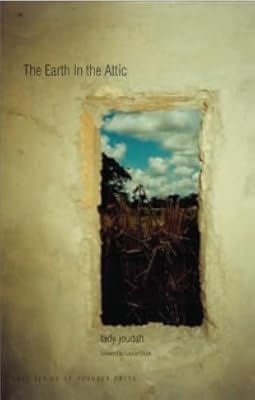
The Earth in the Attic
by Fady Joudah
On This Page
Description
Fady Joudah's The Earth in the Attic is the 2007 winner of the Yale Series of Younger Poets competition. In his poems Joudah explores big themes-identity, war, religion, what we hold in common-while never losing sight of the "idian, the specific. Contest judge Louise Gl©ơck describes the poet in her Foreword as "that strange animal, the lyric poet in whom circumstance and profession . . . have compelled obsession with large social contexts and grave national dilemmas." She finds in his show more poetry an incantatory quality and concludes, "These are small poems, many of them, but the grandeur of conception is inescapable. The Earth in the Attic is varied, coherent, fierce, tender; impossible to put down, impossible to forget." show lessTags
Recommendations








Member Reviews
Fady Joudah is a Palestinian-American poet, whose collection, [The Earth in the Attic], won the Yale Series of Younger Poets competition. A practicing emergency room physician and member of Doctors without Borders, Joudah has also translated the poetry of the Palestinian poets, Mahmoud Darwish and Ghassam Zaqtan. Although Joudah was born and lives in the United States, he was raised in the Middle East, his parents being Palestinian refugees. There is clarity to Joudah’s imagery and uniqueness in the way it integrates disparate worlds - being both American and from a family of Palestinian refugees, and a practitioner of medicine both in Houston and in poverty-stricken African countries.
“Sleeping Trees” is based on accompanying his show more father on a visit to his home village and is representative of how his poetry reflects the experience of the returning exile.
I found Joudah to be at his best when merging his experience as a physician with his humanitarian concerns. My favorite in this collection is “Pulse”, a poem delivered in 15 sections. In her introduction, Louise Gluck notes the likelihood that it is set in Darfur, where Joudah served with Doctors Without Borders. .
“Sleeping Trees” is based on accompanying his show more father on a visit to his home village and is representative of how his poetry reflects the experience of the returning exile.
….My father
Learned to fly in a dream. This is the story
Of a sycamore tree he used to climb
When he was young to watch the rain.
Sometimes it rained so hard it hurt. Like being
Beaten with sticks. Then the mud would run red.
My brother believed bad dreams could kill
A man in his sleep, he insisted
We wake my father from his muffled screams
On the night of the day he took us to see his village.
No longer his village he found his tree amputated. (3-13)
I found Joudah to be at his best when merging his experience as a physician with his humanitarian concerns. My favorite in this collection is “Pulse”, a poem delivered in 15 sections. In her introduction, Louise Gluck notes the likelihood that it is set in Darfur, where Joudah served with Doctors Without Borders. .
Halimah’s mother did not seem aware Halimah was dying.show less
You should have seen Halimah fight her airlessness
Twisting around for a comfortable spot in the world.
………………………….
…Halimah
Died of a failing heart
Early this dawn, her mother, with tears now,
Was on the road, twenty steps past me
Before I turned and found her waiting.
We walked back toward each other, we met, we
Read verses from the Quran,
Our palms open,
Elbows upright like surgeons
Ready to gown up after scrubbing, the slap
Of rubber gloves before we went our separate ways. (“Pulse 12”, 1-3, 9-19)
Ratings
Members
- Recently Added By
Lists

Decolonize Palestine's Reading List
126 works; 3 members
Author Information

7+ Works 214 Members
Awards and Honors
Awards
Series
Belongs to Publisher Series
Common Knowledge
- Canonical title
- The Earth in the Attic
- Original publication date
- 2008
Classifications
Statistics
- Members
- 45
- Popularity
- 661,734
- Reviews
- 1
- Rating
- (3.38)
- Languages
- English
- Media
- Paper, Ebook
- ISBNs
- 4