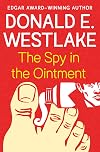
The Spy in the Ointment
by Donald E. Westlake
On This Page
Description
J. Eugene Raxford is not what anyone would call a debonair man of action. He has no class, no skills, and all the physical prowess of a napping tree sloth. James Bond would think twice before letting him park the Aston Martin. Though he is a devoted pacifist, Raxford is also-thanks to a tragically consequential typo-the supposed leader of a half-baked and violent radical organization. That's why the FBI wants him to go undercover and spy on the consortium of real-life terrorists and deadly show more assassins. Now, with the help of his girlfriend-who is even more clueless than he-Raxford is about to enter a realm of danger and deception unlike any he has ever imagined. And the safety of the entire world depends on his every move. show lessTags
Recommendations




















Member Reviews
The late Donald E. Westlake had three words posted on a sign above his Smith-Corona typewriter: 'WEIRD VILLAIN LIAISON." Those were the words that gave him fits when writing because he could never remember the proper order of the vowels.
I thought of this while reading his 1966 novel “The Spy in the Ointment,” which is about a liaison of weird villains.
This novel came early in Westlake's career, soon after he shifted from serious crime novels to comic crime novels. The narrator is J. Eugene Raxford, a pacifist. In the 1960s the feds were as suspicious of pacifists as they are now of Republicans, and so they tap his phone and monitor his movements. Gene knows about it but doesn't much care. He's a true pacifist, after all.
To prove how show more harmless he is, Gene agrees to become an FBI spy at a meeting of representatives from small fringe groups on both the far left and the far right. Most of these people seem too wacky (or weird) to be dangerous to anyone, but that is not true of the leader of this meeting, a young man whose evil plans include blowing up the United Nations building. The weird villains are his patsies. What's more, he is the brother of Angela, Gene's wealthy girlfriend, who goes with him to this meeting and whose life he must ultimately put aside his pacifism to save.
Many complications pile up in barely 200 pages, most of them comic, but for a comic novel there are a surprising number of bodies lying around when it's all over.
“The Spy in the Ointment” is not Westlake at his best — that will come later with the Dortmunder novels and especially his classic “Dancing Aztecs”;— but it shows him in the process of developing his talent as an author of comic crime. show less
I thought of this while reading his 1966 novel “The Spy in the Ointment,” which is about a liaison of weird villains.
This novel came early in Westlake's career, soon after he shifted from serious crime novels to comic crime novels. The narrator is J. Eugene Raxford, a pacifist. In the 1960s the feds were as suspicious of pacifists as they are now of Republicans, and so they tap his phone and monitor his movements. Gene knows about it but doesn't much care. He's a true pacifist, after all.
To prove how show more harmless he is, Gene agrees to become an FBI spy at a meeting of representatives from small fringe groups on both the far left and the far right. Most of these people seem too wacky (or weird) to be dangerous to anyone, but that is not true of the leader of this meeting, a young man whose evil plans include blowing up the United Nations building. The weird villains are his patsies. What's more, he is the brother of Angela, Gene's wealthy girlfriend, who goes with him to this meeting and whose life he must ultimately put aside his pacifism to save.
Many complications pile up in barely 200 pages, most of them comic, but for a comic novel there are a surprising number of bodies lying around when it's all over.
“The Spy in the Ointment” is not Westlake at his best — that will come later with the Dortmunder novels and especially his classic “Dancing Aztecs”;— but it shows him in the process of developing his talent as an author of comic crime. show less
2.5 stars.
This is not his best, but still an entertaining crime caper from 1966. Cold war counter spies play a big role, so it's obviously dated.
This is not his best, but still an entertaining crime caper from 1966. Cold war counter spies play a big role, so it's obviously dated.
Humorous fun
Ratings
Members
- Recently Added By
Author Information

270+ Works 27,923 Members
Author Donald E. Westlake was born in Brooklyn, New York on July 12, 1933. He attended colleges in New York, but did not graduate. He wrote more than 100 novels and 5 screenplays throughout his lifetime. He also wrote under numerous pseudonyms including Richard Stark, Tucker Coe, and Samuel Holt. Almost 20 of his novels were adapted into films and show more he created the television series, The Father Dowling Mysteries. He is a three-time winner of the Edgar Award from the Mystery Writers of America and was nominated for an Academy Award for his screenplay for The Grifters. He was also named a Mystery Writers of America Grand Master in 1993. He died of a heart attack on December 31, 2008 at the age of 75. (Bowker Author Biography) Donald E. Westlake has won three Edgar Awards & was nominated for an Academy Award for Best Adapted Screenplay for "The Grifters". He lives in upstate New York. (Publisher Provided) show less
Some Editions
Awards and Honors
Distinctions
Series
Belongs to Publisher Series
Common Knowledge
- Original title
- The Spy in the Ointment
- Original publication date
- 1966
- Epigraph
- I don't want to offend nobody. - Folk Saying
- Dedication
- To Phil and Nedra
- First words
- I was trying to fix the damn mimeograph machine when the doorbell rang.
- Last words
- (Click to show. Warning: May contain spoilers.)Our signs? You know what they said.
They said: Ban the Bomb
Classifications
Statistics
- Members
- 224
- Popularity
- 145,663
- Reviews
- 3
- Rating
- (3.56)
- Languages
- 5 — Catalan, English, Finnish, French, Swedish
- Media
- Paper, Ebook
- ISBNs
- 13
- ASINs
- 8