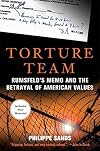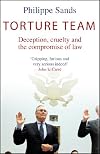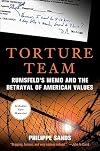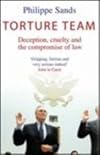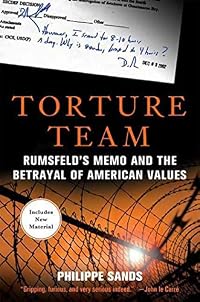
Torture Team: Rumsfeld's Memo and the Betrayal of American Values
by Philippe Sands
On This Page
Description
The shocking revelations of the men and women who adopted and enforced Rumsfeld's 2002 memo that paved the way for the inhuman interrogation practices at Guantanamo and Abu Ghraib. On December 2, 2002 the U.S. Secretary of Defense, Donald Rumsfeld, signed his name at the bottom of a document that listed eighteen techniques of interrogation--techniques that defied international definitions of torture. The Rumsfeld Memo authorized the controversial interrogation practices that later migrated show more to Guantanamo, Afghanistan, Abu Ghraib and elsewhere, as part of the policy of extraordinary rendition. From a behind-the-scenes vantage point, Phillipe Sands investigates how the Rumsfeld Memo set the stage for a divergence from the Geneva Convention and the Torture Convention and holds the individual gatekeepers in the Bush administration accountable for their failure to safeguard international law. The Torture Team delves deep into the Bush administration to reveal: - How the policy of abuse originated with Donald Rumsfeld, Dick Cheney and George W. Bush, and was promoted by their most senior lawyers - Personal accounts, through interview, of those most closely involved in the decisions - How the Joint Chiefs and normal military decision-making processes were circumvented - How Fox TV's 24 contributed to torture planning - How interrogation techniques were approved for use - How the new techniques were used on Mohammed Al Qahtani, alleged to be "the 20th highjacker" - How the senior lawyers who crafted the policy of abuse exposed themselves to the risk of war crimes charges show lessTags
Recommendations


































Member Reviews
Surprisingly gripping. Sands is very good at making a compelling narrative out of the actions of US government lawyers which paved the way for torture in Guantanamo, and arguably, Abu Ghraib. Must read.
I struggled through this book and limped to the end of it, skimming liberally. I had heard an interview with Sands on NPR about this book over the summer & thought it sounded fascinating. Although it is an important book about a serious issue that merits attention, the book really killed me. Even though its based on current events that have been widely covered in the papers, I had such a hard time keeping track of the jumble of actors involved. The book's organizational structure was confusing too - it seemed to jump around in time a bit, and I found myself having to constantly ask myself when in time I was & what had already happened in the storyline. This is the kind of book that requires the reader to put it down often, make sense of show more things, and take breaks. Unfortunately its also the kind of book where if the reader puts it down for a while, s/he is likely to be completely confused simply trying to remember who everyone is when s/he does pick it back up again.
Ultimately what emerges is a very sad picture of violations of international law, which is the picture that I already had from press articles on the matter, so I don't really know what I gained from reading this book other than a sense of how vast and bizarre the military-legal bureaucracy is. Still, its not as though its a bad book, so I feel badly trashing it. The low rating reflects my disappointment with the book more than the fact that its not a good book, I guess. show less
Ultimately what emerges is a very sad picture of violations of international law, which is the picture that I already had from press articles on the matter, so I don't really know what I gained from reading this book other than a sense of how vast and bizarre the military-legal bureaucracy is. Still, its not as though its a bad book, so I feel badly trashing it. The low rating reflects my disappointment with the book more than the fact that its not a good book, I guess. show less
Sands provides a strinking direct lineage between Rusmfeld and the torturers at Gunatanamo. Shows the bureaucratic and legal manuvering which allowed for systemic and prolonged torture.
Shocking story of how the Bush Administration subverted what Americans believe
A great place ffor a prosecutor to begin the investigation into the Bush era.
Ratings
Members
- Recently Added By
Author Information

17+ Works 2,337 Members
Philippe Sands was born in 1960 in London. He is a graduate of Corpus Christi College, Cambridge, receiving his B.A. in 1982 and his LLM, first class honours in 1983. He finished his postgraduate studies at Cambridge and was a visiting scholar at Harvard Law School. He has held positions at numerous distinguished universities around the world. He show more was called to the Bar of England and Wales in 1985. He has written numerous academic and general nonfiction books, newspaper articles, book reviews, and more. His books include Lawless World, and Torture Team. In 2016, he won the Baillie Gifford Prize for nonfiction, for East West Street: On the Origins of Genocide and Crimes against Humanity. (Bowker Author Biography) show less
Awards and Honors
Awards
Common Knowledge
- Canonical title*
- Tortures made in USA
- Original title
- Torture Team: Deception, Cruelty and the Compromise of Law
- Original publication date
- 2008
- People/Characters
- George W. Bush; Dick Cheney; Donald Rumsfeld; Alberto Gonzalez; David Addington; Paul Wolfowitz (show all 12); Douglas Feith; John Ashcroft; John Bybee; John Yoo; George Tenet; Colin Powell
- Important places
- Guantanamo Bay, Cuba
- Epigraph
- We also have to work, though, sort of the dark side, if you will. ... it's going to be vital for us to use any means at our disposal, basically, to achieve our objective. — Vice President Dick Cheney, "Meet the Press... (show all)," 16 September 2001
In situations like this you don't call in the tough guys; you call in the lawyers. — Former CIA Director George Tenet, At the Center of the Storm, 2007 - Dedication
- For my parents, Allan and Ruth
- First words
- Only a few pieces of paper can change the course of history.
- Last words
- (Click to show. Warning: May contain spoilers.)A long way from the eighteen techniques.
- Blurbers
- Le Carré, John
*Some information comes from Common Knowledge in other languages. Click "Edit" for more information.
Classifications
- Genres
- Politics and Government, Nonfiction, General Nonfiction, History
- DDC/MDS
- 341.48 — Society, Government, and Culture Law International Law - United Nations, EU Jurisdiction and human rights Human rights law
- LCC
- K5304 .S26 — Law Comparative law. International uniform law Criminal law and procedure Criminal law
- BISAC
Statistics
- Members
- 140
- Popularity
- 231,303
- Reviews
- 5
- Rating
- (3.86)
- Languages
- English, French
- Media
- Paper, Ebook
- ISBNs
- 5
- UPCs
- 1
- ASINs
- 3