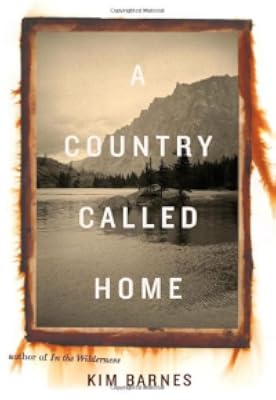
A Country Called Home
by Kim Barnes
On This Page
Description
Driven by youthful idealism, Thomas Deracotte and his pregnant wife, Helen, leave upper-crust Connecticut for a utopian adventure in the Idaho wilderness, purchasing a dilapidated local farm and optimistically setting up housekeeping with the help of a local boy.Tags
Recommendations

























Member Reviews
This is a magical, heartbreaking, and elemental book which nonetheless makes the reader want to smack at least two of the main characters upside the head and tell them to stop being such immature, self-centered, entitled babies.
It's also a story of obsession and loss and the lengths we will travel to fill the aching emptiness within.
Thomas Deracotte and his pampered, pregnant wife are perhaps the worst possible candidates to rehabilitate a deserted farm in the wilderness of north central Idaho in 1960. Totally unprepared by both personality and life experience, their ambitious but poorly planned adventure is doomed to failure. Self-indulgent and willful Helen spends her days napping and reading, lolling half-dressed around the tent show more meant only as a temporary shelter, while Thomas ignores the crumbling buildings and weed-choked fields of his fantasy farm to indulge in his real passion, fly-fishing in the river that runs through the property. Neither is making any effort (or, therefore, progress) toward their stated goal of rehabilitating the farm or to have Thomas open a small medical practice in the closest village.
Local hired men and a homeless boy are enlisted to save the hapless couple from their own navel-gazing paralysis, and by the time Helen's pregnancy comes to a terrifying and bloody end, young Manny has taken on the curious role of hired hand, foster son, master farmer, nursemaid, and odd-man-out in an increasingly fragile and unhealthy relationship between Helen and Thomas. The relationship becomes even more fraught when Helen drowns under suspicious circumstances, and her daughter Elise is left to grow up in almost primitive isolation with her father and Manny, her ties to reality growing ever more tenuous.
Filled with flawed by realistic characters and set against the magnificent isolation of the forest around them, the novel teeters between tragedy and hope as it tests the boundaries of what love makes possible. show less
It's also a story of obsession and loss and the lengths we will travel to fill the aching emptiness within.
Thomas Deracotte and his pampered, pregnant wife are perhaps the worst possible candidates to rehabilitate a deserted farm in the wilderness of north central Idaho in 1960. Totally unprepared by both personality and life experience, their ambitious but poorly planned adventure is doomed to failure. Self-indulgent and willful Helen spends her days napping and reading, lolling half-dressed around the tent show more meant only as a temporary shelter, while Thomas ignores the crumbling buildings and weed-choked fields of his fantasy farm to indulge in his real passion, fly-fishing in the river that runs through the property. Neither is making any effort (or, therefore, progress) toward their stated goal of rehabilitating the farm or to have Thomas open a small medical practice in the closest village.
Local hired men and a homeless boy are enlisted to save the hapless couple from their own navel-gazing paralysis, and by the time Helen's pregnancy comes to a terrifying and bloody end, young Manny has taken on the curious role of hired hand, foster son, master farmer, nursemaid, and odd-man-out in an increasingly fragile and unhealthy relationship between Helen and Thomas. The relationship becomes even more fraught when Helen drowns under suspicious circumstances, and her daughter Elise is left to grow up in almost primitive isolation with her father and Manny, her ties to reality growing ever more tenuous.
Filled with flawed by realistic characters and set against the magnificent isolation of the forest around them, the novel teeters between tragedy and hope as it tests the boundaries of what love makes possible. show less
A beautifully written book that tantalizes the reader with seductions of all types; the lure of nature and simple living, the demons of substance abuse, the desire for joining with another. The story is unexpected at every turn. A young, newly-married couple leaves Connecticut for Idaho. The husband, Thomas, a physician, never makes good on his professional training and becomes enthralled with the river and its fish. Helen, his wife, bears their child but becomes increasingly lonely and isolated. Just after having their daughter, she dies and leaves behind Thomas, the baby Elise, and the caretaker Manny who serves as parents to Elise. Each relationship is delicate but fully described. A haunting book.
Spare, beautifully crafted novel about a young couple that move to a small town in Idaho to pursue their back to nature fantasies. Both come with emotional baggage and end up in this wild place for the wrong reasons and without the right skills. Predictably, things begin to go tragically wrong. At one level the novel is about how early decisions in life have lasting consequences. At a more optimistic level it is also about the strength of the human spirit to persist and even find beauty in meaning in adversity.
A Country Called Home is an exquisitely-told story of a couple who leaves behind a privileged life in Connecticut to carve out a hardscrabble existence in the Idaho wilderness. The story begins in 1960 when Thomas Deracotte and his young, pregnant wife decide to buy a dilapidated farm on the outskirts of a small town. After a sudden tragedy, the family is left to pick up the pieces in an unfamiliar, and often inhospitable, landscape. As the Deracotte's daughter spends her time riding horses and avoiding other children her age, Thomas Deracotte often turns to fly-fishing as an escape. This book's best passages describe the Idaho countryside, particularly the river running along the edge of the Deracotte's farm and its narcotic effect on show more the family's patriarch:
"Even after all the hours spent with a rod in his hands, each strike seemed a surprise rather than the end result of his studied experiment: the fly carefully selected to match hatch and season; the cast so nearly perfect that the feathered hook whispered down like a caddis dipping its wings; the placement at the lip of current just shy of stone; the rise and roll and set. He would bring the fish in, cradle it just below the surface, and rock it softly until it spasmed free."
This novel is deeply grounded in its western setting, which Barnes evokes with beautifully poetic prose. Despite her gift with landscapes, Barnes does not shortchange the human element of this story, and A Country Called Home is populated with sympathetic characters and several lively plot lines. Although the Deracotte's endure loneliness, death, addiction, and mental illness, their story is ultimately hopeful. It's rare to find such striking prose in a page-turner, but A Country Called Home has it all. The overall effect is a powerful book that feels like a classic already.
This review also appears on my blog Literary License. show less
"Even after all the hours spent with a rod in his hands, each strike seemed a surprise rather than the end result of his studied experiment: the fly carefully selected to match hatch and season; the cast so nearly perfect that the feathered hook whispered down like a caddis dipping its wings; the placement at the lip of current just shy of stone; the rise and roll and set. He would bring the fish in, cradle it just below the surface, and rock it softly until it spasmed free."
This novel is deeply grounded in its western setting, which Barnes evokes with beautifully poetic prose. Despite her gift with landscapes, Barnes does not shortchange the human element of this story, and A Country Called Home is populated with sympathetic characters and several lively plot lines. Although the Deracotte's endure loneliness, death, addiction, and mental illness, their story is ultimately hopeful. It's rare to find such striking prose in a page-turner, but A Country Called Home has it all. The overall effect is a powerful book that feels like a classic already.
This review also appears on my blog Literary License. show less
This book is split into multiple parts that go back and forth over decades. It's multiple POVs in third person, sometimes changing every few pages, somethings every few paragraphs. Part I is 182 pages long in the ebook I read, and is completely pointless. The story doesn't begin until page 183, which is Part II. The author does an excellent job distilling the information of the previous 182 pages into just a few. The few pages and sprinkles of paragraphs are spread neatly. It's like the author and editor realized the first 182 pages weren't needed, but forgot to remove them. I resent that my time was wasted; I'd been hoping for a story sooner than that.
Deracotte is utterly useless as a character and reinforces my belief that the story show more doesn't begin until Part II. In Part I, he moves out to a frontier with his young wife who is from old money. Neither can do chores, but Helen learns: to cook. split logs, plant food--farm and homestead things. Deracotte does not. He never even tries. He doesn't even want to be a physician, for which he has training, and wants to be a pharmacist. He takes no steps to change his career, though. He is MISERABLE, but WON'T MOVE HOME. His wife's death makes everything worse. All he does in response is fish and get hooked on drugs, and forget his daughter exists. Manny is a young farmhand who does all Deracotte's chores for him, cares for his daughter from her infant years to teens, and later, has raised her all his own. WHAT A WASTE OF PAGES. HAVE MANNY BE THE STEPDAD, AND BOTH BIO-PARENTS DIE SOONER. That's clearly what the book was angling for. It was just too afraid to name it. Rrgh! The daughter, named Elise, has maternal grandparents who try to get custody of her. Somehow, this was successfully fought and I was furious. Manny was in over his head. The grandparents, from a financial perspective alone, would have more resources for caretaking. It would especially have made for a more interesting story!
Instead, Elise's latest love interest comes to town. He's a preacher's kid. That can't be easy. He...gets Elise to convert to a form of Christianity that involves immersion baptisms, speaking in tongues, fainting, and dancing; all after attending six sermons. Here, it's revealed she has synesthesia. I was -delighted- to find this was a book I'd been looking for, and remembered the ending and laughed Worth it to sit through such a boring, wasteful book: turns out I'd been looking for it for two separate reasons, for awhile now. When I first read this, it was utterly forgettable except for the synesthesia as a subplot, and another incident. The preacher's wife is understandably disgusted and furious with Elise for giving her son a blowjob while the preacher and his wife are maybe four feet away. This happens at the end of chapter fourteen. Elise's synesthesia happens in chapter fifteen. By chapter sixteen, Elise is in an inaccurate mental hospital with over-the-top mental patients. Luke shows up and I wondered, irritably and disgusted, if Elise was going to give him a public blowjob too. No, but he sticks his arms in the water while she bathes and they have sex on the floor. She gets pregnant.
For a book that portrayed eating disorders and mental hospitals respectfully and accurately, I recommend "Wasted" by Marya Hornbacher. This book's epilogue didn't feel like one; it felt like a chapter transition. I was glad it was finally over. show less
Deracotte is utterly useless as a character and reinforces my belief that the story show more doesn't begin until Part II. In Part I, he moves out to a frontier with his young wife who is from old money. Neither can do chores, but Helen learns: to cook. split logs, plant food--farm and homestead things. Deracotte does not. He never even tries. He doesn't even want to be a physician, for which he has training, and wants to be a pharmacist. He takes no steps to change his career, though. He is MISERABLE, but WON'T MOVE HOME. His wife's death makes everything worse. All he does in response is fish and get hooked on drugs, and forget his daughter exists. Manny is a young farmhand who does all Deracotte's chores for him, cares for his daughter from her infant years to teens, and later, has raised her all his own. WHAT A WASTE OF PAGES. HAVE MANNY BE THE STEPDAD, AND BOTH BIO-PARENTS DIE SOONER. That's clearly what the book was angling for. It was just too afraid to name it. Rrgh! The daughter, named Elise, has maternal grandparents who try to get custody of her. Somehow, this was successfully fought and I was furious. Manny was in over his head. The grandparents, from a financial perspective alone, would have more resources for caretaking. It would especially have made for a more interesting story!
Instead, Elise's latest love interest comes to town. He's a preacher's kid. That can't be easy. He...gets Elise to convert to a form of Christianity that involves immersion baptisms, speaking in tongues, fainting, and dancing; all after attending six sermons. Here, it's revealed she has synesthesia. I was -delighted- to find this was a book I'd been looking for, and remembered the ending and laughed Worth it to sit through such a boring, wasteful book: turns out I'd been looking for it for two separate reasons, for awhile now. When I first read this, it was utterly forgettable except for the synesthesia as a subplot, and another incident. The preacher's wife is understandably disgusted and furious with Elise for giving her son a blowjob while the preacher and his wife are maybe four feet away. This happens at the end of chapter fourteen. Elise's synesthesia happens in chapter fifteen. By chapter sixteen, Elise is in an inaccurate mental hospital with over-the-top mental patients. Luke shows up and I wondered, irritably and disgusted, if Elise was going to give him a public blowjob too. No, but he sticks his arms in the water while she bathes and they have sex on the floor. She gets pregnant.
For a book that portrayed eating disorders and mental hospitals respectfully and accurately, I recommend "Wasted" by Marya Hornbacher. This book's epilogue didn't feel like one; it felt like a chapter transition. I was glad it was finally over. show less
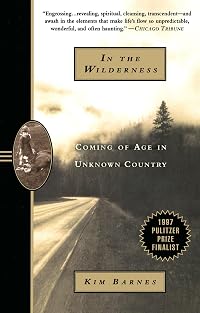
read her memoir In The Wilderness first
Ratings
Members
- Recently Added By
Lists

Top Five Books of 2021
604 works; 180 members

Carole's List
445 works; 13 members
Author Information

13+ Works 920 Members
Kim Barnes is the author of "In the Wilderness", which was a 1997 Pulitzer Prize finalist, & the winner of the PEN/Jerard Fund Award, awarded biennially to a woman writer early in her career for a work-in-progress of general nonfiction. She lives with her husband & three children in Lenore, Idaho. (Bowker Author Biography)
Awards and Honors
Awards
Common Knowledge
- Canonical title
- A Country Called Home
- Original publication date
- 2008-09-30
- People/Characters
- Thomas Deracotte; Helen Deracotte; Manny; Elise Deracotte
- Important places
- Connecticut, USA; Idaho, USA
- Epigraph
- If a man could pass through Paradise in a dream, and have a flower presented to him as a pledge that his soul had really been there, and if he found that flower in his hand when he awake--aye, what then?
Samuel Taylor ... (show all)Coleridge - Dedication
- for my father--beliver in dreams--your vision yet guides me
- First words
- First, the river.
- Last words
- (Click to show. Warning: May contain spoilers.)He wishes he had held her for a moment longer, long enough to tell her all that she was, and, to him, everthing.
- Blurbers
- Spragg, Mark; Udall, Brady; Kitteredge, William; Davis, Claire
Classifications
Statistics
- Members
- 148
- Popularity
- 221,128
- Reviews
- 6
- Rating
- (3.50)
- Languages
- English
- Media
- Paper, Ebook
- ISBNs
- 4
- ASINs
- 1