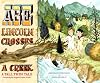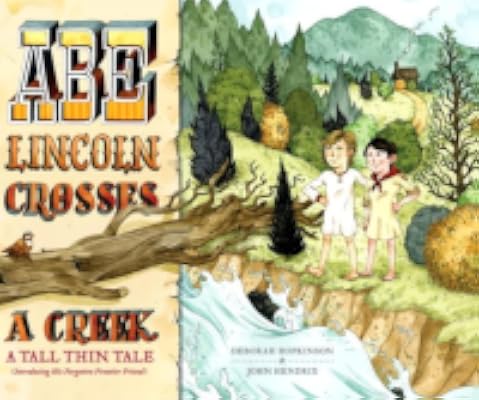
Abe Lincoln Crosses a Creek: A Tall, Thin Tale (Introducing His Forgotten Frontier Friend)
by Deborah Hopkinson
On This Page
Description
In Knob Creek, Kentucky, in 1816, seven-year-old Abe Lincoln falls into a creek and is rescued by his best friend, Austin Gollaher.Tags
Recommendations

Member Reviews
Wtf? Twee story-telling, with distracting structure and meta details. I did like the two morals, that 1. there are important ppl who don't become famous and 2. history is something you can't know for sure unless you were there. Ah, shiny library displays....
If in 2007 a book appeared by a 90 year old author claiming to have been a boyhood friend of JFK, relating an experience where the two as boys nearly drowned in the Charles River of Boston one summer day, where the author saved the young JFK's life and thus played an important role in our nation's history (who would have defeated Nixon in 1960 if JFK weren't even alive?), and there was no one alive who could refute it...
Did it really happen? And would we tell the story as a picture book?
Abe Lincoln Crosses a Creek tells a similar story concerning Abraham Lincoln's Kentucky neighbor Austin Gollaher, about how the the two as young boys attempted to cross a creek, and how Austin rescued Lincoln which allowed him to live and, eventually, show more become our 16th president. The book attempts to tie up this story with the moral that "what we do matters, even if we don't end up in history books."
That's all well and good, but who's to say it happened? Hopkinson sites at the beginning of the book two titles that quote Gollagher from 1898 and 1921 and a third from 1922 that confirms the story, probably taken from the same sources. Given all the biographical scholarship on Lincoln done in the past 90 years it seems odd that more recent references couldn't be cited.
Unless the story couldn't be proven to modern standards.
Here, again, we see another recent example of the "storyography," the biographical recounting that place story before biography and, in this case, the anecdotal above the known. Hopkinson covers her bases by saying "The events described in this story, so far as this author can determine... did, in fact, take place..." Yes, well, short of Lincoln's personal account, or a third party's account, what we have is, as the subtitle indicates, a tall tale concerning a real individual from history. And since it is a tall tale is there really any reason to lend the story a level of legitimacy by pointing out sources? Does the fact that Lincoln is a character require this level of explanation?
And, as always, shouldn't this information be spelled out to the reader in the text and not placed in tiny type on the Library of Congress page intended for adults who won't be as nearly confused about the legitimacy of the story as the intended reader?
Actually, Hopkinson does attempt to alert the reader in the text that the story contains some questionable details. At the point when Lincoln falls into the creek a giant, incongruous caution warning splashes across the illustration announcing "I want to make sure we get this right. Because maybe it didn't happen like that." The narrative then proceeds with an alternative version of the event in question because, as Hopkinson later suggests, "For that's the thing about history – if you weren't there, you can't know for sure."
Ah, I see. Because we were not there, because the source of the story is perhaps an interested party who could profit from the attention of having been the late president's boyhood friend, because no one can say for sure it didn't happen we can proceed to tell this story as if it did.
A book is a powerful thing. It represents the labors of a lot of people – writers and illustrators, editors and publishers and printers – and when presented by adults like parents, librarians, and teachers takes on the weight of authority in a young reader's eyes. They would not have gone through all this trouble if the story weren't true, would they? When a child is handed Abe Lincoln Crosses a Creek and reads the text only, do they have any reason to doubt the story happened as described, or at all? Do we teach young readers how and when to question historical events and to vet them for accuracy? No, of course not. They accept what they are given because they trust adults to be honest with them.
That said I do not suggest that Abe Lincoln Crosses a Creek should not have been written, and that other books that attempt to tell historical anecdotes from the childhood of historical figures cannot be retold, only that it be clearly and directly related to the reader that such stories might not be factually accurate. There should no question in a reader's mind about the story they have just been told, nor should they confuse that story for history if there is any question.
I have an unusual perspective in this area, having been researching Lincoln's life from the period just after the events in this book. Earlier biographies contain second and third hand accounts of events that do not hold water in biographies written after the 1920s. In fact, I could write a few similar picture books concerning the pre-teen life of Lincoln that, while entertaining, would not be considered accurate by modern Lincoln scholars.
For the past decade we've seen a number of biographical picture books that seem to escape the rigor and expectations we would apply to books intended for older readers. This is a mistake, because (and I think I've said this many times before) that this young age is when we do the most damage in terms of misinformation. Children today STILL have heard the story of Washington chopping down a cherry tree when we now know that the story was a fabrication of Washington's childhood neighbors, told to their children as a morality story, recounted to biographer Parson Weems as gospel truth. It is not true and yet the power of this misinformation still courses through our national psyche.
Accuracy should not suffer at the hands of entertainment, not in the books we present to picture book readers. "What we do matters."
Exactly. show less
Did it really happen? And would we tell the story as a picture book?
Abe Lincoln Crosses a Creek tells a similar story concerning Abraham Lincoln's Kentucky neighbor Austin Gollaher, about how the the two as young boys attempted to cross a creek, and how Austin rescued Lincoln which allowed him to live and, eventually, show more become our 16th president. The book attempts to tie up this story with the moral that "what we do matters, even if we don't end up in history books."
That's all well and good, but who's to say it happened? Hopkinson sites at the beginning of the book two titles that quote Gollagher from 1898 and 1921 and a third from 1922 that confirms the story, probably taken from the same sources. Given all the biographical scholarship on Lincoln done in the past 90 years it seems odd that more recent references couldn't be cited.
Unless the story couldn't be proven to modern standards.
Here, again, we see another recent example of the "storyography," the biographical recounting that place story before biography and, in this case, the anecdotal above the known. Hopkinson covers her bases by saying "The events described in this story, so far as this author can determine... did, in fact, take place..." Yes, well, short of Lincoln's personal account, or a third party's account, what we have is, as the subtitle indicates, a tall tale concerning a real individual from history. And since it is a tall tale is there really any reason to lend the story a level of legitimacy by pointing out sources? Does the fact that Lincoln is a character require this level of explanation?
And, as always, shouldn't this information be spelled out to the reader in the text and not placed in tiny type on the Library of Congress page intended for adults who won't be as nearly confused about the legitimacy of the story as the intended reader?
Actually, Hopkinson does attempt to alert the reader in the text that the story contains some questionable details. At the point when Lincoln falls into the creek a giant, incongruous caution warning splashes across the illustration announcing "I want to make sure we get this right. Because maybe it didn't happen like that." The narrative then proceeds with an alternative version of the event in question because, as Hopkinson later suggests, "For that's the thing about history – if you weren't there, you can't know for sure."
Ah, I see. Because we were not there, because the source of the story is perhaps an interested party who could profit from the attention of having been the late president's boyhood friend, because no one can say for sure it didn't happen we can proceed to tell this story as if it did.
A book is a powerful thing. It represents the labors of a lot of people – writers and illustrators, editors and publishers and printers – and when presented by adults like parents, librarians, and teachers takes on the weight of authority in a young reader's eyes. They would not have gone through all this trouble if the story weren't true, would they? When a child is handed Abe Lincoln Crosses a Creek and reads the text only, do they have any reason to doubt the story happened as described, or at all? Do we teach young readers how and when to question historical events and to vet them for accuracy? No, of course not. They accept what they are given because they trust adults to be honest with them.
That said I do not suggest that Abe Lincoln Crosses a Creek should not have been written, and that other books that attempt to tell historical anecdotes from the childhood of historical figures cannot be retold, only that it be clearly and directly related to the reader that such stories might not be factually accurate. There should no question in a reader's mind about the story they have just been told, nor should they confuse that story for history if there is any question.
I have an unusual perspective in this area, having been researching Lincoln's life from the period just after the events in this book. Earlier biographies contain second and third hand accounts of events that do not hold water in biographies written after the 1920s. In fact, I could write a few similar picture books concerning the pre-teen life of Lincoln that, while entertaining, would not be considered accurate by modern Lincoln scholars.
For the past decade we've seen a number of biographical picture books that seem to escape the rigor and expectations we would apply to books intended for older readers. This is a mistake, because (and I think I've said this many times before) that this young age is when we do the most damage in terms of misinformation. Children today STILL have heard the story of Washington chopping down a cherry tree when we now know that the story was a fabrication of Washington's childhood neighbors, told to their children as a morality story, recounted to biographer Parson Weems as gospel truth. It is not true and yet the power of this misinformation still courses through our national psyche.
Accuracy should not suffer at the hands of entertainment, not in the books we present to picture book readers. "What we do matters."
Exactly. show less
What we do in life does matter - even if we're not famous, even if no one is watching, even if we're only ten years old. That's the message in this little-known true story from Abraham Lincoln's childhood.
Delightfully told,
"Now, I can just hear you grumblin', Who? That feller isn't in my history book. What do I care?"
and humorously illustrated, Abe Lincoln Crosses a Creek is a fun read-aloud with a great message.
Delightfully told,
"Now, I can just hear you grumblin', Who? That feller isn't in my history book. What do I care?"
and humorously illustrated, Abe Lincoln Crosses a Creek is a fun read-aloud with a great message.
I absolutely loved this book. I loved this book because of the way the author told the story about Abe Lincoln and his friend Austin. The author told this story as if it was actually being narrated as the reader is reading. I felt the story come to life; almost like the author was sitting in front of me telling me this story. It made the tale that much more interesting. The author starts some pages saying "Now, where were we? Oh, I know-Austin's just waved at his friend. Remember?" This way of writing was very creative and fun. Next, I loved the illustrations. John Hendrix did an amazing job of matching the text. I thought it was creative too that he decided to illustrate onomatopeia. There really is such a difference in the way you show more read words like "Splash!" and "Whoop!" when it's more animated in the book. Finally, I liked how the author stated the moral of the story. Austin and Abe were friends all along but they ended up drifting apart. The author writes on the last page, "About all that's left is to remind you of the moral of our story: Listen to your mother and don't go near any swollen creeks." But that's not the true moral. The moral of this story is that what you do in this world matters. Even if what you do doesn't end up in a history book, it still makes an impact, just like Austin being Abe's friend impacted all of us. Overall, this book was organized, engaging, and well paced. An excellent book to read to students. show less
This book was astounding for three reasons. Firstly, the narration that takes place throughout the story is very witty and entertaining. It is almost as if Deborah Hopkins is talking you through the creation of the story itself. For instance, Hopkins says, "Here comes the bit that’s a mite scary--the part where if this were a movie, the music would get rumbly and you might cover your eyes," and then continues on to tell what happens next in the story. I can imagine how engaging and exciting this story must be for young readers. Secondly, the illustrations are captivating and unique. The style that John Hendrix uses is cartoon-like, with watercolors, pen and ink. The illustrations are comparable to what is happening in the text at the show more time, too. For example, when Hopkins describes Knob Creek, she says, "...its waters rushing through the limestone rock into a dark, deep pool. I'd be scared to cross, wouldn't you?" the illustration shows a rushing river that makes readers fearful. Lastly, the book comes to a satisfying conclusion. Hopkins clearly states the moral of the story, which is, "...what we do matters, even if we don't end up in history books." This is a lesson that is applicable to people of all ages, and can prove especially useful in the classroom setting. show less
1816, Knob Creek, Kentucky.
The sixteenth president of The United States is seven years old. Like all of us at the age of seven, he likes ruining and adventure and to play with his best friend, Benjamin Austin G. One day trying to cross Knob Creek, Abe falls into the water. The current is strong and the rapids are full of big rocks and danger. I found it interesting how in this story the hero is not the famous Abraham Lincoln, but His friend Austin, a person we've never heard of in any history book. This is by far my favorite book I've read so far. The way this book is made is so original. Deborah Hopkinson, the author tells the story of Abe and Austin along with her friend and illustrator John Hendrix. I can almost hear Deborah and show more John's voice while reading the book. The way she speaks throughout the book it feels like if I had them sitting in the living room with me telling me the story. I am in love with the illustrations. The amount of detail, the crossing of the fourth dimension barrier, the different use of lettering to simulate comments of the storytellers...everything! Everything about the illustrations of this book is perfectly made. I am surprised this book did not recieve the Caldecott Award show less
The sixteenth president of The United States is seven years old. Like all of us at the age of seven, he likes ruining and adventure and to play with his best friend, Benjamin Austin G. One day trying to cross Knob Creek, Abe falls into the water. The current is strong and the rapids are full of big rocks and danger. I found it interesting how in this story the hero is not the famous Abraham Lincoln, but His friend Austin, a person we've never heard of in any history book. This is by far my favorite book I've read so far. The way this book is made is so original. Deborah Hopkinson, the author tells the story of Abe and Austin along with her friend and illustrator John Hendrix. I can almost hear Deborah and show more John's voice while reading the book. The way she speaks throughout the book it feels like if I had them sitting in the living room with me telling me the story. I am in love with the illustrations. The amount of detail, the crossing of the fourth dimension barrier, the different use of lettering to simulate comments of the storytellers...everything! Everything about the illustrations of this book is perfectly made. I am surprised this book did not recieve the Caldecott Award show less
This book described a story behind the history of Abe Lincoln of him as a child. It was about his relationship with his friend, and an adventure that they had while crossing the river. The book was engaging and felt like a conversation at some points rather than a simple book.
Genre: Historical Fiction
Genre: Historical Fiction
Members
- Recently Added By
Author Information

91+ Works 15,982 Members
Deborah Hopkinson is the author of over 40 highly acclaimed nonfiction books, including NCTE Orbis Pictus Honor and Jane Addams Honor Book Shutting Out the Sky: Carter G. Woodson Honor Book UP Before Daybreak; Sibert Honor Book and YALSA Award for Excellence in Nonfiction Finalist Titanic: Voices from the Disaster: Sydney Taylor Notable Book show more Courage Defiance: Dive!; D-Day; Sydney Taylor Notable Book We Has to Be Brave; and We Must Not Forget. Deborah lives with her family near Portland, Oregon. show less
All Editions
Awards and Honors
Awards
Distinctions
Common Knowledge
- Canonical title
- Abe Lincoln Crosses a Creek: A Tall, Thin Tale (Introducing His Forgotten Frontier Friend) (Introducing His Forgotten Frontier Friend)
- People/Characters
- Abraham Lincoln
- Important places
- Knob Creek, Kentucky, USA
Classifications
- Genre
- Children's Books
- DDC/MDS
- 808.068 — Literature & rhetoric Literature, rhetoric & criticism Composition Rhetoric and anthologies By Type Of Writing Children's literature
- LCC
- PZ7 .H778125 .A — Language and Literature Fiction and juvenile belles lettres Fiction and juvenile belles lettres Juvenile belles lettres
- BISAC
Statistics
- Members
- 375
- Popularity
- 83,319
- Reviews
- 50
- Rating
- (4.01)
- Languages
- English
- Media
- Paper
- ISBNs
- 6
- ASINs
- 3