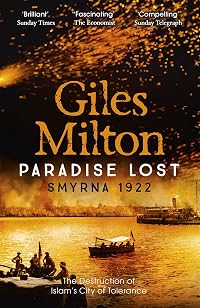
Paradise Lost, Smyrna 1922: The Destruction of Islam's City of Tolerance
by Giles Milton
On This Page
Description
Smyrna was the richest and most cosmopolitan city in the Ottoman Empire, its vast wealth created over centuries. Its factories teemed with Greeks, Armenians, Turks, and Jews--a majority Christian city unique in the Islamic world. But to the Turkish nationalists, Smyrna was a city of infidels. In the aftermath of the First World War and with the support of the Great Powers, Greece had invaded Turkey. But by the summer of 1922, as Greek troops retreated, the non-Muslim civilians of Smyrna show more assumed that American and European warships would intervene if the Turks entered the city. Then, on September 13, 1922, Turkish troops descended. They rampaged first through the Armenian quarter, and then throughout the rest of the city. They looted, raped, and murdered thousands. Soon, all but the Turkish quarter of the city was in flames and hundreds of thousands of refugees crowded the waterfront. The city burned for four days; more than 100,000 people were killed and millions left homeless. Based on eyewitness accounts and the memories of survivors, this book offers a vivid narrative account of one of the most vicious military catastrophes of the modern age.--From publisher description. show lessTags
Recommendations









Member Recommendations

Member Reviews
A great read which makes you wonder on what drives the human race to commit such atrocities. Well explained are the dramatically stupid decisions made at Sevres to carve up the former Ottoman empire and give chunks of it to the Allies, consequently, as Halide Edib writes "throwing fresh fuel onto the smouldering fire of hatred which the Western world had provoked by its conduct in Turkey". I learned a lot about the sloppiness in international politics that time, notably the devastating political roles of then British prime minister Lloyd George and the Greek leader Venizelos. Walking along the beautiful quay of Izmir on my next visit, will not be the same as before.
September 11 is now, for all of us, a tremendously emotive date, so much so that it is surprising when one comes across seismic historic events that did not take place in New York and Washington in 2001 it brings one up short. September 11 1922 is one such date.
I've been reading and thinking about the birth of modern Turkey, to one extent or another, for 20 years or so, and it's a credit to the power of this book that it captured my attention and served very well to keep my attention through a day in a Budapest airport riven by crowds, strikes, and the aftermath of altogether too much hospitality the night before.
Giles Milton's telling of the fall of Smyrna intermingles the broad sweep of the long First World War with individual tales, show more first of opulence, then of heart rending atrocity. Smyrna is portrayed as a bucolic pleasure garden destroyed in an orgy of vandalism by a victorious Turkish army, and as such this should read as a classic tale of 'good and evil'. Interestingly however, Milton cannot achieve such a simplistic conclusion, and ultimately this is the real strength of the work.
There are villains in the piece, but none of them were directly responsible for setting fire to Smyrna in September 1922; indeed at no stage is an attempt made to seriously posit that the fire that engulfed the city was a consciously taken political decision. Instead the reader finds complicity further afield. Smyrna ultimately was not destroyed by Turks, it had, after all, flourished under Ottoman rule and the decentralised Ottoman system of government allowed it to function freely through the First War. Instead the megali idea of Venizelos (and Milton accurately links this etymologically to the concept of megalomania on p.38), supported energetically by Lloyd George. Cast in this light the destruction of Smyrna is only the most tangible instance of the willful attempt to smash the Turkish state at Sevres.
None of this excuses the atrocities perpetrated in September 1922 and the wholesale ethnic cleansing that took place in the aftermath of the Greco-Turkish war, stains that persist to this day, however the broad sweep of Milton's work helps understand why tragedies occur, and why simplistically assigning blame is seldom the correct course of action. show less
I've been reading and thinking about the birth of modern Turkey, to one extent or another, for 20 years or so, and it's a credit to the power of this book that it captured my attention and served very well to keep my attention through a day in a Budapest airport riven by crowds, strikes, and the aftermath of altogether too much hospitality the night before.
Giles Milton's telling of the fall of Smyrna intermingles the broad sweep of the long First World War with individual tales, show more first of opulence, then of heart rending atrocity. Smyrna is portrayed as a bucolic pleasure garden destroyed in an orgy of vandalism by a victorious Turkish army, and as such this should read as a classic tale of 'good and evil'. Interestingly however, Milton cannot achieve such a simplistic conclusion, and ultimately this is the real strength of the work.
There are villains in the piece, but none of them were directly responsible for setting fire to Smyrna in September 1922; indeed at no stage is an attempt made to seriously posit that the fire that engulfed the city was a consciously taken political decision. Instead the reader finds complicity further afield. Smyrna ultimately was not destroyed by Turks, it had, after all, flourished under Ottoman rule and the decentralised Ottoman system of government allowed it to function freely through the First War. Instead the megali idea of Venizelos (and Milton accurately links this etymologically to the concept of megalomania on p.38), supported energetically by Lloyd George. Cast in this light the destruction of Smyrna is only the most tangible instance of the willful attempt to smash the Turkish state at Sevres.
None of this excuses the atrocities perpetrated in September 1922 and the wholesale ethnic cleansing that took place in the aftermath of the Greco-Turkish war, stains that persist to this day, however the broad sweep of Milton's work helps understand why tragedies occur, and why simplistically assigning blame is seldom the correct course of action. show less
Devastating account of one of the worst tragedies of the 20th century--the complete destruction of Smyrna in the last three weeks of September, 1922, [Izmir in today's Turkey]. It was burnt to the ground. Most of its 19th and 20th century history was reported by and has come down to us from the Levantines, the wealthy upper class of Europeans. Smyrna was a completely religiously tolerant city in the Ottoman Empire, with a Christian majority, although the mayor was a Muslim, Rahmi Bey. During the Great War and until he was replaced he bent over backward trying to protect ALL his citizens from the horrors.
The British Lloyd George was unabashedly pro-Greek and supported Eleftherios Venizelos in his "Megali ["Great"] Idea" of an expanded show more Greece--Greece AND the part of Asia Minor, including Smyrna. Fighting between Greeks and Turks ended in a Turkish victory under Mustafa Kemal [not yet termed Ataturk] and the flight of the Greek army back to their country. Other cities and villages were devastated by both armies; both were villains here. Then the Turkish army entered Smyrna; the population for the most part fled in the face of looting, killing, rape, then finally arson that destroyed the non-Turkish quarters. The Allies were apathetic. The "Paradise" of the title was the American section of the city. Today Izmir is a shadow of its former self.
This book was a revelation; I hadn't known much about this period in history. The author appeared to be even-handed; there was enough blame to go around. A cautionary tale: it showed what can happen when a third party [who has no business influencing events] insinuates itself into the affairs of another country and how things can go terribly wrong--does that sound familiar, considering today's events in the Middle East? Two heroic men revealed themselves: Rahmi Bey, who tried to protect the Christians in his city and Asa Jennings, the American Methodist minister who mostly through bluff was instrumental in rescuing a large number of refugees, who had lost everything. He was latter decorated by the Greek government. I felt the most interesting parts were the first 50 pp. or so where everything was set up, then the last part detailing what happened day by day in Smyrna, along with the aftermath. Newspaper reports were fascinating. I enjoyed the personal accounts of some folks lucky and fast-thinking enough to escape--the Armenian doctor; the Armenian family; and even Aristotle Onassis, who I never realized was a Smyrniot. I also recommend a historical novel set in this period, The Ghosts of Smyrna by Loren Edizel.
Recommended. show less
The British Lloyd George was unabashedly pro-Greek and supported Eleftherios Venizelos in his "Megali ["Great"] Idea" of an expanded show more Greece--Greece AND the part of Asia Minor, including Smyrna. Fighting between Greeks and Turks ended in a Turkish victory under Mustafa Kemal [not yet termed Ataturk] and the flight of the Greek army back to their country. Other cities and villages were devastated by both armies; both were villains here. Then the Turkish army entered Smyrna; the population for the most part fled in the face of looting, killing, rape, then finally arson that destroyed the non-Turkish quarters. The Allies were apathetic. The "Paradise" of the title was the American section of the city. Today Izmir is a shadow of its former self.
This book was a revelation; I hadn't known much about this period in history. The author appeared to be even-handed; there was enough blame to go around. A cautionary tale: it showed what can happen when a third party [who has no business influencing events] insinuates itself into the affairs of another country and how things can go terribly wrong--does that sound familiar, considering today's events in the Middle East? Two heroic men revealed themselves: Rahmi Bey, who tried to protect the Christians in his city and Asa Jennings, the American Methodist minister who mostly through bluff was instrumental in rescuing a large number of refugees, who had lost everything. He was latter decorated by the Greek government. I felt the most interesting parts were the first 50 pp. or so where everything was set up, then the last part detailing what happened day by day in Smyrna, along with the aftermath. Newspaper reports were fascinating. I enjoyed the personal accounts of some folks lucky and fast-thinking enough to escape--the Armenian doctor; the Armenian family; and even Aristotle Onassis, who I never realized was a Smyrniot. I also recommend a historical novel set in this period, The Ghosts of Smyrna by Loren Edizel.
Recommended. show less
I'd read a few Giles Milton books in my time, enough to know that he writes a seriously good tale backed by enough research to know he isn't make wild claims.
I'm pleased to say "Paradise Lost ..." continues Milton's good form, and is a study of the idyllic-sounding city of Smyrna, which appeared to compete for the title of world's greatest city during the pre-World War I era. A city where people of different religions and cultures lived together in harmony. I wanted to book my next holiday there. Except of course for the fact that the Turks destroyed it; razing it to the ground while killing many of its Greek inhabitants and driving the Armenians out into the countryside where a certain Armenian Genocide took place.
Of course, it's not show more all doom and gloom, as can be witnessed by one English lady, who played host to Ataturk and his leaders, stating that in her home, near the landing, a new empire was being formed. show less
I'm pleased to say "Paradise Lost ..." continues Milton's good form, and is a study of the idyllic-sounding city of Smyrna, which appeared to compete for the title of world's greatest city during the pre-World War I era. A city where people of different religions and cultures lived together in harmony. I wanted to book my next holiday there. Except of course for the fact that the Turks destroyed it; razing it to the ground while killing many of its Greek inhabitants and driving the Armenians out into the countryside where a certain Armenian Genocide took place.
Of course, it's not show more all doom and gloom, as can be witnessed by one English lady, who played host to Ataturk and his leaders, stating that in her home, near the landing, a new empire was being formed. show less
Giles Milton has written a compelling and at times harrowing account of the siege and eventual destruction of the Turkish city of Smyrna in 1922. The author traces the city’s fortune from the late 19th into the early 20th century principally through the eyes of its most affluent inhabitants - the Levantines. The self serving actions of the victors of WW1 are clearly defined as well as the aspirations of the Turkish nationalists led by Kemal Mustafa; which resulted in the catastrophe at Smyrna. I learnt a great deal about this important episode in European history and gained a better understanding as to why it, even today, still proves contentious.
A superb retelling of what to the Greeks is known as 'The Catastrophe' and was to be the making of modern Turkey. The destruction of Smyrna (now Izmir) in 1922 was also the destruction of a European cosmopolitan culture in the near east. The story focuses on the personal stories of the many families and personalities in the city as well as the larger geopolitical events of the time. My Grandfather was a soldier in this war of 1919 to 1922 and he kept an extensive diary of his experiences in that particularly bloody conflict. Alas I lost the diary in a house fire in 1922 along with all of my other possessions.
When one visits a place there is often the urge to find out more about it. So it was with me when I stayed a few holiday days in the Turkish city of Izmir, formerly Smyrna. A wonderful, vibrant city with lots to see (the fabled Pergamon not far away). One often hears about places ‘that have a great history behind them’ and it’s a bit of a truism. However, with Izmir one can sense that it is a place of great deeds and adventures, some admirable, some reprehensible. So I picked up Giles Milton’s book ‘Paradise Lost’ (subtitled ‘Smyrna 1922: The Destruction of Islam’s City of Tolerance’) to get a bit of backgrounding.
Milton desribes a city founded in ancient times and in which a veritable hodge-podge of nationalities show more lived side by side in tolerance and harmony over the centuries. It is not enough to say that this was due in large part to the fact that it was an important commercial centre and that all latent hostilities were buried under the idea that ‘business is business’ and no ideologies or spiritual beliefs should be allowed to interfere. Doubtless this was one of the reasons for peaceful co-habitation but I believe that living in close and friendly terms with people of different religious persuasion can breed mutual respect, provided there is good will on both sides. The destruction of all this tolerance, and the city itself, makes for sad reading.
Halide Edib, the great woman writer and social advocate who played such a prominent role in her country’s developing history and she is pictured in one of the book’s photos in fiery pose, high on a balcony, her cloak dramatically flying in the wind, addressing a protest rally against the occupation of Smyrna in May1919. G ood book, well written. Recommended. show less
Milton desribes a city founded in ancient times and in which a veritable hodge-podge of nationalities show more lived side by side in tolerance and harmony over the centuries. It is not enough to say that this was due in large part to the fact that it was an important commercial centre and that all latent hostilities were buried under the idea that ‘business is business’ and no ideologies or spiritual beliefs should be allowed to interfere. Doubtless this was one of the reasons for peaceful co-habitation but I believe that living in close and friendly terms with people of different religious persuasion can breed mutual respect, provided there is good will on both sides. The destruction of all this tolerance, and the city itself, makes for sad reading.
Halide Edib, the great woman writer and social advocate who played such a prominent role in her country’s developing history and she is pictured in one of the book’s photos in fiery pose, high on a balcony, her cloak dramatically flying in the wind, addressing a protest rally against the occupation of Smyrna in May1919. G ood book, well written. Recommended. show less
Members
- Recently Added By
Author Information

31 Works 7,130 Members
Giles Milton is the author, most recently, of the critically acclaimed Nathaniel's Nutmeg (FSG, 1999). He lives in London. (Bowker Author Biography)
Series
Belongs to Publisher Series
Common Knowledge
- Canonical title
- Paradise Lost, Smyrna 1922: The Destruction of Islam's City of Tolerance
- Original title
- Paradise lost : Smyrna 1922 : the destruction of Islam's city of tolerance
- Original publication date
- 2009
- People/Characters
- Ντέιβιντ Λόυντ Τζορτζ (Φιλέλληνας πρωθυπουργός της Μεγάλης Βρετανίας); Άρνολτ Τόυνμπι (Ιστορικός- πολεμικός ανταποκριτής της Manchester Guardian); Σερ Χάρρυ Λαμπ (Γενικός πρόξενος της Μεγαλής Βρετανίας στη Σμύρνη το 1922); Αιδεσιμότατος Τσάρλς Ντόμπσον (Αγγλικανός εφημέριος στη Σμύρνη το 1922); Γκρέις Ουίλλιαμσον (Αδελφή νοσοκόμα στο Αγγλικό Γηροκομείο της Σμύρνης); Μαγκτελέιν Ουίτταλ (Αυταρχική δέσποινα, επικεφαλής της δυναστείας των Ουίτταλ) (show all 29); Χέρμπερτ-Οκτάβιος Ουίτταλ (Ενδέκατο παιδί της Μαγκτελέιν); Έντουαρντ Ουίτταλ (Ο προσηνής μεγαλύτερος αδελφός του Χέρμπερτ-Οκτάβιου); Εντμόν Ζιρώ (ιστιοπλόος, ένα από τα ενενήντα ένα εγγόνια της Μαγκτελέιν); Ορτάνς Γουντ (Γεροντοκόρη, φανατική των ημερολογίων. αυτόπτης μάρτυρας των γ); Φερνάντ ντε Κράιμερ (Ο νεότερος ανιψιός της Ορτάνς Γουντ); Δρ Αλεξάντερ ΜακΛάχλαν (Διευθυντής του Αμερικανικού Διεθνούς Κολεγίου στον Παράδεισο); Τζορτζ Χόρτον (Αμερικανός πρόξενος στη Σμύρνη); Μαρκ Μπρίστολ (Αμερικανός ύπατος αρμοστής στην Κωνσταντινούπολη); Μίννι Μιλς (Διευθύντρια του Αμερικάνικου Διακολεγιακού Ινστιτούτου Θηλέων της Σμύρνης); Άζα Τζέννινγκς (Υπάλληλος του παραρτήματος της αμερικανικής Χριστιανικής Αδελφότητας Νέων {YMCA} στη Σμύρνη. Επικεφαλής της επιχείρησης διάσωσης.); Έστερ Λάβτζοϋ (Γιατρός που έπαιξε σημαίνοντα ρόλο στην επιχείρηση διάσωσης); Ελευθέριος Βενιζέλος (Έλληνας πρωθυπουργός και αρχιτέκτονας της Μεγάλης Ιδέας); Αριστείδης Στεργιάδης (Έλληνας ύπατος αρμοστής στη Σμύρνη, 1919-1922); Μητροπολίτης Χρυσόστομος (Θρησκευτικός ηγέτης, αφοσιωμένος θεράπων της εθνικής υπόθεσης των Ελλήνων); Ραχμί Μπέης: Οθωμανός διοικητής (βαλής, της Σμύρνης κατά τη διάρκεια του Πρώτου Παγκόσμιου Πολέμου); Εμβέρ Πασάς (Μέλος της τριανδρίας που κυβερνούσε την Τουρκία μετά την επανάσταση των Νεότουρκων το 1908); Μεχμέτ Ταλαάτ Μπέης (Δεύτερο μέλος της κυβερνητικής τριανδρίας); Μουσταφά Κεμάλ (Ατατούρκ, Ηγέτης του τουρκικού εθνικιστικού κινήματος . Θεμελιωτής της σύγχρονης Τουρκίας); Χαλινέ Εντίμπ (Εξέχουσα μορφή του εθνικιστικού κινήματος και στενή συνεργάτιδα του Κεμάλ); Καραμπέτ Χατσεριάν (Γιατρός του Αρμενικού Εθνικού Νοσοκομείου); Ρόουζ Μπερμπεριάν (Νεαρή Αρμένια, αυτόπτης μάρτυρας των βίαιων περιστατικών); Οβακίμ Ουρεγιάν (Αρμένιος αυτόπτης μάρτυρας του ξεσπάσματος της πυρκαγιάς); Mustafa Kemal Atatürk
- Important places
- Izmir, Turkey; Middle East; Ottoman Empire; Smyrna; Turkey; The Levant
- Important events*
- Η καταστροφή της Σμύρνης (13-17 Σεπτεμβρίου 1922)
- Epigraph*
- Εξ ανατολών το φως.
- First words*
- ΤΟ ΘΕΑΜΑ ΤΟΥ ΤΟΥΡΚΙΚΟΥ ΙΠΠΙΚΟΥ καθώς κάλπαζε στην προκυμαία ήταν αληθινά μεγαλοπρεπές.
- Quotations*
- Μεγάλη απερισκεψία να εγκαταλείψει κανείς το σπίτι του, το επάγγελμα και την κοινωνική του θέση για να κατευθυνθεί προς άγÎ... (show all)½ωστους ορίζοντες.
Μπορούσες να διαλέξεις ανάμεσα σε τρεις τρόπους θανάτου: τη φωτιά που μαινόταν πίσω σου, τους Τούρκους που περίμεναν στα σο... (show all)κάκια και τη θέλασσα που ανοιγόταν μπροστά σου..... στη σύγχρονη ιστορία, ίσως τίποτε δεν μπορεί να συγκριθεί με τη νύχτα της 13ης Σεπτεμβρίου στη Σμύρνη.
Ευτυχώς, φαινόταν να υπάρχει ένα σημείο όπου οι ανθρώπινες υπάρξεις χάνουν την ικανότητα να βιώσουν περισσότερα μαρτύρια.&... (show all)nbsp; - Last words*
- (Click to show. Warning: May contain spoilers.)Το 2007, οι Έλληνες ήλπιζαν να τελέσουν ξανά τη γιορτή. Όμως, άδεια δεν τους δόθηκε.
- Original language
- English
*Some information comes from Common Knowledge in other languages. Click "Edit" for more information.
Classifications
- Genres
- History, Nonfiction, Religion & Spirituality, General Nonfiction
- DDC/MDS
- 949.5072 — History & geography History of Europe Greece, Albania, Yugoslavia, Serbia, Romania, Bulgaria Greece and the Byzantine Empire Byzantine Empire -- 323-1453 History from 1830 Monarchy, 1833-1924
- LCC
- DF845.53 .I94 .M55 — History of Europe, Asia, Africa and Oceania Greece History of Greece Modern Greece
- BISAC
Statistics
- Members
- 263
- Popularity
- 123,385
- Reviews
- 11
- Rating
- (4.12)
- Languages
- 5 — English, French, German, Greek, Turkish
- Media
- Paper, Audiobook, Ebook
- ISBNs
- 13
- ASINs
- 4