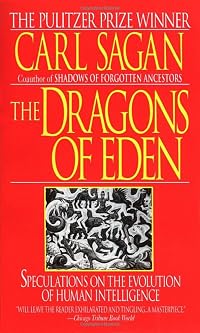
The Dragons of Eden: Speculations on the Evolution of Human Intelligence
by Carl Sagan
On This Page
Description
Presents an overview of human evolution and discusses human and animal intelligence, the mechanisms of the brain, memory, sleep, myths and legends about evolution, and the possibility of intelligent extraterrestrial life.Tags
Recommendations





















Member Reviews
Carl Sagan é muito forte, o cara era muito a frente do tempo. Escreve com uma leveza e dum jeito que é pop science sem abandonar a ciência ou ser denso demais. O cara vai explorando várias paradas maneiras, e eu senti MUITA falta de achar na internet alguma coisa que avaliasse as perspectivas dele, afinal, já tem 50 anos do que ele escreve. O cara simplesmente em 1970 falou que a gente ia ter computadores portáteis, fala de droga como algo aparentemente ok pra explorar o cérebro e entra numa brisa bem interessante do porquê (pode ser que suprima o hemisfério esquerdo, mais lógico). Entra de cabeça num debate sobre aborto dum jeito super maneiro, mete anedota no meio. Simplesmente CRAQUE. O cara naturalmente defende show more financiamento forte pra ciência porque mesmo as coisas mais improváveis podem ser super úteis no futuro, vide o rádio.
Ele também faz uma crítica de que no Ocidente, mas no Oriente, a turma tá se virando pra explicações mais interessantes mas menos verdadeiras pro universo, como astrologia, triângulo de Bermuda, etc.
Ele levanta hipóteses sobre como o cérebro é tipo uma série de camadas evolutivas, que começam no complexo reptiliano, o sistema límbico e então o neocórtex, e que na verdade a evolução tem muita dificuldade de substituir as coisas, então primeiro você tem redundância nas funções e depois certas especializações, mas que muito do nosso comportamento ritualístico e animalesco é derivado dessas formas mais primevas do nosso cérebro. Ele também teoriza que possivelmente na época que a gente competia com répteis, a gente dormia de dia, quando eles conseguiam caçar e que talvez o sono é pra manter o animal quietinho na sua e ia de noite em cima dos répteis e seus ovos. Ele alude várias vezes pruma quase rivalidade histórica entre mamíferos e répteis, que explicaria os inúmeros mitos sobre dragões em várias culturas (tem nas nativas das Américas??) e o medo partilhado de cobras que os mamíferos têm, expresso inclusive nos sonhos super comuns a despeito do setting urbano. É como se parte dos nossos medos ancestrais estivesse ainda ali, carregado: medo de queda, de cobra, etc.
Outra que ele fala é sobre a já conhecida divisão e especialização entre hemisférios cerebrais, e que tanto sonhos quanto viagens psicodélicas são momentos de supressão da parte mais racional (esquerdo), deixando o direito, mais artístico, voar. Que isso explicaria que sonhos podem ter roteiros e ganchos narrativos, mas que neles ler e fazer conta é bem difícil, porque o hemisfério direito tem pouquíssima capacidade pra isso. Tem também o corpus calosum ou algo assim, que é a conexão entre os dois hemisférios e é onde por exemplo a informação é passada entre eles, e que alguns pacientes com epilepsia grave, ao terem isso cortado, exibem comportamentos interessantes apesar de seguirem vidas aparentemente normais. Quando algo é mostrado só pro lado de visão de um hemisfério, eles conscientemente NÃO sabem dizer o que viram, mas se pedem pra colocar a mão numa caixa fechada e escrever, o outro hemisfério escreve a parada. A informação tá lá mas literalmente o tico não fala com o teco.
Deu vontade de ler mais do gênio e mais sobre cérebro. show less
Ele também faz uma crítica de que no Ocidente, mas no Oriente, a turma tá se virando pra explicações mais interessantes mas menos verdadeiras pro universo, como astrologia, triângulo de Bermuda, etc.
Ele levanta hipóteses sobre como o cérebro é tipo uma série de camadas evolutivas, que começam no complexo reptiliano, o sistema límbico e então o neocórtex, e que na verdade a evolução tem muita dificuldade de substituir as coisas, então primeiro você tem redundância nas funções e depois certas especializações, mas que muito do nosso comportamento ritualístico e animalesco é derivado dessas formas mais primevas do nosso cérebro. Ele também teoriza que possivelmente na época que a gente competia com répteis, a gente dormia de dia, quando eles conseguiam caçar e que talvez o sono é pra manter o animal quietinho na sua e ia de noite em cima dos répteis e seus ovos. Ele alude várias vezes pruma quase rivalidade histórica entre mamíferos e répteis, que explicaria os inúmeros mitos sobre dragões em várias culturas (tem nas nativas das Américas??) e o medo partilhado de cobras que os mamíferos têm, expresso inclusive nos sonhos super comuns a despeito do setting urbano. É como se parte dos nossos medos ancestrais estivesse ainda ali, carregado: medo de queda, de cobra, etc.
Outra que ele fala é sobre a já conhecida divisão e especialização entre hemisférios cerebrais, e que tanto sonhos quanto viagens psicodélicas são momentos de supressão da parte mais racional (esquerdo), deixando o direito, mais artístico, voar. Que isso explicaria que sonhos podem ter roteiros e ganchos narrativos, mas que neles ler e fazer conta é bem difícil, porque o hemisfério direito tem pouquíssima capacidade pra isso. Tem também o corpus calosum ou algo assim, que é a conexão entre os dois hemisférios e é onde por exemplo a informação é passada entre eles, e que alguns pacientes com epilepsia grave, ao terem isso cortado, exibem comportamentos interessantes apesar de seguirem vidas aparentemente normais. Quando algo é mostrado só pro lado de visão de um hemisfério, eles conscientemente NÃO sabem dizer o que viram, mas se pedem pra colocar a mão numa caixa fechada e escrever, o outro hemisfério escreve a parada. A informação tá lá mas literalmente o tico não fala com o teco.
Deu vontade de ler mais do gênio e mais sobre cérebro. show less
I loved Carl Sagan so much, and though I'd read some of his books, I'd always meant to read MORE. This one had been lingering on my shelves unread for YEARS, so one day I suggested to my dad that we read this for our buddy read project and he agreed.
The fact that this book is nearly as old as I am was the overwhelming factor in why both my dad and I were constantly stumbling over obstacles in trying to enjoy this. On so many levels. First of all — like it says on the tin — these are SPECULATIONS on the evolution of human intelligence. So, theories science couldn't yet measure or prove. In 1977. Nearly fifty years ago. And to say that there have been major advances in the studies of evolution, intelligence, anthropology, genetics, show more etc., in the last fifty years? Well, I'd hope it would be obvious enough to go without saying. Plus, just the CULTURE has moved in that time — in the way we write about women, minorities, chimpanzee testing, religion?
We kept reminding ourselves (and each other) to read this as an artifact of its time, but we are both also so well conditioned to read Sagan with so much authority and expertise in his subject matter — well, it was a stretch.
But while this was sometimes frustrating, there were enough interesting moments that we never seriously considered giving up on it. Still, I have a hard time imagining what reader I would recommend this book to today. show less
The fact that this book is nearly as old as I am was the overwhelming factor in why both my dad and I were constantly stumbling over obstacles in trying to enjoy this. On so many levels. First of all — like it says on the tin — these are SPECULATIONS on the evolution of human intelligence. So, theories science couldn't yet measure or prove. In 1977. Nearly fifty years ago. And to say that there have been major advances in the studies of evolution, intelligence, anthropology, genetics, show more etc., in the last fifty years? Well, I'd hope it would be obvious enough to go without saying. Plus, just the CULTURE has moved in that time — in the way we write about women, minorities, chimpanzee testing, religion?
We kept reminding ourselves (and each other) to read this as an artifact of its time, but we are both also so well conditioned to read Sagan with so much authority and expertise in his subject matter — well, it was a stretch.
But while this was sometimes frustrating, there were enough interesting moments that we never seriously considered giving up on it. Still, I have a hard time imagining what reader I would recommend this book to today. show less
Thought-provoking, and since it's Carl Sagan it's heavily scientific but accessible in tone. Sagan found joy in thinking and wants you to enjoy thinking about difficult things too.
Hard to rate it higher due almost entirely to how unfortunately dated it is nowadays. Not Sagan's fault - the original came out in the mid-70's. But re-reading The Dragons of Eden today you can't ignore how much in this book has been superseded in the decades since publication.
Hard to rate it higher due almost entirely to how unfortunately dated it is nowadays. Not Sagan's fault - the original came out in the mid-70's. But re-reading The Dragons of Eden today you can't ignore how much in this book has been superseded in the decades since publication.
The paperback copy of The Dragons of Eden, which was published in 1986 and which appears to be the only version in print in 2023, may or may not have been revised and updated from the original hardback book published in 1977. I've just completed the 1977 book, and my observations relate to it; to what extent they also apply to the 1986 printing, I do not know.
My relatively low rating of the book derives principally from the fact that many of its observations and examples are outdated today, although they may have been quite up to date when they were written nearly half a century ago. For instance, Sagan refers to the “mysterious” disappearance of the dinosaurs 66 million years ago, mentioning that “There are literally dozens of show more scientific hypotheses that attempt to explain this event” and adding that “One of the most interesting and promising hypotheses, first suggested by I.S. Shklovskii of the Institute for Cosmic Research, Soviet Academy of Sciences, Moscow, is that the dinosaurs died because of a nearby supernova event...” (page 136). Now, however, based on research begun in 1980, it is generally accepted that dinosaurs (along with many other species) became extinct from massive and abrupt climate change resulting from an impactor such as an asteroid or a comet that created the immense Chicxulub crater and created the world wide geological anomaly known as the Cretaceous–Paleogene (K–Pg) boundary.
Another stark example of outdated observations comes in the discussion of computers and machine learning, with now-outmoded games such as “Pong” and “Space Wars” cited as a sort of brain stimulant (chapter VIII). Also cited are keyboard special characters (i.e., non-alphanumeric characters) being used to form crude images, whereas it has now been quite a few years since actual photographic images could be displayed on computer monitors.
A further example of rather outdated information is that, in discussing public gullibility in believing that unidentified flying objects are necessarily extraterrestrial spacecraft, Sagan spends some time on crop circles. While his explanation is perfectly fine, crop circles are one widespread hoax that has fully run its course in the popular imagination and has all but vanished from public consciousness in the 21st century. Younger readers may be totally unaware of their prevalence in the news during the late 1970s, leading them perhaps to wonder why Sagan expended so much ink on that absurdity.
Another reason that I rate the book no higher than I have is that much of the text is devoted to explaining how various physical parts of the brain are used for very specific purposes and that modern humans have something of a tripartite brain, one part of which is evolved from a reptilian ancestor and that it is this part that drives basic urges such as aggression. For all I know, this picture of the brain may be entirely correct, yet it seems too simplistic, and I must wonder whether it, like the massive extinction event of 66 million years ago and the descriptions of the computer may have been surpassed by more recent research. Too, rather frequent repetition of terms cerebellum, thalamus, pons, amygdala, limbic system, corpus callosum, etc. become a bit mind-numbing (if I may use that phrase) for the general reader who is not well acquainted with the geography of the brain.
These observations should not be taken as a general condemnation of the book, however, for Sagan makes quite a few observations that are as pertinent today as when he wrote them. In Chapter V, he describes a number of experiments that demonstrate the intelligence of chimpanzees, and he asks, “If chimpanzees have consciousness, if they are capable of abstractions, do they not have what until now has been described as 'human rights'? How smart does a chimpanzee have to be before killing him constitutes murder? What further properties must he show before religious missionaries must consider him worthy of attempts at conversion?” (page 120).
Sagan's discussion of the origins of some human folklore and mythology are still as intriguing as when he wrote them. His take on the Christian myth of a talking snake in the Garden of Eden is interesting when he asks whether “the metaphor of the serpent refer[s] to the use of the aggressive and ritualistic component of our brain in the further evolution of the neocortex. . . . With one exception, the Genesis account of the temptation by a reptile in Eden is the only instance in the Bible of humans understanding the language of animals. When we feared the dragons, were we fearing a part of ourselves? One way or another, there were dragons in Eden” (page 141).
One can pick up a bit of curious history in Sagan's writing as well. For instance, I don't believe that I ever knew that a U.S. Secretary of Defense ever died by suicide (or so one is led to believe). On page 181 we read, “At the end of World War II, [James] Forrestal [the first U.S. Secretary of Defense] was convinced that Israeli secret agents were following him everywhere. His physicians . . . diagnosed him as paranoid and confined him to an upper story of Walter Reed Army Hospital, from which he plunged to his death. . . .”
Many books effortlessly withstand the passage of time. The beauty of symbolic expression, the implied commentaries on the human condition, the excellent wordsmithing of an adroit writer – these things are timeless. The novels of a Nabokov and the short stories of a Bradbury remain as superb today as the day they were composed. However, such cannot be said for science books. The uncovering of new facts, the refinement of earlier theories, and the creation of new technologies all conspire to render aging science books obsolete or, at best, obsolescent. Such is the impact of the years on The Dragons of Eden. Yes, there are still gems of wisdom to be found in its pages and reading it is in no way a poor use of one's time; yet, it shone more brightly when it was composed than it does today. show less
My relatively low rating of the book derives principally from the fact that many of its observations and examples are outdated today, although they may have been quite up to date when they were written nearly half a century ago. For instance, Sagan refers to the “mysterious” disappearance of the dinosaurs 66 million years ago, mentioning that “There are literally dozens of show more scientific hypotheses that attempt to explain this event” and adding that “One of the most interesting and promising hypotheses, first suggested by I.S. Shklovskii of the Institute for Cosmic Research, Soviet Academy of Sciences, Moscow, is that the dinosaurs died because of a nearby supernova event...” (page 136). Now, however, based on research begun in 1980, it is generally accepted that dinosaurs (along with many other species) became extinct from massive and abrupt climate change resulting from an impactor such as an asteroid or a comet that created the immense Chicxulub crater and created the world wide geological anomaly known as the Cretaceous–Paleogene (K–Pg) boundary.
Another stark example of outdated observations comes in the discussion of computers and machine learning, with now-outmoded games such as “Pong” and “Space Wars” cited as a sort of brain stimulant (chapter VIII). Also cited are keyboard special characters (i.e., non-alphanumeric characters) being used to form crude images, whereas it has now been quite a few years since actual photographic images could be displayed on computer monitors.
A further example of rather outdated information is that, in discussing public gullibility in believing that unidentified flying objects are necessarily extraterrestrial spacecraft, Sagan spends some time on crop circles. While his explanation is perfectly fine, crop circles are one widespread hoax that has fully run its course in the popular imagination and has all but vanished from public consciousness in the 21st century. Younger readers may be totally unaware of their prevalence in the news during the late 1970s, leading them perhaps to wonder why Sagan expended so much ink on that absurdity.
Another reason that I rate the book no higher than I have is that much of the text is devoted to explaining how various physical parts of the brain are used for very specific purposes and that modern humans have something of a tripartite brain, one part of which is evolved from a reptilian ancestor and that it is this part that drives basic urges such as aggression. For all I know, this picture of the brain may be entirely correct, yet it seems too simplistic, and I must wonder whether it, like the massive extinction event of 66 million years ago and the descriptions of the computer may have been surpassed by more recent research. Too, rather frequent repetition of terms cerebellum, thalamus, pons, amygdala, limbic system, corpus callosum, etc. become a bit mind-numbing (if I may use that phrase) for the general reader who is not well acquainted with the geography of the brain.
These observations should not be taken as a general condemnation of the book, however, for Sagan makes quite a few observations that are as pertinent today as when he wrote them. In Chapter V, he describes a number of experiments that demonstrate the intelligence of chimpanzees, and he asks, “If chimpanzees have consciousness, if they are capable of abstractions, do they not have what until now has been described as 'human rights'? How smart does a chimpanzee have to be before killing him constitutes murder? What further properties must he show before religious missionaries must consider him worthy of attempts at conversion?” (page 120).
Sagan's discussion of the origins of some human folklore and mythology are still as intriguing as when he wrote them. His take on the Christian myth of a talking snake in the Garden of Eden is interesting when he asks whether “the metaphor of the serpent refer[s] to the use of the aggressive and ritualistic component of our brain in the further evolution of the neocortex. . . . With one exception, the Genesis account of the temptation by a reptile in Eden is the only instance in the Bible of humans understanding the language of animals. When we feared the dragons, were we fearing a part of ourselves? One way or another, there were dragons in Eden” (page 141).
One can pick up a bit of curious history in Sagan's writing as well. For instance, I don't believe that I ever knew that a U.S. Secretary of Defense ever died by suicide (or so one is led to believe). On page 181 we read, “At the end of World War II, [James] Forrestal [the first U.S. Secretary of Defense] was convinced that Israeli secret agents were following him everywhere. His physicians . . . diagnosed him as paranoid and confined him to an upper story of Walter Reed Army Hospital, from which he plunged to his death. . . .”
Many books effortlessly withstand the passage of time. The beauty of symbolic expression, the implied commentaries on the human condition, the excellent wordsmithing of an adroit writer – these things are timeless. The novels of a Nabokov and the short stories of a Bradbury remain as superb today as the day they were composed. However, such cannot be said for science books. The uncovering of new facts, the refinement of earlier theories, and the creation of new technologies all conspire to render aging science books obsolete or, at best, obsolescent. Such is the impact of the years on The Dragons of Eden. Yes, there are still gems of wisdom to be found in its pages and reading it is in no way a poor use of one's time; yet, it shone more brightly when it was composed than it does today. show less
It is poor form—I’m sure of it—to complain that a book with the subtitle, Speculations on the Evolution of Human Intelligence, is too speculative. Nevertheless, that’s the position in which I find myself with respect to Carl Sagan’s The Dragons of Eden.
Here we find speculations that the dragon/serpent myths common to far-flung human cultures are expressions of genetic memories of the ancestral struggle between mammal and reptile. Or, alternatively, the tales represent the clash of the well-developed human neocortex with our evolutionarily more ancient reptilian brain, or R-complex. Here we find anthropomorphized brain modules: a left brain that represses the right brain, an R-complex that rebels against the tyranny of the show more neocortex. It’s one thing when Freud poses anthropomorphic, mythological models of the human mind; his psychology was largely ignorant of—and agnostic to—neural anatomy. It’s quite another for Sagan, who should know better, to anthropomorphize the physical stuff of the brain itself, to posit that its parts are literally in a state of conflict with one another, and then to actually take sides in this imagined warfare. His language is just shy of committal; he leaves himself a smidgen of an out, some slight, plausible argument for deniability, that he was really just speaking metaphorically, just motivating a scientific discussion with allusions to well-known legends. But I wasn’t able to shake the feeling sometimes that Sagan actually believed some of this mush. And I’d be surprised if some of his less sophisticated readers didn’t accept these supposed metaphors uncritically as truths.
Sagan is likewise uncharacteristically credulous of such results as those of the now thoroughly debunked chimp sign language experiments. He grates on the nerves of the modern reader of popular science when he uses classifications like “lower” and “higher” animals (p. 29). He falls over the edge into total anathema when he suggests that evolution is oriented towards the establishment of intelligent life: “The entire evolutionary record on our planet… illustrates a progressive tendency towards intelligence. There is nothing mysterious about this: smart organisms by and large survive better and leave more offspring than stupid ones” (p. 240). Any student of biology ought rightly to respond that the appearance of teleology in evolution is an illusion. Or, more pithily: Tell that to a jellyfish.
Some of these faults might be attributable to the age in which Dragons was written: the late 1970’s. The state of the biological sciences was not then what it is today. Perhaps more importantly, the expectations of the audience for popular science may have changed during the past thirty years. I’m not sure to what extent these factors can be said to extenuate this flop. I will note that Richard Dawkins’ The Selfish Gene, published two years prior to the publication of Dragons, still strikes me as thoroughly modern in terms of both style and substance. This leads me to suspect that Sagan, and not just his historical milieu, is to blame for this mess.
To its credit, Dragons is short, easy to read, and likely fodder for the intellect and the imagination, especially (I’d think) that of a young reader. Still, it would weigh heavily on my conscience to recommend it to young readers, since they’re the ones that it is most likely to mislead. It contains a useful chapter on the physiology and evolution of the human brain, a topic that has been given short shrift in many more recent cognitive science books I’ve read. But I could only comfortably recommend it as an object lesson in how far we’ve come. show less
Here we find speculations that the dragon/serpent myths common to far-flung human cultures are expressions of genetic memories of the ancestral struggle between mammal and reptile. Or, alternatively, the tales represent the clash of the well-developed human neocortex with our evolutionarily more ancient reptilian brain, or R-complex. Here we find anthropomorphized brain modules: a left brain that represses the right brain, an R-complex that rebels against the tyranny of the show more neocortex. It’s one thing when Freud poses anthropomorphic, mythological models of the human mind; his psychology was largely ignorant of—and agnostic to—neural anatomy. It’s quite another for Sagan, who should know better, to anthropomorphize the physical stuff of the brain itself, to posit that its parts are literally in a state of conflict with one another, and then to actually take sides in this imagined warfare. His language is just shy of committal; he leaves himself a smidgen of an out, some slight, plausible argument for deniability, that he was really just speaking metaphorically, just motivating a scientific discussion with allusions to well-known legends. But I wasn’t able to shake the feeling sometimes that Sagan actually believed some of this mush. And I’d be surprised if some of his less sophisticated readers didn’t accept these supposed metaphors uncritically as truths.
Sagan is likewise uncharacteristically credulous of such results as those of the now thoroughly debunked chimp sign language experiments. He grates on the nerves of the modern reader of popular science when he uses classifications like “lower” and “higher” animals (p. 29). He falls over the edge into total anathema when he suggests that evolution is oriented towards the establishment of intelligent life: “The entire evolutionary record on our planet… illustrates a progressive tendency towards intelligence. There is nothing mysterious about this: smart organisms by and large survive better and leave more offspring than stupid ones” (p. 240). Any student of biology ought rightly to respond that the appearance of teleology in evolution is an illusion. Or, more pithily: Tell that to a jellyfish.
Some of these faults might be attributable to the age in which Dragons was written: the late 1970’s. The state of the biological sciences was not then what it is today. Perhaps more importantly, the expectations of the audience for popular science may have changed during the past thirty years. I’m not sure to what extent these factors can be said to extenuate this flop. I will note that Richard Dawkins’ The Selfish Gene, published two years prior to the publication of Dragons, still strikes me as thoroughly modern in terms of both style and substance. This leads me to suspect that Sagan, and not just his historical milieu, is to blame for this mess.
To its credit, Dragons is short, easy to read, and likely fodder for the intellect and the imagination, especially (I’d think) that of a young reader. Still, it would weigh heavily on my conscience to recommend it to young readers, since they’re the ones that it is most likely to mislead. It contains a useful chapter on the physiology and evolution of the human brain, a topic that has been given short shrift in many more recent cognitive science books I’ve read. But I could only comfortably recommend it as an object lesson in how far we’ve come. show less
Have you ever wondered how the brain works and how our intelligence evolved? If your brain has presented to you this question, then this might just be the book for you. Your brain wants to know about itself! Whoa.
Firstly, this book was written in the 70's so its possible that some of the information contained here is out of date. Regardless of that fact however, Carl Sagan has that certain charm and special way of writing about subjects and makes it a joy to read. Although he does warn you that Chapter 2 gets super technical and jargon-heavy, the rest of the book is smooth sailing.
Sagan writes about the triune brain model and how the brain has evolved into 3 layers; the R-Complex which is where our reptilian brain functions stem from show more (aggression and territorial behavior) and is the oldest part of the brain, the Limbic System (social emotions) and the Neocortex (sight, sound, knowledge absorption). He also speaks about the left and right hemispheres and how they interact with one another to absorb knowledge and to be able to come up with solutions and theories.
There is information contained within these pages about our early ancestors like Australopithecus, Homo Erectus and Homo Habilis and show how the different sizes of the fossilized skulls show the progression of the size of the brain. Sleep and dreams are also talked about as well as how our distant cousins, the apes, can learn ASL and show some form on intelligence. It begs the question; If other mammals on this planet exhibit a form of intelligence, why don't we take better care of them and instead lock them up in zoos?
The book was a bit hard to get into but I thoroughly enjoyed it. Sagan asks more questions than he gives answers so it turned out to be a great exercise for my brain (maybe that's what my brain wanted all along!) If you want to think critically and expand your horizons a bit, give this gem a shot! show less
Firstly, this book was written in the 70's so its possible that some of the information contained here is out of date. Regardless of that fact however, Carl Sagan has that certain charm and special way of writing about subjects and makes it a joy to read. Although he does warn you that Chapter 2 gets super technical and jargon-heavy, the rest of the book is smooth sailing.
Sagan writes about the triune brain model and how the brain has evolved into 3 layers; the R-Complex which is where our reptilian brain functions stem from show more (aggression and territorial behavior) and is the oldest part of the brain, the Limbic System (social emotions) and the Neocortex (sight, sound, knowledge absorption). He also speaks about the left and right hemispheres and how they interact with one another to absorb knowledge and to be able to come up with solutions and theories.
There is information contained within these pages about our early ancestors like Australopithecus, Homo Erectus and Homo Habilis and show how the different sizes of the fossilized skulls show the progression of the size of the brain. Sleep and dreams are also talked about as well as how our distant cousins, the apes, can learn ASL and show some form on intelligence. It begs the question; If other mammals on this planet exhibit a form of intelligence, why don't we take better care of them and instead lock them up in zoos?
The book was a bit hard to get into but I thoroughly enjoyed it. Sagan asks more questions than he gives answers so it turned out to be a great exercise for my brain (maybe that's what my brain wanted all along!) If you want to think critically and expand your horizons a bit, give this gem a shot! show less
A book where Carl Sagan tackles human intelligence, tries and throw some clues to understand why we are gifted with such ability. No waste of time: since we can only understand its functioning by focusing on its sole anatomy, its physiology, he describes here the brain (its seat) from a purely materialistic perspective. There is no useless chit chat about dualism or any other 'spiritualism' in disguise. It's straightforward -and thank goodness for that!
His endeavour, though, can be surprising: he uses evidences not only from sciences (the works of Wilder Penfield, Ralph Holloway, Gardner & Gardner with the chimpanzee Washoe...) but, also, from myths! The title, in fact, is an hint at one of the verses taken from the Bible (Job, show more 30:29), the reptilian brain being also put to use to illustrate the particularities of ours (e.g. the importance of the neocortex...). As such, it's all very interesting, but, also, highly speculative! Well, the sub-title is a warning enough... Science and myths, Carl Sagan constantly walks the razor's edge, and his metaphors, I have to confess, are sometimes frankly annoying. In fact, coming from such an intellect, a brilliant man with a remarkable intelligence himself, I found such approach disappointing.
It surely is outdated at times (it was first published in 1977!) yet we discover nevertheless a few tid-bits, such as how pathologies and brain injuries can affect brain functioning, and, even, how dreams may help us in understanding our evolution. It's a nice read for sure, then, but, being now in the 21st century there surely are better books on the topic to go through! show less
His endeavour, though, can be surprising: he uses evidences not only from sciences (the works of Wilder Penfield, Ralph Holloway, Gardner & Gardner with the chimpanzee Washoe...) but, also, from myths! The title, in fact, is an hint at one of the verses taken from the Bible (Job, show more 30:29), the reptilian brain being also put to use to illustrate the particularities of ours (e.g. the importance of the neocortex...). As such, it's all very interesting, but, also, highly speculative! Well, the sub-title is a warning enough... Science and myths, Carl Sagan constantly walks the razor's edge, and his metaphors, I have to confess, are sometimes frankly annoying. In fact, coming from such an intellect, a brilliant man with a remarkable intelligence himself, I found such approach disappointing.
It surely is outdated at times (it was first published in 1977!) yet we discover nevertheless a few tid-bits, such as how pathologies and brain injuries can affect brain functioning, and, even, how dreams may help us in understanding our evolution. It's a nice read for sure, then, but, being now in the 21st century there surely are better books on the topic to go through! show less
Members
- Recently Added By
Published Reviews
Populair wetenschappelijke uiteenzetting over het menselijk brein. Het beschrijft de evolutie van de hersenen, de uit verschillende perioden stammende lagen, de verschillen tussen de linker- en de rechterhelft, en vergelijkt de menselijke intelligentie met enerzijds dierlijke, anderzijds kunstmatige. Het is goed leesbaar, redelijk betrouwbaar, niet erg overzichtelijk, en wekt met literaire show more middelen een indruk van visie die de inhoud niet waarmaakt. Bevat woordenlijst bibliografie en register. Zwart-wit illustraties. show less
added by karnoefel
Lists

Libros para periodistas de ciencia
25 works; 1 member

Big History
72 works; 1 member

Alan Kay's Reading List
103 works; 3 members

Blue Pyramid 1,276 Best Books of All Time
1,248 works; 32 members

Authors from the United States
245 works; 3 members

Mustich's 1000 Books to Read Before You Die: A Life Changing List
1,001 works; 19 members
Author Information

A respected planetary scientist best known outside the field for his popularizations of astronomy, Carl Sagan was born in New York City on November 9, 1934. He attended the University of Chicago, where he received a B.A. in 1954, a B.S. in 1955, and a M.S. in 1956 in physics as well as a Ph.D. in 1960 in astronomy and astrophysics. He has several show more early scholarly achievements including the experimental demonstration of the synthesis of the energy-carrying molecule ATP (adenosine triphosphate) in primitive-earth experiments. Another was the proposal that the greenhouse effect explained the high temperature of the surface of Venus. He was also one of the driving forces behind the mission of the U.S. satellite Viking to the surface of Mars. He was part of a team that investigated the effects of nuclear war on the earth's climate - the "nuclear winter" scenario. Sagan's role in developing the "Cosmos" series, one of the most successful series of any kind to be broadcast on the Public Broadcasting System, and his book The Dragons of Eden (1977) won the Pulitzer Prize in 1978. He also wrote the novel Contact, which was made into a movie starring Jodie Foster. He died from pneumonia on December 20, 1996. (Bowker Author Biography) show less
Awards and Honors
Awards
Distinctions
Notable Lists
Series
Belongs to Publisher Series
Common Knowledge
- Canonical title
- The Dragons of Eden: Speculations on the Evolution of Human Intelligence
- Original title
- The Dragons of Eden: Speculations on the Evolution of Human Intelligence
- Alternate titles
- Dragons of Eden
- Original publication date
- 1977
- People/Characters
- Charles Darwin [Charles Robert: 1809-1882]; Jacob Bronowski
- Epigraph
- Mankind is poised midway between the gods and the beasts.
Plotinus
I am a brother to dragons, and a companion to owls.
Job 30:29 - Dedication
- For my wife, Linda, with love
- First words
- Jacob Bronowski was one of a small group of men and women in any age who find all of human knowledge—the arts and sciences, philosophy and psychology—interesting and accessible.
- Last words
- (Click to show. Warning: May contain spoilers.)"Knowledge is our destiny."
- Blurbers
- Asimov, Isaac; Gardner, Martin; Leonard, John
- Original language
- English
Classifications
Statistics
- Members
- 4,052
- Popularity
- 3,841
- Reviews
- 41
- Rating
- (4.07)
- Languages
- 14 — Czech, Dutch, English, French, German, Hungarian, Korean, Norwegian (Bokmål), Romanian, Russian, Spanish, Swedish, Turkish, Portuguese (Portugal)
- Media
- Paper, Audiobook, Ebook
- ISBNs
- 50
- ASINs
- 28