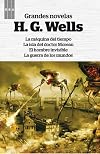
The Time Machine / The Invisible Man / The Island of Doctor Moreau / The War of the Worlds
by H. G. Wells
On This Page
Description
In The Time Machine the Time Traveler journeys to a futuristic environment and people. There he finds that humanity has evolved into two races: the peaceful Eloi--vegetarians who tire easily--and the carnivorous, predatory Morlocks; thus symbolizing the duality of human nature, as these turned upon each other in a primal display of horror. After narrowly escaping from the Morlocks, the Time Traveller undertakes another journey even further into the future where he finds the earth growing show more bitterly cold as the heat and energy of the sun wane. Horrified, he returns to the present, but soon departs again on his final journey. This science fiction classic raises profound questions about progress and social order.Written in 1896, The Island of Dr. Moreau is one of the earliest scientific romances. An instant sensation, it was meant as a commentary on Darwin's theory of evolution, which H.G. Wells stoutly believed. The story centers on the depraved Dr. Moreau, a scientist expelled from his homeland for conducting unspeakable animal experiments. He finds a deserted island where he can create a race of pseudo-humans out of the animals he found living there. Edward Prendick, an English-man whose misfortunes bring him to the island, is witness to the Beast Folk's strange civilization. Initially they befriend him. But as the stress of the abuse they endure continues, he witnesses the terrifying result of their struggle between the animal instinct and man's facade of civility, until they regress back to their original nonhuman nature and worse. While gene-splicing and bioengineering are common practices today, readers are still astounded at Wells's haunting vision and the ethical questions he raised a century before our time. This is one of Well's earliest and most sinister personifications of the scientific quest to control and manipulate the natural world, and, ultimate, human nature itself.In the Invisible Man, once a brilliant scientist, Griffin has been gradually consumed by his research. He theorizes that if a person's refractive index is changed to exactly that of air, and his body does not absorb or reflect light, then he will be invisible. He successfully carries out this procedure on himself, but to his initial horror he cannot become visible again. He wants desperately to find the antidote, but a side effect of the drug is driving him insane until is he departs from any sense of humanity. He feels no remorse in using his invisibility to gratify his increasing desires. As he gradually loses his mind, it is hard to determine if it is a result of his chemical concoction, or a simple continuation of his moral decline. At a time when science fiction was depicting what wonders the future would bring, H.G. Wells was one the first writers to explore the dark side of science and portray how easily mortal man could be corrupted when tempted by seemingly unlimited power.In the War of the Worlds a Martian spacecraft lands on Woking Common. They came from a depleted, dying planet seeking the riches of a moist, green Earth. Mankind is terrorised by aliens in tall, armoured capsules which stalk the countryside on three legs. With horrifyingly advanced machines of destruction, they began their inexorable conquest. They wreak havoc on London and the Southern Counties, and survivors are driven underground. Scientist John Nicholson tells how he was plunged into a paralyzing nightmare of stark terror, savage madness and utter destruction. Mankind is in the greatest danger in all its history. Can anyone-or anything-save our world? show lessTags
Recommendations

















Member Reviews
Ratings
Members
- Recently Added By
Author Information

1,563+ Works 109,352 Members
H. G. Wells was born in Bromley, England on September 21, 1866. After a limited education, he was apprenticed to a draper, but soon found he wanted something more out of life. He read widely and got a position as a student assistant in a secondary school, eventually winning a scholarship to the Royal College of Science in South Kensington, where show more he studied biology. He graduated from London University in 1888 and became a science teacher. He also wrote for magazines. When his stories began to sell, he left teaching to write full time. He became an author best known for science fiction novels and comic novels. His science fiction novels include The Time Machine, The War of the Worlds, The Wonderful Visit, The Island of Doctor Moreau, The Invisible Man, The First Men in the Moon, and The Food of the Gods. His comic novels include Love and Mr. Lewisham, Kipps: The Story of a Simple Soul, The History of Mr. Polly, and Tono-Bungay. He also wrote several short story collections including The Stolen Bacillus, The Plattner Story, and Tales of Space and Time. He died on August 13, 1946 at the age of 79. (Bowker Author Biography) show less
Work Relationships
Contains
Common Knowledge
- Canonical title
- The Time Machine / The Invisible Man / The Island of Doctor Moreau / The War of the Worlds
- Alternate titles
- The Works of H.G. Wells: The Invisible Man; The Island of Dr. Moreau; The Time Machine; The War of the Worlds; Classics of Science Fiction: The Time Machine; The Invisible Man (with The Island of Dr. Moreau); The War of the Worlds (with The Island of Dr. Moreau)
- Disambiguation notice
- This work contains the four H.G. Wells works listed in the Book description CK below. It should not be combined with any of the individual works, or with any other work that contains a different combination of works.
T... (show all)he three-volume Folio Society "Classics of Science Fiction" set is combined here because its volume titled The Time Machine also includes The Island of Dr. Moreau.
Classifications
Statistics
- Members
- 425
- Popularity
- 72,929
- Reviews
- 1
- Rating
- (4.21)
- Languages
- English, Italian, Spanish
- Media
- Paper, Ebook
- ISBNs
- 9
- ASINs
- 5