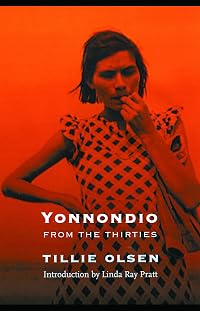
Yonnondio: From the Thirties
by Tillie Olsen
On This Page
Description
"Yonnondio follows the heartbreaking path of the Holbrook family in the late 1920s and the Great Depression as they move from the coal mines of Wyoming to a tenant farm in Western Nebraska, ending up finally on the killing floors of the slaughterhouses and in the wretched neighborhoods of the poor in Omaha, Nebraska. Mazie, the oldest daughter in the growing family of Jim and Anna Holbrook, tells the story of the family's desire for a better life--Anna's dream that her children be educated show more and Jim's wish for a life lived out in the open, away from the darkness and danger of the mines. At every turn in their journey, however, their dreams are frustrated, and the family is jeopardized by cruel and indifferent systems."--Publisher's description on back cover. show lessTags
Recommendations
















Member Recommendations


Member Reviews
I first heard of Tillie Olsen's name in a quote from Lydia Davis about Lucia Berlin. Then I happened on a collection of short stories which included her most famous short story "I Stand Here Ironing", where the comparison to Berlin is definitely warranted, from the topic to the style.
Yonnondio is Olsen's only novel, written in the 30s and published in 1974. As Willa Cather is to the pioneering spirit in the late 19th century (albeit with earthy optimism), Olsen with Yonnondio is to the realistic struggles of a working-class family in the Depression era.
She is unblinkingly realistic in her portrayals of the way that poverty affects her characters, the strain it puts on relationships, between spouses, between parents and children, the show more hopes of the parents for a better life for their children, the chances they must take for that minuscule chance at upward mobility, and the way classism is reinforced by other adults, other children, moulding them into the roles that society has prepared for them, most likely trapped in the generational cycle of poverty.
I'm not sure how to describe her prose (stream of consciousness?), other than the fact I loved it. It was poetical the way she so seamlessly blended the thoughts of each character (each with their own distinct voices as well) to the setting of the scene or the action of plot, dipping out of the and into the other.
Technically, the novel is unfinished, Olsen apparently only edited the manuscript drafts that she wrote in the 30s and did not add a single new word. However, my personal tastes consider the novel complete. I found the uneventful ending more affecting than a resolution in a three-act story could have been, the way it so matter-of-factly implies that things will just continue the way they have been going for the characters, with no sudden change of fortune, nor sudden windfall to alleviate their hardships, just small variations on the life that they're living already.
Sign me up for more Olsen please. Preferably all of them. show less
Yonnondio is Olsen's only novel, written in the 30s and published in 1974. As Willa Cather is to the pioneering spirit in the late 19th century (albeit with earthy optimism), Olsen with Yonnondio is to the realistic struggles of a working-class family in the Depression era.
She is unblinkingly realistic in her portrayals of the way that poverty affects her characters, the strain it puts on relationships, between spouses, between parents and children, the show more hopes of the parents for a better life for their children, the chances they must take for that minuscule chance at upward mobility, and the way classism is reinforced by other adults, other children, moulding them into the roles that society has prepared for them, most likely trapped in the generational cycle of poverty.
I'm not sure how to describe her prose (stream of consciousness?), other than the fact I loved it. It was poetical the way she so seamlessly blended the thoughts of each character (each with their own distinct voices as well) to the setting of the scene or the action of plot, dipping out of the and into the other.
Technically, the novel is unfinished, Olsen apparently only edited the manuscript drafts that she wrote in the 30s and did not add a single new word. However, my personal tastes consider the novel complete. I found the uneventful ending more affecting than a resolution in a three-act story could have been, the way it so matter-of-factly implies that things will just continue the way they have been going for the characters, with no sudden change of fortune, nor sudden windfall to alleviate their hardships, just small variations on the life that they're living already.
Sign me up for more Olsen please. Preferably all of them. show less
Set in the American Great Depression, this short novel is the story of a family caught in a downward economic spiral. Jim Holbrook works in a Wyoming mine while Anna cares for their two small children, Mazie and Will. There is never enough money to meet their basic needs, and they live in constant fear of an accident that will leave Jim incapacitated, or worse. They decide to leave in search of a better livelihood, but this proves elusive. Meanwhile Anna seems to be perpetually pregnant, and the children attend school so infrequently they fail to make progress. It’s all quite bleak.
Tillie Olsen began writing this novel during the Depression, and effectively captured the despair and exhaustion that affected so many during that time. show more She set the work aside after four chapters and returned to it many years later, piecing together previous drafts and other fragments in an attempt to create a cohesive whole. Unfortunately, it doesn’t quite work. There are too many gaps, too little character development, and the ending is abrupt and inconclusive. show less
Tillie Olsen began writing this novel during the Depression, and effectively captured the despair and exhaustion that affected so many during that time. show more She set the work aside after four chapters and returned to it many years later, piecing together previous drafts and other fragments in an attempt to create a cohesive whole. Unfortunately, it doesn’t quite work. There are too many gaps, too little character development, and the ending is abrupt and inconclusive. show less
The saddest book ever... this is the story of a poor family that just got more and more poor. The author's use of imagery helps the reader feel the descriptions of the Earth, the skinny children, the despair of poverty and hopelessness... first, working in the coal tunnels, and the father getting much of his pay in scrip for the company store. Then, tenant farming and the owner taking everything he harvested, yet still he owes...on to the slaughterhouse work he considers himself lucky to get. The air in the town is so stifling from the slaughterhouse and Benjy has asthma and can't breathe.... Things get worse and worse, and the story remains unfinished, but the reader can imagine the ragged end of this family, during the depression that show more beat them further and further down. show less
Heartbreaking and wonderfully written evocation of the pre-Depression years in the western US.
Alice Mattison said I had to read these. They're concise, precise, striking, disturbing, complete, and great models for how to write a short story, and how much a short story can cover.
"Yonnondio follows the heartbreaking path of the Holbrook family in the late 1920s and the Great Depression as they move from the coal mines of Wyoming to a tenant farm in Western Nebraska, ending up finally on the killing floors of the slaughterhouses and in the wretched neighborhoods of the poor in Omaha, Nebraska. Mazie, the oldest daughter in the growing family of Jim and Anna Holbrook, tells the story of the family's desire for a better life--Anna's dream that her children be educated and Jim's wish for a life lived out in the open, away from the darkness and danger of the mines. At every turn in their journey, however, their dreams are frustrated, and the family is jeopardized by cruel and indifferent systems."--Publisher's show more description on back cover. show less
Depressing story and tiresomely affected writing style.
Members
- Recently Added By
Lists

Jewish Books
367 works; 24 members
Author Information

20+ Works 1,912 Members
Born in Omaha, Nebraska, Tillie Olsen received only a high school education. But because of her success as a writer, she has served as a visiting lecturer and writer-in-residence at a number of colleges, including Amherst College, Stanford University, and MIT. She has received numerous awards for her work, including an O. Henry Award for best show more American short story (1961) and a Guggenheim fellowship (1976-77). The widely anthologized "I Stand Here Ironing" (1961), in the circumstances of its publication and its voice and subject, embodies the concerns of Olsen's literary career. In this monologue of a woman reviewing her relationship to her 19-year-old daughter, Olsen suggests the themes of the blighted potential and wasted talent of working-class women that have preoccupied her throughout her career. As she irons, the woman mournfully meditates on how she may have prevented her daughter's full "flowering" - a flowering that she herself has never had. Most intensely recalled is how she had to leave her infant daughter to go to work after her husband abandoned them. A mother herself by age 19, Olsen did not publish her first work until she was in her forties (though she began to write in her teens) when the pressures of supporting herself and her four children lessened and she felt she had written something worthy of publication. At times considered unrelenting in the despair that she attributes to her characters, Olsen's style is marked by a rhythmic, hypnotic lyricism and an evocative use of language. Olsen later published an introductory essay to the reprint of Rebecca Harding Davis's nineteenth-century novel, Life in the Iron Mills. In Silences (1978), a collection of essays, she addresses directly the various cultural, political, and economic forces that silence women writers and writers from working-class or minority backgrounds. (Bowker Author Biography) show less
Some Editions
Series
Belongs to Publisher Series
Work Relationships
Is contained in
Common Knowledge
- Canonical title
- Yonnondio: From the Thirties
- Original publication date
- 1974
- Important places
- Wyoming, USA; USA; Nebraska, USA
- Dedication
- For Jack
- First words
- The whistles always woke Mazie. They pierced into her sleep like some gutteral-voiced metal beast, tearing at her; breathing a terror.
- Last words
- (Click to show. Warning: May contain spoilers.)Yonnondio! Yonnondio! --unlimn'd they disappear.
Classifications
Statistics
- Members
- 376
- Popularity
- 83,290
- Reviews
- 8
- Rating
- (3.72)
- Languages
- Danish, English, German, Swedish
- Media
- Paper, Audiobook, Ebook
- ISBNs
- 19
- ASINs
- 8