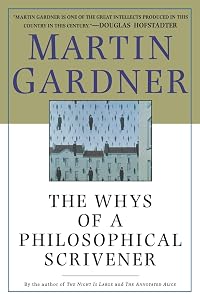
The Whys of a Philosophical Scrivener
by Martin Gardner
On This Page
Description
The Whys of a Philosophical Scrivener showcases Martin Gardner as the consummate philosopher, thinker, and great mathematician that he is. Exploring issues that range from faith to prayer to evil to immortality, and far beyond, Garnder challenges the discerning reader with fundamental questions of classical philosophy and life's greater meanings. Recalling such philosophers was Wittgenstein and Arendt, The Whys of Philosophical Scrivener embodies Martin Garner's unceasing interest and joy in show more the impenetrable mysteries of life. show lessTags
Recommendations












Member Recommendations
ehines While I agree with Dawkins and disagree with Gardner about the existence of God, Gardner's open-mindedness judicious and friendly tone, even in error, serves as a rebuke to Dawkins' inability to understand or respect his intellectual opponents.
21
Member Reviews
A fascinating collection of essays by mathematical guru and pseudo-science debunker, Martin Gardner. He is not afraid to tackle the most difficult questions ever asked and to candidly reveal his own, personal thoughts on them.
The book provides the most convincing arguments for atheism that I have ever read (and that includes Dawkin's "The God Delusion") but surprisingly Gardner is not an atheist. He calls himself a "philosophical theist". I was not convinced by the reasons he gives. I think it has more to do with his protestant fundamentalist upbringing than he is willing to face.
The book provides the most convincing arguments for atheism that I have ever read (and that includes Dawkin's "The God Delusion") but surprisingly Gardner is not an atheist. He calls himself a "philosophical theist". I was not convinced by the reasons he gives. I think it has more to do with his protestant fundamentalist upbringing than he is willing to face.
Very honest and enlightening reflections of a skeptical theist.
If clear thinking is important then this book is every bit as important as Korzybskis efforts. For a summary of Korzybski look into the Cosmic Triggers and Coincidance by the late Robert Anton Wilson.
Philosophy, Agnosticism, Theism,
Ratings
Members
- Recently Added By
Published Reviews
ThingScore 50
To put it bluntly, Gardner is a simpleminded fideist who sees himself in the tradition of Kant, William James, and Miguel de Unamuno. It is impossible to imagine anyone reading his outrageous confessional (unless the reader is a clone of Gardner) who, however impressed he may be by the author's wide-ranging erudition and rhetorical skill, will not be infuriated by his idiosyncrasies...
How show more seriously should we take Gardner's fideism? He seems sincere, yet one wonders. After all, the man has a reputation as a hoaxer. His April 1975 column in Scientific American purported to disclose such dramatic breakthroughs as the discovery of a map that required five colors, a fatal flaw in relativity theory, an opening move in chess (pawn to queen's rook four) that is a certain win for white, and a lost parchment proving that Leonardo da Vinci invented the flush toilet. Thousands of readers wrote to tell Gardner where he went wrong, and one irate professor tried to have him expelled from the American Mathematical Society. Happily, the society made him an honorary life member. George Groth, by the way, is one of Gardner's pseudonyms. show less
How show more seriously should we take Gardner's fideism? He seems sincere, yet one wonders. After all, the man has a reputation as a hoaxer. His April 1975 column in Scientific American purported to disclose such dramatic breakthroughs as the discovery of a map that required five colors, a fatal flaw in relativity theory, an opening move in chess (pawn to queen's rook four) that is a certain win for white, and a lost parchment proving that Leonardo da Vinci invented the flush toilet. Thousands of readers wrote to tell Gardner where he went wrong, and one irate professor tried to have him expelled from the American Mathematical Society. Happily, the society made him an honorary life member. George Groth, by the way, is one of Gardner's pseudonyms. show less
added by SnootyBaronet
Author Information

Martin Gardner is the author of more than seventy books on a vast range of topics including "Did Adam & Eve Have Navels?", "Calculus Made Easy", & "The Annotated Alice". He lives in Hendersonville, North Carolina. (Publisher Provided)
Some Editions
Series
Belongs to Publisher Series
Metatemas (18)
Common Knowledge
- Canonical title*
- Los porqués de un escriba filósofo
- Dedication
- Why do I dedicate this book to Charlotte? She knows.
- First words
- This is a book of essays about what I believe and why.
- Quotations
- I would expect Jesus to accept, as we are told he did, the historical truth of all the Old Testament stories, including Noah’s flood and Jonah’s travail in the belly of a whale. But on a question so basic to faith as the ... (show all)fate of the wicked, I would expect an incarnated God to rise above his culture.
- Last words
- (Click to show. Warning: May contain spoilers.)Grey is a color that always seems on the eve of changing to some other colour; of brightening into blue or blanching into white or bursting into green and gold. So we may be perpetually reminded of the indefinite hope that is in doubt itself; and when there is grey weather in our hills or grey hairs in our heads, perhaps they may still remind us of the morning.
*Some information comes from Common Knowledge in other languages. Click "Edit" for more information.
Classifications
Statistics
- Members
- 377
- Popularity
- 82,818
- Reviews
- 4
- Rating
- (4.04)
- Languages
- English, Spanish
- Media
- Paper, Ebook
- ISBNs
- 7
- ASINs
- 3