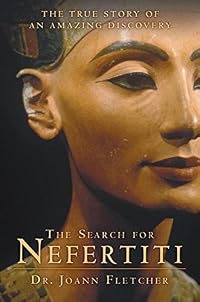
The Search for Nefertiti: The True Story of an Amazing Discovery
by Joann Fletcher
On This Page
Description
Her power was rivaled only by her beauty. Her face has become one of the most recognizable images in the world. She was an independent woman and thinker centuries before her time. But who was Egypt's Queen Nefertiti? After years of intense research, Dr. Joann Fletcher has answered the questions countless researchers before her could not. While studying Egyptian royal wigs, she read a brief mention of an unidentified and mummified body, discovered long ago and believed to belong to an show more Egyptian of little importance. This body happened to have a wig, which Dr. Fletcher knew was a clear sign of power. After examining the hairpiece and the woman to which it belonged, to the astonishment of her colleagues she identified this body as the missing remains of Queen Nefertiti. The search for Nefertiti had ended. She had been found. But the questions were just beginning. Nefertiti first rose to prominence in Egyptology in 1912, when a three-thousand-year-old bust of the queen was unearthed and quickly became a recognizable artifact around the world. But pieces of Nefertiti's life remained missing. The world had seen what she looked like, but few knew about her place in history. Virtually nothing is recorded about Nefertiti's early years. What is known about her life starts with her rise to power, her breaking through the sex barrier to rule as a virtual co-Pharaoh alongside her husband, Akhenaten. Upon his death she took full control of his kingdom. The Egyptian people loved her and celebrated her beauty in art, but the priests did not feel the same way. They believed Nefertiti's power over her husband was so great that she would instill her monotheistic beliefs upon him, rendering their own power obsolete. Egyptologists concur that it was these priests who, upon Nefertiti's death, had her name erased from public record and any likeness of her defaced. This ultimately led to her being left out of history for three thousand years. In The Search for Nefertiti Dr. Fletcher, an esteemed Egyptologist, traces not only her thirteen-year search for this woman, whose beauty was as great as her power, but also brings to the forefront the way Egypt's royal dead have been treated over time by people as varied as Agatha Christie and Adolf Hitler. She also explores how modern technology and forensics are quickly changing the field of archaeology and, in turn, what we know about history. show lessTags
Recommendations
















Member Reviews
It must have been very crowded in there, since dozens - hundreds - thousands - of New Agers were Nefertiti, subject of one of the most famous sculptures known from ancient Egypt, in one of their previous lives.
A little background is necessary:
In the 18th dynasty Egypt, about 1352 BCE, Amenhotep IV came to the throne. He quickly changed his name to Akhenaten, abandoned the worship of the ancient gods, and set up a new capital city at a place then called Akhetaten and now Tell-El-Amarna or just "Amarna", leading to the name "Amarna Period" for the time. His "great royal wife", Nefertiti, is displayed with unusual prominence - always shown the same size as the pharaoh and participating in almost all royal activities. Egyptian state power show more apparently declined during Akhenaten's reign, and near the end the country seems to have gone through a period of disorder. Akhenaten was succeeded by a Smenkhkare, who reigned only briefly; Smenkhkare, in turn, was succeeded by the famous (if also short-lived) Tutankhamun, who moved the capital back to Waset (Thebes) and restored the old gods.
In 1898, French Egyptologist Victor Loret discovered the tomb of Amenhotep II in the Valley of the Kings (Now known as KV35). In addition to Amenhotep II, the tomb contained the mummies of a number of other pharaohs, including various Rameses,(maybe) Amenhotep III, and (maybe) Setnakht (how about that?). Three partially wrapped and otherwise unidentified mummies were found in a side chamber; "The Elder Lady", a adolescent boy, and what was originally identified as a second adolescent boy. After medical examination, the third mummy was reidentified as a women and called "The Younger Lady". These three bodies were returned to their chamber, which was then bricked up. Over the years various other Egyptologist reopened the chamber, took alook around, made some notes, and bricked it back up again. All the other bodies were moved to the Cairo museum. The identity of the three bodies was subject to much speculation, with various famous and not famous candidates proposed.
In 2003, recently minted Egyptology PhD Joann Fletcher received permission to reopen the side chamber and spend two working days photographing and x-raying the three unidentified bodies. The project became the subject of a Discovery Channel TV special, with Fletcher identifying the "Younger Lady" as Nefertiti and also contending that the enigmatic successor to Akhenaten, Smenkhkare, was Nefertiti under a "throne name" - i.e., that Nefertiti had ruled Egypt as a pharaoh. The program included a dramatic forensic reconstruction of the face of the "Younger Lady".
The excrement then contacted the rotating air handler blades. Zahi Hawass, Director of the Supreme Council of Antiquities, announced that Fletcher had violated a publishing agreement with the SCA and banned her from further work in Egypt. Numerous Egyptologists made public and semipublic statements ranging from polite disagreement to outright ridicule. Although the book came out some time after the TV special, Dr. Fletcher did not take the opportunity to respond.
Enough background then - on to the book. I found it entertaining and enjoyable. Unlike any other Egyptology work I can think of, Fletcher tells us something about her life and how she became interested in Egyptology; this degree of candor is refreshing. She comes from a middle class background, and her particular interest and dissertation topic was hair and hair styles of Egypt. Her own hair is pretty eclectic; she decribes it as "bright orange" the first time she visited Egypt, it's a mass of barely restrained brunette curls in stills from the TV show, and in the jacket illustration from the book it's straight and jet black. In the book she says she has a nose ring; in the jacket picture it's a discrete stud. Why is this relevant? Modern Egyptians are pretty conservative and most Egyptologists go out of their way to avoid looking unusual; Dr. Fletcher obviously doesn't fit that mold. She's also something of a feminist; she criticizes male Egyptologists for ignoring the place of women in ancient Egypt, and I have to say there's something to this.
For her theory itself, I have to say it's interesting but speculative. It's actually two theories:
That the mummy of the "Younger Lady" in KV35 is Nefertiti, and
That Nefertiti is identical to the ephemeral pharaoh Smenkhkare.
The first of these is possible but unlikely. It's based on the fact that the mummy has two ear piercings in the surviving ear and one bust of Nefertiti also has two ear piercings (at least two little dots painted on the earlobe), that a wig associated with this tomb but no longer in context is similar to one worn by Nefertit in some reliefs, and that the x-rays show skeletal features similar to the famous bust and other statuary. It's not at all clear how old the "Younger Lady" was at death; the medical team originally described the body as being someone who died in her late teens (which would clearly not be Nefertiti, who had six daughters); although Fletcher's team identified it as female, subsequent (but not well published) reports by the SCA say cell samples show Y chromosomes.
The identification of Nefertiti with Smenkhkare is a little more convincing. Suurviving artwork from the Amarna period shows Nefertiti with much more prominence than any other Egyptian queen (with the exception of Hatshepsut, who also ruled as pharaoh). The mummy of Smenkhkare has never been found (although there's a candidate), and there are reasonble explanations for most of the objections.
What's may be most interesting is these stories and theories illustrate how tentative a lot of Egyptology is. Mark Twain wrote “There is something fascinating about science. One gets such a wholesale return of conjecture for such a trifling investment of facts” and that applies in spades to the study of ancient Egypt. There are several biographies of Nefertiti besides this one, all of full book length; however, the entire corpus of ancient Egytian writing concerning her would probably fit into about two typewritten pages. There's somewhat more in the way of illustration - tomb and temple reliefs, statuary, etc., but you could probably fit it all in, say, 1/2 scale into a "coffee-table" volume.
And speculation based on this level of evidence is not at all unusual in Egyptology. All sorts of theories about Egypt have been proposed by eminent Egyptologists based on less than this.
So why the hostility to Fletcher? Well, she did something to get the SCA mad at her; it's not clear what - the Discovery Channel claims it followed all the rules set down by the SCA. And if you want to be an Egyptologist and actually work in Egypt, you have to keep the SCA happy. Quickly distancing yourself from Fletcher would not be a bad idea. I hate to say it, but Fletcher's class background may also contribute. Finally, the SCA has an interest in creating controversy - 40% of Egyptian revenue comes from tourism and the more interest stirred up, the better.
On the other hand, Fletcher seems to have contributed to making herself unpopular. While there's a whole page of dedications in her book, only one is to another Egyptologist, Earl Ertman, and he's really an art historian. The book proper is full of sentences beginning "As a prominent Egyptologist says..." without mentioning who that is. And her own thesis advisor, Roaslie David, was one of her severest critics, complaining that Fletcher never contacted her after graduation and stating that Fletcher has no expertise in the identification of mummies.
This is an interesting book; it has some fine insights into areas of Egyptology not generally publicized. You should take everything with a grain of salt and it definitely shouldn't be your only reference to the Amarna period. It may be as interesting as a reference for the archaeological personality conflicts as anything else.
Added later (2017): The Supreme Council of Antiquities (SCA above) is now the Ministry of State for Antiquities.
DNA studies have since suggested the "Younger Lady" is both the mother of Tutankhamun and a daughter of Amenhotep III and Tiye, making her both the sister and wife of Akhenaton. However her name is unknown.
There is still no Egyptological consensus on the identity of Smenkhkare.
The burial place of Nefertiti is still unknown. show less
A little background is necessary:
In the 18th dynasty Egypt, about 1352 BCE, Amenhotep IV came to the throne. He quickly changed his name to Akhenaten, abandoned the worship of the ancient gods, and set up a new capital city at a place then called Akhetaten and now Tell-El-Amarna or just "Amarna", leading to the name "Amarna Period" for the time. His "great royal wife", Nefertiti, is displayed with unusual prominence - always shown the same size as the pharaoh and participating in almost all royal activities. Egyptian state power show more apparently declined during Akhenaten's reign, and near the end the country seems to have gone through a period of disorder. Akhenaten was succeeded by a Smenkhkare, who reigned only briefly; Smenkhkare, in turn, was succeeded by the famous (if also short-lived) Tutankhamun, who moved the capital back to Waset (Thebes) and restored the old gods.
In 1898, French Egyptologist Victor Loret discovered the tomb of Amenhotep II in the Valley of the Kings (Now known as KV35). In addition to Amenhotep II, the tomb contained the mummies of a number of other pharaohs, including various Rameses,(maybe) Amenhotep III, and (maybe) Setnakht (how about that?). Three partially wrapped and otherwise unidentified mummies were found in a side chamber; "The Elder Lady", a adolescent boy, and what was originally identified as a second adolescent boy. After medical examination, the third mummy was reidentified as a women and called "The Younger Lady". These three bodies were returned to their chamber, which was then bricked up. Over the years various other Egyptologist reopened the chamber, took alook around, made some notes, and bricked it back up again. All the other bodies were moved to the Cairo museum. The identity of the three bodies was subject to much speculation, with various famous and not famous candidates proposed.
In 2003, recently minted Egyptology PhD Joann Fletcher received permission to reopen the side chamber and spend two working days photographing and x-raying the three unidentified bodies. The project became the subject of a Discovery Channel TV special, with Fletcher identifying the "Younger Lady" as Nefertiti and also contending that the enigmatic successor to Akhenaten, Smenkhkare, was Nefertiti under a "throne name" - i.e., that Nefertiti had ruled Egypt as a pharaoh. The program included a dramatic forensic reconstruction of the face of the "Younger Lady".
The excrement then contacted the rotating air handler blades. Zahi Hawass, Director of the Supreme Council of Antiquities, announced that Fletcher had violated a publishing agreement with the SCA and banned her from further work in Egypt. Numerous Egyptologists made public and semipublic statements ranging from polite disagreement to outright ridicule. Although the book came out some time after the TV special, Dr. Fletcher did not take the opportunity to respond.
Enough background then - on to the book. I found it entertaining and enjoyable. Unlike any other Egyptology work I can think of, Fletcher tells us something about her life and how she became interested in Egyptology; this degree of candor is refreshing. She comes from a middle class background, and her particular interest and dissertation topic was hair and hair styles of Egypt. Her own hair is pretty eclectic; she decribes it as "bright orange" the first time she visited Egypt, it's a mass of barely restrained brunette curls in stills from the TV show, and in the jacket illustration from the book it's straight and jet black. In the book she says she has a nose ring; in the jacket picture it's a discrete stud. Why is this relevant? Modern Egyptians are pretty conservative and most Egyptologists go out of their way to avoid looking unusual; Dr. Fletcher obviously doesn't fit that mold. She's also something of a feminist; she criticizes male Egyptologists for ignoring the place of women in ancient Egypt, and I have to say there's something to this.
For her theory itself, I have to say it's interesting but speculative. It's actually two theories:
That the mummy of the "Younger Lady" in KV35 is Nefertiti, and
That Nefertiti is identical to the ephemeral pharaoh Smenkhkare.
The first of these is possible but unlikely. It's based on the fact that the mummy has two ear piercings in the surviving ear and one bust of Nefertiti also has two ear piercings (at least two little dots painted on the earlobe), that a wig associated with this tomb but no longer in context is similar to one worn by Nefertit in some reliefs, and that the x-rays show skeletal features similar to the famous bust and other statuary. It's not at all clear how old the "Younger Lady" was at death; the medical team originally described the body as being someone who died in her late teens (which would clearly not be Nefertiti, who had six daughters); although Fletcher's team identified it as female, subsequent (but not well published) reports by the SCA say cell samples show Y chromosomes.
The identification of Nefertiti with Smenkhkare is a little more convincing. Suurviving artwork from the Amarna period shows Nefertiti with much more prominence than any other Egyptian queen (with the exception of Hatshepsut, who also ruled as pharaoh). The mummy of Smenkhkare has never been found (although there's a candidate), and there are reasonble explanations for most of the objections.
What's may be most interesting is these stories and theories illustrate how tentative a lot of Egyptology is. Mark Twain wrote “There is something fascinating about science. One gets such a wholesale return of conjecture for such a trifling investment of facts” and that applies in spades to the study of ancient Egypt. There are several biographies of Nefertiti besides this one, all of full book length; however, the entire corpus of ancient Egytian writing concerning her would probably fit into about two typewritten pages. There's somewhat more in the way of illustration - tomb and temple reliefs, statuary, etc., but you could probably fit it all in, say, 1/2 scale into a "coffee-table" volume.
And speculation based on this level of evidence is not at all unusual in Egyptology. All sorts of theories about Egypt have been proposed by eminent Egyptologists based on less than this.
So why the hostility to Fletcher? Well, she did something to get the SCA mad at her; it's not clear what - the Discovery Channel claims it followed all the rules set down by the SCA. And if you want to be an Egyptologist and actually work in Egypt, you have to keep the SCA happy. Quickly distancing yourself from Fletcher would not be a bad idea. I hate to say it, but Fletcher's class background may also contribute. Finally, the SCA has an interest in creating controversy - 40% of Egyptian revenue comes from tourism and the more interest stirred up, the better.
On the other hand, Fletcher seems to have contributed to making herself unpopular. While there's a whole page of dedications in her book, only one is to another Egyptologist, Earl Ertman, and he's really an art historian. The book proper is full of sentences beginning "As a prominent Egyptologist says..." without mentioning who that is. And her own thesis advisor, Roaslie David, was one of her severest critics, complaining that Fletcher never contacted her after graduation and stating that Fletcher has no expertise in the identification of mummies.
This is an interesting book; it has some fine insights into areas of Egyptology not generally publicized. You should take everything with a grain of salt and it definitely shouldn't be your only reference to the Amarna period. It may be as interesting as a reference for the archaeological personality conflicts as anything else.
Added later (2017): The Supreme Council of Antiquities (SCA above) is now the Ministry of State for Antiquities.
DNA studies have since suggested the "Younger Lady" is both the mother of Tutankhamun and a daughter of Amenhotep III and Tiye, making her both the sister and wife of Akhenaton. However her name is unknown.
There is still no Egyptological consensus on the identity of Smenkhkare.
The burial place of Nefertiti is still unknown. show less
I liked reading about the author's journey to becoming an archeologiest - it reminds me of my first impressions of Egyptian culture. Her deductions and reasoning are sound and plausible, whilst enjoyable and easy to read. Since the book was published it has apparently been disproven that the mummy she examined is Nefertiti (it seems the mummy is male after all), but even though her conclusion is therefore incorrect, it's still a fascinating account and a good read; with the new findings in mind it still leaves a lot of unanswered questions.
Loved it - looking forward to her new book on Cleopatra.
Ratings
Members
- Recently Added By
Lists

r/History Recommended Reading List
603 works; 12 members
Author Information

15+ Works 983 Members
Joann Fletcher is director of the NILE educational organization, as well as a frequent university lecturer. She divides her time between Egypt and England. (Bowker Author Biography)
Common Knowledge
- People/Characters
- Nefertiti
- Important places
- Egypt
- Important events
- New Kingdom of Egypt; Eighteenth Dynasty of Egypt; Amarna Period
Classifications
- Genres
- Anthropology, History, Nonfiction, General Nonfiction, Biography & Memoir
- DDC/MDS
- 932.014 — History & geography History of ancient world (to ca. 499) Egypt to 640 Early history to 332 BC Pharaohs -- Biography and History
- LCC
- DT87.45 .F54 — History of Europe, Asia, Africa and Oceania Africa History of Africa Egypt History
- BISAC
Statistics
- Members
- 294
- Popularity
- 108,800
- Reviews
- 3
- Rating
- (4.09)
- Languages
- Dutch, English, Spanish
- Media
- Paper, Ebook
- ISBNs
- 9
- ASINs
- 3