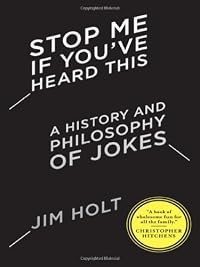
Stop Me If You've Heard This: A History and Philosophy of Jokes
by Jim Holt
On This Page
Description
"Stop Me If You've Heard This is the first book to trace the evolution of the joke all the way from the stand-up comics of ancient Athens to the comedy-club Seinfelds of today. Cropping up en route are such unforgettable figures as Poggio, a Renaissance papal secretary and sexual adventurer who set up a joke factory in the Vatican, and Gershon Legman, the FBI-hounded psychoanalyst of dirty jokes who invented the slogan "Make Love Not War."" "After exploring humor's history in part one, the show more irreducible Jim Holt delves into philosophy in part two. Jewish jokes; Wall Street jokes; jokes about lesbians and violists, rednecks and atheists, bulimics and politicians; jokes that you missed if you didn't go to a Catholic girls' school; jokes about language and logic itself - all become fodder for the grand theories of Aristotle, Kant, Freud, and Wittgenstein. Among the mysteries examined is why the cerebral pleasure of a joke should issue in a spasmodic discharge of nervous energy through the facial and respiratory muscles - that is, in laughter."--Jacket. show lessTags
Recommendations






Member Reviews
Largely because of the old saw about a joke ceasing to be funny when you have to explain it, I was a bit dubious about starting this book, as the subtitle "a History and Philosophy of Jokes" didn't seem to hold too much promise. What a pleasant surprise, then, to begin the book to find that not only does author Jim Holt have a pleasing and engaging narrative voice, but that the book, unlike much of the genre purporting to deconstruct the concept of the joke (Sigmund Freud, I'm talking to you) is itself quite funny. Although Holt does enumerate the various philosophies purporting to explain why we, as a species, find jokes funny, he never descends into academic dryness.
The book is extremely short -- 126 pages, much of which is taken up show more by illustrations -- and thus, is something of a lengthened article rather than a book (a trait that Holt more or less concedes in the preface). Nonetheless, the book never feels rushed or underdeveloped, and I actually found myself sorry it was ending so quickly.
A tip for New Yorkers, or people who have spent a fair amount of time here: even if you think you don't want to read the book itself, pick it up next time you're in the bookstore and read the footnote on pages 80 to 81. It was so funny (to me, anyway) that I actually started carrying the book around so I could read it to people. show less
The book is extremely short -- 126 pages, much of which is taken up show more by illustrations -- and thus, is something of a lengthened article rather than a book (a trait that Holt more or less concedes in the preface). Nonetheless, the book never feels rushed or underdeveloped, and I actually found myself sorry it was ending so quickly.
A tip for New Yorkers, or people who have spent a fair amount of time here: even if you think you don't want to read the book itself, pick it up next time you're in the bookstore and read the footnote on pages 80 to 81. It was so funny (to me, anyway) that I actually started carrying the book around so I could read it to people. show less
i really enjoyed this. it's very much only a dabble into the history and theory of the joke, but it's wonderful for all that - holt is an engaging, entertaining writer and does a good job of cutting through historical and philosophical baggage to make his arguments. plus, you know, it's very funny
i'd like to read a more in depth work on the history of the joke, but for the moment this a lovely little starter on the subject. highly recommended
i'd like to read a more in depth work on the history of the joke, but for the moment this a lovely little starter on the subject. highly recommended
It would be hard to imagine a book about jokes that was less humorous than this small work. It reads like a New Yorker article -- which in fact, half of the book is. (The first 55 of its small pages -- focusing on the history of jokes-- are taken word-for-word from a 2004 article by the author). The second half of the book considers the philosophy of jokes -- a subject that has been done better elsewhere. To help fill out this tiny work (i.e., to make it look like more than the essay that it is), a number of full page photos are included -- of Kant, Freud, Wittgenstein, Bertrand Russell, and compiler of the first joke book, Philip the Great of Macedonia (b. 382 BCE).
One might think that a book about jokes would be full of examples, if show more for no other reason than to illustrate the nature of the humor. The 2nd half of this book has some, but I found most of them notably unfunny.
(A small exception: A skeleton walks into a bar, and says "Give me a beer and a mop".
Want another? An angry guy walks into a bar, orders a drink, says to the bartender "All agents are a--holes!" Guy sitting at the end of the bar says "Just a minute! I resent that!" "Why? You an agent?" "No; I'm an a--hole.").
Overall, I found this book verbose, dry, and stimulating to neither the intellect nor funny bone. For another book on jokes with hilarious choices, I recommend Thomas Cathcart's "Plato and a Platypus walk into a Bar. . . : Understanding Philosophy Through Jokes". show less
One might think that a book about jokes would be full of examples, if show more for no other reason than to illustrate the nature of the humor. The 2nd half of this book has some, but I found most of them notably unfunny.
(A small exception: A skeleton walks into a bar, and says "Give me a beer and a mop".
Want another? An angry guy walks into a bar, orders a drink, says to the bartender "All agents are a--holes!" Guy sitting at the end of the bar says "Just a minute! I resent that!" "Why? You an agent?" "No; I'm an a--hole.").
Overall, I found this book verbose, dry, and stimulating to neither the intellect nor funny bone. For another book on jokes with hilarious choices, I recommend Thomas Cathcart's "Plato and a Platypus walk into a Bar. . . : Understanding Philosophy Through Jokes". show less
What’s so funny?
This is the question that Holt aims to answer in his short, witty, and pithy book. He traces the history of jokes-when we started telling them, when they were recorded, and how they have evolved (and devolved) over time. He focuses mostly on dirty jokes-jokes about sex, bodily functions, racism, and sexism-namely because at a certain level, all jokes are dirty and tasteless, and that’s why we love them. He also examines WHY things are funny from philosophical, psychological, and physiological perspectives. Do we laugh at a joke because it is unexpected, because it allows us to acknowledge the darker sides of our psyche, or because a certain section of our brain is suddenly stimulated?
Holt is a clever writer and show more provides lots of sample jokes to show what he’s trying to explain. However, this book is just too darn short. He could have easily doubled the length of the book to just get into everything. This book gives a few biographies of influential people in the history and study of jokes, but doesn’t delve into the theories nearly deeply enough. I was constantly disappointed that he didn’t spend more time on each topic. But this just shows how good a read the book is-he leaves the reader wanting more. show less
This is the question that Holt aims to answer in his short, witty, and pithy book. He traces the history of jokes-when we started telling them, when they were recorded, and how they have evolved (and devolved) over time. He focuses mostly on dirty jokes-jokes about sex, bodily functions, racism, and sexism-namely because at a certain level, all jokes are dirty and tasteless, and that’s why we love them. He also examines WHY things are funny from philosophical, psychological, and physiological perspectives. Do we laugh at a joke because it is unexpected, because it allows us to acknowledge the darker sides of our psyche, or because a certain section of our brain is suddenly stimulated?
Holt is a clever writer and show more provides lots of sample jokes to show what he’s trying to explain. However, this book is just too darn short. He could have easily doubled the length of the book to just get into everything. This book gives a few biographies of influential people in the history and study of jokes, but doesn’t delve into the theories nearly deeply enough. I was constantly disappointed that he didn’t spend more time on each topic. But this just shows how good a read the book is-he leaves the reader wanting more. show less
This book was an interesting introduction to the study of the history of jokes and the philosophy behind them. I didn't find it boring, but it could have been much more informative and could have used more jokes to illustrate some of the points made. There are some jokes -- they aren't very funny, though. The book is short and whetted my appetite for a more in-depth look at the topic.
A brief lucid overview of some theories of jokes. It is somewhat more superficial than I expected (and shorter) given the amount of attention the book received when published. Those interested enough to have already delved into the subject are unlikely to find much new, though they might like the reminder. It is like a very good article in a magazine of general interest for an intelligent reader. The great virtue of the book, besides the casual and clear style and good common sense of the author, is that the the jokes are actually funny. A rare occurrence among books about the theory of humor; there is such a thing as valuing irony too highly.
This is a cute and informative little book about the evolution and history of the joke. I thought it would have been boring and dry but was actually enlightening and interesting.
Members
- Recently Added By
Author Information

13+ Works 1,963 Members
Jim Holt writes about math, science, and philosophy for The New York Times, The New Yorker, The Wall Street Journal, and The New York Review of Books. His book Why Does the World Exist? An Existential Detective Story was an international bestseller.
Some Editions
Common Knowledge
- Original publication date
- 2008
- Epigraph
- Haec enim ridentur vel sola vel maxime
quae notant et designant turpitudinem
aliquam non turpiter.
An indecency decently put is the thing we laugh at hardest.
-Cicero - Dedication
- For Inigo Thomas, master of piffle
and sometimes staunch friend - First words
- A few years ago, browsing in a dusty used-book store in Maine, I came across a curious volume.
- Quotations
- I hope I have not done that.
- Last words
- (Click to show. Warning: May contain spoilers.)I hope I have not done that.
- Blurbers
- Lebowitz, Fran; Hitchens, Christopher; McGinn, Colin; Collins, Billy
Classifications
- Genres
- Philosophy, Literature Studies and Criticism, Fiction and Literature
- DDC/MDS
- 809.7 — Literature & rhetoric Literature, rhetoric & criticism History, description, critical appraisal of more than two literatures Comedy
- LCC
- PN6147 .H584 — Language and Literature Literature (General) Literature (General) Collections of general literature Wit and humor
- BISAC
Statistics
- Members
- 195
- Popularity
- 167,309
- Reviews
- 10
- Rating
- (2.87)
- Languages
- English, French, Italian
- Media
- Paper, Ebook
- ISBNs
- 8
- ASINs
- 5