
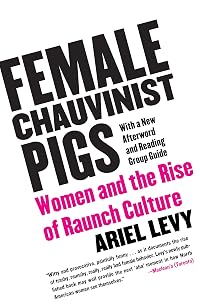
Female Chauvinist Pigs: Women and the Rise of Raunch Culture
by Ariel Levy
On This Page
Description
Examines how some women are promoting chauvinism by behaving in sexually compromising ways, in an account that evaluates how women may be contributing to misogynistic and stereotyped belief systems.Tags
Recommendations




























Member Recommendations



Member Reviews
This doesn't offer any answers, just questions and the questions are pretty disturbing. This book was read while a man justifies a t-shirt that says "no+rhyphonol=yes" with a "not intended for ugly feminists"; where a book for children depicts a tomboy princess realising that dressing up is the way to win the boy; and where an orthodox Jewish girls school is picketed by ultra-orthodox men because the girls are "too distracting", and those were just what made it's way onto my twitter stream during the day I was reading this short collection of essays on women today.
It's a scary read. Women are trying harder and harder to be men, rather than women, and are finding the task impossible. The behaviour many are emulating are teenage boys but show more they're failing to become adults, thus undermining the entire feminist agenda.
Women's roles have become more constrained, more trivialised and this book asks many of the deep questions about why and how we've accepted this from the constant battering of our psyches by media. show less
It's a scary read. Women are trying harder and harder to be men, rather than women, and are finding the task impossible. The behaviour many are emulating are teenage boys but show more they're failing to become adults, thus undermining the entire feminist agenda.
Women's roles have become more constrained, more trivialised and this book asks many of the deep questions about why and how we've accepted this from the constant battering of our psyches by media. show less
A cultural critique which is insightful and - I can't help saying it - so right! One of those books I want to order 10 copies of and pass to friends and family and ask, "What do you think about THIS?" Reading this text is influencing how I read other popular culture. In the New York Times, for example, last Sunday, the headline was "Bottoms Up!" - and the caption, under 3 leering young men - was something like "Seeds of democracy seen in strip clubs in Iraq." We fail to see the objectification of women as oppression. Somehow we mistakenly think that pornography is a sign of freedom instead of a tightening of patriarchy. Ariel Levy is both eloquent and convincing.
Not sure this 17-year-old book that should have just been a New Yorker piece entirely holds up—so many things have changed since the aughts. She’s a bit of a scold, but she did have a point.
And the thrust of the book calls to mind that meme of the late 2010s: “I never thought leopards would eat MY face,” sobs woman who voted for the Leopards Eating People’s Faces Party.
And the thrust of the book calls to mind that meme of the late 2010s: “I never thought leopards would eat MY face,” sobs woman who voted for the Leopards Eating People’s Faces Party.
If you're as gobsmacked as I am by the idea of 'Girls Gone Wild' as female empowerment or Paris Hilton as a role model for teens' sexual expression, this book will probably speak to you and frustrate you as much as it did me. It has some enlightening (and deeply disturbing) interviews with middle school and high school girls, singletons in NYC, and lesbians in California. I do find it genuinely upsetting that this air-brushed, overwaxed, silicone vacuousness is increasingly displayed as the only acceptable form of 'sexy' (esp because I don't think this is even truly what a good chunk of people consider desirable). I also find it really mind-blowing that, as is clear from the interviews, this conception of sexiness seems almost by show more definition divorced from any notion of sexual fufillment or even desire on the part of the women emulating it, and yet it is supposed to be 'empowering'. Attention ladies, if flashing your boobs at hooting frat boys for a camera crew makes you feel icky, bored, or contemptuous? Then you did not just find it 'liberating'. If that happens to be your thing, bully for you, but try to tell me it's feminist self-expression for everyone and I will try to restrain myself from poking your eyeballs out. show less
Ariel Levy's assessment in Female Chauvinist Pigs of "raunch culture" and its impact on women and teenaged girls is spot on, and she provides a useful historical overview of how feminism developed into different strands, one of which has morphed into this mainstream embracing of the ideal of female sexual expression being that of porn stars. I occasionally found her evidence weighed slightly heavily on the anecdotal side and thus its generality is questionable, and she doesn't seem to acknowledge that there *are* differences between men and women (although they are perhaps not as wide as popular literature would have us believe). However, my main issue with books which provide analyses of such dangerous trends is that I want answers: show more where do we go from here? How do we tackle these attitudes? I'm certain that part of the solution is formulating the problem, which this short read admirably achieves, but the lack of an approach to tackle the problem has the net effect of leaving me with a deep sense of unease. show less
Did you know Barbie dolls were modelled after blonde German sex dolls called Bild Lilli? Disturbing to know I played with a sex doll as a child. o_O
Chapter One: Raunch Culture
Published in 2006 one would assume Female Chauvinist Pigs would be fairly up-to-date, but it becomes obvious quite quickly that much has changed in the six years since this was written. Here, Levy focuses on the late nineties and early noughties, in the days of Sex and the City, Sexcetera, and Eurotrash, producing nauseating examples of raunch, harassment and coercion of women, exploiting them and their insecurities for entertainment and profit. Playboy's hypocrisy is maddening.
I could almost picture Levy's lips curling with distain and hear the disgust in her show more voice as she makes judgements about what women do with their own bodies. Framing her concerns in terms of self-respect and self-worth would encourage these strippers and porn stars she castigates, to listen to her arguments. Her angle seems to be to comment and complain rather than influence change to the status quo, therefore FCP appears at this stage only marketable to conservative types, or at least those that keep their private parts private.
Nevertheless, she does tell both sides of the story by using, as examples, the women who embrace, participate and perpetuate raunch culture, and Hugh Hefner and Playboy, letting their own words and actions speak for themselves. However, there is no mention of disadvantaged backgrounds or anything else that could lead them women to turn to raunch. [She rectifies this in Chapter 6.]
Chapter Two: The Future That Never Happened
Less relevant to me as a non-American was the description of American feminist history, most of which was completely new and confusing to me, though, in the end, I grasped Levy's messages.
The ultimate (ideal) feminist goal:
Feminism diversified and splintered into the anti-porn feminists vs. sex-positive feminists, the former believing porn degrades women and feeds rape culture, while the latter thought porn empowering; evidence of sexual emancipation and freedom to pursue active sex lives, like that of men.
Raunch culture was pervasive, unrelenting. At its emergence, when it wasn't instantly rejected, it's subversive nature, working in the background until those you'd expect to denounce it embraced it instead, even feminists. That's when it became socially acceptable. The saying, 'give them an inch and they'll take a mile' comes to mind.
[Levy's thoroughly ruined "sexy" for me. She'd probably like that since we agree it's been co-opted as a slang term for "cool".]
Chapter Three: Female Chauvinist Pigs
‘Them’ being men. Joining men meant taking part in male activities i.e. forgetting the feminist cause upheld by your forebears and participating in the un-sister-like behaviour of denigrating your fellow woman by acting like a man. In effect, they switch teams and start actively working against feminist goals and promote male ones. ‘FCPs don't bother to question the criteria on which women are judged, they are too busy judging other women themselves.’
In turning ‘traitor,’ FCPs can be interpreted as Uncle Toms. ‘An Uncle Tom is a person who deliberately upholds the stereotypes assigned to his or her marginalized group in the interest of getting ahead with the dominant group.’ Upholding sexist stereotypes and mimicking male behaviour by positioning themselves as the exception to the rule, setting themselves apart from other (inferior) women –‘the girly-girls’, ingratiates FCPs to men by showing them they share a similar mindset, thereby reinforcing anti-feminist views once the subject of them (women) accepts them.
So Levy theorises there are two types of FCP:
(1) ‘acting like a cartoon man-who drools over strippers, says things like "check out that ass," and brags about having the "biggest cock in the building"'
(2) 'or acting like a cartoon woman, who has cartoon breasts, wears little cartoon outfits, and can only express her sexuality by spinning around a pole.’
Both involve pleasing and seeking the approval of others rather than being true to individual wants and needs.
Chapter Four: From Womyn to Bois
Lesbianism and the transgendered are the examined in this chapter.
Butch (masculine lesbians) and femmes (feminine lesbians) I've heard of, bois is a new one on me. They seem to be characterised as behaving similar to teenage boys: unsophisticated, immature, letting their id control their actions.
I'm in complete agreement with Rosskum on finding 'the idea that there are two distinct genders and nothing in between constricting and close-minded.' Physically, genetically, hormonally and psychologically -One person can be a different gender in each of those categories (intersex). XX and XY are not the be all and end all to gender identification.
Why so much body modification (or mutilation)? Genuine need for plastic surgery to aid reconstruction after injury or cancer, psychological requirement (e.g. gender dysphoria, severely impeding quality of life), or fear of dangerous situations (e.g. revirginization of girls worried about repercussions from religious community) -Those I understand, but to make possibly life-altering decisions when succumbing to peer pressure or to conform for acceptance is profoundly sad.
Almost exclusively focusing on specific subgroups of women in two metropolitan areas (San Francisco and New York City) of one country, such as the career woman, the stripper, masculine lesbians (butch and bois), FTMs, serves to highlight extremes among minorities some of which the global media may have made popular and as a result, socially acceptable, to the detriment of the feminist cause (i.e. equality with men) and the benefit of masculinism by reconfirming the superiority of men.
Unrepresentative of the larger population, these generalisations based on small groups aren’t necessarily indicative of a larger problem and treating them as such may hurt Levy’s message when some of us haven’t experienced or witnessed the examples given (but just because we've not encountered something doesn't mean it doesn't exist), and fail to see or understand the relationships between certain behaviours, causes and effects detailed.
Culturally speaking, on the whole, this is only directly applicable to metropolitan America, and to a lesser extent other developed countries, because feminism isn't always recognised or is oppressed in the developing world.
Chapter Five: Pigs in Training
By far the best chapter, describing the feelings and actions of teenage girls, and the ineffectual sex education they receive.
A girl's self-worth is derived from the attention of boys, competition with other girls for a boy's attention results in dressing provocatively, flirting, the flashing of 'assets', performing oral sex on boys, intercourse and publicly documenting nudity or sexual acts and sharing them to increase one's popularity. Sadly, peer pressure seems to dictate when girls lose their virginity rather than thrill-seeking curiosity and the pursuit of pleasure.
At no point does it occur to these girls to request reciprocal oral sex, and have difficulty recognising, expressing and experiencing sexual desire, and sex education doesn't teach 'sexuality as a larger more complex, more fundamental part of being human.' Instead guilt-ridden Christian America has spent $1bn in ten years teaching abstinence while ignoring contraception or lying about its effectiveness. The message children receive is:
Confusing. I feel lucky to have received the sex education I did. It wasn't perfect but it was practical, informative and truthful. I can't wait to read [b:The Purity Myth: How America's Obsession with Virginity is Hurting Young Women|4914761|The Purity Myth How America's Obsession with Virginity is Hurting Young Women|Jessica Valenti|http://photo.goodreads.com/books/1239579553s/4914761.jpg|4980306] because it looks to be an outrage-inducing experience.
Chapter Six: Shopping for Sex
Levy's highly critical of Sex and the City, Carrie in particular, because she 'rarely evaluated her own happiness' and instead 'measur[ed] men's interest' which is a 'flawed guide to empowerment.' I loathed Carrie's unchecked materialist obsession with expensive shoes when she needed money to pay her rent. She regularly offended my practical sensibilities and her frequently 'complicated' love life because she made it so.
As a teenager I watched the show with fascination and surprise. It was a source of sex education, an insight into the fashionable American woman, and covered important subjects I'd never considered before, like abortion. Miranda and Charlotte were my favourite characters, though I respected Samantha's refusal to be embarrassed about anything sex-related, to her it was a fact of life, which it is.
I'd argue with Levy about Samantha's mannish approach to her sexual exploits as Levy emphasises FCP's requirement for quantity of sexual partners over quality, knowingly robbing themselves of satisfying sex, whereas Samantha made a concerted effort to get as much enjoyment and pleasure out of every conquest she could, exploring the different facets of sexuality along the way, without fear or judgement. She doesn't comfortably fit the mould Levy's created, though she does match a few of the criteria.
An underlying inferred theory for the reason women act like men by seeking unemotional, non-committal sex, is the possible prior rejection and hurt experienced after what turns out to be a one-night stand, encouraging women to take out emotion from the equation when they recover and decide to move on to the next man, and use sex as proof of future desirability to soothe the insecurities that arose from that injury to her pride.
Pornography is documented prostitution, and Levy argues stripping falls under this category as well, for the commodification of a naked body. She goes on to use successful porn star Jenna Jameson as an example of the damaging nature of porn:
Not once does she use the word 'pleasure' to describe her sexuality. 'Like most employees of the sex industry, [she] is not sexually uninhibited, she is sexually damaged.' Being a sex worker further damages these vulnerable people, and Levy suggests these inappropriate erotic role models are suffering PTSD from past sexual abuse, 'It's like using a bunch of shark attack victims as our lifeguards.'
Conclusion
We've adopted and conformed to the sex industry's representation of sexuality, which dictates what's desirable and worthy of fantasy. 'We have to ask ourselves why we are so focused on silent girly-girls in G-strings faking lust,' must we also fake it to the detriment of our own personal tastes and sexual satisfaction?
‘Sexual power is only one very specific kind of power,' we should be looking at other types of power, breaking through the glass ceiling and pursuing higher female representation in politics and the boardrooms of big business for which previous generations’ feminists originally strived.
Men are all evil, sexist pigs! Well, no. They're not. As Levy shows men so unfavourably throughout, I do wish she'd included a caveat in her introduction stating that not all men act in negative, stereotypical ways. Kind and respectful men do exist, though you wouldn't think so from reading this book.
Occasionally, I was uncomfortable with taking Levy's chosen quotes from other people, whether from printed sources or her own personal interviews, as a truthful representation of that person's opinion. It would be so easy for Levy's bias to influence the way she edits and presents others' words. Although this was based on my own inexperience and naivety with regards to certain viewpoints, e.g. having had little knowledge of the ins and outs of lesbian and transgendered culture and communities, etc.
A thought-provoking, informative and nauseating read, one I hope will one day be studied in schools. It would've been very useful to me when I was studying for A Level English Literature 'moral pornographer' [a:Angela Carter|27500|Angela Carter|http://photo.goodreads.com/authors/1241164068p2/27500.jpg]'s [b:The Bloody Chamber and Other Stories|49011|The Bloody Chamber and Other Stories|Angela Carter|http://photo.goodreads.com/books/1348808640s/49011.jpg|47950] first published in 1979, who was compared to [a:Donatien-Alphonse-François de Sade|2885224|Donatien-Alphonse-François de Sade|http://photo.goodreads.com/authors/1315315272p2/2885224.jpg], informally known as the father of Sadism, the Marquis de Sade.
Warning: Don't read this book if you're easily offended, or partial to feeling shame or guilt for falling into one of the groups Levy criticises, it will only make you feel worse. Both Christianity and politics are also discussed and criticised. show less
Chapter One: Raunch Culture
Published in 2006 one would assume Female Chauvinist Pigs would be fairly up-to-date, but it becomes obvious quite quickly that much has changed in the six years since this was written. Here, Levy focuses on the late nineties and early noughties, in the days of Sex and the City, Sexcetera, and Eurotrash, producing nauseating examples of raunch, harassment and coercion of women, exploiting them and their insecurities for entertainment and profit. Playboy's hypocrisy is maddening.
I could almost picture Levy's lips curling with distain and hear the disgust in her show more voice as she makes judgements about what women do with their own bodies. Framing her concerns in terms of self-respect and self-worth would encourage these strippers and porn stars she castigates, to listen to her arguments. Her angle seems to be to comment and complain rather than influence change to the status quo, therefore FCP appears at this stage only marketable to conservative types, or at least those that keep their private parts private.
Nevertheless, she does tell both sides of the story by using, as examples, the women who embrace, participate and perpetuate raunch culture, and Hugh Hefner and Playboy, letting their own words and actions speak for themselves. However, there is no mention of disadvantaged backgrounds or anything else that could lead them women to turn to raunch. [She rectifies this in Chapter 6.]
Chapter Two: The Future That Never Happened
Less relevant to me as a non-American was the description of American feminist history, most of which was completely new and confusing to me, though, in the end, I grasped Levy's messages.
The ultimate (ideal) feminist goal:
“Women as a class have never subjugated another group; we have never marched off to wars of conquest in the name of the fatherland ... those are the games men play.We see it differently. We want to be neither oppressor nor the oppressed. The women’s revolution is the final revolution of them all. [...] The goals of liberation go beyond the simple concept of equality.”
Feminism diversified and splintered into the anti-porn feminists vs. sex-positive feminists, the former believing porn degrades women and feeds rape culture, while the latter thought porn empowering; evidence of sexual emancipation and freedom to pursue active sex lives, like that of men.
Raunch culture was pervasive, unrelenting. At its emergence, when it wasn't instantly rejected, it's subversive nature, working in the background until those you'd expect to denounce it embraced it instead, even feminists. That's when it became socially acceptable. The saying, 'give them an inch and they'll take a mile' comes to mind.
[Levy's thoroughly ruined "sexy" for me. She'd probably like that since we agree it's been co-opted as a slang term for "cool".]
Chapter Three: Female Chauvinist Pigs
'Why worry about disgusting or degrading when you could be giving - or getting - a lap dance yourself? Why try to beat them when you can join them?’
‘Them’ being men. Joining men meant taking part in male activities i.e. forgetting the feminist cause upheld by your forebears and participating in the un-sister-like behaviour of denigrating your fellow woman by acting like a man. In effect, they switch teams and start actively working against feminist goals and promote male ones. ‘FCPs don't bother to question the criteria on which women are judged, they are too busy judging other women themselves.’
In turning ‘traitor,’ FCPs can be interpreted as Uncle Toms. ‘An Uncle Tom is a person who deliberately upholds the stereotypes assigned to his or her marginalized group in the interest of getting ahead with the dominant group.’ Upholding sexist stereotypes and mimicking male behaviour by positioning themselves as the exception to the rule, setting themselves apart from other (inferior) women –‘the girly-girls’, ingratiates FCPs to men by showing them they share a similar mindset, thereby reinforcing anti-feminist views once the subject of them (women) accepts them.
So Levy theorises there are two types of FCP:
(1) ‘acting like a cartoon man-who drools over strippers, says things like "check out that ass," and brags about having the "biggest cock in the building"'
(2) 'or acting like a cartoon woman, who has cartoon breasts, wears little cartoon outfits, and can only express her sexuality by spinning around a pole.’
Both involve pleasing and seeking the approval of others rather than being true to individual wants and needs.
Chapter Four: From Womyn to Bois
Lesbianism and the transgendered are the examined in this chapter.
Butch (masculine lesbians) and femmes (feminine lesbians) I've heard of, bois is a new one on me. They seem to be characterised as behaving similar to teenage boys: unsophisticated, immature, letting their id control their actions.
[There is] 'another camp of bois who date femmes exclusively and follow a locker-room code of ethics referenced by the phrase "bros before hos" or "bros before bitches," which means they put the similarly masculine identified women they hang out with in a different, higher category than the feminine women they have sex with. This school of bois tends to adhere to almost comically unreconstructed fifties gender roles. They just reposition themselves as the ones who wear the pants-they take Feminist Chauvinist Piggery to a whole different level.'
I'm in complete agreement with Rosskum on finding 'the idea that there are two distinct genders and nothing in between constricting and close-minded.' Physically, genetically, hormonally and psychologically -One person can be a different gender in each of those categories (intersex). XX and XY are not the be all and end all to gender identification.
'Women are actually becoming men' and 'Elective cosmetic surgery - implants for straight women, mastectomies for FTMs (female-to-male transexuals) - is popular to the point of being faddish. Non-committal sex is widespread, and frequently prefigured by a public spectacle.'
Why so much body modification (or mutilation)? Genuine need for plastic surgery to aid reconstruction after injury or cancer, psychological requirement (e.g. gender dysphoria, severely impeding quality of life), or fear of dangerous situations (e.g. revirginization of girls worried about repercussions from religious community) -Those I understand, but to make possibly life-altering decisions when succumbing to peer pressure or to conform for acceptance is profoundly sad.
Almost exclusively focusing on specific subgroups of women in two metropolitan areas (San Francisco and New York City) of one country, such as the career woman, the stripper, masculine lesbians (butch and bois), FTMs, serves to highlight extremes among minorities some of which the global media may have made popular and as a result, socially acceptable, to the detriment of the feminist cause (i.e. equality with men) and the benefit of masculinism by reconfirming the superiority of men.
Unrepresentative of the larger population, these generalisations based on small groups aren’t necessarily indicative of a larger problem and treating them as such may hurt Levy’s message when some of us haven’t experienced or witnessed the examples given (but just because we've not encountered something doesn't mean it doesn't exist), and fail to see or understand the relationships between certain behaviours, causes and effects detailed.
Culturally speaking, on the whole, this is only directly applicable to metropolitan America, and to a lesser extent other developed countries, because feminism isn't always recognised or is oppressed in the developing world.
Chapter Five: Pigs in Training
By far the best chapter, describing the feelings and actions of teenage girls, and the ineffectual sex education they receive.
A girl's self-worth is derived from the attention of boys, competition with other girls for a boy's attention results in dressing provocatively, flirting, the flashing of 'assets', performing oral sex on boys, intercourse and publicly documenting nudity or sexual acts and sharing them to increase one's popularity. Sadly, peer pressure seems to dictate when girls lose their virginity rather than thrill-seeking curiosity and the pursuit of pleasure.
At no point does it occur to these girls to request reciprocal oral sex, and have difficulty recognising, expressing and experiencing sexual desire, and sex education doesn't teach 'sexuality as a larger more complex, more fundamental part of being human.' Instead guilt-ridden Christian America has spent $1bn in ten years teaching abstinence while ignoring contraception or lying about its effectiveness. The message children receive is:
'Girls have to be hot. Girls who aren't hot probably need breast implants. Once a girl is hot, she should be as close to naked as possible all the time. Guys should like it. Don't have sex.'
Confusing. I feel lucky to have received the sex education I did. It wasn't perfect but it was practical, informative and truthful. I can't wait to read [b:The Purity Myth: How America's Obsession with Virginity is Hurting Young Women|4914761|The Purity Myth How America's Obsession with Virginity is Hurting Young Women|Jessica Valenti|http://photo.goodreads.com/books/1239579553s/4914761.jpg|4980306] because it looks to be an outrage-inducing experience.
Chapter Six: Shopping for Sex
Levy's highly critical of Sex and the City, Carrie in particular, because she 'rarely evaluated her own happiness' and instead 'measur[ed] men's interest' which is a 'flawed guide to empowerment.' I loathed Carrie's unchecked materialist obsession with expensive shoes when she needed money to pay her rent. She regularly offended my practical sensibilities and her frequently 'complicated' love life because she made it so.
As a teenager I watched the show with fascination and surprise. It was a source of sex education, an insight into the fashionable American woman, and covered important subjects I'd never considered before, like abortion. Miranda and Charlotte were my favourite characters, though I respected Samantha's refusal to be embarrassed about anything sex-related, to her it was a fact of life, which it is.
I'd argue with Levy about Samantha's mannish approach to her sexual exploits as Levy emphasises FCP's requirement for quantity of sexual partners over quality, knowingly robbing themselves of satisfying sex, whereas Samantha made a concerted effort to get as much enjoyment and pleasure out of every conquest she could, exploring the different facets of sexuality along the way, without fear or judgement. She doesn't comfortably fit the mould Levy's created, though she does match a few of the criteria.
An underlying inferred theory for the reason women act like men by seeking unemotional, non-committal sex, is the possible prior rejection and hurt experienced after what turns out to be a one-night stand, encouraging women to take out emotion from the equation when they recover and decide to move on to the next man, and use sex as proof of future desirability to soothe the insecurities that arose from that injury to her pride.
Pornography is documented prostitution, and Levy argues stripping falls under this category as well, for the commodification of a naked body. She goes on to use successful porn star Jenna Jameson as an example of the damaging nature of porn:
'Jameson thinks that women outside the sex industry have internalized its spirit and model their sexuality on porn. [She] presents life in the industry as marked by violence and violation: She tells us she was beaten unconscious with a rock, gang-raped, and left for dead on a dirt road during her sophomore year of high school; she was life-threateningly addicted to drugs before she was twenty; she was beaten by her boyfriend and sexually assaulted by his friend. She also writes, "To this day, I still can't watch my own sex scenes."
Not once does she use the word 'pleasure' to describe her sexuality. 'Like most employees of the sex industry, [she] is not sexually uninhibited, she is sexually damaged.' Being a sex worker further damages these vulnerable people, and Levy suggests these inappropriate erotic role models are suffering PTSD from past sexual abuse, 'It's like using a bunch of shark attack victims as our lifeguards.'
Conclusion
We've adopted and conformed to the sex industry's representation of sexuality, which dictates what's desirable and worthy of fantasy. 'We have to ask ourselves why we are so focused on silent girly-girls in G-strings faking lust,' must we also fake it to the detriment of our own personal tastes and sexual satisfaction?
'Why have we fallen sway to a kind of masculine mystique, determined that to be adventurous is to be like a man, and decided that the best thing we can possibly expect for women is hotness?’ The 'prevalence of raunch in the mainstream has diluted the effect of both sex radicals and feminists, who've seen their movement's images popularized while their ideals are forgotten.
‘Sexual power is only one very specific kind of power,' we should be looking at other types of power, breaking through the glass ceiling and pursuing higher female representation in politics and the boardrooms of big business for which previous generations’ feminists originally strived.
Men are all evil, sexist pigs! Well, no. They're not. As Levy shows men so unfavourably throughout, I do wish she'd included a caveat in her introduction stating that not all men act in negative, stereotypical ways. Kind and respectful men do exist, though you wouldn't think so from reading this book.
Occasionally, I was uncomfortable with taking Levy's chosen quotes from other people, whether from printed sources or her own personal interviews, as a truthful representation of that person's opinion. It would be so easy for Levy's bias to influence the way she edits and presents others' words. Although this was based on my own inexperience and naivety with regards to certain viewpoints, e.g. having had little knowledge of the ins and outs of lesbian and transgendered culture and communities, etc.
A thought-provoking, informative and nauseating read, one I hope will one day be studied in schools. It would've been very useful to me when I was studying for A Level English Literature 'moral pornographer' [a:Angela Carter|27500|Angela Carter|http://photo.goodreads.com/authors/1241164068p2/27500.jpg]'s [b:The Bloody Chamber and Other Stories|49011|The Bloody Chamber and Other Stories|Angela Carter|http://photo.goodreads.com/books/1348808640s/49011.jpg|47950] first published in 1979, who was compared to [a:Donatien-Alphonse-François de Sade|2885224|Donatien-Alphonse-François de Sade|http://photo.goodreads.com/authors/1315315272p2/2885224.jpg], informally known as the father of Sadism, the Marquis de Sade.
Warning: Don't read this book if you're easily offended, or partial to feeling shame or guilt for falling into one of the groups Levy criticises, it will only make you feel worse. Both Christianity and politics are also discussed and criticised. show less
adult nonfiction; sociology. This was a book club pick and I wasn't sure I'd like it, but it turned out to be interesting and thought-provoking. Levy expresses perfectly what we've all noticed (whether consciously or not) about 'raunch' culture and the seeming idolization of sluts, and her analysis is fairly thorough and most importantly, digestible.
Members
- Recently Added By
Published Reviews
ThingScore 75
As a consciousness-raising call to arms, "Female Chauvinist Pigs" is clearly to the good.
added by Shortride
Lists

Best Feminist Literature
188 works; 26 members

Non-Fiction Worth Reading
1,015 works; 261 members

Simon & Schuster
136 works; 4 members

el
1,139 works; 1 member
Author Information

3+ Works 2,573 Members
Ariel Levy is an American journalist and writer, born in 1974. She is a graduate of Wesleyan University. Before becoming a writer, she worked for Planned Parenthood and New York magazine. In 2008, she became a staff writer for The New Yorker. Her essay, The Lesbian Bride's Handbook, was published in The Best American Essays 2008. She is the author show more of two books, Female Chauvinist Pigs: Women and the Rise of Raunch Culture, and The Rules Do Not Apply: a Memoir. (Bowker Author Biography) show less
Common Knowledge
- Original publication date
- 2005
- First words
- I first noticed it several years ago.
Classifications
- Genres
- Sexuality and Gender Studies, Sociology, General Nonfiction, Nonfiction
- DDC/MDS
- 305.420973090511 — Society, government, & culture Social sciences, sociology & anthropology Social group - Age, Gender, Ethnicity Women Social role and status of women Standard subdivisions History, geographic treatment, biography North America
- LCC
- HQ1155 .L48 — Social sciences The family. Marriage, Women and Sexuality The Family. Marriage. Women Women. Feminism
- BISAC
Statistics
- Members
- 1,576
- Popularity
- 14,407
- Reviews
- 47
- Rating
- (3.67)
- Languages
- Dutch, English, Italian, Norwegian (Bokmål)
- Media
- Paper, Audiobook, Ebook
- ISBNs
- 14
- UPCs
- 1
- ASINs
- 9