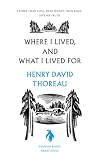
Where I Lived, and What I Lived For
by Henry David Thoreau
On This Page
Description
Throughout history, some books have changed the world. They have transformed the way we see ourselves - and each other. They have inspired debate, dissent, war and revolution. They have enlightened, outraged, provoked and comforted. They have enriched lives - and destroyed them. Now Penguin brings you the works of the great thinkers, pioneers, radicals and visionaries whose ideas shook civilization and helped make us who we are. Thoreau's account of his solitary and self-sufficient home in show more the New England woods remains an inspiration to the environmental movement - a call to his fellow men to abandon their striving, materialistic existences of 'quiet desperation' for a simple life within their means, finding spiritual truth through awareness of the sheer beauty of their surroundings. show lessTags
Recommendations



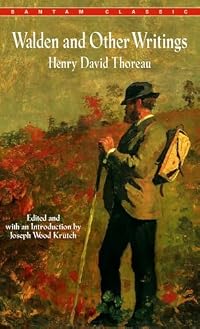
































Member Recommendations

Bill-once Fulfilment
Member Reviews
Beautifully presented excerpt from Thoreau's classic Walden.
Ratings
Members
- Recently Added By
Author Information

612+ Works 49,149 Members
In September 1842, Nathaniel Hawthorne noted this social encounter in his journal: "Mr. Thorow dined with us yesterday. He is a singular character---a young man with much of wild original nature still remaining in him; and so far as he is sophisticated, it is in a way and method of his own. He is as ugly as sin, long-nosed, queer-mouthed, and with show more uncouth and somewhat rustic, although courteous manners, corresponding very well with such an exterior. But his ugliness is of an honest and agreeable fashion, and becomes him much better than beauty. On the whole, I find him a healthy and wholesome man to know." Most responses to Thoreau are as ambiguously respectful as was Hawthorne's. Thoreau was neither an easy person to like nor an easy writer to read. Thoreau described himself as a mystic, a Transcendentalist, and a natural philosopher. He is a writer of essays about nature---not of facts about it but of his ideals and emotions in its presence. His wish to understand nature led him to Walden Pond, where he lived from 1845 to 1847 in a cabin that he built. Though he was an educated man with a Harvard degree, fluent in ancient and modern German, he preferred to study nature by living "a life of simplicity, independence, magnanimity, and trust." Knowing this, we should beware of misreading the book that best reflected this great experience in Thoreau's life: Walden; or, Life in the Woods (1854). It is not a handbook of the simple life. Though there are elements in the book of a "whole-earth catalogue" mentality, to focus on the radical "economic" aspects of Thoreau's work is to miss much in the book. Nor is it an autobiography. The right way to read Walden is as a "transcendental" narrative prose poem, whose hero is a man named Henry, a modern Odysseus in search of a "true America." Thoreau left Walden Pond on September 6, 1846, exactly two years, two months, and two days after he had settled there. As he explained in the pages of Walden: "I left the woods for as good a reason as I went to live there. Perhaps it seemed to me that I had several more lives to live, and could not spare any more time for that one." Growth, change, and development were essential to his character. One should not overlook the significance of his selecting July 4 as the day for taking possession of his residence at Walden Pond, a day that celebrates the establishment of a new government whose highest ideal is individual freedom. In terms of Thoreau's redefinition of the nation-idea, "the only true America" is that place where one may grow wild according to one's nature, where one may "enjoy the land, but own it not." Thoreau believed that each person should live according to individual conscience, willing to oppose the majority if necessary. An early proponent of nonviolent resistance, he was jailed briefly for refusing to pay his poll tax to support the Mexican War and the slave system that had promoted that war. His essay "On Civil Disobedience" (1849), which came from this period of passive resistance, was acknowledged by Mahatma Gandhi (who read it in a South African jail) as the basis for his campaign to free India. Martin Luther King, Jr. later attributed to Thoreau and Gandhi the inspiration for his leadership in the civil rights movement in the United States. Thoreau contracted tuberculosis in 1835 and suffered from it sporadically afterwards. His health declined over three years with brief periods of remission, until he eventually became bedridden. Recognizing the terminal nature of his disease, Thoreau spent his last years revising and editing his unpublished works, particularly The Maine Woods and Excursions, and petitioning publishers to print revised editions of A Week and Walden. He died on May 6, 1862 at age 44. (Bowker Author Biography) show less
Some Editions
Series
Belongs to Publisher Series
Great Ideas II (37)
Penguin Great Ideas (37)
Work Relationships
Is contained in
A Week on the Concord and Merrimack Rivers / Walden / The Maine Woods / Cape Cod by Henry David Thoreau (indirect)
Walden / The Maine Woods / A Week on the Concord and Merrimack Rivers / Civil Disobedience by Henry David Thoreau (indirect)
The Norton Anthology of American Literature, Seventh Edition: Volume B: 1820-1865 by Nina Baym (indirect)
The Maine Woods / A Week on the Concord and Merrimack Rivers / Walden by Henry David Thoreau (indirect)
Walden and Resistance to Civil Government [Norton Critical Edition] by Henry David Thoreau (indirect)
90 Masterpieces You Must Read (Vol.1): Novels, Poetry, Plays, Short Stories, Essays, Psychology & Philosophy by Various (indirect)
Common Knowledge
- Canonical title
- Where I Lived, and What I Lived For
Classifications
Statistics
- Members
- 395
- Popularity
- 78,617
- Reviews
- 1
- Rating
- (3.77)
- Languages
- English, German, Portuguese
- Media
- Paper, Ebook
- ISBNs
- 6
- ASINs
- 4