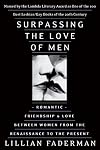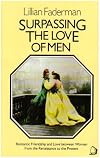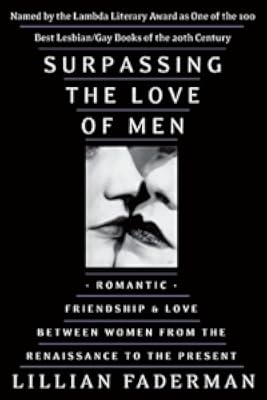
Surpassing the Love of Men: Romantic Friendship and Love Between Women from the Renaissance to the Present
by Lillian Faderman
On This Page
Description
A classic of its kind, this fascinating cultural history draws on everything from private correspondence to pornography to explore five hundred years of friendship and love between women. Surpassing the Love of Men throws a new light on shifting theories of female sexuality and the changing status of women over the centuries.Tags
Recommendations























Member Reviews
I found this book wholly fascinating and compelling, yet sad. It tells the story of love between women and how perceptions and prejudices have shaped it across the centuries. As it was first published in 1981, the subtitle is no longer accurate. The lesbian-feminist movement of the 1970s is the last trend described and it is salutary to compare this to the situation today. The book begins with the notion of ‘romantic friendship’, which reached its height of popularity in the 18th century. Faderman’s examination of romantic friendship demonstrates powerfully how changeable cultural norms are, in an area (love and sex) often blithely treated as immutable. Certainly, you have the trend today of framing so-called masculine and show more feminine behaviours as biologically fixed, as challenged in the excellent [b:Delusions of Gender: How Our Minds, Society, and Neurosexism Create Difference|8031168|Delusions of Gender How Our Minds, Society, and Neurosexism Create Difference|Cordelia Fine|https://images.gr-assets.com/books/1348833681s/8031168.jpg|12635310].
A major theme that I felt ran through the book was how sexuality is currently seen as a matter of desire and attraction, rather than behaviour, whereas this has not always been the case. Romantic friendships were a loving behaviour between women which did not tie them to a particular identity, sexual or otherwise. In the 18th century, though, it was widely assumed that none of these romantic friendships could have a sexual aspect, as a) women were assumed to have little or no libido, and b) the men whose writings on the topic have survived did not know how two women could have sex! There is thus a bittersweet tone to the initial chapters on romantic friendship. Undoubtedly their bonds brought a lot of women much joy, companionship, and deep love, however this was within a deeply oppressive patriarchal society. When it became possible for women to be financially independent from men, romantic friendships became suspect.
Thus, the chapters on the 19th century are saddening, as they recount how romantic friendship became pathologised, exoticised, and condemned. Women who had been happily emotionally involved with one another were now treated as sick, in need of psychotherapy, and a threat to family life/the children/society in general. The sexologists, especially Freud, were at the vanguard of this. In short, the patriarchy attempted to ruin the emotional bonds that women had developed in part as a way to survive misogyny. Faderman examines the fictional depictions of women loving women (by then labelled ‘lesbianism’) that promulgated these negative ideas. I was amused by her palpable scorn at the decadent movement’s voyeuristic lesbian stereotyping. For example, ‘The emphasis in most of Verlaine’s other lesbian poems, as in Baudelaire’s, is on sex and sin - but of course the women are always young and lovely and arousing as they shuffle off to hell’.
In Faderman’s opinion, only the feminist movement of the 1970s has been able to rehabilitate love between women. I didn’t previously understand what feminists of that decade meant by lesbian, as it seems to differ significantly from the assumed definition today. Lesbian-feminists of the 1970s apparently made a decision to focus their important emotional relationships (which could be sexual but might not be) on other women. Their lesbianism is thus defined by choice and behaviour, whereas today it is assumed that a lesbian is a woman who is sexually attracted to other women whether she likes it or not. In a way, this shifting definition powerfully demonstrates that in the 21st century, there is an assumption of compulsory sexuality. Thus, behaviour is presumed to follow attraction. Lesbians are women who are attracted to women and therefore have sex with them. Whereas Faderman is at pains to point out that romantic friendships seems often to have been sensual, maybe even sexual, but that was by no means the most important thing about them. Love today is so defined by sex. All serious non-familial relationships and emotional attachments are assumed to have a sexual component. I seem to recall that Freud even claimed that all platonic friendships have sexual attraction buried at their core. Freud has a lot to answer for, really. Even as his theories have been academically discredited, their influence on Western popular culture continues.
‘Surpassing the Love of Men’ reminded me that as women in Europe and the US have gained more sexual freedom, this has brought new constraints and novel forms of sexism. The idea of sexuality as being innate, something you’re born with, counters homophobia by denying the possibility of medical rehabilitation. On the other hand, it also tends to exclude the freedom to choose your sexual and emotional behaviours and aims to neatly categorise everyone. I can imagine the hostile confusion that would result today if you came out as a lesbian, on the basis of not wanting emotional relationships with men whether or not you are attracted to them. Women’s bodies are still generally presumed to be sexually available to men. Moreover, any attraction is generally assumed to be sexual, despite the asexual community’s efforts at subdivision (sexual/romantic/sensual elements, etc). And as sexual attraction is treated as the most important and irresistible component of love, non-sexual relationships are deemed unimportant. This is why I felt a sense of loss when reading about romantic friendships. I love my close female friends very much, however none of them are my 'girlfriend', so these relationships are trivialised. In the media, there are very few depictions of female friendships that are recognisable to me. Female characters in films and on TV are so often rivals for a man's interest, rather than having emotional attachments to one another. Since the 18th century women's lives have improved immeasurably, but not without some losses. We still live in a misogynistic world, though I'm well aware that as a white, middle class woman I'm insulated from the worst of it. show less
A major theme that I felt ran through the book was how sexuality is currently seen as a matter of desire and attraction, rather than behaviour, whereas this has not always been the case. Romantic friendships were a loving behaviour between women which did not tie them to a particular identity, sexual or otherwise. In the 18th century, though, it was widely assumed that none of these romantic friendships could have a sexual aspect, as a) women were assumed to have little or no libido, and b) the men whose writings on the topic have survived did not know how two women could have sex! There is thus a bittersweet tone to the initial chapters on romantic friendship. Undoubtedly their bonds brought a lot of women much joy, companionship, and deep love, however this was within a deeply oppressive patriarchal society. When it became possible for women to be financially independent from men, romantic friendships became suspect.
Thus, the chapters on the 19th century are saddening, as they recount how romantic friendship became pathologised, exoticised, and condemned. Women who had been happily emotionally involved with one another were now treated as sick, in need of psychotherapy, and a threat to family life/the children/society in general. The sexologists, especially Freud, were at the vanguard of this. In short, the patriarchy attempted to ruin the emotional bonds that women had developed in part as a way to survive misogyny. Faderman examines the fictional depictions of women loving women (by then labelled ‘lesbianism’) that promulgated these negative ideas. I was amused by her palpable scorn at the decadent movement’s voyeuristic lesbian stereotyping. For example, ‘The emphasis in most of Verlaine’s other lesbian poems, as in Baudelaire’s, is on sex and sin - but of course the women are always young and lovely and arousing as they shuffle off to hell’.
In Faderman’s opinion, only the feminist movement of the 1970s has been able to rehabilitate love between women. I didn’t previously understand what feminists of that decade meant by lesbian, as it seems to differ significantly from the assumed definition today. Lesbian-feminists of the 1970s apparently made a decision to focus their important emotional relationships (which could be sexual but might not be) on other women. Their lesbianism is thus defined by choice and behaviour, whereas today it is assumed that a lesbian is a woman who is sexually attracted to other women whether she likes it or not. In a way, this shifting definition powerfully demonstrates that in the 21st century, there is an assumption of compulsory sexuality. Thus, behaviour is presumed to follow attraction. Lesbians are women who are attracted to women and therefore have sex with them. Whereas Faderman is at pains to point out that romantic friendships seems often to have been sensual, maybe even sexual, but that was by no means the most important thing about them. Love today is so defined by sex. All serious non-familial relationships and emotional attachments are assumed to have a sexual component. I seem to recall that Freud even claimed that all platonic friendships have sexual attraction buried at their core. Freud has a lot to answer for, really. Even as his theories have been academically discredited, their influence on Western popular culture continues.
‘Surpassing the Love of Men’ reminded me that as women in Europe and the US have gained more sexual freedom, this has brought new constraints and novel forms of sexism. The idea of sexuality as being innate, something you’re born with, counters homophobia by denying the possibility of medical rehabilitation. On the other hand, it also tends to exclude the freedom to choose your sexual and emotional behaviours and aims to neatly categorise everyone. I can imagine the hostile confusion that would result today if you came out as a lesbian, on the basis of not wanting emotional relationships with men whether or not you are attracted to them. Women’s bodies are still generally presumed to be sexually available to men. Moreover, any attraction is generally assumed to be sexual, despite the asexual community’s efforts at subdivision (sexual/romantic/sensual elements, etc). And as sexual attraction is treated as the most important and irresistible component of love, non-sexual relationships are deemed unimportant. This is why I felt a sense of loss when reading about romantic friendships. I love my close female friends very much, however none of them are my 'girlfriend', so these relationships are trivialised. In the media, there are very few depictions of female friendships that are recognisable to me. Female characters in films and on TV are so often rivals for a man's interest, rather than having emotional attachments to one another. Since the 18th century women's lives have improved immeasurably, but not without some losses. We still live in a misogynistic world, though I'm well aware that as a white, middle class woman I'm insulated from the worst of it. show less
I certainly took my time in reading this (over a year--oops), so the earlier sections have lost some of their original "oomf." That said, the discussions regarding historical relationships between women, specifically the idea of the romantic friendships, was fascinating and easily the best parts of the entire book. They were informative and well-researched, and full of information and ideas I'd never heard or thought of before.
In contrast, the latter parts that discuss second-wave feminism were odd and uncomfortable to read. There's blatant homo-, trans-, and bi-phobia throughout. It was moderately interesting in terms of learning about ideas that were central to second-wave feminism, but Faderman believed (believes?) that to be a true show more feminist meant one had to choose lesbianism and had to reject any and all male relationships (...though perhaps not familial relationships with the brothers and fathers? It's difficult to tell).
Overall, I do recommend "Surpassing the Love of Men." It was interesting and informative and, from what I've gleaned, a seminal part of second-wave feminism. However, I do wish I'd skipped, or perhaps just skimmed, the latter sections. show less
In contrast, the latter parts that discuss second-wave feminism were odd and uncomfortable to read. There's blatant homo-, trans-, and bi-phobia throughout. It was moderately interesting in terms of learning about ideas that were central to second-wave feminism, but Faderman believed (believes?) that to be a true show more feminist meant one had to choose lesbianism and had to reject any and all male relationships (...though perhaps not familial relationships with the brothers and fathers? It's difficult to tell).
Overall, I do recommend "Surpassing the Love of Men." It was interesting and informative and, from what I've gleaned, a seminal part of second-wave feminism. However, I do wish I'd skipped, or perhaps just skimmed, the latter sections. show less
An excellent history of romantic friendship, with a little of the associated links of first and second wave feminism, from the sixteenth century through the first half of the twentieth century. The main text is well sourced (the endnotes are over 60 pages), so there are quite a lot of concrete references to go with the main points of the text. One nitpick is that the author will sometimes overquote, ie., list an entire paragraph of references within the main text, or lift an entire poem from source when only a single stanza is referenced. Otherwise, an indispensable read.
I've been reading this book in bed before going to sleep for a couple of months and at times I've been all set to chuck it out of the window. While I'm sure the book was a significant piece of scholarship in 1981, it does feel more than a little dated now - not the least because we now have more sophisticated theories about gender and sexuality than those that were widespread at the end of the 1970s.
As the subheading indicates, Faderman is primarily interested in romantic friendship and love and often seems to go out of her way to emphasise that women did not have sex until the sexually obsessed twentieth century. I am exaggerating but as this aspect of her analysis kept bugging me all the way through the book, I can't really help it. show more I'm only a couple of pages into Emma Donoghue's Passions between Women and her approach is markedly different - she does not assume that women were quite as ignorant of the possibilities of love and passion between women as Faderman argues they were.
It was interesting to read this book but I did not get very much out of it. show less
As the subheading indicates, Faderman is primarily interested in romantic friendship and love and often seems to go out of her way to emphasise that women did not have sex until the sexually obsessed twentieth century. I am exaggerating but as this aspect of her analysis kept bugging me all the way through the book, I can't really help it. show more I'm only a couple of pages into Emma Donoghue's Passions between Women and her approach is markedly different - she does not assume that women were quite as ignorant of the possibilities of love and passion between women as Faderman argues they were.
It was interesting to read this book but I did not get very much out of it. show less
A classic of feminism.
Ratings
Members
- Recently Added By
Lists

The Best LGBTQ Nonfiction
159 works; 68 members
Author Information

Lillian Faderman is an internationally revered scholar of lesbian and ethnic history and literature. She is the recipient of six Lambda Literary Awards, two American Library Association Awards, and several lifetime achievement awards for her scholarship. She is the author of Surpassing the Love of Men and Odd Girls and Twilight Lovers, both New show more York Times Notable Books. show less
Some Editions
Awards and Honors
Series
Belongs to Publisher Series
Common Knowledge
- Original title
- Surpassing the Love of Men: Romantic Friendship and Love Between Women from the Renaissance to the Present
- Original publication date
- 1981
- Epigraph
- "Your love was wonderful to me, passing the love of women."
David to Jonathan
2 Samuel, I,26
"I assure you, with a love "passing the Love of Men," that I am yours..."
Lucy to Harriot
William Hayley's The Young Widow, 1789
"Davidean friendship, emulation warm
Coy blossoms, perishing in courtly air,
Its vain parade, restraint, and irksome form,
Cold as the ice, tho' with the comets' glare,
By firmness won, by constancy secured,
of Sarah Ponsonby and Eleanor Butler
Anna Seward's Poetical Works, 1810 - Dedication
- To Phyllis for everything
- First words
- This book began as a study of Emily Dickinson's love poems and letters to Sue Gilbert, the woman who became her sister-in-law.
--Introduction - Last words
- (Click to show. Warning: May contain spoilers.)But until men stop giving women cause to see them as the enemy and until their ceases to be coercion to step into prescribed roles without reference to individual needs and desires, lesbian-feminists will continue to view their choice as the only logical one possible for a woman who desires to be her own adult person.
- Blurbers
- Smith-Rosenberg, Carroll
- Original language
- English
- Canonical DDC/MDS
- 306.7609
- Canonical LCC
- HQ75.5
Classifications
- Genres
- Sexuality and Gender Studies, LGBTQ+, Nonfiction, History, General Nonfiction, Literature Studies and Criticism
- DDC/MDS
- 306.7609 — Society, government, & culture Social sciences, sociology & anthropology Social Behavior - Dating, Marriage, Divorce Sexual relations Sexual orientation, transgender identity, intersexuality History, geographic treatment, biography
- LCC
- HQ75.5 — Social sciences The family. Marriage, Women and Sexuality The Family. Marriage. Women Sexual life Homosexuality. Lesbianism
- BISAC
Statistics
- Members
- 741
- Popularity
- 38,075
- Reviews
- 5
- Rating
- (3.76)
- Languages
- Czech, English, German, Slovenian
- Media
- Paper
- ISBNs
- 10
- ASINs
- 4