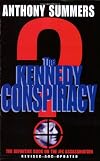
Conspiracy
by Anthony Summers
On This Page
Description
First paperbacked by Fontana 1980, revised and updated for Sphere edition 1989, transferred to Warner 1992. This is new, updated and revised edition for 1998.Tags
Recommendations



















Member Reviews
Originally published in 1980, this impressive example of deep investigative journalism has been regularly updated and revised with new information. The Edition that I am reviewing is the 1998 edition.
The book contains several pleas for the US Government to be more forthcoming with documentation and I am not qualified to assess whether any 'smoking gun' document has been found since my reprint (2001). I think we would have heard of it by now.
Nevertheless, what is in this dense and fully foot-noted book, which tries to summarise research by other respectable investigators (a story where politically engaged populists like Oliver Stone have probably done more harm than good) is remarkably full and interesting.
Summers lays out his evidence show more and refuses to speculate too far beyond the data, certainly not directly on the grand questions of whether Oswald pulled the trigger or not and whether he was a patsy or a participant in some conspiracy to kill President Kennedy.
Part of the value of the book is that it forces you to think and evaluate the evidence for yourself and so to come up with the most likely (all things being equal) narrative for what actually happened in the years and months leading up to the assassination and even on the day itself.
Perhaps once or twice in nearly 400 pages and another just under 1oo of footnotes I may have questioned Summers' interpretation of specific evidence but his work stands up very well to scrutiny with speculation reduced to the minimum necessary to make some sense of it all.
The best I can do is interpret the facts as I can, knowing that another reader may read them differently. There is no shock headline here just the accumulation of circumstantial evidence to the point when you would be wilfully blind to believe the Warren Commission Report was not fiction.
1. It is possible that Lee Harvey Oswald did not actually pull the trigger from the Book Warehouse but we can probably never know that. The 'grassy knoll' and forensic evidence is indistinct.
2. It is almost certain that the Soviets or Castro Cubans had nothing to do with any conspiracy although immense efforts (well documented) appeared to have gone into trying to 'frame' the Soviet Union or Cuba in the weeks before the assassination.
3. There is significant evidence that Oswald was involved in special intelligence 'dirty tricks' operations against Castro's Cuba and that he was a well known participant in 'deep state' or radical right circles since late teen age.
4. There is evidence that Oswald was on the US intelligence services' radar screens for some time before the assassination and the FBI and CIA appear to have gone to an awful lot of trouble to try and cover up that aspect of the matter immediately afterwards.
5. Oswald was possibly a high security clearance agent for naval intelligence and his visit to the Soviet Union engineered for intelligence purposes. His 'flakiness' is as likely as not to have been cover. Of course, the line between flakiness and off balance sheet security work is a fine one.
6. Oswald had family connections to the mob and Jack Ruby was much more embedded in mob networks (notably the powerful Marcello network) than most accounts seem to imply. He was not quite such a minor player, with a track record that goes back to Capone and the Outfit in Chicago.
7. Oswald appears to have had longstanding personal connections to right-wing extremists with links to the anti-Castro community who in turn had close links to the Mob (in view of a shared interest in overthrowing Castro)
8. There is reason to believe that, for different reasons, the Mob (Giancana-Marcello-Trafficante) and extreme elements in the anti-Castro insurgent forces (and their minders in the intelligence services) had 'good reason' to want Kennedy dead.
9. Oswald's engagement with anti-Castro activity looks increasingly (as the evidence piles up) like the sort of agent provocateur action typical of domestic intelligence operations and adds to the 'evidence' that if he was being set up as a patsy in the context of what was to happen in Dallas.
10. There is evidence that in the period leading up to the assassination there were contacts between Oswald and others which might imply police corruption and Oswald being set up for arrest. The ease of access to Oswald of Jack Ruby also looks suspicious in this context.
The attempted assassination of right-wing extremist General Walker has always looked suspiciously 'set up' to me especially as Oswald (or whoever) missed but there is no evidence that Walker was involved in any conspiracy.
Similarly the murdered Officer Tippit looks a lot less of an innocent party in Summers account of him and even the circumstances of Oswald's movements and arrest at the cinema look puzzling.
Overall, the most plausible scenario (as far as Oswald is concerned) is that he was being set up to be a patsy or was directly involved in the assassination but was unaware of a second level of activity designed to incriminate the Soviet Union in the assassination.
This latter really does look evidenced by the weight of suspicious activity involving possible impersonations of Oswald in Mexico City and the stories placed in the media in the immediate aftermath of the assassination - though this part looks pretty amateur to my seasoned eye.
As for the 'conspiracy', the most plausible scenario is that anti-Castro militants (supported by a right-wing fringe element in the security services), with Mob connections and access to Mob assets and resources, killed the President.
I now find the Robin Ramsay 'cui bono' related to the circle around LBJ as less plausible unless someone is postulating that all Summers evidence is incredibly coincidental and that something else was going on all this time! Summers is certainly as plausible as any official investigation.
If so, the anti-Castro militants feared (wrongly) that Kennedy was turning away from toppling the regime (and that LBJ would take a tougher line) and the Mob wanted to pay the Kennedys for welching on the deal they thought they had in 1960 and also warn off investigators.
The identity of interest between Mob and anti-Castro activists was the overthrow of the Castro regime (an interest shared with the Government and the CIA) but this would be only the framework for a more specifically directed plot.
And where do the US intelligence services fit into this? Probably just as totally embarrassed people who find that one of their own (albeit a minor player) has killed their own boss. Then they desperately run around trying to get the facts off the agenda of investigators, colleagues and media.
There is a strong suggestion which would be plausible, of an element in the intelligence services, perhaps semi-detached and 'political', engaged directly in anti-Castro subversion, emotionally engaged in the Cuban situation and able to talk to the Mob when required.
It would be naive not to believe that these types of sociopathic groups emerge inside all unaccountable intelligence services at moments of tension or under weak leadership - we can think of the Italian cases in the 1970s and rogue activity in Northen Ireland.
The question is whether such a rogue element knew of, connived in and even facilitated an essentially Cuban dissident operation with Mob aspects in order to meet some other political objective. This one is tougher to claim - doubtful for any but criminalised security elements.
But this moves us well into 'deep state' territory which is, by its very nature, almost impossible to evidence very far. The balance of admittedly circumstantial evidence strongly indicates that this was more than possible with motive and means both available.
I will leave you to read the book in regard to motives but, in the foot notes, there is one very dark suggestion which we should note, disturbed perhaps, and pass on - this is that the assassination might be linked to a military claim of a particular window of opportunity.
There was serious military interest in a successful 'first strike' against the Soviet Union before the notorious 'missile gap' disappeared. This too has to be seen in a Cuban context since all Americans were painfully aware of how close they had come to be being incinerated.
Kennedy was horrified and forbad any further discussion of it but we have to take account of the possibility (no more) that radical right intelligence awareness of this 'opportunity' might offer the chance to incriminate the Soviet bloc and defeat world communism. Some were nutty enough.
Should we take this seriously? We are a long way now from a lone loony gunman. Oswald can only be regarded as that if we forget his family connections to organised crime, the mass of coincidences, the historic link to right-wing extremists, the Cuban aspect and so on and so forth.
Maybe he had all these attributes and connections but still was loopy and did the deed without orders. Under this scenario, Jack Ruby took him out before he could open up a can of worms that might implicate 'innocent' parties. That too is possible.
In the end, we do not know but we do know that the 'conspiracy theories' are not to be dismissed as the work of nutters (though some are) but as ways of seeing events in a way that is no less plausible (probably more so) than the grossly poorly evidenced official versions.
The real story is, as always, hidden. It is not who killed the President - do we honestly care any more? It is what conditions make the alternative versions credible and what did and do we do about it if they persist. Let us review them.
A: There is the lack of accountability of the military towards the welfare of the people they serve - the people we elect are merely a thin and weak barrier between us and destruction. In the standard model, welfare-warfare state, the two elements are regarded as separate. Is this wise?
B: There can be a lack of accountability and gross internal mismanagement within the intelligence services but especially of sections of the intelligence services that operate either outside the law or become politicised in undemocratic ways because of their secret work.
C: There is the state sponsorship of subversive operations against other 'regimes' that permits the emergence of special interest groups trained to kill, with intelligence connections and with political motives in using violence or disinformation to affect democratic decision-making.
D: There is the use of low level operatives to investigate but also to disrupt and discredit lawful dissident political operations in a democracy (as Oswald was clearly doing if Summers' pile of evidence stands up)
E: There is the impunity of organised crime and the tendency of political intelligence services to solve problems outside the law by cutting deals with mobsters.
These disturbing but well known aspects of the 'deep state' are all found evidentially laid out (regardless of the assassination) in Summers' book at different points.
Together, they almost define the infamous Deep State: institutionalised military power, an unaccountable security apparatus, state-backed regime change, state infiltration of internal politics and the latitude permitted to any organised crime interest that stays within 'its box'.
I would like to think that matters have improved somewhat since 1963 but I have my doubts. Everything is just run more effectively (lessons learned!) and more subtly. If some state actor was complicit in the Kennedy assassination, the first lesson would have been that victory was Pyrrhic.
Perhaps from now on, the Deep State just tries to make sure a wrong 'un isn't put into power at the start. Yet much of what we saw in 1963 has simply been transmuted into another form despite some honest reforming efforts by some honest politicians.
Just glance at NATO's political interventions in Europe in the last few years, at the emergence of mass surveillance, at the manipulation of soft power to build momentum for regime change, at the use of the media for political purposes and at the lack of progress in dealing with organised crime.
But matters are at least less violent and obvious. We have become sophisticated. But, going back to the Kennedy assassination, we should not look at the US through the lense of the half century since 1963.
If we look at the country through a different lens - the previous half century - we see a nation with a high level of overt and covert violence inherent in its politics, not just cultural manipulation and control of information.
Assassinating a President may seem horrific to 'ordinary' Americans but, just as the US is only now coming to terms with its criminal gulag and police brutality, it would take another two decades for the US to exorcise state violence as an instrument of policy and then not for long.
The Church Committee Hearings were an eye-opener but the old ways were back with a vengeance with the arrival of George Bush II and on terms that ensured direct advocacy for sociopathy by half the political class. The next assassin will no doubt be a Muslim threat or Muslim patsy.
So it is very reasonable to look at the hyper-tense culture of the American South, in the context of civil rights and fear of communism, as always marginally on the edge of political violence but also possibly of military intervention in politics.
Be all that as it may, the book is highly recommended for anyone seriously interested not just in the Kennedy assassination but also in modern American politics and the curious phenomenon of the Deep State. show less
The book contains several pleas for the US Government to be more forthcoming with documentation and I am not qualified to assess whether any 'smoking gun' document has been found since my reprint (2001). I think we would have heard of it by now.
Nevertheless, what is in this dense and fully foot-noted book, which tries to summarise research by other respectable investigators (a story where politically engaged populists like Oliver Stone have probably done more harm than good) is remarkably full and interesting.
Summers lays out his evidence show more and refuses to speculate too far beyond the data, certainly not directly on the grand questions of whether Oswald pulled the trigger or not and whether he was a patsy or a participant in some conspiracy to kill President Kennedy.
Part of the value of the book is that it forces you to think and evaluate the evidence for yourself and so to come up with the most likely (all things being equal) narrative for what actually happened in the years and months leading up to the assassination and even on the day itself.
Perhaps once or twice in nearly 400 pages and another just under 1oo of footnotes I may have questioned Summers' interpretation of specific evidence but his work stands up very well to scrutiny with speculation reduced to the minimum necessary to make some sense of it all.
The best I can do is interpret the facts as I can, knowing that another reader may read them differently. There is no shock headline here just the accumulation of circumstantial evidence to the point when you would be wilfully blind to believe the Warren Commission Report was not fiction.
1. It is possible that Lee Harvey Oswald did not actually pull the trigger from the Book Warehouse but we can probably never know that. The 'grassy knoll' and forensic evidence is indistinct.
2. It is almost certain that the Soviets or Castro Cubans had nothing to do with any conspiracy although immense efforts (well documented) appeared to have gone into trying to 'frame' the Soviet Union or Cuba in the weeks before the assassination.
3. There is significant evidence that Oswald was involved in special intelligence 'dirty tricks' operations against Castro's Cuba and that he was a well known participant in 'deep state' or radical right circles since late teen age.
4. There is evidence that Oswald was on the US intelligence services' radar screens for some time before the assassination and the FBI and CIA appear to have gone to an awful lot of trouble to try and cover up that aspect of the matter immediately afterwards.
5. Oswald was possibly a high security clearance agent for naval intelligence and his visit to the Soviet Union engineered for intelligence purposes. His 'flakiness' is as likely as not to have been cover. Of course, the line between flakiness and off balance sheet security work is a fine one.
6. Oswald had family connections to the mob and Jack Ruby was much more embedded in mob networks (notably the powerful Marcello network) than most accounts seem to imply. He was not quite such a minor player, with a track record that goes back to Capone and the Outfit in Chicago.
7. Oswald appears to have had longstanding personal connections to right-wing extremists with links to the anti-Castro community who in turn had close links to the Mob (in view of a shared interest in overthrowing Castro)
8. There is reason to believe that, for different reasons, the Mob (Giancana-Marcello-Trafficante) and extreme elements in the anti-Castro insurgent forces (and their minders in the intelligence services) had 'good reason' to want Kennedy dead.
9. Oswald's engagement with anti-Castro activity looks increasingly (as the evidence piles up) like the sort of agent provocateur action typical of domestic intelligence operations and adds to the 'evidence' that if he was being set up as a patsy in the context of what was to happen in Dallas.
10. There is evidence that in the period leading up to the assassination there were contacts between Oswald and others which might imply police corruption and Oswald being set up for arrest. The ease of access to Oswald of Jack Ruby also looks suspicious in this context.
The attempted assassination of right-wing extremist General Walker has always looked suspiciously 'set up' to me especially as Oswald (or whoever) missed but there is no evidence that Walker was involved in any conspiracy.
Similarly the murdered Officer Tippit looks a lot less of an innocent party in Summers account of him and even the circumstances of Oswald's movements and arrest at the cinema look puzzling.
Overall, the most plausible scenario (as far as Oswald is concerned) is that he was being set up to be a patsy or was directly involved in the assassination but was unaware of a second level of activity designed to incriminate the Soviet Union in the assassination.
This latter really does look evidenced by the weight of suspicious activity involving possible impersonations of Oswald in Mexico City and the stories placed in the media in the immediate aftermath of the assassination - though this part looks pretty amateur to my seasoned eye.
As for the 'conspiracy', the most plausible scenario is that anti-Castro militants (supported by a right-wing fringe element in the security services), with Mob connections and access to Mob assets and resources, killed the President.
I now find the Robin Ramsay 'cui bono' related to the circle around LBJ as less plausible unless someone is postulating that all Summers evidence is incredibly coincidental and that something else was going on all this time! Summers is certainly as plausible as any official investigation.
If so, the anti-Castro militants feared (wrongly) that Kennedy was turning away from toppling the regime (and that LBJ would take a tougher line) and the Mob wanted to pay the Kennedys for welching on the deal they thought they had in 1960 and also warn off investigators.
The identity of interest between Mob and anti-Castro activists was the overthrow of the Castro regime (an interest shared with the Government and the CIA) but this would be only the framework for a more specifically directed plot.
And where do the US intelligence services fit into this? Probably just as totally embarrassed people who find that one of their own (albeit a minor player) has killed their own boss. Then they desperately run around trying to get the facts off the agenda of investigators, colleagues and media.
There is a strong suggestion which would be plausible, of an element in the intelligence services, perhaps semi-detached and 'political', engaged directly in anti-Castro subversion, emotionally engaged in the Cuban situation and able to talk to the Mob when required.
It would be naive not to believe that these types of sociopathic groups emerge inside all unaccountable intelligence services at moments of tension or under weak leadership - we can think of the Italian cases in the 1970s and rogue activity in Northen Ireland.
The question is whether such a rogue element knew of, connived in and even facilitated an essentially Cuban dissident operation with Mob aspects in order to meet some other political objective. This one is tougher to claim - doubtful for any but criminalised security elements.
But this moves us well into 'deep state' territory which is, by its very nature, almost impossible to evidence very far. The balance of admittedly circumstantial evidence strongly indicates that this was more than possible with motive and means both available.
I will leave you to read the book in regard to motives but, in the foot notes, there is one very dark suggestion which we should note, disturbed perhaps, and pass on - this is that the assassination might be linked to a military claim of a particular window of opportunity.
There was serious military interest in a successful 'first strike' against the Soviet Union before the notorious 'missile gap' disappeared. This too has to be seen in a Cuban context since all Americans were painfully aware of how close they had come to be being incinerated.
Kennedy was horrified and forbad any further discussion of it but we have to take account of the possibility (no more) that radical right intelligence awareness of this 'opportunity' might offer the chance to incriminate the Soviet bloc and defeat world communism. Some were nutty enough.
Should we take this seriously? We are a long way now from a lone loony gunman. Oswald can only be regarded as that if we forget his family connections to organised crime, the mass of coincidences, the historic link to right-wing extremists, the Cuban aspect and so on and so forth.
Maybe he had all these attributes and connections but still was loopy and did the deed without orders. Under this scenario, Jack Ruby took him out before he could open up a can of worms that might implicate 'innocent' parties. That too is possible.
In the end, we do not know but we do know that the 'conspiracy theories' are not to be dismissed as the work of nutters (though some are) but as ways of seeing events in a way that is no less plausible (probably more so) than the grossly poorly evidenced official versions.
The real story is, as always, hidden. It is not who killed the President - do we honestly care any more? It is what conditions make the alternative versions credible and what did and do we do about it if they persist. Let us review them.
A: There is the lack of accountability of the military towards the welfare of the people they serve - the people we elect are merely a thin and weak barrier between us and destruction. In the standard model, welfare-warfare state, the two elements are regarded as separate. Is this wise?
B: There can be a lack of accountability and gross internal mismanagement within the intelligence services but especially of sections of the intelligence services that operate either outside the law or become politicised in undemocratic ways because of their secret work.
C: There is the state sponsorship of subversive operations against other 'regimes' that permits the emergence of special interest groups trained to kill, with intelligence connections and with political motives in using violence or disinformation to affect democratic decision-making.
D: There is the use of low level operatives to investigate but also to disrupt and discredit lawful dissident political operations in a democracy (as Oswald was clearly doing if Summers' pile of evidence stands up)
E: There is the impunity of organised crime and the tendency of political intelligence services to solve problems outside the law by cutting deals with mobsters.
These disturbing but well known aspects of the 'deep state' are all found evidentially laid out (regardless of the assassination) in Summers' book at different points.
Together, they almost define the infamous Deep State: institutionalised military power, an unaccountable security apparatus, state-backed regime change, state infiltration of internal politics and the latitude permitted to any organised crime interest that stays within 'its box'.
I would like to think that matters have improved somewhat since 1963 but I have my doubts. Everything is just run more effectively (lessons learned!) and more subtly. If some state actor was complicit in the Kennedy assassination, the first lesson would have been that victory was Pyrrhic.
Perhaps from now on, the Deep State just tries to make sure a wrong 'un isn't put into power at the start. Yet much of what we saw in 1963 has simply been transmuted into another form despite some honest reforming efforts by some honest politicians.
Just glance at NATO's political interventions in Europe in the last few years, at the emergence of mass surveillance, at the manipulation of soft power to build momentum for regime change, at the use of the media for political purposes and at the lack of progress in dealing with organised crime.
But matters are at least less violent and obvious. We have become sophisticated. But, going back to the Kennedy assassination, we should not look at the US through the lense of the half century since 1963.
If we look at the country through a different lens - the previous half century - we see a nation with a high level of overt and covert violence inherent in its politics, not just cultural manipulation and control of information.
Assassinating a President may seem horrific to 'ordinary' Americans but, just as the US is only now coming to terms with its criminal gulag and police brutality, it would take another two decades for the US to exorcise state violence as an instrument of policy and then not for long.
The Church Committee Hearings were an eye-opener but the old ways were back with a vengeance with the arrival of George Bush II and on terms that ensured direct advocacy for sociopathy by half the political class. The next assassin will no doubt be a Muslim threat or Muslim patsy.
So it is very reasonable to look at the hyper-tense culture of the American South, in the context of civil rights and fear of communism, as always marginally on the edge of political violence but also possibly of military intervention in politics.
Be all that as it may, the book is highly recommended for anyone seriously interested not just in the Kennedy assassination but also in modern American politics and the curious phenomenon of the Deep State. show less
Ratings
Members
- Recently Added By
Author Information

23+ Works 2,651 Members
Investigative journalist and author Anthony Summers has written Official and Confidential: The Secret Life of J. Edgar Hoover, Goddess: The Secret Life of Marilyn Monroe and Not in Your Lifetime, a book about the Kennedy assassination. Summers received the British Crime Writers' Association Gold Dagger Award for Non-Fiction in 1980 for Conspiracy. show more (Bowker Author Biography) Anthony Summers is the author of the best-selling biographies "Goddess: The Secret Lives of Marilyn Monroe" & "Official & Confidential: The Secret Life of J. Edgar Hoover." (Bowker Author Biography) show less
Awards and Honors
Common Knowledge
- Original publication date
- 1980
- People/Characters
- John F. Kennedy; Lee Harvey Oswald
- Important places
- Dallas, Texas, USA
- Important events
- Assassination of John F. Kennedy (1963-11-22)
Classifications
- Genres
- Nonfiction, History, General Nonfiction, Politics and Government
- DDC/MDS
- 973.922 — History & geography History of North America United States 1901- Cold War, Vietnam War, Digital Age (1953-2001) Dwight D. Eisenhower, 2nd Term (1953-1961) Sputnik Crisis, Little Rock Crisis, National Aeronautics and Space Act
- LCC
- E842.9 .S9 — History of the United States United States Later twentieth century, 1961-2000 Kennedy's administration, 1961-November 22, 1963 Assassination, funeral, memorial services, etc.
Statistics
- Members
- 166
- Popularity
- 198,016
- Reviews
- 1
- Rating
- (3.65)
- Languages
- English
- Media
- Paper
- ISBNs
- 10
- ASINs
- 5