On This Page
Description
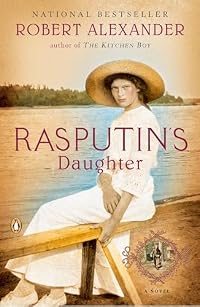
Fiction. Literature. Suspense. Thriller. With the same riveting historical narrative that made The Kitchen Boy a national bestseller and a book club favorite, Robert Alexander returns to revolutionary Russia for the harrowing tale of Rasputin's final days as told by his youthful and bold daughter, Maria. Interrogated by the Provisional Government on the details of her father's death, Maria vividly recounts a politically tumultuous Russia, where Rasputin's powerful influence over the throne show more are unsettling to all levels of society, and the threats to his life are no secret. With vast conspiracies mounting against his father, Maria must struggle with the discovery of Rasputin's true nature-his unbridled carnal appetites, mysterious relationship with the Empress, rumors of involvement in secret religious cults-to save her father from his murderers. Swept away in a plot much larger than the death of one man, Maria fmds herself on the cusp of the Russian Revolution itself. With Rasputin's Daughter, Robert Alexander once again delivers an imaginative and compelling story, fashioned from one of history's most fascinating periods that, until now, has been virtually unexplored in fiction. "The combination of Alexander's research and his rich characterizations produces an engaging historical fiction that offers a Rasputin who is neither beast nor saint, but merely, compellingly human."-Publishers Weekly. show lessTags
Recommendations



















Member Recommendations

wrz2 An interesting look at the Romanov's last days

Member Reviews
Alexander's second book on the downfall of the Romanovs read more like a novel than the first one, which made it a bit easier to take in. While The Kitchen Boy often stated sources and where the letters could now be found (archives), this time Alexander told the story here and then included more information about the real people in the back of the book.
I definitely enjoyed reading this one more than The Kitchen Boy. Granted, with not nearly as much real 'evidence' to go on, it is probably more historically fictional than the first story, but I think Alexander tried to stay true in his character sketch of Rasputin and I found it quite interesting.
I definitely enjoyed reading this one more than The Kitchen Boy. Granted, with not nearly as much real 'evidence' to go on, it is probably more historically fictional than the first story, but I think Alexander tried to stay true in his character sketch of Rasputin and I found it quite interesting.
This book was fun to read and about an interesting time period--when science is really starting to gain momentum and the world is becoming more global-minded. I liked it. I really liked how the "real" Rasputin was never clearly laid out on the table. Even at the end when he talks about his wrong-doings, it's never explicitly stated if he was as big an ass as he had the potential for or if his activities were just misinterpreted by those around him.
This book made me want to learn more about the Romanov family and Russian history in general. Also, I now want to read about Rasputin from the Romanov's perspective.
This book made me want to learn more about the Romanov family and Russian history in general. Also, I now want to read about Rasputin from the Romanov's perspective.
This is a reasonably entertaining historical potboiler. I don't know the history well enough to judge how accurately Alexander follows what is known about Rasputin and his death; he certainly uses imagination to fill in a lot that can't be known.
Fascinating finding out more about Rasputin, a name I have heard often but never really knew much about. His daughter Maria comes across as being a very naive teenager learning a lot about life in one week. She thought of her father as something special but realizes he has more faults which the book clearly explains in great detail, she meets a boy and falls for him while knowing he is not all he seems and she runs all over the city trying to save her father yet going places no normal girl would go alone. Learned about Russian history while enjoyed a story.
I'm rating this a little lower than "The Kitchen Boy," largely because the subject matter isn't as interesting to me (I've never found Rasputin a particularly interesting character) and the mystery wasn't as compelling. (The whole "poisoned-shot-drowned" thing was made up according to this - as historical "revelations" go, it wasn't as compelling to me as what really happened to Maria and Alexei.)
Where Robert Alexander shines is his obvious love for Russian people, language and culture. His lingering descriptions of tradtional Russian meals and customs were wonderful, and really made the setting come alive.
I did have a few qualms - I think choosing to show Rasputin's healing directly was a mistake. It's the kind of thing that needed to show more be off screen, because explanations of mystic phenomena don't work well. In addition, it forced Alexander to take a position on the question of whether Rasputin actually had healing powers, which I felt would have been better left ambiguous.
I had a few other quibbles - everything I've ever read indicated that Rasputin was despised by all classes, and his association with the Empress was an unalloyed disaster. There are a couple of scenes here that feature peasants saying that the fact that a peasant like Rasputin could talk to the Tsar gave them hope.
Similarly, I have a hard time believing that, in the small and crowded apartment the family lived in, so many things could be a surprise, or successfully hidden from the other inhabitants. (I'm trying not to give away too much of the plot, here.)
However, I enjoyed the book, and I look forward to reading the third of the trilogy. show less
Where Robert Alexander shines is his obvious love for Russian people, language and culture. His lingering descriptions of tradtional Russian meals and customs were wonderful, and really made the setting come alive.
I did have a few qualms - I think choosing to show Rasputin's healing directly was a mistake. It's the kind of thing that needed to show more be off screen, because explanations of mystic phenomena don't work well. In addition, it forced Alexander to take a position on the question of whether Rasputin actually had healing powers, which I felt would have been better left ambiguous.
I had a few other quibbles - everything I've ever read indicated that Rasputin was despised by all classes, and his association with the Empress was an unalloyed disaster. There are a couple of scenes here that feature peasants saying that the fact that a peasant like Rasputin could talk to the Tsar gave them hope.
Similarly, I have a hard time believing that, in the small and crowded apartment the family lived in, so many things could be a surprise, or successfully hidden from the other inhabitants. (I'm trying not to give away too much of the plot, here.)
However, I enjoyed the book, and I look forward to reading the third of the trilogy. show less
This is one of the best books i have read in the the last 12 months.
Rasputin’s Daughter is considered historical fiction. it is based around Maria, one of Grigori Rasputin’s daughters. The book covers the time frame of up to a week prior to Rasputin’s death.
Rasputin himself has been world renowned as a charlatan, a genius, a monk, faith healer and psychic. in folklore, his powers were limitless, his ability to manipulate was matchless, and it took a whole lot to kill the bastard. most of the world knows him as one of the most evil and untamed humans ever to live.
Maria is a different person all together. she is mellow and loving, sweet and kindly. she sees nothing but purity in her father. Maria herself is confused, she is lonely show more and sad, but she has high hopes for her future. Maria is a daddy’s girl through and through.
the book reads well. the dialogue through out the book is excellent and persuasive.
RD leads you down som interesting thought paths. what happens if you remove the demonized perception of Rasputin and instead review the history of his culture in Siberia? was he really as evil as they all make him appear, or was he nothing more than a pawn in a political game, murdered and defamed in order to regain control during a coup? Maria’s perspective does exactly that, it allows him the luxury of “innocence” and allows the reader to see this historical figure in a light that would never normally be possible. we have all learned the legends too well to question them otherwise.
for anyone who cares for historical fiction, this is a great book. those who enjoy general fiction or romance thrillers, this is also a good choice.
~~
yes, for those who are interested, there is some detailed discussion on the size, length,girth of Rasputin’s cock.. no conversation pertaining to him is complete with out at least mentioning it.. it is is supposedly in the Russian museum of erotica, after all. the book even makes mention of his penis’s powers to heal, though it was still attached to his body during the time frame in the book.
go magic cock and undying men!
http://en.wikipedia.org/wiki/Rasputin%27s_penis show less
Rasputin’s Daughter is considered historical fiction. it is based around Maria, one of Grigori Rasputin’s daughters. The book covers the time frame of up to a week prior to Rasputin’s death.
Rasputin himself has been world renowned as a charlatan, a genius, a monk, faith healer and psychic. in folklore, his powers were limitless, his ability to manipulate was matchless, and it took a whole lot to kill the bastard. most of the world knows him as one of the most evil and untamed humans ever to live.
Maria is a different person all together. she is mellow and loving, sweet and kindly. she sees nothing but purity in her father. Maria herself is confused, she is lonely show more and sad, but she has high hopes for her future. Maria is a daddy’s girl through and through.
the book reads well. the dialogue through out the book is excellent and persuasive.
RD leads you down som interesting thought paths. what happens if you remove the demonized perception of Rasputin and instead review the history of his culture in Siberia? was he really as evil as they all make him appear, or was he nothing more than a pawn in a political game, murdered and defamed in order to regain control during a coup? Maria’s perspective does exactly that, it allows him the luxury of “innocence” and allows the reader to see this historical figure in a light that would never normally be possible. we have all learned the legends too well to question them otherwise.
for anyone who cares for historical fiction, this is a great book. those who enjoy general fiction or romance thrillers, this is also a good choice.
~~
yes, for those who are interested, there is some detailed discussion on the size, length,girth of Rasputin’s cock.. no conversation pertaining to him is complete with out at least mentioning it.. it is is supposedly in the Russian museum of erotica, after all. the book even makes mention of his penis’s powers to heal, though it was still attached to his body during the time frame in the book.
go magic cock and undying men!
http://en.wikipedia.org/wiki/Rasputin%27s_penis show less
Wow, this book was just bad. The setting was flat. The historical period was barely touched upon. It was like gazing at a painting through a pin hole in a sheet of white paper. The focus is so tight upon Rasputin that we don't get to know his daughter, the political atmosphere, the city of St. Petersberg, nothing. We don't really even get to know Rasputin, only various things that happened to him.
All the characters are flat and boring. Especially the novel's narrator, Maria who is a completely unbelievable character. She has one brief conversation with a mysterious stranger and immediately falls in love with him. For no reason. Later he betrays her and she hates him until she has another brief conversation with him after which she show more forgives him and loves him again. *Shockingly* he betrays her one more time at the end and reveals himself to be a conspirator. I'd seen this coming since nearly the beginning of the novel. Really the whole book was just tediously boring. Truly awful stuff. show less
All the characters are flat and boring. Especially the novel's narrator, Maria who is a completely unbelievable character. She has one brief conversation with a mysterious stranger and immediately falls in love with him. For no reason. Later he betrays her and she hates him until she has another brief conversation with him after which she show more forgives him and loves him again. *Shockingly* he betrays her one more time at the end and reveals himself to be a conspirator. I'd seen this coming since nearly the beginning of the novel. Really the whole book was just tediously boring. Truly awful stuff. show less
Members
- Recently Added By
Lists

Historical Fiction
889 works; 91 members

History: Eastern Europe
97 works; 2 members
Author Information

5 Works 2,882 Members
Series

Common Knowledge
- Canonical title
- Rasputin's Daughter
- Original publication date
- 2006
- People/Characters
- Grigori Rasputin; Alexandra Feodorovna, Empress of Russia; Nicholas II, Emperor of Russia; Alexei Nikolayevich Tsesarevich of Russia (as Tsarevich Aleksei); Matryona Grigorevna Rasputina (Maria)
- Important places
- Tsarskoye Selo, Russia
- Important events
- death of Rasputin
- Epigraph
- In the beginning of the twentieth century
Russia found itself at a rasputiye,
When all of a sudden there appeared a rasputnik
And Russia became mired in a rasputitsa. M. Tarlova - Dedication
- For Marly Rusoff
- First words
- Believe me, I'd tell you if I knew.
- Last words
- (Click to show. Warning: May contain spoilers.)Turning back to the front page of the prince's confession, Blok wrote in large letters, PRISONER TO REMAIN AT SHPALERNAYA INDEFINITELY
Classifications
Statistics
- Members
- 729
- Popularity
- 38,608
- Reviews
- 25
- Rating
- (3.24)
- Languages
- 5 — English, French, Greek, Hungarian, Portuguese
- Media
- Paper, Audiobook, Ebook
- ISBNs
- 17
- ASINs
- 4