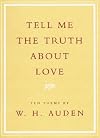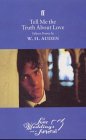
Tell Me the Truth About Love
by W. H. Auden 
On This Page
Description
A collection of 10 of W.H. Auden's love poems and cabaret songs from the 1930s.Tags
Recommendations










Member Reviews
While most poems fly over my head, Auden's poetry has always made sense to me. It's beautiful without being too abstract and it always seems to strike a chord for me. Auden had a wonderful gift for conveying emotion in only a few lines. This sweet collection includes one of my favorite poems, "Funeral Blues." Here's one section from the poem...
"He was my North, my South, my East and West,
My working week and my Sunday rest,
My noon, my midnight, my talk, my song;
I thought that love would last forever: I was wrong."
It just makes my heart ache. I also loved the poem "Lullaby," here's a taste...
"Not a whisper, not a thought, Not a kiss nor look be lost."
"He was my North, my South, my East and West,
My working week and my Sunday rest,
My noon, my midnight, my talk, my song;
I thought that love would last forever: I was wrong."
It just makes my heart ache. I also loved the poem "Lullaby," here's a taste...
"Not a whisper, not a thought, Not a kiss nor look be lost."
This collection of Auden's poems is perhaps not the greatest but, it is, in the main, Auden at his most cheerful: a welcome antidote to the Davenport-Hines biography which I read alongside this collection.
The title poem is a song, written for a musical show: nothing wrong in that but, a source of an amusing rhyme, rather than an opportunity for great poetry. Other works do add to our admiration for one of the twentieth century's greatest poets, such as 'Deftly, Admiral, Cast Your Fly' and 'Funeral Blues'.
The title poem is a song, written for a musical show: nothing wrong in that but, a source of an amusing rhyme, rather than an opportunity for great poetry. Other works do add to our admiration for one of the twentieth century's greatest poets, such as 'Deftly, Admiral, Cast Your Fly' and 'Funeral Blues'.
Ten lovely poems that try to describe just what is this thing called love. Two particular favorites: the light and lyrical "O Tell Me The Truth About Love" ("Some say that love's a little boy, And some say it's a bird, Some say it makes the world go round, And some say that's absurd...") and the incomparably crushing "Funeral Blues" ("He was my North, my South, my East and West, My working week and my Sunday rest, My noon, my midnight, my talk, my song; I thought that love would last for ever: I was wrong.") (JAF)
This little collection of poems is what got me started reading Auden's poetry. A wonderful little collection. His poetry is easy to read and enjoy, and makes him a good entry point for someone looking to getting into reading poetry.
"Funeral blues", after seeing Four Weddings and a Funeral.
Probably the first poem in English I truly read (after "Mirror" by Sylvia Plath). The beauty, the truth of it, the practicality of it almost. I do not know anything about W.H. Auden, and it doesn't matter, somehow. I almost do not want to know about his private life. The poem. like a well made painting, is enough.
Probably the first poem in English I truly read (after "Mirror" by Sylvia Plath). The beauty, the truth of it, the practicality of it almost. I do not know anything about W.H. Auden, and it doesn't matter, somehow. I almost do not want to know about his private life. The poem. like a well made painting, is enough.
A slim volume (no room for writing on the spine, even), probably made most (justly) famous by a reading of "Funeral Blues" in the movie Four Weddings and a Funeral. A little bitter, often biting.
W. H. Auden wrote some of the greatest love poetry of the twentieth century. This book contains ten of his poems about love. They range in mood from the exhilaration of a new love affair, through love's anxieties and fears, to the sorrow that comes with the end of love.
Members
- Recently Added By
Lists

Tonikat reading completed on Librarything journals
329 works; 2 members
Author Information

307+ Works 14,552 Members
W. H. Auden, who was born in York, England, on February 21, 1907, is one of the most successful and well-known poets of the 20th century. Educated at Oxford, Auden served in the Spanish Civil War, which greatly influenced his work. He also taught in public schools in Scotland and England during the 1930s. It was during this time that he rose to show more public fame with such works as "Paid on Both Sides" and "The Orators." Auden eventually immigrated to the United States, becoming a citizen in 1946. It was in the U.S. that he met his longtime partner Chester Kallman. Stylistically, Auden was known for his incomparable technique and his linguistic innovations. The term Audenesque became an adjective to describe the contemporary sounding speech reflected in his poems. Auden's numerous awards included a Bollingen Prize in Poetry, A National Book Award for "The Shield of Achilles," a National Medal for Literature from the National Book Committee, and a Gold Medal from the National Institute of Arts and Letters. Numerous volumes of his poetry remain available today, including "About the House" and "City Without Walls." W.H. Auden died on September 28, 1973 in Vienna. (Bowker Author Biography) show less
W. H. Auden has a Legacy Library. Legacy libraries are the personal libraries of famous readers, entered by LibraryThing members from the Legacy Libraries group.
Common Knowledge
- Original publication date
- 1986
- First words
- Some say that love's a little boy, / And some say it's a bird, / Some say it makes the world go round, / And some say that it's absurb, / And when I asked the man next door, / Who looked as if he knew, / His wife got very cro... (show all)ss indeed, / And said it wouldn't do.
- Last words
- (Click to show. Warning: May contain spoilers.)The stars are not wanted now; put out every one; / Pack up the moon and dismantle the sun; / Pour away the ocean and sweep up the wood; / For nothing now can ever come to any good.
Classifications
Statistics
- Members
- 650
- Popularity
- 44,516
- Reviews
- 10
- Rating
- (3.91)
- Languages
- 7 — Catalan, Dutch, English, French, German, Italian, Portuguese
- Media
- Paper, Audiobook, Ebook
- ISBNs
- 16
- UPCs
- 1