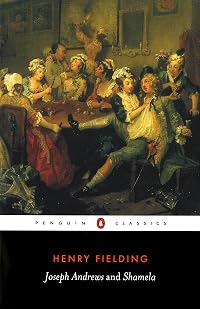
Joseph Andrews and Shamela
by Henry Fielding, R F Brissenden
On This Page
Description
'Kissing, Joseph, is but a Prologue to a Play. Can I believe a young Fellow of your Age and Complexion will be content with Kissing?' Joseph Andrews, Henry Fielding's first full-length novel, depicts the many colourful and often hilarious adventures of a comically chaste servant. After being sacked for spurning the lascivious Lady Booby, Joseph takes the road, accompanied by his beloved Fanny Goodwill, a much-put-upon foundling girl, and Parson Adams, a man often duped and humiliated, but show more still a model of Christian charity. In the boisterous short tale Shamela, a brilliant parody of Richardson's Pamela, the spirited and sexually honest heroine uses coyness and mock modesty to catch herself a rich husband. Together these works anticipate Fielding's great comic epic Tom Jones, with their amiable good humour and pointed social satire. show lessTags
Recommendations









Member Reviews
Shamela is a short, funny novella with a literal parody of Richardson's Pamela while Joseph Andrews uses that book's theme - virtuous servant resisting aggressive employer - and builds a Tom Jones-esque road trip. Shamela purports to be the 'real' story of Pamela and Mr. B. Even her name reveals her deception. As told by Fielding, Shamela is the loose daughter or a rather vulgar mother. She and the equally amoral Mrs. Jarvis plot ways to trick Mr. B into a relationship with Shamela. She's definitely meant to be a golddigger, but this really only evens them out as Mr. B's behavior was abominable. Shamela fakes indignation and virtue, then reveals her greed after they're married. All around hilarity, if you've read Pamela. Fielding was show more addressing the Pamela backlash after the often exaggerated praise given to that novel.
Joseph Andrews also takes its cue from Richardson - he is Pamela's brother and also a servant for the Booby family (the B's are given a name). Like Pamela, he's a valued employee and a good Christian, thanks to the teachings of Parson Abraham Adams. When Lady Booby is left a widow, she attempts to hit on Joseph and is rejected. Joseph gets fired and has to make his way back to the country alone. His refusal was meant to be comic, but I didn't think so. He was just trying to be a good Christian, a refreshing change from all the male characters who subscribe to the religion - just not that part.
After Joseph leaves, the novel resembles part of Tom Jones where they were all traveling. He encounters Mr. Adams and his love, Fanny, then adventures ensue. Fanny is constantly sexually harassed and they meet assorted hypocrites, a rich man who makes extravagant promises then vanishes, a reformed rake living happily with his family and a crude squire with his train of freaks and cronies who also harass Fanny. When the trio finally returns home, more romantic and familial problems arise.
The plot is entertaining, and Fielding's prose great as usual. A lot similar to the more complex Tom Jones, and also hints of Don Quixote, what with the multiple road discussions and meeting people who all tell their stories. Fielding is hard on people with excesses, hypocrites and those who are extremely affected. Not even Joseph and Adams are immune to doses of imperfections. Though Joseph tries to be a good Christian he always ends up in fights. Adams, for a parson, is extremely violent. He fights innkeepers, gets pig's blood poured on him, fights a hunter's dogs, beats up a rapist, and brawls with the squire's men. One scene displays his massive hypocrisy comically. Lecturing Fanny and Joseph on not loving too much - using the analogy of Abraham sacrificing Isaac - Adams suddenly believes his son is dead. His grief is extreme, crying, swearing, stomping and nothing Joseph says can comfort him. When he realizes his son is alive, his joy is also - as he would put it - immoderate. Even Fielding's best characters can have massive flaws. Overall - good parody and writing. show less
Joseph Andrews also takes its cue from Richardson - he is Pamela's brother and also a servant for the Booby family (the B's are given a name). Like Pamela, he's a valued employee and a good Christian, thanks to the teachings of Parson Abraham Adams. When Lady Booby is left a widow, she attempts to hit on Joseph and is rejected. Joseph gets fired and has to make his way back to the country alone. His refusal was meant to be comic, but I didn't think so. He was just trying to be a good Christian, a refreshing change from all the male characters who subscribe to the religion - just not that part.
After Joseph leaves, the novel resembles part of Tom Jones where they were all traveling. He encounters Mr. Adams and his love, Fanny, then adventures ensue. Fanny is constantly sexually harassed and they meet assorted hypocrites, a rich man who makes extravagant promises then vanishes, a reformed rake living happily with his family and a crude squire with his train of freaks and cronies who also harass Fanny. When the trio finally returns home, more romantic and familial problems arise.
The plot is entertaining, and Fielding's prose great as usual. A lot similar to the more complex Tom Jones, and also hints of Don Quixote, what with the multiple road discussions and meeting people who all tell their stories. Fielding is hard on people with excesses, hypocrites and those who are extremely affected. Not even Joseph and Adams are immune to doses of imperfections. Though Joseph tries to be a good Christian he always ends up in fights. Adams, for a parson, is extremely violent. He fights innkeepers, gets pig's blood poured on him, fights a hunter's dogs, beats up a rapist, and brawls with the squire's men. One scene displays his massive hypocrisy comically. Lecturing Fanny and Joseph on not loving too much - using the analogy of Abraham sacrificing Isaac - Adams suddenly believes his son is dead. His grief is extreme, crying, swearing, stomping and nothing Joseph says can comfort him. When he realizes his son is alive, his joy is also - as he would put it - immoderate. Even Fielding's best characters can have massive flaws. Overall - good parody and writing. show less
An Apology for the Life of Mrs. Shamela Andrews:
This got a proper laugh out of me. There's no point reading it unless you've read Pamela - which I urge you to do as you're in for a treat. It's also worth reading the introduction to the 2nd edition as you'll get more of the jokes.
The humour here depends on the idea that Pamela is not as she presents herself in her letters but is in fact the saucy slut Mr B accuses her of being - an idea that I must admit I suspected when I first began reading the novel.
The History of the Adventures of Joseph Andrews, and of His Friend Mr. Abraham Adams:
This novel can be read on it's own but you'll get more out of it if you've read Pamela. If you intend to read Pamela then you should definitely read that show more first as this gives away an important plot point.
It has many parallels with it's progenitor as everything in it has a counterpart or opposite: high vs low class, innocence & guilt, appearance vs reality, hypocrisy and truth.
And let's not forget that it's just tremendous fun!
I read Tom Jones last year and wish now that I'd read this first. It shares so much with the later novel: a journey, a handsome hero with a love interest, comic sidekick and money worries; secret family histories; guilt & innocence; hypocrisy. It's like a dry run for the later novel. Perhaps he thought no-one had read this so could recycle much of it. Not that I'm complaining. I enjoyed the relative tightness of this novel even if the rambling scope of Tom Jones is technically, well, more classic.
Oh, and if you don't like his portrayal of Gypsies, Tom Jones has a more balanced view. show less
This got a proper laugh out of me. There's no point reading it unless you've read Pamela - which I urge you to do as you're in for a treat. It's also worth reading the introduction to the 2nd edition as you'll get more of the jokes.
The humour here depends on the idea that Pamela is not as she presents herself in her letters but is in fact the saucy slut Mr B accuses her of being - an idea that I must admit I suspected when I first began reading the novel.
The History of the Adventures of Joseph Andrews, and of His Friend Mr. Abraham Adams:
This novel can be read on it's own but you'll get more out of it if you've read Pamela. If you intend to read Pamela then you should definitely read that show more first as this gives away an important plot point.
It has many parallels with it's progenitor as everything in it has a counterpart or opposite: high vs low class, innocence & guilt, appearance vs reality, hypocrisy and truth.
And let's not forget that it's just tremendous fun!
I read Tom Jones last year and wish now that I'd read this first. It shares so much with the later novel: a journey, a handsome hero with a love interest, comic sidekick and money worries; secret family histories; guilt & innocence; hypocrisy. It's like a dry run for the later novel. Perhaps he thought no-one had read this so could recycle much of it. Not that I'm complaining. I enjoyed the relative tightness of this novel even if the rambling scope of Tom Jones is technically, well, more classic.
Oh, and if you don't like his portrayal of Gypsies, Tom Jones has a more balanced view. show less
A picaresque novel and as such, eminently forgettable and largely tedious. I can understand the importance of the book for the time it was written in, but unless you really enjoy “adventures” and plot elements that inevitably contrive to farce, then this isn’t for you.
It wasn’t for me.
So, why are we bothering with it at all? Well, the novel at the time Fielding wrote Joseph (1742) was a fairly predictable affair. Rules that heavily defined British society had constrained the novel within it’s own particular literary rules. Fielding was particularly upset about this and the popularity of such constrained novels by Samuel Richardson in particular.
Fielding intended to break some of the barriers of contemporary fiction and if show more Wikipedia is any authority to go by, he seems to have succeeded. But, never lacking historical irony, the success of trail-blazing mould-breakers only inspires others to form new moulds of their own.
In particular, Fielding inspired Smollet and Peregrine Pickle is, to my mind, a much more engaging piece of work than Joseph Andrews. If you were looking for an 18th century picaresque novel to while away some time, I’d recommend you bypass Joseph’s outstretched hand of friendship and hit the open road with Peregrine. show less
It wasn’t for me.
So, why are we bothering with it at all? Well, the novel at the time Fielding wrote Joseph (1742) was a fairly predictable affair. Rules that heavily defined British society had constrained the novel within it’s own particular literary rules. Fielding was particularly upset about this and the popularity of such constrained novels by Samuel Richardson in particular.
Fielding intended to break some of the barriers of contemporary fiction and if show more Wikipedia is any authority to go by, he seems to have succeeded. But, never lacking historical irony, the success of trail-blazing mould-breakers only inspires others to form new moulds of their own.
In particular, Fielding inspired Smollet and Peregrine Pickle is, to my mind, a much more engaging piece of work than Joseph Andrews. If you were looking for an 18th century picaresque novel to while away some time, I’d recommend you bypass Joseph’s outstretched hand of friendship and hit the open road with Peregrine. show less
i'm sure there is more value to this than i am finding, but man this was a slog. certainly there were parts that were much more readable than the majority, and thematically i can't say i mind what he's doing (mostly around hypocrisy). probably i'd have appreciated it much more if i had read pamela, which apparently this is in response to.
but as it was, it was repetitive and over the top farcical, when it was actually understandable. mostly i couldn't care less what was happening or to whom. the troubles they all got into (especially parsons) was just too much. i know it wasn't supposed to be a believable story, but it went too far and i just found it annoying. i did more skimming than reading by the end.
but as it was, it was repetitive and over the top farcical, when it was actually understandable. mostly i couldn't care less what was happening or to whom. the troubles they all got into (especially parsons) was just too much. i know it wasn't supposed to be a believable story, but it went too far and i just found it annoying. i did more skimming than reading by the end.
This is a good parody of Richardson's 'Pamela', and Shamela looks more like a gold-digging temptress than her previous, angelic, Pamela. The comic events are funny, but the style of writing became a bit tedious after a while, so, while I read the original novel without any problem, 'Shamela' did not much to appeal to me, because I probably had grown bored of the book. Comedy is best served short, in this case!
Shamela gets a solid 3.5 stars: It is quite funny--though only if you have read Pamela! Otherwise many of the jokes will not work. Unfortunately, Shamela is only about 50 pages.
Joseph Andrews gets 2 stars: It certainly has its moments. I found parts 1, 3, and 4, to be the strongest. Part 2, though, I found to be long and tiringäóîand I did not like the character of Parson Adams, even if he was meant to represent someone or a certain sort of Parson. Again, it help to have read Pamela (as Joseph Andrews is meant to be her brother), though a recent reading of Don Quixote would also help (I read it decades ago).
As with many of these 18th century novels, footnotes are needed to understand the many references to events, laws, and people show more that are referenced or represented. It makes the story a bit hard to follow and hard to fully comprehendäóîeven though it might have been quite funny to those reading it when it was written. show less
Joseph Andrews gets 2 stars: It certainly has its moments. I found parts 1, 3, and 4, to be the strongest. Part 2, though, I found to be long and tiringäóîand I did not like the character of Parson Adams, even if he was meant to represent someone or a certain sort of Parson. Again, it help to have read Pamela (as Joseph Andrews is meant to be her brother), though a recent reading of Don Quixote would also help (I read it decades ago).
As with many of these 18th century novels, footnotes are needed to understand the many references to events, laws, and people show more that are referenced or represented. It makes the story a bit hard to follow and hard to fully comprehendäóîeven though it might have been quite funny to those reading it when it was written. show less
I quite enjoyed these, Fielding is good at parody and is much the best of the 18thC novelists.
Members
- Recently Added By
Author Information

264+ Works 15,924 Members
Henry Fielding, 1707 - 1754 A succcessful playwright in his twenties, Henry Fielding turned to the study of law and then to journalism, fiction, and a judgeship after his Historical Register, a political satire on the Walpole government, contributed to the censorship of plays that put him out of business. As an impoverished member of the upper show more classes, he knew the country squires and the town nobility; as a successful young playwright, the London jet set; as a judge at the center of London, the city's thieves, swindlers, petty officials, shopkeepers, and vagabonds. As a political journalist (editor-author of The Champion, 1739-1741; The True Patriot, 1745-1746; The Jacobite's Journal, 1747-1748; The Covent-Garden Journal, 1752), he participated in argument and intrigue over everything from London elections to national policy. He knowledgeably attacked and defended a range of politicians, from ward heelers to the Prince of Wales. When Fielding undertook writing prose fiction to ridicule the simple morality of Pamela by Samuel Richardson, he first wrote the hilarious burlesque Shamela (1741). However, he soon found himself considering all the forces working on humans, and in Joseph Andrews (1742) (centering on his invented brother of Pamela), he played with the patterns of Homer, the Bible, and Cervantes to create what he called "a comic epic poem in prose." His preface describing this new art form is one of the major documents in literary criticism of the novel. Jonathan Wild, a fictional rogue biography of a year later, plays heavily with ironic techniques that leave unsettled Fielding's great and recurring theme: the difficulty of uniting goodness, or an outflowing love of others, with prudence in a world where corrupted institutions support divisive pride rather than harmony and self-fulfillment. In his masterpiece Tom Jones (1749), Fielding not only faces this issue persuasively but also shows for the first time the possibility of bringing a whole world into an artistic unity, as his model Homer had done in verse. Fielding develops a coherent and centered sequence of events-something Congreve had done casually on a small scale in Incognita 60 years before. In addition he also relates the plot organically to character and theme, by which he gives us a vision of the archetypal good person (Tom) on a journey toward understanding. Every act by every character in the book reflects the special and typical psychology of that character and the proper moral response. In Tom Jones, Fielding affirms the existence of an order under the surface of chaos. In his last novel, Amelia (1751), which realistically examines the misery of London, he can find nothing reliable except the prudent good heart, and that only if its possessor escapes into the country. Fielding based the title character on his second wife, with whom he was deeply in love. However, ill himself, still saddened by the deaths of his intensely loved first wife and daughter, and depressed by a London magistrate's endless toil against corruption, Fielding saw little hope for goodness in that novel or in his informal Journal of a Voyage to Lisbon (1755). Shortly after traveling to Lisbon for his health, Fielding died at the age of 47, having proved to his contemporaries and successors that the lowly novel was capable of the richest achievements of art. (Bowker Author Biography) show less
22+ Works 1,734 Members
Some Editions
Series
Belongs to Publisher Series
Work Relationships
Is contained in
Contains
Common Knowledge
- Canonical title
- Joseph Andrews and Shamela
- Original publication date
- 1741 (Shamela) (Shamela); 1742 (Joseph Andrews) (Joseph Andrews)
- People/Characters
- Joseph Andrews; Shamela; Fanny Goodwill; Lady Booby; Mrs. Jarvis
- Important places
- England, UK
- Related movies
- Joseph Andrews (1977 | IMDb)
Classifications
Statistics
- Members
- 1,642
- Popularity
- 13,737
- Reviews
- 9
- Rating
- (3.39)
- Languages
- English, Finnish, German
- Media
- Paper, Audiobook, Ebook
- ISBNs
- 31
- ASINs
- 25
