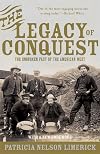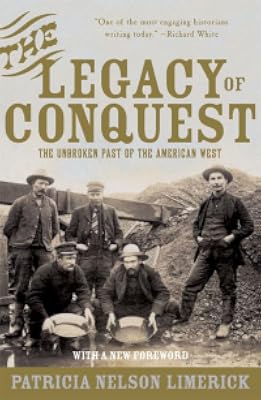
The Legacy of Conquest: The Unbroken Past of the American West
by Patricia Nelson Limerick
On This Page
Description
The "settling" of the American West has been perceived throughout the world as a series of quaint, violent, and romantic adventures. But in fact, Patricia Nelson Limerick argues, the West has a history grounded primarily in economic reality; in hardheaded questions of profit, loss, competition, and consolidation. Here she interprets the stories and the characters in a new way: the trappers, traders, Indians, farmers, oilmen, cowboys, and sheriffs of the Old West "meant business" in more ways show more than one, and their descendants mean business today. show lessTags
Recommendations






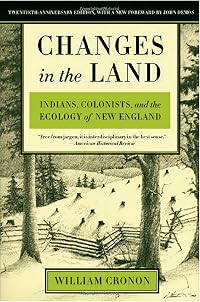
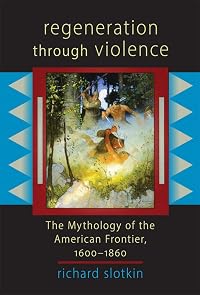

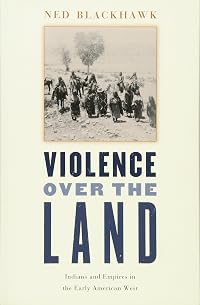
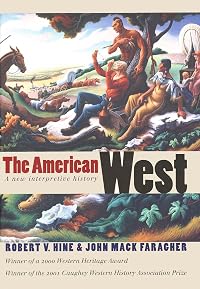














Member Recommendations
goddan Both books look at historical actors traditionally marginalized or ignored in previous histories (namely, women in "Testimonios").
Member Reviews
This history of the American West is a significant revisionary account, which takes as its foil the century-old thesis of Frederick Turner’s “The Significance of the Frontier in American History.” Author Limerick notes the effective obsolescence of any narrative about the West structured around a frontier, and she laments this conception as one that has caused a general eclipse of interest in the West as a historical topic. She then proceeds to raise a wide range of issues with which to demonstrate continuity between the ‘frontier’ West of the 19th century and the contemporary West of the late 20th. She seeks to portray “the West as a place and not a [completed] process.” (26) The innovation of the book is in its breadth show more of its perspective. Limerick has drawn principally on secondary sources written in the second half of the 20th century. Historical specialists had already come to factual grips with the individual issues and concerns that she constellates into an “unbroken past.” Her synthesis thus provides a new point of departure for historians and readers seeking fresh problems.
The book is divided into two sections. The first, “The Conquerors,” undermines heroic stereotypes of settlers and frontiersmen. Limerick provides resounding evidence against the savvy and independence that Turner attributed to those living a “frontier life,” and develops a counter-narrative in which settlers and developers of the West embraced naive hopes, and often came to view themselves as victims, tied as they were into commercial, social, and environmental nets of interdependence.
The book’s second section, “The Conquerors Meet Their Match,” restores narrative agency to the allegedly conquered forces of indigenous peoples, Mexican-Americans, other racial and religious minorities, and the wilderness environment itself. Limerick’s account firmly and convincingly contradicts the “composite nationality” of inter-ethnic solidarity asserted by Turner as a feature of the West, by pointing out racial conflicts and divides as significant and persistent as those chronicled in the South.
Limerick writes, “Simplicity, alas, is the one quality that cannot be found in the actual story of the American West.” (323) But on those occasions where she suggests a keynote, it is “the contest for property and profit,” (292) “an array of efforts to wrap the concept of property around unwieldy objects.” (71)
A chief feature of The Legacy of Conquest is its consistent success in tying its topics from the 19th century West to dilemmas of the same region in the late 20th century. While aimed at the reader in history, the book would be engaging for those whose ultimate interest is the contemporary American West. Like Turner, Limerick represents the stories of the West as the most characteristically American portion of America’s history, and thus reflective of tropes and trends common to the nation as a whole, and even to the entire project of European conquest of the Americas. show less
The book is divided into two sections. The first, “The Conquerors,” undermines heroic stereotypes of settlers and frontiersmen. Limerick provides resounding evidence against the savvy and independence that Turner attributed to those living a “frontier life,” and develops a counter-narrative in which settlers and developers of the West embraced naive hopes, and often came to view themselves as victims, tied as they were into commercial, social, and environmental nets of interdependence.
The book’s second section, “The Conquerors Meet Their Match,” restores narrative agency to the allegedly conquered forces of indigenous peoples, Mexican-Americans, other racial and religious minorities, and the wilderness environment itself. Limerick’s account firmly and convincingly contradicts the “composite nationality” of inter-ethnic solidarity asserted by Turner as a feature of the West, by pointing out racial conflicts and divides as significant and persistent as those chronicled in the South.
Limerick writes, “Simplicity, alas, is the one quality that cannot be found in the actual story of the American West.” (323) But on those occasions where she suggests a keynote, it is “the contest for property and profit,” (292) “an array of efforts to wrap the concept of property around unwieldy objects.” (71)
A chief feature of The Legacy of Conquest is its consistent success in tying its topics from the 19th century West to dilemmas of the same region in the late 20th century. While aimed at the reader in history, the book would be engaging for those whose ultimate interest is the contemporary American West. Like Turner, Limerick represents the stories of the West as the most characteristically American portion of America’s history, and thus reflective of tropes and trends common to the nation as a whole, and even to the entire project of European conquest of the Americas. show less
This would be an excellent Mencken-ish send-up of Western politics if Limerick weren't so earnest about history scholarship being able to sort out our problems. If only we realized most of the United States originally belonged to Mexico! Then our illegal immigration problems would... what, exactly? Go away?
Earnestness aside, there's some really funny stuff in here. And a decent survey of western history scholarship. As is usual in academic books, you're better off skipping the first and last chapters, and you'll still run into some sentences like this: "When horses met Volkswagens in what had once been wilderness, it was obvious that a great deal had changed in the American West." [p. 134]
Earnestness aside, there's some really funny stuff in here. And a decent survey of western history scholarship. As is usual in academic books, you're better off skipping the first and last chapters, and you'll still run into some sentences like this: "When horses met Volkswagens in what had once been wilderness, it was obvious that a great deal had changed in the American West." [p. 134]
A classic of Western history, Limerick was among the first to write in women and non-whites into the Western narrative.
Ratings
Members
- Recently Added By
Lists

r/AskHistorians' Recommended Books
1,068 works; 19 members
Author Information

12+ Works 822 Members
Patricia Nelson Limerick is a professor of history & chair of the Center of the American West at the University of Colorado at Boulder. (Bowker Author Biography) Patricia Nelson Limerick is professor of history at the University of Colorado. (Bowker Author Biography)
Awards and Honors
Common Knowledge
- Original publication date
- 1987
- Important places
- USA
- Dedication
- To Jeff Limerick, and to our utterly Western nephews and niece, Jay, Michael, and Francine.
- First words
- Each age writes the history of the past anew with reference to the conditions uppermost n their time...
- Last words
- (Click to show. Warning: May contain spoilers.)The serious exploration of the historical process that made us neighbors provides that information.
Classifications
Statistics
- Members
- 522
- Popularity
- 57,381
- Reviews
- 3
- Rating
- (3.82)
- Languages
- English
- Media
- Paper, Ebook
- ISBNs
- 4
- ASINs
- 4