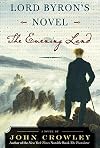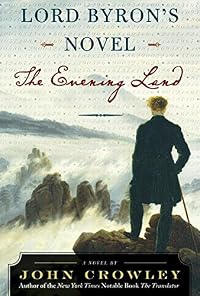
Lord Byron's Novel: The Evening Land
by John Crowley
On This Page
Description
One of our most accomplished literary artists, John Crowley imagines the novel the haunted Romantic poet Lord Byron never penned ...but very well might have. Saved from destruction, read, and annotated by Byron's own abandoned daughter, Ada, the manuscript is rediscovered in our time -- and almost not recognized. Lord Byron's Novel is the story of a dying daughter's attempt to understand the famous father she longed for -- and the young woman who, by learning the secret of Byron's manuscript show more and Ada's devotion, reconnects with her own father, driven from her life by a crime as terrible as any of which Byron himself was accused. show lessTags
Recommendations








Member Reviews
Crowley imagines what Byron would have written if Byron had written a novel. It's a semi-autobiographical story, full of Romantic and Gothic conventions. The novel is entirely convincing - it reads just like a novel of the period. There is also a frame story. Actually, two frame stories: at the end of each chapter, there are notes attributed to Ada Lovelace, who encrypted the novel in her last painful months while she was dying of cancer in an attempt to hide the novel from her mother. Meanwhile, we also read a series of emails sent to and from the woman who discovered the novel and who relies on her girlfriend to unencrypt it and her estranged father (a Byron expert) to explain its significance and help her understand the book.
The show more frame story works very well to fully expose the genius of Crowley's hypothetical Byron novel. To fully appreciate the novel, you really have to know a lot about Byron himself, and about the controversy over whether his personality was misunderstood or not. The frame stories also add another theme to the novel that would not be there otherwise - the theme of relationships between fathers and daughters. Ada Lovelace was a child when Byron died, and her mother tried to keep him away from her, so for her, reading and encrypting the novel is a way of getting to know her father and finding his qualities in herself. Smith, the woman who discovers the novel, gets in touch with her estranged father to understand it, and ends up learning about him and reconciling with him. In some ways this theme was a little underdeveloped - the daughters have a respect and love for their fathers, and a capacity to forgive them, that I'm not sure the fathers deserve. show less
The show more frame story works very well to fully expose the genius of Crowley's hypothetical Byron novel. To fully appreciate the novel, you really have to know a lot about Byron himself, and about the controversy over whether his personality was misunderstood or not. The frame stories also add another theme to the novel that would not be there otherwise - the theme of relationships between fathers and daughters. Ada Lovelace was a child when Byron died, and her mother tried to keep him away from her, so for her, reading and encrypting the novel is a way of getting to know her father and finding his qualities in herself. Smith, the woman who discovers the novel, gets in touch with her estranged father to understand it, and ends up learning about him and reconciling with him. In some ways this theme was a little underdeveloped - the daughters have a respect and love for their fathers, and a capacity to forgive them, that I'm not sure the fathers deserve. show less
Wow. Finally got to this. Revolves around the discovery of an old sea trunk in which are found, among other things, one page of nearly illegible scrawl (and if you know Byron's handwriting, you're immediately onto that clue) and many pages of numbers, apparently a cypher. Turns out Ada Byron has encoded her father's manuscript of a novel so that it will not, at her mother's and husband's insistence, be destroyed for all time. Ada undertook this massive project in the last year of her life when she knew she was dying (and knew what would become of her papers). She also wrote extensive notes to accompany the manuscript.
The third layer of story--of book within book within book--is of the discovery of the sea chest at the turn of the 21st show more century by the editor of a women-of-science website and her attempt to decypher the manuscript with the help of her lover (who's numerically inclined) and her estranged father (happily, a Byron scholar).
Many stories are told and retold here.... As an amateur Byron scholar myself (or, at least, a humble enthusiast), who's read any number of attempts to ventriloquize the poet's voice (usually in fictitious attempts to recreate the burnt memoirs), I've never felt before that I was conceivably in his company until now with "his" manuscript THE EVENING LAND. Crowley has really pulled it off.
I don't know what to think about readers coming to the book without extensive background on the Byrons.... Their story is told compellingly here, and that's probably enough. Without deeper biographical info, knowledge of the poetry and letters and journals, etc., Crowley's Byron manuscript can't resonate as deeply, but it's still a ripping yarn, and Crowley fills in a lot, so... I'm just not in a position to say. I loved it. show less
The third layer of story--of book within book within book--is of the discovery of the sea chest at the turn of the 21st show more century by the editor of a women-of-science website and her attempt to decypher the manuscript with the help of her lover (who's numerically inclined) and her estranged father (happily, a Byron scholar).
Many stories are told and retold here.... As an amateur Byron scholar myself (or, at least, a humble enthusiast), who's read any number of attempts to ventriloquize the poet's voice (usually in fictitious attempts to recreate the burnt memoirs), I've never felt before that I was conceivably in his company until now with "his" manuscript THE EVENING LAND. Crowley has really pulled it off.
I don't know what to think about readers coming to the book without extensive background on the Byrons.... Their story is told compellingly here, and that's probably enough. Without deeper biographical info, knowledge of the poetry and letters and journals, etc., Crowley's Byron manuscript can't resonate as deeply, but it's still a ripping yarn, and Crowley fills in a lot, so... I'm just not in a position to say. I loved it. show less
Here’s what we know. In June of 1816, Lord Byron, John Polidori (Byron’s personal physician), Percy Bysshe Shelley, Mary Godwin (soon to be Mary Shelley) and Claire Claremont all gathered at Byron’s place on the shore of Lake Geneva, Villa Diodati. 1816 was a “year without a summer” because the year before a huge volcanic eruption had sheathed the planet in a blanket of sun-blocking dust. On what must have been one of many dark and stormy nights that summer, the above-named crew sat around a fire and told stories. (See Ken Russell’s 1986 film Gothic for a wonderfully kinky version of the story of that famous night.) It was so much bone-chilling fun that young Mary (she was not quite nineteen at the time) suggested that they show more all write supernatural stories. And all agreed.
What followed is history: Mary wrote Frankenstein, Or the Modern Prometheus, the grandmother of all science fiction novels. The rest of the Diodati gang went on to fame or obscurity, as the case may be, but none followed up on Mary’s challenge. Or did they? Polidori, in fact, wrote a short novel called The Vampyre, generally credited with being the first tale of blood-sucking in English. But there’s a controversial line of evidence that strongly indicates that Polidori, more than a bit of a blood-sucking sycophant, stole the idea and plot of The Vampyre from Byron. There’s a scrap of a prose manuscript by Byron on that subject, and it seems likely that Byron, before he told Polidori to hit the road, conveyed to his doctor, in great detail, the nitty-gritty of the vampire tale. So Polidori’s novel, this line of reasoning goes, is really “Lord Byron’s novel.”
Which is what I was expecting when I read Crowley’s latest outing (he’s the author of a number of well-regarded novels, including Aegypt, one of a tetralogy and, before The Evening Land, The Translator). But The Evening Land is not a vampire story at all. The Evening Land is, in fact, two novels, one tucked more or less neatly inside the other (which explains the bulky title).
Lord Byron’s novel is discovered in an enciphered manuscript. (What is it about codes, ciphers and old manuscripts in recent fiction? There’s The Da Vinci Code, of course, but also Caldwell and Thomason’s The Rule of Four, Stephenson’s The Baroque Cycle, Grossman’s Codex, and Phillips’ The Egyptologist, among others; we seem to have entered an era of epistemological uncertainty in fiction, acting, perhaps, as a counterweight to the textual fundamentalisms of a certain Administration’s certainties.) Byron’s daughter, Ada Byron Lovelace, the godmother of modern computer programming is, in Crowley’s novel, the woman who preserves her never-met father’s novel by enciphering it (thus simultaneously defeating and according her mother’s wishes that the manuscript be destroyed).
It’s up to a lesbian couple—a historian who is writing and designing a Web site dedicated to the recovery of the history of women in science and her Aspergeresque math-whiz girlfriend—to decipher the novel. Add to this a more-than-slightly Freudian relationship with the historian’s long-lost father (a filmmaker cum Byron scholar, conveniently enough) and you’ve got the elements of a complex and satisfying yarn with hints of a parallel to Byatt’s Possession. We get the story of the decipherment as a series of e-mails between the girlfriends, while Lord Byron’s novel is presented in, so to speak, plain text.
The novel opens with a long passage from Byron’s novel, the story of Ali Sane, the half-English, half-Albanian son of Lord Sane. We are congratulated by the putative Byron on wading through these first pages; it’s the only part of the novel which nearly lost me. That’s a dangerous burden for a writer to place on his reader, but it turns out to be well worth the wade. Ali is marked with a tattoo that identifies him as the heir of Sane, and he is whisked from the Albanian outback (where his father abandoned him before birth) to the outback of Sane’s green and pleasant land, England. What ensues in Byron’s novel is a tale of murder, lost loves, betrayal, sudden reversals and (gotta love this twist on the Gothic supernatural) zombies.
Crowley does an amazing job of capturing the early nineteenth-century voice of Byron; The Evening Land is full of both subtle and obvious allusions to Byron’s life and work. It’s not hard to imagine that this novel really is a fictionalized autobiography of Byron, who was a champion of marginalized peoples and cultures, and especially of Albania and Greece. (The comparisons to Byron’s life are intriguing, as the characters in the novel-within-the-novel point out to each other; and as well as Possession there is a strong resonance here with Le Carré’s Our Game.) The metanovel, the story of the decipherment of The Evening Land, is perhaps less brilliant: the use of the e-mail format seems, at first, forced, as does the insistent drawing of parallels between the father-daughter relationships of Ada and Lord Byron and the historian and her Byronic father. There’s a bit of wading to be done but once in the reader is in, we’re up to our eyes in a great story full of wit and insight.
Originally published in Curled Up with a Good Book show less
What followed is history: Mary wrote Frankenstein, Or the Modern Prometheus, the grandmother of all science fiction novels. The rest of the Diodati gang went on to fame or obscurity, as the case may be, but none followed up on Mary’s challenge. Or did they? Polidori, in fact, wrote a short novel called The Vampyre, generally credited with being the first tale of blood-sucking in English. But there’s a controversial line of evidence that strongly indicates that Polidori, more than a bit of a blood-sucking sycophant, stole the idea and plot of The Vampyre from Byron. There’s a scrap of a prose manuscript by Byron on that subject, and it seems likely that Byron, before he told Polidori to hit the road, conveyed to his doctor, in great detail, the nitty-gritty of the vampire tale. So Polidori’s novel, this line of reasoning goes, is really “Lord Byron’s novel.”
Which is what I was expecting when I read Crowley’s latest outing (he’s the author of a number of well-regarded novels, including Aegypt, one of a tetralogy and, before The Evening Land, The Translator). But The Evening Land is not a vampire story at all. The Evening Land is, in fact, two novels, one tucked more or less neatly inside the other (which explains the bulky title).
Lord Byron’s novel is discovered in an enciphered manuscript. (What is it about codes, ciphers and old manuscripts in recent fiction? There’s The Da Vinci Code, of course, but also Caldwell and Thomason’s The Rule of Four, Stephenson’s The Baroque Cycle, Grossman’s Codex, and Phillips’ The Egyptologist, among others; we seem to have entered an era of epistemological uncertainty in fiction, acting, perhaps, as a counterweight to the textual fundamentalisms of a certain Administration’s certainties.) Byron’s daughter, Ada Byron Lovelace, the godmother of modern computer programming is, in Crowley’s novel, the woman who preserves her never-met father’s novel by enciphering it (thus simultaneously defeating and according her mother’s wishes that the manuscript be destroyed).
It’s up to a lesbian couple—a historian who is writing and designing a Web site dedicated to the recovery of the history of women in science and her Aspergeresque math-whiz girlfriend—to decipher the novel. Add to this a more-than-slightly Freudian relationship with the historian’s long-lost father (a filmmaker cum Byron scholar, conveniently enough) and you’ve got the elements of a complex and satisfying yarn with hints of a parallel to Byatt’s Possession. We get the story of the decipherment as a series of e-mails between the girlfriends, while Lord Byron’s novel is presented in, so to speak, plain text.
The novel opens with a long passage from Byron’s novel, the story of Ali Sane, the half-English, half-Albanian son of Lord Sane. We are congratulated by the putative Byron on wading through these first pages; it’s the only part of the novel which nearly lost me. That’s a dangerous burden for a writer to place on his reader, but it turns out to be well worth the wade. Ali is marked with a tattoo that identifies him as the heir of Sane, and he is whisked from the Albanian outback (where his father abandoned him before birth) to the outback of Sane’s green and pleasant land, England. What ensues in Byron’s novel is a tale of murder, lost loves, betrayal, sudden reversals and (gotta love this twist on the Gothic supernatural) zombies.
Crowley does an amazing job of capturing the early nineteenth-century voice of Byron; The Evening Land is full of both subtle and obvious allusions to Byron’s life and work. It’s not hard to imagine that this novel really is a fictionalized autobiography of Byron, who was a champion of marginalized peoples and cultures, and especially of Albania and Greece. (The comparisons to Byron’s life are intriguing, as the characters in the novel-within-the-novel point out to each other; and as well as Possession there is a strong resonance here with Le Carré’s Our Game.) The metanovel, the story of the decipherment of The Evening Land, is perhaps less brilliant: the use of the e-mail format seems, at first, forced, as does the insistent drawing of parallels between the father-daughter relationships of Ada and Lord Byron and the historian and her Byronic father. There’s a bit of wading to be done but once in the reader is in, we’re up to our eyes in a great story full of wit and insight.
Originally published in Curled Up with a Good Book show less
A novel with three levels: Byron's putative novel "The Evening Land"; notes on the "novel" by his daughter, and pioneer computer programmer, Ada Augusta's; and email correspondence between three present-day researchers as they piece together "The Evening Land" and the story of its creation and transmission. I found Byron's novel, and Ada's notes, fascinating: John Crowley is a wonderful writer, and proves as effective at pastiche of Byron as he is writing in his usual style. The only thing that stops me giving this novel five stars is that I didn't find the present-day, outer framing story as compelling as the two inner stories. Still highly recommended, however.
Ah, what an exquisite novel! Texts within text, a story from the past parallelling a story from the present, a gothic story in the mix ... what else can you ask for? Would I recommend it? Definitely, but not just to any reader: if you're a fan of Crowley's, yes. If you're a fan of gothic novels, yes. If you are a fan of the text within a text style of reading, yes. If you aren't any of these, probably not.
The basis of the novel is that bad-guy Lord Byron (there is so much info on his character out there in cyber space that I'll leave you to find it) did write masses of poetry but never a major work of prose. So when an historian of science, Alexandra Novak (also known as Smith in the novel) comes across a carefully-encrypted cipher show more purportedly from Ada Lovelace (Byron's daughter), she begins to wonder if indeed what she has is a never-before known novel written by Byron. It seems that Ada was a devotee of Babbage, who invented a system much like today's computer, or its precursor with punch cards, and based on that knowledge, plus the bizarre structure of the cypher and some written notes, Alex and her partner Thea Swann, a mathematician, decode the cypher and what they have is a very strange story, told in gothic tones of Byron's time. Along the way Alex uncovers some of Ada's thoughts about her father, from whom she was estranged early in life, and her discoveries parallel things she finds out about her father, from whom she was also estranged as a child.
An excellent novel, and the story within the story kept me reading throughout the day. I can definitely recommend this one. show less
The basis of the novel is that bad-guy Lord Byron (there is so much info on his character out there in cyber space that I'll leave you to find it) did write masses of poetry but never a major work of prose. So when an historian of science, Alexandra Novak (also known as Smith in the novel) comes across a carefully-encrypted cipher show more purportedly from Ada Lovelace (Byron's daughter), she begins to wonder if indeed what she has is a never-before known novel written by Byron. It seems that Ada was a devotee of Babbage, who invented a system much like today's computer, or its precursor with punch cards, and based on that knowledge, plus the bizarre structure of the cypher and some written notes, Alex and her partner Thea Swann, a mathematician, decode the cypher and what they have is a very strange story, told in gothic tones of Byron's time. Along the way Alex uncovers some of Ada's thoughts about her father, from whom she was estranged early in life, and her discoveries parallel things she finds out about her father, from whom she was also estranged as a child.
An excellent novel, and the story within the story kept me reading throughout the day. I can definitely recommend this one. show less
Similar thematically to The Girlhood of Shakespeare's Heroines. Very enjoyable. I found myself slightly less interested in the invented novel than in the contemporary e-mail frame of the story. I had to do some searching to find out what it meant but when I did, I was amused by Crowley's wink to the reader in the final pages.
An epistolary novel, a gothic novel and footnotes all rolled into one.
The structure of the novel is a epistolary tale told in emails of Alexandra Novak (AKA Smith) of her finding and decoding an old manuscript which turns out to be Lord Byron's lost novel, along with notebooks provided by Ada Lovelace, his only legitimate child.
Most criticism of the novel has concentrated on the modern tale - that of Smith corresponding with, primarily, her partner, her father, and employer. This section provides the editor's explanation of the manuscript - how it was found, it's veracity, etc. This is a standard prop of the gothic novel but usually is dispensed with through an editor's introduction in a traditional gothic novel - in a postmodern text show more it normally becomes a story itself and a method of commenting critically on the fiction itself. (Helpfully, Smith's partner is a mathematician, and her, an expert on Byron). Crowley's explanation of the manuscript unfortunately gets bogged down in the minutae of code-breaking, which though interesting in itself drags the narrative. Admittedly, the code-breaking allows the author to discuss Ada's mathematical prowess but it adds little to the story. Smith's relationship with her father is also there to reflect on Ada's relationship with her father but I never quite bought the estrangement between them (modern technology makes it harder to engineer non-communication), and using Roman Polanski's infamous case of underage sex as the basis of why Smith's father can't meet her was very distracting.
The gothic novel itself, The Evening Land of the title, is a superior pastiche. Excellently written, it has all the hallmarks of a true gothic novels - remote wild countries, doubles, false identities, hints of the supernatural, legal cases, etc. Everything that should be here is here, plus it operates as a fictional gothic biography of Byron. But, for all it's merits, there is something missing at the heart of it - a sense of exuberance, of flamboyance that inhabits the best gothic tales. Crowley's tale is almost too well done, too good a pastiche that it can't break the control of the author and develop life of it's own.
In many ways, though by far the shortest of the three strands, Ada's footnotes contain the most interest. Through simple annotation Crowley is able to tell a potted biography of Ada Lovelace, while revealing the innermost workings of her mind and her heart. While the other two threads are well-written and structured this is the one thread that rises above the mere technical to provide greater insight and emotional impact.
The three stranded approach also allows the author to bake his cake and eat it - in that he gets to provide three differing endings rather than the standard one.
Technically this is a superb novel and is written with Crowley's customary skill but the technique too often overwhelms the content, which results in a novel that is easier to admire than love. show less
The structure of the novel is a epistolary tale told in emails of Alexandra Novak (AKA Smith) of her finding and decoding an old manuscript which turns out to be Lord Byron's lost novel, along with notebooks provided by Ada Lovelace, his only legitimate child.
Most criticism of the novel has concentrated on the modern tale - that of Smith corresponding with, primarily, her partner, her father, and employer. This section provides the editor's explanation of the manuscript - how it was found, it's veracity, etc. This is a standard prop of the gothic novel but usually is dispensed with through an editor's introduction in a traditional gothic novel - in a postmodern text show more it normally becomes a story itself and a method of commenting critically on the fiction itself. (Helpfully, Smith's partner is a mathematician, and her, an expert on Byron). Crowley's explanation of the manuscript unfortunately gets bogged down in the minutae of code-breaking, which though interesting in itself drags the narrative. Admittedly, the code-breaking allows the author to discuss Ada's mathematical prowess but it adds little to the story. Smith's relationship with her father is also there to reflect on Ada's relationship with her father but I never quite bought the estrangement between them (modern technology makes it harder to engineer non-communication), and using Roman Polanski's infamous case of underage sex as the basis of why Smith's father can't meet her was very distracting.
The gothic novel itself, The Evening Land of the title, is a superior pastiche. Excellently written, it has all the hallmarks of a true gothic novels - remote wild countries, doubles, false identities, hints of the supernatural, legal cases, etc. Everything that should be here is here, plus it operates as a fictional gothic biography of Byron. But, for all it's merits, there is something missing at the heart of it - a sense of exuberance, of flamboyance that inhabits the best gothic tales. Crowley's tale is almost too well done, too good a pastiche that it can't break the control of the author and develop life of it's own.
In many ways, though by far the shortest of the three strands, Ada's footnotes contain the most interest. Through simple annotation Crowley is able to tell a potted biography of Ada Lovelace, while revealing the innermost workings of her mind and her heart. While the other two threads are well-written and structured this is the one thread that rises above the mere technical to provide greater insight and emotional impact.
The three stranded approach also allows the author to bake his cake and eat it - in that he gets to provide three differing endings rather than the standard one.
Technically this is a superb novel and is written with Crowley's customary skill but the technique too often overwhelms the content, which results in a novel that is easier to admire than love. show less
Members
- Recently Added By
Author Information

46+ Works 12,780 Members
John Crowley was a recipient of the American Academy & Institute of Arts & Letters Award for Literature. He lives in the hills above the Connecticut River in northern Massachusetts with his wife & twin daughters. (Bowker Author Biography)
Awards and Honors
Distinctions
Common Knowledge
- Original title
- Lord Byron's Novel: The Evening Land
- Original publication date
- 2005-06
- People/Characters
- Ada Byron Lovelace; Alexandra Novak; Ali Sane
- First words
- Ada Byron was the daughter of the Romantic poet George Gordon, Lord Byron, and Anne Isabella Milbanke, who separated from Byron just a month after Ada was born.
- Original language
- English
Classifications
- Genres
- Fiction and Literature, General Fiction, Fantasy, Historical Fiction
- DDC/MDS
- 813.54 — Literature & rhetoric American literature in English American fiction in English 1900-1999 1945-1999
- LCC
- PS3553 .R597 .L67 — Language and Literature American literature American literature Individual authors 1961-
- BISAC
Statistics
- Members
- 522
- Popularity
- 57,087
- Reviews
- 17
- Rating
- (3.84)
- Languages
- English, Portuguese, Spanish, Swedish
- Media
- Paper, Ebook
- ISBNs
- 10
- ASINs
- 4