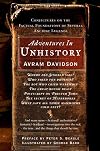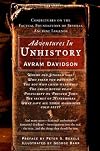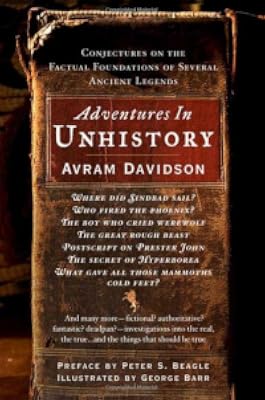
Adventures in Unhistory: Conjectures on the Factual Foundations of Several Ancient Legends
by Avram Davidson
On This Page
Description
Explores the foundations of fifteen legends involving the voyages of Sinbad, dragons, mermaids, the moon, and various other subjects.Tags
Recommendations

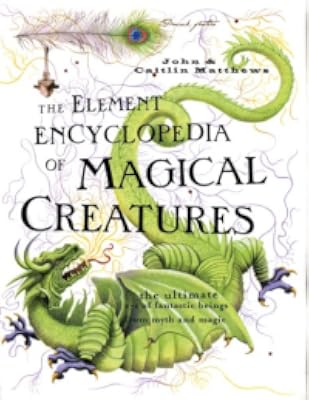

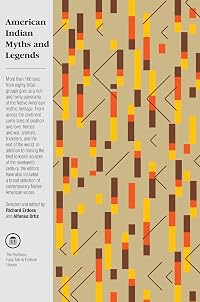
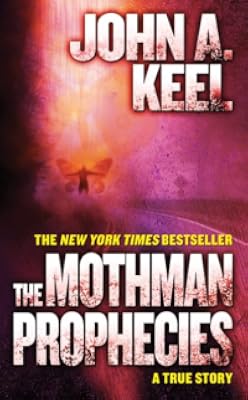
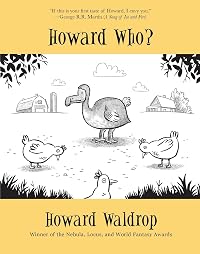
















Member Recommendations
Member Reviews
This was one of the best books (writing- and ideas-wise) that I’ve picked up on impulse in a long time. Davidson’s prose is this amazing blend of literary and colloquial, almost reading like a speech transcript sometimes, and was just a wonder to read. And the subject matter was equally awesome. Davidson was incredibly well-read and manages to connect dots between all sorts of things—ornithological trivia, folklore, etymologies, poetry, ancient trade routes, history, religion, feral children, and so, so much more—in a way that’s both highly logical and highly speculative. For him, it’s more about showing that something might be possible than genuinely proving it, because he’s dealing with a lot of stuff that’s not really show more provable. Dragons, for instance. Werewolves. How do you account for where those legends came from? His theories are oddly compelling, though.
However, that colloquial style I mentioned? It’s got three flaws. First, it’s colloquial à la the early ‘90s, so a number of his “as we say nowadays” jokes are a bit obscure, to the point where I think some of the essays were actually written in the ‘70s. Second, because it’s all colloquial, it got a bit predictable, repetitive, and annoying by the end.
And third, and this is a BIG THIRD, he’s … kinda _____ist? Native and non-white populations? Speak in broken English. Arabs? Pictured in a couple spots as the stereotypical hookah-smoking merchant, and they’re not the only group to have that happen. Trans people? Oddly come up in the werewolf essay, I don’t even. I don’t remember any particular instances of sexist or homophobia, but I’m fairly sure they’re in there. (This is actually a little odd to me, because Davidson also spends a fair bit of time calling out people for _____ist attitudes and pointing out that the “uncivilized” peoples … weren’t.)
7/10 (would be an 8.5 without the iffy bits) show less
However, that colloquial style I mentioned? It’s got three flaws. First, it’s colloquial à la the early ‘90s, so a number of his “as we say nowadays” jokes are a bit obscure, to the point where I think some of the essays were actually written in the ‘70s. Second, because it’s all colloquial, it got a bit predictable, repetitive, and annoying by the end.
And third, and this is a BIG THIRD, he’s … kinda _____ist? Native and non-white populations? Speak in broken English. Arabs? Pictured in a couple spots as the stereotypical hookah-smoking merchant, and they’re not the only group to have that happen. Trans people? Oddly come up in the werewolf essay, I don’t even. I don’t remember any particular instances of sexist or homophobia, but I’m fairly sure they’re in there. (This is actually a little odd to me, because Davidson also spends a fair bit of time calling out people for _____ist attitudes and pointing out that the “uncivilized” peoples … weren’t.)
7/10 (would be an 8.5 without the iffy bits) show less
Essentially a collection of musing and speculations and explorations of assorted odd and erudite topics, fascinating, funny, and mischevous. The audio book narrator mangles some Irish and his Irish accent is deplorable, but it's all of a piece with the twinking, chatty, discursive rambling around familiar and unfamiliar esoterica.
Adventures in Unhistory is a collection of columns in Issac Asimov's Science Fiction Magazine by the late Avram Davidson in the 1980's. In these columns, Davidson takes on a mythological/fantastic subject that has fascinated people for centuries, and unwinds its history and origins in popular culture, and tries to find the grain of truth in the mountain of myth and legend.
Its a wonderful set of essays. The style of Davidson is conversational, jovial, joking, digressive but in the end illuminating and entertaining. As I read his analysis of mermaids, werewolves, dragons, Aleister Crowley and others, I could imagine myself in a deli in Manhattan, listening to Davidson over a bagel and coffee explain in a style that has to be read to be show more fully enjoyed. Here he is in an essay about Sindbad (Sinbad) with one of his side digressions...
In a way, there really was a Sindbad, sort of;his name was Mohammed Ibn Battuta;and he was a Berber, a native of Northwest Africa;if anything, as far as time and territory are involved, he out Sindbaded Sindbad. I believe that he spent something like 34 years in travelling, from Morocco to China, and back again. The only troube is that he didn't draw the long bow near as much. Perhaps he had been influenced by Sindbad, perhaps he was a reincarnation. Even if you have never heard of him you have heard of anyway one of his stories, under the name of the Indian Rope Trick: evidently Ibn Battuta was the first to mention it in writing.
I'm tempted to bring in Ibn Battuta right along here because of his Sindbadian parallels or whatever; or also because his life experiences are so exceedingly interesting. But I think I'll withstand the temptation and perhaps employ him or them some other time...perhaps in and adventure entitled The Man Who Was Sindbad the Sailor. Perhaps...and perhaps not.
Anyway, the book is a real treasure, and I enjoyed it immensely. I can think of a few of my friends who will love this, if they haven't already beaten me to reading Davidson's work.
My only regret is that it was too short. I don't know how many of these columns he actually wrote; if another volume of his columns were collected and published, I'd get it in a heartbeat. show less
Its a wonderful set of essays. The style of Davidson is conversational, jovial, joking, digressive but in the end illuminating and entertaining. As I read his analysis of mermaids, werewolves, dragons, Aleister Crowley and others, I could imagine myself in a deli in Manhattan, listening to Davidson over a bagel and coffee explain in a style that has to be read to be show more fully enjoyed. Here he is in an essay about Sindbad (Sinbad) with one of his side digressions...
In a way, there really was a Sindbad, sort of;his name was Mohammed Ibn Battuta;and he was a Berber, a native of Northwest Africa;if anything, as far as time and territory are involved, he out Sindbaded Sindbad. I believe that he spent something like 34 years in travelling, from Morocco to China, and back again. The only troube is that he didn't draw the long bow near as much. Perhaps he had been influenced by Sindbad, perhaps he was a reincarnation. Even if you have never heard of him you have heard of anyway one of his stories, under the name of the Indian Rope Trick: evidently Ibn Battuta was the first to mention it in writing.
I'm tempted to bring in Ibn Battuta right along here because of his Sindbadian parallels or whatever; or also because his life experiences are so exceedingly interesting. But I think I'll withstand the temptation and perhaps employ him or them some other time...perhaps in and adventure entitled The Man Who Was Sindbad the Sailor. Perhaps...and perhaps not.
Anyway, the book is a real treasure, and I enjoyed it immensely. I can think of a few of my friends who will love this, if they haven't already beaten me to reading Davidson's work.
My only regret is that it was too short. I don't know how many of these columns he actually wrote; if another volume of his columns were collected and published, I'd get it in a heartbeat. show less
Have I seriously not written a review for this? It's a supremely fun picaresque journey into the origins of legends, written by someone who deeply loved them. This could actually the best thing Avram Davidson ever wrote.
Ratings
Members
- Recently Added By
Lists

Michael Dirda's Desert Island Books
62 works; 5 members
Author Information

182+ Works 5,671 Members
Avram Davidson was one of the great masters of short fiction of the twentieth century, a writer who won the major awards in the science-fiction, fantasy, and mystery genres -- the Hugo, Edgar, and World Fantasy Awards -- while constantly pushing at the boundaries of those genres. He published seventeen novels and wrote more than 200 stories and show more essays during his lifetime show less
Some Editions
Work Relationships
Contains
Common Knowledge
- Original publication date
- 1993
- People/Characters
- Aleister Crowley
Classifications
Statistics
- Members
- 224
- Popularity
- 145,914
- Reviews
- 5
- Rating
- (4.27)
- Languages
- English
- Media
- Paper, Audiobook, Ebook
- ISBNs
- 4
- ASINs
- 5