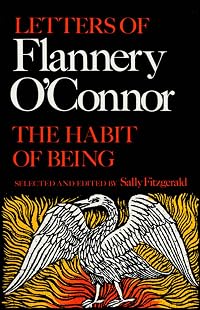
The Habit of Being: Letters of Flannery O'Connor
by Sally Fitzgerald (Editor), flannery o'connor (Author), Flannery O'Connor
On This Page
Description
Excerpts of letters, written throughout the professional life of the author, to her personal friends, business, and literary acquaitances.Tags
Recommendations














Member Reviews
This remarkable book, which I've read over a period of years, distills and reveals the great personality of our best Southern writer, particularly as it is revealed and expressed by the two pillars of her life: fiction and faith. There is a stunning directness here, a deliberate willingness to be herself, that underlies every letter, from the most formal, carefully considered letters to strangers, to the most whimsical and idiosyncratic dispatches to intimates. She is sharp, but never mean; modest, but never humble; witty, but never glib; devout, but never pious. If you like her fiction, you'll hear a lot about it from the author's point of view. If you're interested in the thought of a supremely intelligent, independent-minded but show more hardcore mid-twentieth-century Catholic, there's even more about that. Personally, I find her fiction difficult to approach (although one piece of hers, "A Good Man is Hard to Find," is my favorite short story bar none), but her collected letters speak to me more truly and wisely about the religious impulse than virtually anything else I know. I've collected some of the things she wrote in her letters for my own reflection.
"I must say that the thought of everyone lolling about in an emotionally satisfying faith is repugnant to me. The truth does not change according to our ability to stomach it emotionally…there are long periods in the lives of all of us, and of the saints, when the truth revealed by faith is hideous, emotionally disturbing, downright repulsive." – 9/6/55
"I think that the Church is the only thing that is going to make the terrible world we are coming to endurable; the only thing that makes the Church endurable is that it is somehow the body of Christ and that on this we are fed. It seems to be a fact that you have to suffer as much from the Church as for it but if you believe in the divinity of Christ, you have to cherish the world at the same time that you struggle to endure it." – 7/20/55
"I hate to say most of those prayers written by saints-in-an-emotional-state. You feel you are wearing somebody else’s finery and I can never describe my heart as “burning” to the Lord (who knows better) without snickering." – 3/10/56
Or, if you're more interested in O'Connor as a writer:
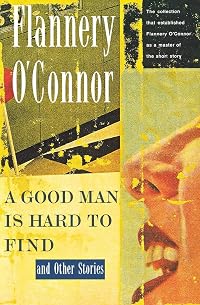
"I am mighty tired of reading reviews that call A Good Man brutal and sarcastic. The stories are hard but they are hard because there is nothing harder or less sentimental than Christian realism. I believe that there are many rough beasts now slouching toward Bethlehem to be born and that I have reported the progress of a few of them, and when I see these stories described as horror stories I am always amused because the reviewer always has hold of the wrong horror." – 7/20/55
"The meaning of a story should go on expanding for the reader the more he thinks about it, but meaning cannot be captured in an interpretation. If teachers are in the habit of approaching a story as if it were a research problem for which any answer is believable so long as it is not obvious, then I think students will never learn to enjoy fiction." – 3/28/61
"In any fiction where the omniscient narrator uses the same language as the characters, there is a loss of tension and a lowering of tone." – 8/21/55
In short, there are many riches here. I've left out excerpts from the letters where she writes about her impossibly colorful rural farm, her peacocks, the characters in her town. That's entertaining, but it's not important. It serves to leaven the book, and fill out O'Connor as a real person in a real place. Flannery O'Connor died of lupus at the age of 39, and had she lived, she would still be short of ninety. It's sad to think of what she might have produced had she been given more years, but in this book of letters she wrote to friends and colleagues, she's left a full lifetime's food for thought. show less
"I must say that the thought of everyone lolling about in an emotionally satisfying faith is repugnant to me. The truth does not change according to our ability to stomach it emotionally…there are long periods in the lives of all of us, and of the saints, when the truth revealed by faith is hideous, emotionally disturbing, downright repulsive." – 9/6/55
"I think that the Church is the only thing that is going to make the terrible world we are coming to endurable; the only thing that makes the Church endurable is that it is somehow the body of Christ and that on this we are fed. It seems to be a fact that you have to suffer as much from the Church as for it but if you believe in the divinity of Christ, you have to cherish the world at the same time that you struggle to endure it." – 7/20/55
"I hate to say most of those prayers written by saints-in-an-emotional-state. You feel you are wearing somebody else’s finery and I can never describe my heart as “burning” to the Lord (who knows better) without snickering." – 3/10/56
Or, if you're more interested in O'Connor as a writer:
"I am mighty tired of reading reviews that call A Good Man brutal and sarcastic. The stories are hard but they are hard because there is nothing harder or less sentimental than Christian realism. I believe that there are many rough beasts now slouching toward Bethlehem to be born and that I have reported the progress of a few of them, and when I see these stories described as horror stories I am always amused because the reviewer always has hold of the wrong horror." – 7/20/55
"The meaning of a story should go on expanding for the reader the more he thinks about it, but meaning cannot be captured in an interpretation. If teachers are in the habit of approaching a story as if it were a research problem for which any answer is believable so long as it is not obvious, then I think students will never learn to enjoy fiction." – 3/28/61
"In any fiction where the omniscient narrator uses the same language as the characters, there is a loss of tension and a lowering of tone." – 8/21/55
In short, there are many riches here. I've left out excerpts from the letters where she writes about her impossibly colorful rural farm, her peacocks, the characters in her town. That's entertaining, but it's not important. It serves to leaven the book, and fill out O'Connor as a real person in a real place. Flannery O'Connor died of lupus at the age of 39, and had she lived, she would still be short of ninety. It's sad to think of what she might have produced had she been given more years, but in this book of letters she wrote to friends and colleagues, she's left a full lifetime's food for thought. show less
I liked this collection of Flannery's letters much better than I thought I would. I postponed reading it for six months. No matter how hard I have tried, I do not like her novels or stories. But her letters bring out the true character that she was. Especially in her earlier years when she wasn't so dragged down by lupus, her letters are funny and just a bit bordering on hysteria. Her depiction of Southerners of that day from her mother to their tennant farmers are apt and poignent. I laughed out loud regularly. She was clearly odd, even in comparision with some of her characters. But the way she lived her life, her obesssion with peacocks and how all of her friends insisted that none of the photographs taken of her did her justice show more makes her an interesting person who was so far out of touch with her contemporaries and even with her firends. I found myself thinking that not only would she have been fascinating to know and to discover her life perspective. I did become tired of the devotional aspects of her life, but I guess that her faith got her through her painful death. Odd books, odd character, but absolutely delightful letters were the hallmark. tedious this book would have been without the show less
Stimulating, thoughtful, profound letters on literature, religion and life by an American classic. Her charm and humor and generosity in the face of the lupus which kept her homebound are as homey and inspiring as a favored family member telling you special secrets of love and life.
Wow! Found a friend in Flannery. Even had a Mass prayed for her, although probably benefited some other soul after these many years. Learned her like she probably knows me now, or her knowing the better of me, from her view. Confessor says she makes a good mentor for the likes of this suffering hermit. Loved her peacock interest, her saying she is a literary hermit, and how she suffered so well and kept going...simply kept going. But she had the Catholic faith, and she knew where to go for a degree in writing. She also humbly accepted the hand dealt her, and played it well, living with her mother after her New York City life early closed and she returned to the Georgia family farm. She existed in and yet beyond the acres.
Flannery O'Connor was a beautiful person, and these letters bring out her personality in a delightful way.
If you've read her stories and been confused (as I have), going to these letters to read what she says about the stories helps so much. I've known people who start with the letters, and then every time Flannery mentions one of her works, they put down the letters and pick up that book or story, going back when they've finished it. It sounds like a delightful way to do it!
If you've read her stories and been confused (as I have), going to these letters to read what she says about the stories helps so much. I've known people who start with the letters, and then every time Flannery mentions one of her works, they put down the letters and pick up that book or story, going back when they've finished it. It sounds like a delightful way to do it!
I read these letters in conjunction with O'Connor's short stories. They bound with interesting ideas presented by one of America's greatest artists.
Simply beautiful. Gone too soon.
Members
- Recently Added By
Lists

Epistolary Non-Fiction (Letters and Correspondence)
99 works; 5 members

Mustich's 1000 Books to Read Before You Die: A Life Changing List
1,001 works; 19 members

Books Read in 2020
4,379 works; 124 members
Author Information

168+ Works 29,874 Members
Flannery O'Connor was born in Savannah, Georgia. She had a quiet, bookish life as a child before attending Georgia State College for Women and going on tot he Writers Workshop at the State University of Iowa, where she earned a Master of Fine Arts degree. Her 1949 dissertation consisted of six short stories, one of which she developed into her show more first novel, Wise Blood (1952). Wise Blood is the story of a fanatical, wandering preacher who sets out to found a "church of truth without Jesus Christ crucified." The book introduces some of the religious themes that run throughout O'Connor's later work. Her second novel, The Violent Bear It Away (1960), is the story of murder involving a Tennessee backwoods preacher and a small boy. Once again, O'Connor explores unusual manifestation of religion and human eccentricities. Although O'Connor produced only a small body of work during her relatively brief lifetime, she has received much critical attention. O'Connor suffered from lupus, an inherited disease, which crippled her and cut short her life, and so her creative work was largely compressed within a decade of the 1950's. Her father also dies of Lupus when she was 15 years old. O'Connor is frequently praised as being the most creative and distinctive writer of this period. The two most notable aspects of her fiction are its religious themes and its commentary on the oppressive traditions of the mid-twentieth-century Deep South. (Bowker Author Biography) show less

Flannery O'Connor has a Legacy Library. Legacy libraries are the personal libraries of famous readers, entered by LibraryThing members from the Legacy Libraries group.
Awards and Honors
Distinctions
Work Relationships
Is abridged in
Common Knowledge
- Original publication date
- 1979
- People/Characters
- Walker Percy; Flannery O'Connor
- Dedication
- To Regina Cline O'Connor in gratitude for letting readers come to know her daughter better
- Blurbers
- Gilman, Richard; Gordon, Mary; Clemens, Walter
Classifications
- Genres
- Biography & Memoir, Literature Studies and Criticism, Nonfiction, Religion & Spirituality
- DDC/MDS
- 809 — Literature & rhetoric Literature, rhetoric & criticism History, description, critical appraisal of more than two literatures
- LCC
- PS3565 .C57 .Z48 — Language and Literature American literature American literature Individual authors 1961-
- BISAC
Statistics
- Members
- 1,336
- Popularity
- 17,933
- Reviews
- 12
- Rating
- (4.35)
- Languages
- English, French, Italian, Spanish
- Media
- Paper, Ebook
- ISBNs
- 9
- ASINs
- 10
