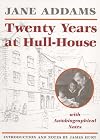
Twenty Years at Hull-House
by Jane Addams
On This Page
Description
The classic memoir of one of the Progressive Era's most important reformers and social activists. If it is natural to feed the hungry... it is certainly natural to give pleasure to the young, comfort to the aged, and to minister to the deep-seated craving for social intercourse that all men feel. In 1889, Jane Addams and her partner, Ellen Starr, opened the first settlement house in the United States. On Chicago's West Side, Hull House was devoted to the city's poor and forgotten, from show more immigrants and unwed mothers to the elderly, homeless, and hungry. Its charter proclaimed its mission "to provide a center for higher civic and social life, to institute and maintain educational and philanthropic enterprises, and to investigate and improve the conditions in the industrial districts of Chicago." In Twenty Years at Hull House, Addams chronicles her revolutionary work from its conception in the Gilded Age through the dawn of the Progressive Era. A cofounder of the American Civil Liberties Union and the first American woman to win the Nobel Peace Prize, Addams devoted her life to realizing a more noble vision of democracy. More than a personal memoir, Twenty Years at Hull-House is a landmark document of social theory and political history. This ebook has been professionally proofread to ensure accuracy and readability on all devices. show lessTags
Recommendations






























Member Reviews
Interesting historically. Addams was an assimilationist who spoke fairly respectfully about Southern European and Jewish traditions; a reformer who sought government by experts but also the franchise for women; a believer that labor rights mattered and that bad conditions produced bad behavior rather than the reverse; and a condemner of prostitution who both thought that many women were tricked or coerced into sex work and that sex work ruined any woman who engaged in it such that other “good” people were justified in excluding them from polite society no matter how repentant they were.
Jane Addams was one of those remarkable rare creatures, a true citizen of the world. She used her intelligence and humanity to assist disadvantaged people in Chicago to develop intellectually, artistically, intellectually, physically, and emotionally. As a social scientist she formulated ideas and plans then was always ready to change them when new information about people and societies showed the need. You could say she was for the underdog, but not just for the underdog, because she realized the underdog could sometimes act on ideas that were not beneficial to society. This put her on the bad side of some underdogs. She tolerated and supported all religions at her settlement, which put her on the bad side of many religious people. She show more supported people who were wrongly accused of anarchism this put her on the bad side of many politically conservative people. In fact she said that rather than ignoring human rights in order to prosecute anarchists the government should show how the government assisted people through the support of their political and human rights. She encouraged play, pleasure and humor saying that drudgery and hard work could not be all humans had to look forward to. Above all, she knew the necessity of community, the way the individual could thrive only by assisting community in whatever individual way he or she could. If there were such a thing as a secular saint, I'd nominate Jane Addams. I would encourage everyone to read this book before they vote. show less
As the title says, this book chronicles two decades in the life of Hull House, founded in Chicago by Jane Addams. Addams talks about her own life to the extent that it inspired her to build the house, and about the life of the house and its members. The house became a refuge for new arrivals to Chicago, a place for youth to gather safely, and a place where the traditions of immigrants' home countries could be showcased and passed down to new generations.
The actual work done by Hull House is valuable and important, and it is inspiring these days to read about initiatives that bring people together. I did find this something of a slog, though. Lots of long, dense paragraphs and long chapters. Definitely one for the dedicated reader rather show more than the casual one.
I read this after seeing it mentioned in The Women of the Copper Country, by Mary Doria Russell. show less
The actual work done by Hull House is valuable and important, and it is inspiring these days to read about initiatives that bring people together. I did find this something of a slog, though. Lots of long, dense paragraphs and long chapters. Definitely one for the dedicated reader rather show more than the casual one.
I read this after seeing it mentioned in The Women of the Copper Country, by Mary Doria Russell. show less
The opening chapters about her life filled me with some hope but the main bulk was a bit more stiff and stilted. It seemed an equal mixture of antedoctes and theory and they didn't always mesh well. She mostly served to downplay her own role, which I'm guessing was fairly substanial. Perhaps a bio of her would tell me more of what I wanted to know.
Written in the early 1900s, this is the story of the beginnings of Social Services in America. Jane Addams tells not only about her experiment with Hull House, but about her philosophy of what social service is or can be, the need for it and some of the episodes with the people she helped. It is quite dry, more of an intellectual observation than a personal story. I admire her for trying to stay clear of being identified with or owned by other social movements of the times. Still, I couldn't finish this book. More my problem than a problem with the book, but it didn't involve me in it, too much observation and not enough personal experiences I suppose. I quit reading about half way through.
Wow. Jane Adams is truly one of my heroes now. So inspiring for the work I want to do in the world.
Ratings
Members
- Recently Added By
Published Reviews
Originally published in 1910, this was Jane Addams' most successful book. Now regarded as a classic of American social history, this first annotated edition is issued on the occasion of the Hull-House centennial. Annotation c. Book News, Inc., Portland, OR (booknews.com)
added by Citizenjoyce
Lists

New York Public Library's Books of the Century
120 works; 20 members

New York Public Library's Books of the Century - All
170 works; 14 members

Books Set in Chicago
19 works; 7 members

Trinity College Booklist (1951): Class Six, Biography
119 works; 4 members

100 Best Books by American Women During the Past 100 Years, 1833-1933
27 works; 5 members

Robert B. Downs's Books that Changed America
15 works; 1 member

Nobel Price Winners
222 works; 19 members
Author Information

Jane Addams was born Laura Jane Addams in Cedarville, Illinois, on September 6, 1860. She graduated from Rockford Female Seminary with the hope of attending medical school. Her father opposed her unconventional ambition and, in an attempt to redirect it, sent her to Europe. In London, Addams was moved by the work done at Toynbee Hall, a settlement show more house. Upon her return to the United States, she began her lifelong fight for the underprivileged, women, children laborers, and social reform. In the space of four years she received Yale University's first honorary doctorate awarded to a woman, published her first book, was the first woman president of the National Conference of Charities and Corrections, and was elected vice president of the National American Women Suffrage Association. In 1915 she became the first president of the Women's International League for Peace and Freedom. With Ellen G. Starr, Addams founded Hull House in Chicago, a renowned settlement house dedicated to serving the disadvantaged and the poor. Addams went on to author twelve books, including Twenty Years in Hull House, Newer Ideals of Peace, and Peace and Bread in Time of War. The latter title was written to protest the U.S.'s involvement in World War I and was based on Addams's experience assisting Herbert Hoover in sending relief supplies to women and children in enemy nations. Hospitalized following a heart attack in 1926, Addams could not accept in person the Nobel Peace Prize she was awarded in 1931. She was the first American woman to receive the honor. Addams died in 1935. (Bowker Author Biography) show less
Some Editions
Awards and Honors
Series
Belongs to Publisher Series
Work Relationships
Has the (non-series) sequel
Is abridged in
Has as a supplement
Has as a student's study guide
Common Knowledge
- Canonical title
- Twenty Years at Hull-House
- Alternate titles
- 20 Years at Hull House
- Original publication date
- 1910
- People/Characters
- Jane Addams; Ellen Starr
- Important places
- Chicago, Illinois, USA
- Dedication
- To the Memory of MY FATHER
- First words
- Even as a little girl in the pastoral community of Cedarville, in northern Illinois, Jane Addams was – as she herself tells us – "busy with the old question eternally suggested by the inequalities of the human lot." [Fore... (show all)word]
Every preface is, I imagine, written after the book has been completed, and now that I have finished this volume I will state several difficulties which may put the reader on his guard unless he too postpones the preface to t... (show all)he very last. [Preface]
On the theory that our genuine impulses may be connected with out childish experiences, that on'e bent may be tracked back to that "No-Man's Land" where character is formless but nevertheless settling into definite lines of f... (show all)uture development, I begin this record with some impressions of my childhood. [Chapter 1] - Last words
- (Click to show. Warning: May contain spoilers.)The educational activities of a Settlement, as well as its philanthropic, civic, and social undertakings, are but different manifestations of the attempt to socialize democracy, as is the very existence of the Settlement itself.
- Original language
- English
Classifications
- Genres
- Nonfiction, Biography & Memoir, History, General Nonfiction
- DDC/MDS
- 361.92 — Society, government, & culture Social problems and social services Social problems and services Biography; History by Place Biography
- LCC
- HV4196 .C4 .A3 — Social sciences Social pathology. Social and public welfare. Criminology Social pathology. Social and public welfare. Protection, assistance and relief Poor in cities. Slums
- BISAC
Statistics
- Members
- 911
- Popularity
- 29,422
- Reviews
- 6
- Rating
- (3.71)
- Languages
- Czech, English, French, Japanese
- Media
- Paper, Audiobook, Ebook
- ISBNs
- 58
- ASINs
- 37