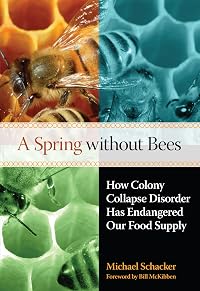
A Spring without Bees: How Colony Collapse Disorder Has Endangered Our Food Supply
by Michael Schacker
On This Page
Description
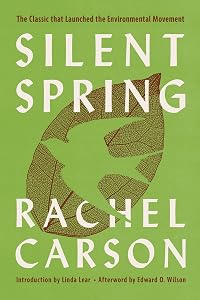
From the Publisher: A century after the birth of Rachel Carson, the world faces a new environmental disaster, from a chemical similar to DDT. This time the culprit appears to be IMD, or imidacloprid, a relatively new but widely used insecticide in the United States. Many beekeepers and researchers blame IMD for Colony Collapse Disorder, which has wiped out 23% of America's beehives. Even trace amounts make bees unable to fly back to their hive. Since honeybees are essential to the show more production of most major food crops, their demise could spell catastrophe. In a riveting, scientific/political detective story, Michael Schacker examines the evidence and offers a plan to save the bees. Like An Inconvenient Truth and Silent Spring, A Spring without Bees is both a powerful cautionary tale and a call to action. show lessTags
Recommendations












Member Reviews
If we don't smarten the hell up and pay attention to the damage we're causing to this planet, the bees are going to up and disappear. Then, we're screwed: the honey bee is responsible for 1/3 of the world's food supply and they're incredibly vulnerable to the chemical poisons that we insist on using with no regard for the consequences.
Read it. Be afraid. Do something about it.
Read it. Be afraid. Do something about it.
I've been reading all of the available books and watching the documentaries on this subject.
This is far and away the least readable and least reliable. There is lots of data and information packed in the book, but descriptors and connectors are pretty lacking. I think the conclusion is correct that neonicotinoids are at the root of the problem, but Schacker's recommended fixes are poorly thought out.
The most glaring problem is his high recommendation that everyone should plant Silver Lindens - "the Magic Bee Tree." Since he doesn't even bother to tell why the tree is so valuable, I had to do some online research. And the designation is faulty. Honey bees can tolerate some pollen, but it's toxic to bumblebees.
That's it! Throw this one show more right in the trash! show less
This is far and away the least readable and least reliable. There is lots of data and information packed in the book, but descriptors and connectors are pretty lacking. I think the conclusion is correct that neonicotinoids are at the root of the problem, but Schacker's recommended fixes are poorly thought out.
The most glaring problem is his high recommendation that everyone should plant Silver Lindens - "the Magic Bee Tree." Since he doesn't even bother to tell why the tree is so valuable, I had to do some online research. And the designation is faulty. Honey bees can tolerate some pollen, but it's toxic to bumblebees.
That's it! Throw this one show more right in the trash! show less
This weekend, I finally finished A Spring Without Bees. This was definitely not a book which took a while because I wasn’t into it, but because I was busy. Plus I had to restrain myself from stopping every few sentences to write down interesting facts about bees! Did you know, bees travel approximately 7 million miles per gallon of honey they produce? All I can say is that if people did that much work for a gallon of honey, it would probably be worth its weight in gold.
Read the rest here...
Read the rest here...
I enjoyed the beginning of this book (especially the story of Charity Crabtree and how she saved the fledgling US republic by throwing her bag of bees at British soldiers). I've like to give this one my time because honeybees and other pollinators interest me, but I'm feeling burnt out on nonfiction, and I still have Queen Noor's memoir to read for book club in two weeks.
I'm also worried that the information is going to be out of date anyway since the book is four years old. I'm putting this one down and opting for fiction, which may sometimes feel dated but is never out-of-date. Maybe once I've had a fiction infusion, I'll pick this one up again.
I'm also worried that the information is going to be out of date anyway since the book is four years old. I'm putting this one down and opting for fiction, which may sometimes feel dated but is never out-of-date. Maybe once I've had a fiction infusion, I'll pick this one up again.
Some interesting info on bees and colony collapse disorder. However, it is sensationalist writing. He over-stresses the evidence that supports his theory (neonicotinoids cause CCD) and dismisses anything that doesn't. Heavily relies on one or two studies. Also heavily relies on his claim that bees returned to France after IMD was banned, when many, if not most, dispute this "fact".
Members of Essex County Beekeeper's Association highly recommend this book.
Ratings
Members
- Recently Added By
Author Information
2 Works 94 Members
Michael Schacker is an investigative science writer and is the founder of The New Earth Institute, a lifelong learning center on the Internet. He has served as a strategic consultant and contract writer in the field of regenerative agriculture. He lives in Willow, New York. Visit him at PlanBeeCentral.com.
Some Editions
Common Knowledge
- Original publication date
- 2008
Classifications
Statistics
- Members
- 91
- Popularity
- 352,808
- Reviews
- 6
- Rating
- (4.00)
- Languages
- English
- Media
- Paper
- ISBNs
- 2
- ASINs
- 2