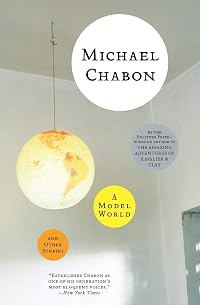
A Model World and Other Stories
by Michael Chabon
On This Page
Description
A story collection from the Pulitzer Prize–winning author of The Amazing Adventures of Kavalier & Clay, "one of his generation's most eloquent new voices" (The New York Times).With his first novel, The Mysteries of Pittsburgh, Michael Chabon announced his presence as a literary wunderkind of style and substance. A Model World and Other Stories only burnished his reputation as a distinctive prose stylist.
In eleven elegant tales—some of them linked—by the New York Times–bestselling show more author of Telegraph Avenue and The Amazing Adventures of Kavalier & Clay, Chabon's singular characters hold tight to private dreams even as their closest relationships crumble. Five stories follow an anxious adolescent from the beach vacation where he learns of his parents' divorce to the confused days of a woefully misguided crush. Others find ex-lovers tormenting each other at an oceanside café, a washed-up professional baseball player attending a teammate's funeral, and a Pittsburgh disc jockey still pining for a woman who married him to get her American citizenship.
"Chabon moves across powerful emotional ground with certainty and delicacy," raves the Chicago Tribune. "There are heartbreaking moments in these stories, but they are rendered so precisely, through incidents that capture the subtlest of feelings, that the reader can only smile at Chabon's skill."
This ebook features a biography of the author.
. show less
Tags
Recommendations








Member Reviews
I have such mixed feelings about this one. The first few stories were a slog for me. Not that they were bad, but just hard for me to get through. This was partly my fault, for choosing to try to read this immediately after reading to my daughters while waiting for them to fall asleep. Maybe the jump from 'Barnyard Animals' to this was too much for my somewhat sleepy brain.
But even when reading in more ideal circumstances, I almost felt like Mr Chabon, as a young writer, was just super eager to use all the best and biggest words he knew. And although he definitely used them correctly, it made the prose stuffier than it needed to be, especially for a small piece set in a wedding reception that is almost more of a character study than a show more story.
Another gripe I have is that for the first 3 or 4 stories, at least, the characters are unlikable. Not a bad choice, necessarily, but it made it harder for me to connect to the action.
Also, these are very 80's stories. Like, they were written in the 80's, about the 80's and seemingly for an 80's audience. I already returned the book to the library, so unfortunately I can't give specific examples. But it did feel at times like I was cracking open a time capsule- interesting, but not engaging.
I almost gave up on it, but I hate doing that, so I rarely do. So, I pushed forward, and boy was I pleasantly surprised. Eventually I warmed up to his writing, his style, whatever it was that had been slowing me down, and found the second half of the collection to be delightful.
I won't go into the details, but the last 4 or 5 stories all stand on their own, and also connect together (pretty straightforwardly) to form a small novella too. I'm really happy I stuck it out.
This was my first foray into this author's writing. I can't help but feel both this book and I would have been better served if I had read one of his more popular books first, so I'd recommend doing that, if you're interested in either Mr. Chabon or this book. show less
But even when reading in more ideal circumstances, I almost felt like Mr Chabon, as a young writer, was just super eager to use all the best and biggest words he knew. And although he definitely used them correctly, it made the prose stuffier than it needed to be, especially for a small piece set in a wedding reception that is almost more of a character study than a show more story.
Another gripe I have is that for the first 3 or 4 stories, at least, the characters are unlikable. Not a bad choice, necessarily, but it made it harder for me to connect to the action.
Also, these are very 80's stories. Like, they were written in the 80's, about the 80's and seemingly for an 80's audience. I already returned the book to the library, so unfortunately I can't give specific examples. But it did feel at times like I was cracking open a time capsule- interesting, but not engaging.
I almost gave up on it, but I hate doing that, so I rarely do. So, I pushed forward, and boy was I pleasantly surprised. Eventually I warmed up to his writing, his style, whatever it was that had been slowing me down, and found the second half of the collection to be delightful.
I won't go into the details, but the last 4 or 5 stories all stand on their own, and also connect together (pretty straightforwardly) to form a small novella too. I'm really happy I stuck it out.
This was my first foray into this author's writing. I can't help but feel both this book and I would have been better served if I had read one of his more popular books first, so I'd recommend doing that, if you're interested in either Mr. Chabon or this book. show less
Although I love well- written short stories of the traditional form, contemporary versions commonly leave me bored, if not mystified. However, I greatly enjoyed the selections in A Model World. Author Michael Chabon has a rare talent. His fiction is best read slowly, allowing one to savor the words. In sparse prose, he can evoke a feeling or a fleeting episode, and can sum up a person, or the status of a marriage, like no other author that I’ve read.
The contributions in this collection are sensitive, evocative stories, full of compassion and understanding. I particularly liked the five stories that make up the second half of the book (subtitled “The Lost World”). They are vignettes from the life of young Nathan Shapiro from show more boyhood (when his parents’ marriage is breaking up) through his mid- teens (when sexual attraction comes to the fore). To tell of the themes of the other stories unfairly diminishes them into the ordinary. The story “S Angel ” captures a lonely, single young man at the wedding reception of his cousin. In “Ocean Avenue”, a young man encounters his former lover in a coffee shop. In “A Model World” a physics graduate student plagiarizes his graduate thesis, with success. In “Smoke”, an ex-ballplayer attends the funeral of his former team-mate. Clearly, such descriptions will do nothing to attract a prospective reader. That’s too bad, because each is a small treasure.
Commonly, for my own benefit, I rate stories in collections such as these. I won't do so here; suffice to say that I rated most with four-stars (the others with three).
Other reviewers state that Chabon’s writing has improved significantly from these early (1991) stories. I take that as good reason to explore his more recent work, and plan to do so. show less
The contributions in this collection are sensitive, evocative stories, full of compassion and understanding. I particularly liked the five stories that make up the second half of the book (subtitled “The Lost World”). They are vignettes from the life of young Nathan Shapiro from show more boyhood (when his parents’ marriage is breaking up) through his mid- teens (when sexual attraction comes to the fore). To tell of the themes of the other stories unfairly diminishes them into the ordinary. The story “S Angel ” captures a lonely, single young man at the wedding reception of his cousin. In “Ocean Avenue”, a young man encounters his former lover in a coffee shop. In “A Model World” a physics graduate student plagiarizes his graduate thesis, with success. In “Smoke”, an ex-ballplayer attends the funeral of his former team-mate. Clearly, such descriptions will do nothing to attract a prospective reader. That’s too bad, because each is a small treasure.
Commonly, for my own benefit, I rate stories in collections such as these. I won't do so here; suffice to say that I rated most with four-stars (the others with three).
Other reviewers state that Chabon’s writing has improved significantly from these early (1991) stories. I take that as good reason to explore his more recent work, and plan to do so. show less
I've mentioned before that Michael Chabon is a writer I greatly respect, not just for penning one of my favourite novels of all time (Kavalier & Clay), but also for being a literary heavyweight determined to restore the good name of genre fiction: someone decrying "the contemporary, quotidian, plotless, moment-of-truth revelatory story." I fucking hate those stories.
"A Model World" is a collection of precisely those kinds of stories, drawn from the very early years of Chabon's career, before he was... cleansed. They are, of course, brimming with beautiful prose and perfect turns of phrase, because he is Michael Chabon. Yet they're also pointless. Forgettable. Unremarkable. They may inspire emotions, but like emotions themselves, they show more quickly fade away. They are, to use another of his quotes I delight in, "sparkling with epiphanic dew." Which evaporates.
If you're going to read that kind of story you could probably do worse, mind you. There are a couple of good ones in here. The final five all follow the same character, Nathan Shapiro, through a predictable bildungsroman; sort of like Hemingway's Nick Adams but with less manliness and more existential melancholy (or did Nick do that a lot too?) It's quite banal, but because it's done by Chabon it's not a complete waste of your time. Sort of like how Shutter Island was a typical psychological thriller, but much better than usual because it was directed by Martin Scorsese. Except Shutter Island was much better than "A Model World," but you get what I mean.
In any case, I only have to muck about in the fetid slop of Chabon's early career long enough to read "The Mysteries of Pittsburgh" and "Werewolves In Their Youth." Then it's rocketing back into his awesome post-2000 work, with epic World War II adventures and Sherlock Holmes and alternate dimension homicide detectives and all that jazz. That's gonna be awesome.
Having said that, Mike, I GET THAT YOU ARE JEWISH! I REALLY, REALLY DO! NOW WILL YOU PLEASE STOP WRITING ABOUT IT OVER AND OVER AND OVER AGAIN! show less
"A Model World" is a collection of precisely those kinds of stories, drawn from the very early years of Chabon's career, before he was... cleansed. They are, of course, brimming with beautiful prose and perfect turns of phrase, because he is Michael Chabon. Yet they're also pointless. Forgettable. Unremarkable. They may inspire emotions, but like emotions themselves, they show more quickly fade away. They are, to use another of his quotes I delight in, "sparkling with epiphanic dew." Which evaporates.
If you're going to read that kind of story you could probably do worse, mind you. There are a couple of good ones in here. The final five all follow the same character, Nathan Shapiro, through a predictable bildungsroman; sort of like Hemingway's Nick Adams but with less manliness and more existential melancholy (or did Nick do that a lot too?) It's quite banal, but because it's done by Chabon it's not a complete waste of your time. Sort of like how Shutter Island was a typical psychological thriller, but much better than usual because it was directed by Martin Scorsese. Except Shutter Island was much better than "A Model World," but you get what I mean.
In any case, I only have to muck about in the fetid slop of Chabon's early career long enough to read "The Mysteries of Pittsburgh" and "Werewolves In Their Youth." Then it's rocketing back into his awesome post-2000 work, with epic World War II adventures and Sherlock Holmes and alternate dimension homicide detectives and all that jazz. That's gonna be awesome.
Having said that, Mike, I GET THAT YOU ARE JEWISH! I REALLY, REALLY DO! NOW WILL YOU PLEASE STOP WRITING ABOUT IT OVER AND OVER AND OVER AGAIN! show less
A Model World marks Michael Chabon's first work. Whilst this collection of short stories lacks the strength of his best novels, and his later collection, Werewolves in Their Youth, there are nonetheless a few treasures glinting in there for the discerning reader.
These stories are all concerned with loss or missed expectations, typically based around young men. As a beginning writer, Chabon understood that the easiest way to gather an emotional punch in a short story is through an elegiac, melancholy tone. This does lead to him dodging the rigorous narrative requirements of a truly excellent short story (demands well and truly met in his subsequent collection).
Nonetheless, Chabon - even in his twenties - was an excellent writer, and show more this collection demonstrates that. Beautiful prose combines the best aspects of brevity and lyricism, married to a true gift for off-the-cuff characterisation. Chabon peppers his characters with incidental biographical detail that is both fascinating and utterly believable.
These stories of young men on the precipice of irrevocably growing up remind me nothing so much of young F. Scott Fitzgerald's short stories, with all their strengths and weaknesses. I don't think A Model World is a good introduction for readers new to Chabon - its offerings are too slight to win any converts. However, Chabon is one of America's best writers, and it's still worthwhile read, especially for fans.
The book stands quietly in the corner on it own merits, but there is an added bonus in seeing the young writer that would grow - irrevocably - old with such panache. show less
These stories are all concerned with loss or missed expectations, typically based around young men. As a beginning writer, Chabon understood that the easiest way to gather an emotional punch in a short story is through an elegiac, melancholy tone. This does lead to him dodging the rigorous narrative requirements of a truly excellent short story (demands well and truly met in his subsequent collection).
Nonetheless, Chabon - even in his twenties - was an excellent writer, and show more this collection demonstrates that. Beautiful prose combines the best aspects of brevity and lyricism, married to a true gift for off-the-cuff characterisation. Chabon peppers his characters with incidental biographical detail that is both fascinating and utterly believable.
These stories of young men on the precipice of irrevocably growing up remind me nothing so much of young F. Scott Fitzgerald's short stories, with all their strengths and weaknesses. I don't think A Model World is a good introduction for readers new to Chabon - its offerings are too slight to win any converts. However, Chabon is one of America's best writers, and it's still worthwhile read, especially for fans.
The book stands quietly in the corner on it own merits, but there is an added bonus in seeing the young writer that would grow - irrevocably - old with such panache. show less
Someday I’m going to write a treatise on short stories of today – that is, the current fiction that everyone thinks are great and wonderful. I am hoping that, in that way, I will have a better understanding of what I’m missing, because I must be missing something. This collection may be the perfect place to start. Chabon is good. He proved his story-telling and writing abilities in Kavalier and Clay and (even though it didn’t resonate that well with me) he showed excellence in craft with The Final Solution. And in this collection, each of these stories kept my attention – the writing and skill were there. But far too often I left wondering, “Yeah, but so what?” Someday I’m going to investigate these stories and analyze show more the plot, climaxes, etc. I can see the characterization, but isn’t there supposed to be more?
All of this makes me sound particularly down on this collection, and I am not. As I indicated, I cared. The stories kept me reading. I just didn’t always get the pay-off I expected. (Again I warn, maybe I’m expecting something far too pedestrian and I just need to learn to drink Pinot instead of Boone’s Farm.) In particular, the second half paid off more because the six stories were a connected narrative – almost feeling autobiographical. But then, as I look back through, and remember how much I enjoyed reading “Blumenthal on the Air” and “Smoke” and, actually, all the others, I know there is more here – more that I need to explore.
So, maybe I don’t need to write that treatise – maybe that is the answer. Maybe I feel the change that has occurred without recognizing it. And, to me, that is really what story is about. It is about process. Something comes in, it is changed (the process) and something different comes out. The subjects of the stories are different when they leave, and I am different after I read about them. I left this collection changed because of what I read, and that may be all that is important.
(Okay, I never do this. I write my review, post it, then read other reviews. But, no matter what I see, my review stands. However, the other review posted for this book reminded me of something in this collection. “Ocean Avenue” begins with one of the best lines I’ve ever read. “If you can still see how you could once have loved a person, you are still in love; an extinct love is always wholly incredible.” That line alone makes this collection worth it.) show less
All of this makes me sound particularly down on this collection, and I am not. As I indicated, I cared. The stories kept me reading. I just didn’t always get the pay-off I expected. (Again I warn, maybe I’m expecting something far too pedestrian and I just need to learn to drink Pinot instead of Boone’s Farm.) In particular, the second half paid off more because the six stories were a connected narrative – almost feeling autobiographical. But then, as I look back through, and remember how much I enjoyed reading “Blumenthal on the Air” and “Smoke” and, actually, all the others, I know there is more here – more that I need to explore.
So, maybe I don’t need to write that treatise – maybe that is the answer. Maybe I feel the change that has occurred without recognizing it. And, to me, that is really what story is about. It is about process. Something comes in, it is changed (the process) and something different comes out. The subjects of the stories are different when they leave, and I am different after I read about them. I left this collection changed because of what I read, and that may be all that is important.
(Okay, I never do this. I write my review, post it, then read other reviews. But, no matter what I see, my review stands. However, the other review posted for this book reminded me of something in this collection. “Ocean Avenue” begins with one of the best lines I’ve ever read. “If you can still see how you could once have loved a person, you are still in love; an extinct love is always wholly incredible.” That line alone makes this collection worth it.) show less
Pleasant collection extremely anchored in a particular time, place, class, social circle. Write what you know! Chabon as ever has the deftly-observed character and the piercing turn of phrase.
Early Chabon is still good Chabon. Standalone stories in the first section (Model World) track the connections.... missed and made... by young adults. Linked stories in the second section (Lost World) shows the dissolution of the Shapiro family by divorce and its effects on everyone, especially young Nathan (stand-in for Michael?). Delicate & visceral feelings, dynamically and divinely written.
Members
- Recently Added By
Published Reviews
ThingScore 100
"With this volume of stories -- and in particular, the stories about Nathan Shapiro -- Mr. Chabon goes beyond the promise of his last book. Indeed, he establishes himself as one of his generation's most eloquent new voices"
added by danielx
Lists

Books Read in 2025
4,091 works; 97 members

Books Read in 1992
8 works; 1 member
Author Information

74+ Works 67,792 Members
Michael Chabon was born in Washington, D.C. on May 24, 1963. He received a B.A. in English literature from the University of Pittsburgh in 1985 and a Master of Fine Arts degree in English writing at the University of California at Irvine in 1987. Chabon found success at the age of 24, when William Morrow publishing house offered him $155,000, a show more near-record sum, for the rights to his first novel The Mysteries of Pittsburgh, which was his thesis in graduate school. After The Mysteries of Pittsburgh became a national bestseller, he began writing a series of short stories about a little boy dealing with his parents' divorce. The stories, which in part appeared in The New Yorker and G.Q., were bound together in 1991 into a volume titled A Model World and Other Stories. His other works include Wonder Boys, The Astonishing Secret of Awesome Man, Telegraph Avenue, and Pop: Fatherhood in Pieces. In 2001 he won the Pulitzer Prize for fiction for his novel The Amazing Adventures of Kavalier and Clay. He and Ayelet Waldman are co-editors of, Kingdom of Olives and Ash: Writers Confront the Occupation.. (Bowker Author Biography) show less
Common Knowledge
- Original publication date
- 1991
Classifications
Statistics
- Members
- 1,188
- Popularity
- 21,024
- Reviews
- 26
- Rating
- (3.50)
- Languages
- 6 — Czech, Dutch, English, German, Italian, Spanish
- Media
- Paper, Ebook
- ISBNs
- 24
- ASINs
- 8