On This Page
Description
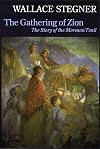
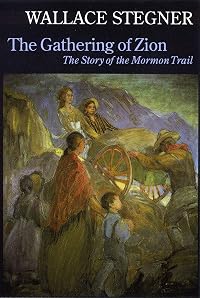
Pulitzer Prize-winning author Wallace Stegner tells about a thousand-mile migration marked by hardship and sudden death--but unique in American history for its purpose, discipline, and solidarity. Other Bison Books by Wallace Stegner include Mormon Country, Recapitulation, Second Growth, and Women on the Wall.Tags
Recommendations



























Member Recommendations

gypsysmom This was my introduction to the handcart pioneers' story.
Member Reviews
I read this book during the first four weeks I lived in Salt Lake City. As a newcomer both to the city and the culture, this book has really helped shape my vision of this city and its people. Stegner, with the narrative style of a novelist, takes the reader from Kirtland, Ohio, to Salt Lake City, Utah. He outlines the trials and triumphs of the Mormon pioneers in a realistic and non-idealistic way. The pioneers are human, with human pettiness and pride. Death and despair feature heavily in this history but are ultimately triumphed by faith, perseverance, and community. I look at the grid of streets in SLC and see the history behind them. I take my daughter out to the hills east of town, and I turn back and try to envision the valley show more through the eyes of the pilgrims as they finished their more than 1000-mile march to Zion. Knowing the character of those who founded this city has helped me to understand the character of the people who live here today.
I'm not a frequent reader of nonfiction or history, and I found it difficult to keep track of all the "characters" in this epic. I also found that Stegner assumed that the reader understood certain terms, like "fustian trousers," that at least this modern reader did not understand. By and large, though, this was a thoroughly enjoyable and enlightening book. show less
I'm not a frequent reader of nonfiction or history, and I found it difficult to keep track of all the "characters" in this epic. I also found that Stegner assumed that the reader understood certain terms, like "fustian trousers," that at least this modern reader did not understand. By and large, though, this was a thoroughly enjoyable and enlightening book. show less
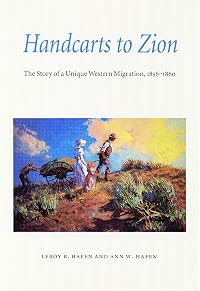
This is my first Wallace Stegner book but he's been on my radar for a long time. Earlier this year I read a fictional account of one of the handcart companies that travelled the Mormon Trail. True Sisters told the story of the Martin Handcart Company that took a group of British immigrants from Iowa City to Salt Lake City in 1856. They set out much too late in the year to make the 1400 mile journey and suffered the consequences of bad weather and insufficient food. I had a pretty bad opinion of Brigham Young and the elders of the Mormon church after reading that book. This unbiased account of the opening up of the trail, including an account of the handcart companies, changed that a bit (for the better).
Opening the west to settlement show more wasn't only done by Mormons. Lots of other people went west to Oregon and California and places in between. But, as Stegner points out, the Mormons were the only group that improved the trail so that people coming behind them would have an easier time. They also subsidized travel costs for a great many people who would not have been able to make the journey. Most of the people in the handcart companies were poor Europeans who were victims of the Industrial Revolution. If they had stayed in England, Sweden, Switzerland their lives probably would have been short and disease-ridden. It is true that some of them, particularly those in the Martin handcart company, died prematurely but for those that survived and made it to Utah their lives and that of their descendants was immeasurably better.
I'm glad I read this book. Stegner does not pull any punches when he feels the church elders made mistakes but at the same time he shows how world-changing their efforts were.
Highly recommended. show less
Opening the west to settlement show more wasn't only done by Mormons. Lots of other people went west to Oregon and California and places in between. But, as Stegner points out, the Mormons were the only group that improved the trail so that people coming behind them would have an easier time. They also subsidized travel costs for a great many people who would not have been able to make the journey. Most of the people in the handcart companies were poor Europeans who were victims of the Industrial Revolution. If they had stayed in England, Sweden, Switzerland their lives probably would have been short and disease-ridden. It is true that some of them, particularly those in the Martin handcart company, died prematurely but for those that survived and made it to Utah their lives and that of their descendants was immeasurably better.
I'm glad I read this book. Stegner does not pull any punches when he feels the church elders made mistakes but at the same time he shows how world-changing their efforts were.
Highly recommended. show less
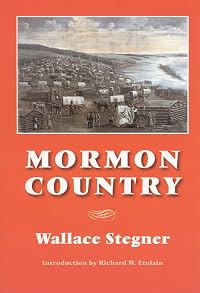
Stegner was not a Mormon; however, he spent many years in Salt Lake City and had respect for many of the values ( as distinguished from the religious beliefs) of the church. This book is the epic story of the Mormon Trail and a must read for any student of the American West. The religious prejudices faced by the Mormons find echoes in the modern resurgence of the intolerant Christian fundamentalists. On the other hand the religious insularity of smaller Utah communities (see, e.g., Mormon Country also by Stegner) which may well be a hangover from a history of persecution, leads many Gentiles to feel frozen out. If crossing the Great Plains in a covered wagon was difficult, imagine the challenge of pushing a handcart for the distance.
Drawing largely from diaries and journals written by those who took this trail, Wallace Stegner gives us a look at the factors that led the Mormons from Kirtland, Ohio to Nauvoo, Illinois and eventually on the Mormon Trail which led to the Great Salt Lake Basin area. With a wealth of primary source materials available, he is able to give us a detailed glimpse at what life was like for persons accompanying Brigham Young westward. Stegner himself was a Presbyterian but he offers us a glimpse at their life with a balanced approach. While he did not use footnotes for reference purposes, one can often tell which account is being utilized by the context, and he does offer notes on the sources used in each chapter at the end of the book. There show more is an index mostly comprised of names and locations which will be useful for persons interested in specific persons or in places along the Trail. show less
Ratings
Members
- Recently Added By
Author Information

94+ Works 20,877 Members
In 1972, Wallace Earle Stegner won a Pulitzer Prize for Angle of Repose (1971), a novel about a wheelchair-bound man's recreation of his New England grandmother's experience in a late nineteenth-century frontier town. Stegner was born on February 18, 1909 in Lake Mills, Iowa. He was an American novelist, short story writer, environmentalist, and show more historian; he has been called "The Dean of Western Writers". He also won the US National Book Award in 1977 for The Spectator Bird. Stegner grew up in Great Falls, Montana; Salt Lake City, Utah; and in the village of Eastend, Saskatchewan, which he wrote about in his autobiography Wolf Willow. Stegner taught at the University of Wisconsin and Harvard University. Eventually he settled at Stanford University, where he initiated the creative writing program. His students included Wendell Berry, and Sandra Day O'Connor. The Stegner Fellowship program at Stanford University is a two-year creative writing fellowship. The house Stegner lived in from age 7 to 12 in Eastend, Saskatchewan, Canada, was restored by the Eastend Arts Council in 1990 and established as a Residence for Artists; the Wallace Stegner Grant For The Arts offers a grant of $500 and free residency at the house for the month of October for published Canadian writers. Stegner died in Santa Fe, New Mexico, on April 13, 1993, from a car accident on March 28, 1993. (Bowker Author Biography) show less
Awards and Honors
Series

Common Knowledge
- Canonical title
- The Gathering of Zion: The Story of the Mormon Trail
- Original publication date
- 1964
- People/Characters
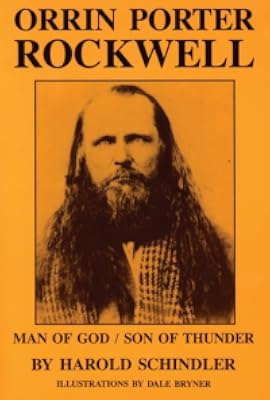
- Young, Brigham, 1801–1877; Jim Bridger; William Huntington; Thomas Kane; Heber C. Kimball; Orson Pratt (show all 14); Parley P. Pratt; Charles Coulson Rich; Franklin D. Richards; Orrin Porter Rockwell; Joseph Smith; Eliza Snow; Hosea Stout; Wilford Woodruff
- Important places
- Mormon Trail, USA; American West; Utah, USA; Salt Lake City, Utah, USA; Garden Grove, Iowa, USA; Great Salt Lake, Utah, USA (show all 10); Missouri River, USA; Nauvoo, Illinois, USA; Platte River, Nebraska, USA; Sweetwater River, USA
- Important events
- Mormon Exodus
- First words
- Checkpoints on the Road to New Jerusalem
1805
December 23 Joseph Smith born in Sharon, Vermont.
Introduction: The Way to the Kingdom
Close to the heart of Mormondom, as close as the beehive symbol of labor and cohesiveness that decorates the great seal of Utah, is the stylized memory of the trail. - Last words
- (Click to show. Warning: May contain spoilers.)Ultimately he is the object of every pilgrimage; for if we understand him we can understand it all.
- Original language
- English
Classifications
- Genres
- Nonfiction, History, General Nonfiction, Religion & Spirituality, Travel
- DDC/MDS
- 978 — History & geography History of North America Western United States
- LCC
- F593 .S85 — Local History of the United States, Canada and Latin America United States local history The West. Trans-Mississippi Region. Great Plains
- BISAC
Statistics
- Members
- 266
- Popularity
- 121,939
- Reviews
- 4
- Rating
- (4.09)
- Languages
- English
- Media
- Paper
- ISBNs
- 5
- ASINs
- 4