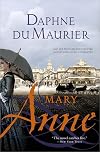
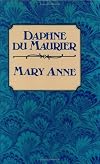
Mary Anne
by Daphne du Maurier
On This Page
Description
Based on the life of Mary Anne Clarke.Tags
Recommendations


















Member Recommendations


mambo_taxi Vanity Fair is definitely the more enjoyable romp with an equally colorful heroine.
Member Reviews
Though the blurbs of her books make them sound like romantic potboilers, Daphne du Maurier is no writer of cheesy romances. Her prose is subtle, her plots layered, and her characters - especially her heroines - often refreshingly complex, shaped as much by their flaws as their virtues. The plot of this book is as represented in all the reviews, but what the reviews can't capture is the delight of sinking into a story with characters who are authentic, believable, real. Mary Anne is no historical superwoman, just a believable woman of her time whose passion and ambition turn out to be both her salvation and her destruction. Good writing is hard to find - good writing about strong women even harder. Hope others enjoy this as I did!
It would take a lot to get over the disappointment that this book is not equal to du Maurier's best works. The presentation of the life of Mary Anne Clarke, du Maurier's infamous great-great-grandmother, is bland at best when it was probably supposed to be presented as quite the strong-willed romp a la Becky Sharp. The book suffers stylistically because it seems as if du Maurier could never figure out whether she wanted to write a novel or a biography, and the dialogue is largely a hollow excuse for plot exposition. In short, this is a 'rise and fall' story, with boring emphasis on the fall.
I sometimes forget how good Du Maurier's prose is, so books languish on the shelf. A fictionalised biography of her ancestor, DuMaruier's Mary Anne is a pithy deconstruction of a woman's sole source of power in the eighteenth century. The third person PoV disguises quite how unreliable a narrator Mary Anne is, but her attempts to deny and suppress her feelings comes through strongly, especially in the second half of the novel. I admit, though I knew it couldn't have a happy ending (that a happy ending wouldn't have fit the character regardless) I wish there had been a little more self-discovery for Mary Anne, perhaps in exploration of her time in prison.
A strange novel,the story told in a rather hurried, precied way, perhaps echoing the impatience of Mary Anne herself, who kept herself and her family by entertaining lovers and brokering promotions.
Du Maurier appeared to have researched deeply her great-great-grandmother's life, especially the way she made and frittered money. But I didn't feel she showed exactly why her relative captivated practically every man who crossed her path.
Du Maurier appeared to have researched deeply her great-great-grandmother's life, especially the way she made and frittered money. But I didn't feel she showed exactly why her relative captivated practically every man who crossed her path.
Can't quite decide between 3 & 4 stars. This tells the tale of Du Maurier's great great grandmother, Mary Anne Clarke, who was mistress to the Duke of York. She was then pivotal in the investigation into the sale of commissions that took place in the House of Commons. A novelised biography, the first sections chart her upbringing in London poverty, then her hasty marriage and subsequent struggles with a lacklustre drunk of a husband. This wasnlt the life she wanted when she was in poveryt, and so her ambition rises still further. She eventually leaves him and finds her way to be mistress of the Duke of York. And here, she does actually seem to be happy, although there are perenial money problems, which is, in part, leads her into the show more murky issue of selling commisions. She takes a sum of money to put a name forward for a comission or exchange within the armed forces, of which the Duke is Commander in Chief. It is illegal, but it's not exactly unusual at this time in history. It all then starts to go down hill after she ceases her relationship with the Duke. There are the debts, the inability to maintain the standard of living to which she'd become accustomed. This all leads her into increasingly desparate ways of extracting money from old acquaintances, including the writing of defamatory pamphlets. This ends with a court case and the ultimate downfall. It's an interesting sotry, although the sections leading up to her period as mistress are more interesting, surprising and enjoyable to read than the book thereafter. The fall is, in part, due to her own inability to compromise and moderate herself. She thinks she has been hard done by, and never blames herself for a single part of what happens to her. But she never makes any attempt to plan for the future - she always lives for the day. This has its consequences. show less
Hell hath no fury like a woman scorned. A bit different from your usual Du Maurier novel, in this one she tells the story of her great-great-grandmother Mary Anne Clarke. Borne into a poor London family, Mary Anne marries Joseph Clarke who ends up drinking and gambling away any money he gets from his family. Disgusted with the marriage and desperate to support her children, Mary Anne finds herself tempted by a *cough* broker for the wealthy nobility and becomes mistress to Frederick Duke of York. Although being a mistress of a prince with no head for money brings on its own dilemma - how to run a household and a lavish lifestyle on the meager allowance the Duke gives her. With a war looming, men eager for commissions seek preferable show more treatment through Mary Anne, as the Duke is also the Commander-in-Chief and an offer of money gets a word in the right ear.
Eventually the Duke tires of Mary Anne and she finds herself out in the cold with massive household debts and no pension from the Duke, her brother unjustly cashiered out of the army and her finger is very much in the pie when the scandal of selling commissions hits Parliament with a full blown investigation including the testimony of one very disgruntled ex-mistress. I won't be a spoiler, but further actions taken by Mary Anne in revenge against those who "done her wrong" don't work out as planned and sets her on a nine-month path of harrowing consequences.
Du Maurier is superb as always, she had me hooked from the very unusual opening reflecting back on Mary Anne's life (do go back and reread it after you've finished) to the very end as she makes a very final and fitting farewell to the man who had such an impact on her life. The kind of woman you either love or hate, Mary Anne was most definitely a woman who did what she had to do in order to survive in a man's world and make a better life for her children. Du Maurier doesn't sugar coat her image either - she's presented as is, warts and all. I loved the relationship between her and the Duke, particularly their first meeting in the *cough* broker's parlor where not knowing who she's set to meet she natters on about the latest court gossip (priceless!), to their first dinner and the popping buttons (you'll know when you get there) although tops was the way the author worked in Mary Anne getting those officer's names out there in between seducing the Duke. Its so refreshing to see that an author can write a sex scene so subtly that it isn't staring you in the face with blow-by-blow details but you know what's going on at the same time. The only parts that did drag were the court scenes, with endless pages of testimony and dialogue, and for that I'm knocking off 1/2 star - 4.5/5 stars. show less
Eventually the Duke tires of Mary Anne and she finds herself out in the cold with massive household debts and no pension from the Duke, her brother unjustly cashiered out of the army and her finger is very much in the pie when the scandal of selling commissions hits Parliament with a full blown investigation including the testimony of one very disgruntled ex-mistress. I won't be a spoiler, but further actions taken by Mary Anne in revenge against those who "done her wrong" don't work out as planned and sets her on a nine-month path of harrowing consequences.
Du Maurier is superb as always, she had me hooked from the very unusual opening reflecting back on Mary Anne's life (do go back and reread it after you've finished) to the very end as she makes a very final and fitting farewell to the man who had such an impact on her life. The kind of woman you either love or hate, Mary Anne was most definitely a woman who did what she had to do in order to survive in a man's world and make a better life for her children. Du Maurier doesn't sugar coat her image either - she's presented as is, warts and all. I loved the relationship between her and the Duke, particularly their first meeting in the *cough* broker's parlor where not knowing who she's set to meet she natters on about the latest court gossip (priceless!), to their first dinner and the popping buttons (you'll know when you get there) although tops was the way the author worked in Mary Anne getting those officer's names out there in between seducing the Duke. Its so refreshing to see that an author can write a sex scene so subtly that it isn't staring you in the face with blow-by-blow details but you know what's going on at the same time. The only parts that did drag were the court scenes, with endless pages of testimony and dialogue, and for that I'm knocking off 1/2 star - 4.5/5 stars. show less
This is the story of Daphne du Maurier’s great-great-grandmother, Mary Anne Clarke, born into a poor family in the East End of London, married at fifteen and the mother of four children by the time she was twenty-three. Mary Anne became a notorious courtesan and mistress of the Duke of York and was later the central figure in a political corruption scandal, the repercussions of which ultimately led to her downfall.
According to Lisa Hilton, who wrote the introduction to the 2003 Virago edition, du Maurier did not much care for Mary Anne. She wrote that it was “lacking in human interest and reads like a newspaper report”. To some extent du Maurier was right. While it’s not really devoid of human interest, neither Mary Anne nor show more most of the other characters are particularly sympathetic. Although what motivates Mary Anne to behave in the way she does is understandable, it does not make her likeable. Further, much of the latter part of the book reads like transcripts from the parliamentary inquiry at which she gave evidence and the various trials in which she was involved.
The outcome of this is an uneven tone. Part of the book reads like a novel and part of it reads like a biography. The writing is excellent, but the two parts of the book feel quite separate. It may be the lawyer in me, but I found the parliamentary inquiry and the trials incredibly interesting. However, I really would have liked a bibliography or at the very least an author’s note discussing the primary sources and explaining what is fact and what is fiction. What I would have liked even more, I think, is an actual biography, rather than historical fiction. If du Maurier had written a biography about her ancestor, this might have been a much better book. It could have been the [b:Georgiana: Duchess of Devonshire|319300|Georgiana Duchess of Devonshire|Amanda Foreman|http://photo.goodreads.com/books/1332041559s/319300.jpg|578160] of its time.
Still, I don’t regret the time I’ve spent reading Mary Anne. In spite of its weaknesses, the book still demonstrates du Maurier’s consummate skill as a writer. She was able to create a sense of place and time without resorting to archaic vocabulary. The central characters – for all they are mostly unlikeable - are vividly realised and never feel like transplants from du Maurier’s time. There were also moments of wonderfully written sly humour.
For me, this was a 3-1/2 star read. It gets half a star because I found the content about the parliamentary inquiry and the legal system so very interesting. Another buddy read with my friend Jemidar. show less
Members
- Recently Added By
Lists

Favourite Virago Modern Classics
183 works; 38 members

Discontinued
19 works; 4 members

Publisher's Weekly Bestsellers - Part II - 1940 - 1979
355 works; 5 members
Author Information

204+ Works 57,518 Members
Daphne Du Maurier was born in London on May 13, 1907 and educated in Paris. In 1932, she married Lieutenant-General Sir Frederick Browning. She began writing short stories of mystery and suspense for magazines in 1928, a collection of which appeared as The Apple Tree in 1952. Her first novel, The Loving Spirit, was published in 1931. Her tightly show more woven, highly suspenseful plots and her strong characters make her stories perfect for adaptation to film or television. Among her many novels that were made into successful films are Jamaica Inn (1936), Rebecca (1938), Frenchman's Creek (1941), Hungry Hill (1943), My Cousin Rachel (1952), and The Scapegoat (1957). Her short story, The Birds (1953), was brought to the screen by director Alfred Hitchcock in a treatment that has become a classic horror-suspense film. She died on April 19, 1989 at the age of 81. (Bowker Author Biography) show less
Some Editions
Awards and Honors
Distinctions
Series
Belongs to Publisher Series
Work Relationships
Common Knowledge
- Canonical title
- Mary Anne
- Original publication date
- 1954
- People/Characters
- Mary Anne Clarke; Frederick, Duke of York; Charles Thompson; William Dowler
- Important places
- London, England, UK
- Dedication
- To
MARY ANNE CLARKE
my great-great grandmother
died Boulogne, June 21st, 1852
and to
GERTRUDE LAWRENCE
who was to have acted the part
on the stage
died New York, September 6th 1952 ... (show all)
In memory of both - First words
- Introduction
Mary Anne Clarke, the notorious mistress of the Duke of York, had much in common with her descendant, Daphne du Maurier.
Years later, when she had gone and was no longer part of their lives, the thing they remembered about her was her smile. - Last words
- (Click to show. Warning: May contain spoilers.)The bells of St. Martin's began to toll, but she went on sitting there, eating her bread-and-cheese, tossing the rind to the pigeons that spattered the steps, and watching a million starlings span the sky.
(Click to show. Warning: May contain spoilers.)Daphne du Maurier has collected the shards, and though there are cracks in her portrait, it still scintillates, a captured prism of words that joyously illuminate another word. (Introduction) - Original language
- English
Classifications
- Genres
- Fiction and Literature, General Fiction, Historical Fiction, Romance
- DDC/MDS
- 823.912 — Literature & rhetoric English & Old English literatures English fiction 1900- 1901-1999 1901-1945
- LCC
- PZ3 .D8916 — Language and Literature Fiction and juvenile belles lettres Fiction and juvenile belles lettres Fiction in English
- BISAC
Statistics
- Members
- 993
- Popularity
- 26,369
- Reviews
- 22
- Rating
- (3.52)
- Languages
- 9 — Czech, Dutch, English, French, German, Italian, Norwegian (Bokmål), Portuguese, Swedish
- Media
- Paper, Audiobook, Ebook
- ISBNs
- 41
- UPCs
- 1
- ASINs
- 54