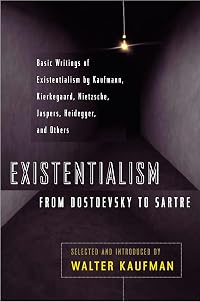
Existentialism from Dostoevsky to Sartre
by Walter Kaufmann (Editor)
On This Page
Description
What is Existentialism? It is perhaps the most misunderstood of modern philosophic positions-misunderstood by reason of its broad popularity and general unfamiliarity with its origins, representatives, and principles.Existential thinking does not originate with Jean Paul Sartre. It has prior religious, literary, and philosophic origins. In its narrowest formulation it is a metaphysical doctrine, arguing as it does that any definition of man's essence must follow, not precede, an estimation show more of his existence. In Heidegger, it affords a view of Being in its totality; in Kierkegaard an approach to that inwardness indispensable to authentic religious experience; for Dostoevsky, Kafka, and Rilke the existential situation bears the stamp of modern man's alienation, uprootedness, and absurdity; to Sartre it has vast ethical and political implications.Walter Kaufmann, author of Nietzsche, is eminently qualified to present and interpret the insights of existentialism as they occur and are deepened by the major thinkers who express them.In every case complete selections or entire works have been employed: The Wall, Existentialism, and the complete chapter on "Self-Deception" from L'e tre et le Ne ant by Sartre; two lectures from Jaspers' book Reason and Existenz; original translations of On My Philosophy by Jaspers and The Way Back into the Ground of Metaphysics by Heidegger. There is, as well, material from Dostoevsky, Kierkegaard, Nietzsche, Rilke, and Camus. show lessTags
Recommendations















Member Reviews
Later: OK, very glad I pushed passed the block of Jaspers. An overall great collection, and it's pretty funny in itself to find Heidegger and Sartre, who follow J, a wondrous relief of comparatively easy understanding.
Everything was going well until I snagged on the LONG, LONG excerpt from Karl Jaspers's Existenzphilosophie. I finally broke out in laughter yesterday at what seems like a manic parody of mid-20th-century European philosophers. The only way I'll get through this section is if I view it as unintentional comedy.
Everything was going well until I snagged on the LONG, LONG excerpt from Karl Jaspers's Existenzphilosophie. I finally broke out in laughter yesterday at what seems like a manic parody of mid-20th-century European philosophers. The only way I'll get through this section is if I view it as unintentional comedy.
This anthology has been the first introduction to existentialism for English readers since it first appeared in 1956. It collects nine authors but devotes unequal amounts of attention to them, with the selections from Jaspers and Sartre being the longest. Every collection is a selection and always leaves room for discussion of what was included and left out. In this book, I missed Simone de Beauvoir and wondered about the inclusion of Rilke. Even Camus’s presence is questionable; he claimed he wasn’t an existentialist, nor did Sartre recognize him as one.
I was struck by the variation in readability, especially in the principal two authors represented. At times, Jaspers lapsed into jargon. I imagine a serious read of one of his books show more in German would involve coming to terms with him. With Sartre, it was more extreme. I had a hard time following the chapter on self-deception (“mauvaise foi”) from Being and Nothingness. Sartre seemed to pursue his own dialectic, negating every term he introduced. The lecture, “Existententialism is a Humanism,” on the other hand, was easily readable. show less
I was struck by the variation in readability, especially in the principal two authors represented. At times, Jaspers lapsed into jargon. I imagine a serious read of one of his books show more in German would involve coming to terms with him. With Sartre, it was more extreme. I had a hard time following the chapter on self-deception (“mauvaise foi”) from Being and Nothingness. Sartre seemed to pursue his own dialectic, negating every term he introduced. The lecture, “Existententialism is a Humanism,” on the other hand, was easily readable. show less
Somewhat "old" now, I still view this as an excellent anthology, most especially the intro by Kaufmann himself. It's rather ironic, because in looking at reader reviews, ratings, comments, etc., now, currently, years later, they seem to reinforce a thesis I got from him, and that the entire concept, if not the term itself, of existentialism is subjective for more reasons that I have time or space to go into. But there are plenty of people complaining about the authors and selections in this book, which reinforces the point that even the so-called "Existentialists" themselves couldn't agree on who or what comprised a "true" existentialist or existentialism. Which is why it probably will prove to be a twentieth century fad, and not a show more longterm philosophical school. I made peace with this a long time ago and have patterned much of my life's outlook, behaviors and existence on the principles of several noted existentialist writers/philosophers, and I feel comfortable I can back up my stance, but I feel no need to argue it either, nor defend it, because I think even those in question would question the need or point in even doing so. Who really cares who is an "authentic" existentialist? I know of some who do -- they've got too much damn time on their hands. A good book, a classic. Perfect? No. It's subjective. show less
In this work published in 1956, Professor Kaufmann provides a lively and accessible introduction to his well-chosen compilation of writings by existentialists. The most rewarding sections of the introduction are on the major figures of Heidegger and Sartre, but Kierkegaard, Nietzsche and Jaspers also get covered and their views come up further in the Heidegger and Sartre sections. Freud, the Buddha and Schelling are also brought into the discussion at various points. At the end Kaufmann contrasts existentialism and analytic philosophy in the context of his time: existentialism brings philosophy down to earth while analytic philosophy has analytic rigor which unfortunately focuses on trivial issues. Rather than look at each other across show more a great divide, Kaufmann believes these approaches should be brought together, something Socrates accomplished in the philosophy of his day.
Of Dostoevsky Kaufmann says "I see no reason for calling Dostoevsky an existentialist, but I do think that Part One of the Notes from Underground is the best overture for existentialism ever written." "Kierkegaard [in rejecting reason] would have you become a Christian, Nietzsche [in rejecting Christianity but not reason] says 'Be a man and do not follow me--but yourself!' Heidegger tries to arouse us from the oblivion of Being. And all of them contrast inauthentic and authentic life." "Unlike the great philosophers of the past, [Jaspers] insists that the rational sphere is subphilosophic and that philosophy begins only where reason fails us or, in Jasper's phrase, has suffered shipwreck." "Heidegger's philosophy has increasingly turned from an attempt to comprehend Being directly into a series of efforts to comprehend it by way of interpretation of selected texts." "Many of Sartre's pages on the central themes of existentialism have the plausibility and contact with experience which are lacking in the similar analysis of Heidegger" and "when we compare Sartre and Heidegger it generally seems as if Sartre had written from experience what in Heidegger seemed relatively academic and abstract."
Kierkegaard in his own words: “A crowd in its very concept is untruth, by reason of the fact that it renders the individual completely impenitent and irresponsible, or at least weakens his sense of responsibility by reducing it to a fraction…. The crowd is untruth. Hence no one has more contempt for what it is to be a man than they who make it their profession to lead the crowd. … The crowd is untruth. Therefore, Christ was crucified because ... He would not permit the crowd to aid him in any way… but would be what He is, the Truth, which relates itself to the individual.”
Nietzsche: “The secret of the greatest fruitfulness and the greatest enjoyment of existence is: to live dangerously!”
Jaspers: “Man lives in the world as an existent. As thinking consciousness generally he is searchingly oriented towards objects. As spirit he shapes the idea of the whole in his world existence. As Existenz he is related to Transcendence through which he knows himself as given to himself in his freedom…. Being is not the sum of objects; rather objects extend, as it were, towards our intellect in the subject-object division, from the Encompassing of Being itself, which is beyond objective comprehension, but from which nevertheless all separate, determinate objective knowledge derives….”
Heidegger: “To characterize with a single term both the involvement of Being in human nature and the essential relation of man to the openness (‘there’) of Being as such, the name of ‘being there’ [Dasein] was chosen for that sphere of being in which man stands as man. … ‘Being there’ names that which should first of all be experienced, and subsequently thought of, as a place -- namely, the location of the truth of Being…. The Being that exists is man. Man alone exists …. Horses are, but they do not exist. … God is but does not exist…. The proposition ‘man exists’ means: man is that being whose Being is distinguished by the open-standing standing-in the unconcealededness of Being, from Being, in Being.”
Sartre: “Man is nothing else but what he purposes, he exists only in so far as he realizes himself, he is therefore nothing else but the sum of his actions, nothing else but what his life is. … [M]an is condemned to be free … because he did not create himself, yet is nevertheless at liberty, and from the moment that he is thrown into this world he is responsible for everything he does. … Man is all the time outside of himself: it is in projecting and losing himself beyond himself that he makes man to exist; and, on the other hand, it is by pursuing transcendent aims that he himself is able to exist….. This relation of transcendence as constitutive of man (not in the sense that God is transcendent, but in the sense of self-surpassing) with subjectivity (in such a sense that man is not shut up in himself but forever present in a human universe)-- it is this that we call existential humanism.” show less
Of Dostoevsky Kaufmann says "I see no reason for calling Dostoevsky an existentialist, but I do think that Part One of the Notes from Underground is the best overture for existentialism ever written." "Kierkegaard [in rejecting reason] would have you become a Christian, Nietzsche [in rejecting Christianity but not reason] says 'Be a man and do not follow me--but yourself!' Heidegger tries to arouse us from the oblivion of Being. And all of them contrast inauthentic and authentic life." "Unlike the great philosophers of the past, [Jaspers] insists that the rational sphere is subphilosophic and that philosophy begins only where reason fails us or, in Jasper's phrase, has suffered shipwreck." "Heidegger's philosophy has increasingly turned from an attempt to comprehend Being directly into a series of efforts to comprehend it by way of interpretation of selected texts." "Many of Sartre's pages on the central themes of existentialism have the plausibility and contact with experience which are lacking in the similar analysis of Heidegger" and "when we compare Sartre and Heidegger it generally seems as if Sartre had written from experience what in Heidegger seemed relatively academic and abstract."
Kierkegaard in his own words: “A crowd in its very concept is untruth, by reason of the fact that it renders the individual completely impenitent and irresponsible, or at least weakens his sense of responsibility by reducing it to a fraction…. The crowd is untruth. Hence no one has more contempt for what it is to be a man than they who make it their profession to lead the crowd. … The crowd is untruth. Therefore, Christ was crucified because ... He would not permit the crowd to aid him in any way… but would be what He is, the Truth, which relates itself to the individual.”
Nietzsche: “The secret of the greatest fruitfulness and the greatest enjoyment of existence is: to live dangerously!”
Jaspers: “Man lives in the world as an existent. As thinking consciousness generally he is searchingly oriented towards objects. As spirit he shapes the idea of the whole in his world existence. As Existenz he is related to Transcendence through which he knows himself as given to himself in his freedom…. Being is not the sum of objects; rather objects extend, as it were, towards our intellect in the subject-object division, from the Encompassing of Being itself, which is beyond objective comprehension, but from which nevertheless all separate, determinate objective knowledge derives….”
Heidegger: “To characterize with a single term both the involvement of Being in human nature and the essential relation of man to the openness (‘there’) of Being as such, the name of ‘being there’ [Dasein] was chosen for that sphere of being in which man stands as man. … ‘Being there’ names that which should first of all be experienced, and subsequently thought of, as a place -- namely, the location of the truth of Being…. The Being that exists is man. Man alone exists …. Horses are, but they do not exist. … God is but does not exist…. The proposition ‘man exists’ means: man is that being whose Being is distinguished by the open-standing standing-in the unconcealededness of Being, from Being, in Being.”
Sartre: “Man is nothing else but what he purposes, he exists only in so far as he realizes himself, he is therefore nothing else but the sum of his actions, nothing else but what his life is. … [M]an is condemned to be free … because he did not create himself, yet is nevertheless at liberty, and from the moment that he is thrown into this world he is responsible for everything he does. … Man is all the time outside of himself: it is in projecting and losing himself beyond himself that he makes man to exist; and, on the other hand, it is by pursuing transcendent aims that he himself is able to exist….. This relation of transcendence as constitutive of man (not in the sense that God is transcendent, but in the sense of self-surpassing) with subjectivity (in such a sense that man is not shut up in himself but forever present in a human universe)-- it is this that we call existential humanism.” show less
How unfortunate to have forgotten the curator to that museum of ideas. I once was young. Concepts all too often were inchoate. Kaufmann directed my stumbling progress through these choppy waters.
I had a long hooded green coat then.
I walked around the university brooding -- largely for effect.
My focus shifted from social justice to existential peril.
I'd like to beat that guy's ass.
What emerged was a lifelong appreciation of Hamlet.
I'm now curious if further biases leaped upon me with my dazzled attentions elsewhere.
I had a long hooded green coat then.
I walked around the university brooding -- largely for effect.
My focus shifted from social justice to existential peril.
I'd like to beat that guy's ass.
What emerged was a lifelong appreciation of Hamlet.
I'm now curious if further biases leaped upon me with my dazzled attentions elsewhere.
A great overview of existentialist writing from its Russian origins to its French dominance. I only wish Kaufmann had put more of his own thoughts into this book, as he has the widest perspective of anyone in it.
O ensaio que dá nome ao livro é muito interessante, e pretende discutir os conceitos de existencialismo, principalmente porque os três autores que estão em todas as listas - Jaspers, Heidegger e Sartre - discordavam quanto aos essenciais, e somente o último aceitava o título de existencialista. Precursores como Pascal, Kierkegaard, Dostoiévski e Nietzsche diferem dos três primeiros, e se ainda acrescentarmos Kafka, Rilke e Camus, é quase impossível determinar a característica que une todos esses autores.
A recusa de pertencer a uma escola de pensamento, o repúdio de sistemas de pensamento, uma insatisfação com a filosofia tradicional e acadêmica, distanciada da vida, uma preocupação com os temas de desespero e morte, a show more crença que existência vem antes da essência - esse é o coração do existencialismo. A partir daí o autor discute alguns autores, chegando à conclusão, por exemplo, de que O Subsolo, primeira parte da novela Notas do Subsolo, é um prelúdio ao existencialismo, e que o próprio Homem do Subsolo é existencialista, mas o autor não o é.
A partir daí, há traduções de trechos escritos por alguns autores, muitos inéditos em inglês. show less
A recusa de pertencer a uma escola de pensamento, o repúdio de sistemas de pensamento, uma insatisfação com a filosofia tradicional e acadêmica, distanciada da vida, uma preocupação com os temas de desespero e morte, a show more crença que existência vem antes da essência - esse é o coração do existencialismo. A partir daí o autor discute alguns autores, chegando à conclusão, por exemplo, de que O Subsolo, primeira parte da novela Notas do Subsolo, é um prelúdio ao existencialismo, e que o próprio Homem do Subsolo é existencialista, mas o autor não o é.
A partir daí, há traduções de trechos escritos por alguns autores, muitos inéditos em inglês. show less
Members
- Recently Added By
Lists

Books referenced in Jim Holt's Why Does the World Exist?
119 works; 1 member

Literary Works Read in College
316 works; 15 members
Author Information

All Editions
Work Relationships
Is an abridged version of
Common Knowledge
- Canonical title
- Existentialism from Dostoevsky to Sartre
- Original publication date
- 1956
- People/Characters
- Fyodor Dostoevsky; Søren Kierkegaard; Friedrich Nietzsche; Rainer Maria Rilke; Franz Kafka; José Ortega y Gasset (show all 10); Karl Jaspers; Martin Heidegger; Jean-Paul Sartre; Albert Camus
- Important events
- Existentialism
- Dedication
- To Felix
- First words
- Existentialism is not a philosophy but a label for several widely different revolts against traditional philosophy.
- Last words
- (Click to show. Warning: May contain spoilers.)One must imagine Sisyphus happy.
Classifications
- Genres
- Philosophy, Nonfiction, General Nonfiction
- DDC/MDS
- 142.78 — Philosophy & psychology Philosophical schools of thought Critical philosophy Existentialism And Phenomenology Existentialism
- LCC
- B819 .K3 — Philosophy, Psychology and Religion Philosophy (General) By period Modern Special topics and schools of philosophy
- BISAC
Statistics
- Members
- 2,330
- Popularity
- 8,529
- Reviews
- 21
- Rating
- (3.86)
- Languages
- English, German, Thai
- Media
- Paper, Ebook
- ISBNs
- 17
- ASINs
- 41