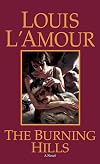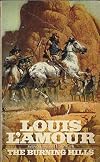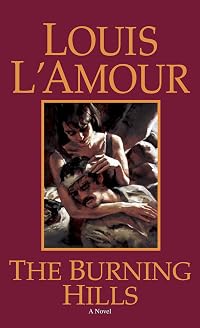
The Burning Hills
by Louis L'Amour
On This Page
Description
Fiction. Western. Thriller. Historical Fiction. HTML:Wounded, dehydrated, and escaping a violent feud with the men of Bob Sutton’s ranch, Trace Jordan is near collapse when he descends from the heat of the desert into a cool, secluded canyon. He wakes to find a beautiful woman gently nursing him back to health. Strong and proud, Maria Cristina has also suffered at the hands of Sutton and his men. The experience has left her hostile and defiant. Trace, intrigued by Maria’s grit and show more determination, can’t help trying to peel back her layers—but his attraction makes her a target.Sutton’s men are watching and waiting for Trace to show himself. If he escapes, Maria will have to face them alone. But if he convinces her to go with him, Trace and Maria will have to survive a heat-blasted, waterless desert. And if that doesn’t kill them, the Apaches will. show less
Tags
Recommendations









Member Reviews
I really disliked this book. I've read enough of L'Amour's novels to be used to his sexist characters and the role of women in his stories, and sometimes he writes some pretty decent ones. This novel, though, shows a non-white woman in the Mexican border region of California who is forced to accept an asshole hero gunfighter as her 'protector' and partner, after he rescues her from the bad guys. The hero seems to think that when the woman refuses him, she is simply untamed and needs to be trained, or broken, the way he breaks wild horses. He does 'get' the woman in the end, but not because he wins her over so that she chooses him. He simply forces himself on her and she reluctantly relents and accepts him. This novel does show how awful show more non-white women's circumstances may have been during the Wild West era, but I was really annoyed at the ending and was rooting for the bad guys or at least for the Apaches by the end. Surely the woman would have been better off if she had hooked up with one of the Indians rather than a white gunman she didn't love and who would never really respect her as a person. show less
Pretty good read about a posse trying to eliminate someone who killed a cattle baron, even though it was done in self-defense. The interesting portion of this story is who comes to his aid, though some of the scenes might cause modern readers a little discomfort.
Another page turner from Louis. In this effort, Trace Jordan is catching wild horses with a friend then breaking with the idea of making enough money to start a business that will eventually lead to the purchase of a ranch. While Trace is in town to buy some supplies, two men kill his friend and steal the horses. When he sees a man riding one of his horses in town, he challenges him and in the ensuing gun fight Trace kills him. Turns out the man is the owner of the largest ranch in the area and he did not know the horse was stolen by his men.
Now the pursuit is on and Trace is wounded and nearly exhausted when he finds a deer trail that leads to a hidden ledge where he hides from the pursuers. Near death he awakens to find an attractive show more young woman tending to his wounds. The remainder of the story is the chase across the desert with Trace trying to keep his attractive companion out of the hands of the cowboys and the Apaches as well. show less
Now the pursuit is on and Trace is wounded and nearly exhausted when he finds a deer trail that leads to a hidden ledge where he hides from the pursuers. Near death he awakens to find an attractive show more young woman tending to his wounds. The remainder of the story is the chase across the desert with Trace trying to keep his attractive companion out of the hands of the cowboys and the Apaches as well. show less
Ratings
Members
- Recently Added By
Author Information

871+ Works 99,762 Members
Born in Jamestown, North Dakota on March 22, 1908, Louis L'Amour's adventurous life could have been the subject of one of his novels. Striking out on his own in 1923, at age 15, L'Amour began a peripatetic existence, taking whatever jobs were available, from skinning dead cattle to being a sailor. L'Amour knew early in life that he wanted to be a show more writer, and the experiences of those years serve as background for some of his later fiction. During the 1930s he published short stories and poetry; his career was interrupted by army service in World War II. After the war, L'Amour began writing for western pulp magazines and wrote several books in the Hopalong Cassidy series using the pseudonym Tex Burns. His first novel, Westward the Tide (1950), serves as an example of L'Amour's frontier fiction, for it is an action-packed adventure story containing the themes and motifs that he uses throughout his career. His fascination with history and his belief in the inevitability of manifest destiny are clear. Also present and typical of L'Amour's work are the strong, capable, beautiful heroine who is immediately attracted to the equally capable hero; a clear moral split between good and evil; reflections on the Native Americans, whose land and ways of life are being disrupted; and a happy ending. Although his work is somewhat less violent than that of other western writers, L'Amour's novels all contain their fair share of action, usually in the form of gunfights or fistfights. L'Amour's major contribution to the western genre is his attempt to create, in 40 or more books, the stories of three families whose histories intertwine as the generations advance across the American frontier. The novels of the Irish Chantry, English Sackett, and French Talon families are L'Amour's most ambitious project, and sadly were left unfinished at his death. Although L'Amour did not complete all of the novels, enough of the series exists to demonstrate his vision. L'Amour's strongest attribute is his ability to tell a compelling story; readers do not mind if the story is similar to one they have read before, for in the telling, L'Amour adds enough small twists of plot and detail to make it worth the reader's while. L'Amour fans also enjoy the bits of information he includes about everything from wilderness survival skills to finding the right person to marry. These lessons give readers the sense that they are getting their money's worth, that there is more to a L'Amour novel than sheer escapism. With over 200 million copies of his books in print worldwide, L'Amour must be counted as one of the most influential writers of westerns in this century. He died from lung cancer on June 10, 1988. (Bowker Author Biography) Louis L'Amour, truly America's favorite storyteller, was the first fiction writer ever to receive the Congressional Gold Medal from the United States Congress in honor of his life's work, & was also awarded the Medal of Freedom. There are over 260 million copies of his books in print worldwide. (Publisher Provided) show less
Work Relationships
Has the adaptation
Common Knowledge
- Canonical title
- The Burning Hills
- Original publication date
- 1956-08
- People/Characters
- Trace Jordan; Maria Cristina Chavero; Juanito Chavero; Vincente Chavero; Jack Sutton; Jacob Lantz (show all 15); Mort Bayless; Ben Hinderman; Buck Bayless; Wes Parker; Joe Sutton; Johnny Hendrix; Bob Sutton; Pablo Chavero; John Slaughter
- Important places
- North Mexico; Tokewanna, The Border Area, USA and Mexico
- Related movies
- The Burning Hills (1956 | IMDb)
- Epigraph
- [None]
- Dedication
- To my Mother--
who also loved the desert - First words
- On a ridge above Texas Flat upon a rock shaped like flame, a hand moved upon the lava.
- Last words
- (Click to show. Warning: May contain spoilers.)She laughed then, a laugh teasing and tender, a soft laughter that lost itself with the campfire smoke in the brush along the canyon's wall.
- Disambiguation notice
- ISBN0552083054 does not belong with The Burning Hills by Louis L'Amour.
Classifications
Statistics
- Members
- 675
- Popularity
- 42,496
- Reviews
- 4
- Rating
- (3.71)
- Languages
- English
- Media
- Paper, Audiobook, Ebook
- ISBNs
- 19
- ASINs
- 15