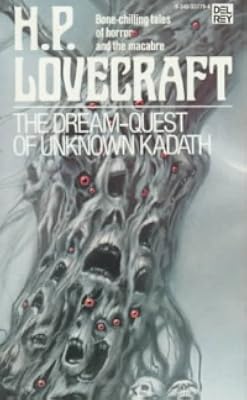
The Dream-Quest of Unknown Kadath and Others
by H. P. Lovecraft
On This Page
Description
Fiction. Literature. Excerpt: "Three times Randolph Carter dreamed of the marvellous city, and three times was he snatched away while still he paused on the high terrace above it. All golden and lovely it blazed in the sunset, with walls, temples, colonnades and arched bridges of veined marble, silver-basined fountains of prismatic spray in broad squares and perfumed gardens, and wide streets marching between delicate trees and blossom-laden urns and ivory statues in gleaming rows; while on show more steep northward slopes climbed tiers of red roofs and old peaked gables harbouring little lanes of grassy cobbles. It was a fever of the gods, a fanfare of supernal trumpets and a clash of immortal cymbals. Mystery hung about it as clouds about a fabulous unvisited mountain; and as Carter stood breathless and expectant on that balustraded parapet there swept up to him the poignancy and suspense of almost-vanished memory, the pain of lost things and the maddening need to place again what once had been an awesome and momentous place.". show lessTags
Recommendations





















Member Recommendations
Member Reviews
I got about a third of the way through the walls of text Lovecraft threw up at me, and I simply didn't have the heart to go on.
This is one of the unreadable Lovecraft stories, in my opinion. In it, there's no real discernable plot, just Randolph Carter moving from one location to the next, wildly observing things. Meanwhile, Lovecraft's imagination is in overdrive, and he's slinging names and locations and infernal beasts three, four, or five to a page. Unfortunately, while the imagination was firing on all cylinders, his storytelling/pacing/plotting abilities were nonexistent.
There is no dialogue to be found in this 40 K-word story, so, we are honestly treated to walls of text. And that text is dense. Like, for example, this single show more sentence gem:
And before the day was done Carter saw that the steersman could have no other goal than the Basalt Pillars of the West, beyond which simple folk say Cathuria lies, but which wise dreamers well know are the gates of a monstrous cataract wherein the oceans of earth's dreamland drop wholly to abysmal nothingness and shoot through the empty spaces toward other worlds and other stars and the awful voids outside the ordered universe where the daemon-sultan Azathoth gnaws hungrily in chaos amid pounding and piping and the hellish dancing of the Other Gods, blind, voiceless, tenebrous, and mindless, with their souls and messenger Nyarlathotep.
And no, I didn't skip any commas or anything. That's precisely how it's presented. Try reading that aloud. Like, Howard, dude, take a damn breath now and again, would ya?
So, yeah, three stars for the book's packaging and artwork, etc. 0 stars for the story, such as it is. show less
This is one of the unreadable Lovecraft stories, in my opinion. In it, there's no real discernable plot, just Randolph Carter moving from one location to the next, wildly observing things. Meanwhile, Lovecraft's imagination is in overdrive, and he's slinging names and locations and infernal beasts three, four, or five to a page. Unfortunately, while the imagination was firing on all cylinders, his storytelling/pacing/plotting abilities were nonexistent.
There is no dialogue to be found in this 40 K-word story, so, we are honestly treated to walls of text. And that text is dense. Like, for example, this single show more sentence gem:
And before the day was done Carter saw that the steersman could have no other goal than the Basalt Pillars of the West, beyond which simple folk say Cathuria lies, but which wise dreamers well know are the gates of a monstrous cataract wherein the oceans of earth's dreamland drop wholly to abysmal nothingness and shoot through the empty spaces toward other worlds and other stars and the awful voids outside the ordered universe where the daemon-sultan Azathoth gnaws hungrily in chaos amid pounding and piping and the hellish dancing of the Other Gods, blind, voiceless, tenebrous, and mindless, with their souls and messenger Nyarlathotep.
And no, I didn't skip any commas or anything. That's precisely how it's presented. Try reading that aloud. Like, Howard, dude, take a damn breath now and again, would ya?
So, yeah, three stars for the book's packaging and artwork, etc. 0 stars for the story, such as it is. show less
H. P. Lovecraft (1890-1937) wrote "The Dream-Quest of Unknown Kadath" in 1927, but the story was not published until 1943. It was already warmed-over, derivative gothic horror when he wrote it. The prose is as purple as it gets. Lord Dunsany said that Lovecraft had borrowed his style and was “welcome to it.” Indeed.
Randolph Carter, one of Lovecraft’s recurrent protagonists, wants to explore the city of Kadath in Dreamland. Why exactly I am not sure. But that is what Byronic heroes do, I guess.
The story gets more credit than it deserves as an exploration of Nietzsche’s will to power, Jung’s collective unconscious, occultism, modernist nihilism, and even as an early example of “queer Gothic.” Take your pick. It has recently show more inspired a feminist reboot by Kij Johnson, “The Dream-Quest of Vellitt Boe,” which at least has a logical plot, which Lovecraft could never claim. show less
Randolph Carter, one of Lovecraft’s recurrent protagonists, wants to explore the city of Kadath in Dreamland. Why exactly I am not sure. But that is what Byronic heroes do, I guess.
The story gets more credit than it deserves as an exploration of Nietzsche’s will to power, Jung’s collective unconscious, occultism, modernist nihilism, and even as an early example of “queer Gothic.” Take your pick. It has recently show more inspired a feminist reboot by Kij Johnson, “The Dream-Quest of Vellitt Boe,” which at least has a logical plot, which Lovecraft could never claim. show less
Another entertaining "history lesson" from HPL, this novella an overview of his Dreamlands and their alien intrusions into our waking world. Like "At the Mountains of Madness", "Kadath" offers an adventure story; unlike that exploration of Antarctica, this story feels less menacing and tense in tone. But "Kadath" is like AtMoM in linking to other HPL tales, in this case borrowing characters from other HPL stories. "Kadath" is worth reading as much for plot as for the wealth of world-disclosive hints and references, documenting a Grand Tour of Dreamland geography and residents.
While Randolph Carter may well wake from his adventure, his journey is fundamentally different than Alice's. In a way the Red Queen does not, Nyarlathotep remains show more on the other side, waiting and perhaps following. show less
While Randolph Carter may well wake from his adventure, his journey is fundamentally different than Alice's. In a way the Red Queen does not, Nyarlathotep remains show more on the other side, waiting and perhaps following. show less
I read this H. P. Lovecraft novella to prepare to read [The Dream-Quest of Vellitt Boe], one of this year's Hugo Award-nominated novellas. The new book is a sequel of sorts to the old story.
Lovecraft's "dreamlands" can be reached by sufficiently strong dreamers, and are populated by humans, and all manner of monsters and gods. A dreamer can awaken back into our world - but the dreamlands are nonetheless a real place, where a dreamer can die. The protagonist wishes to enter a city he has discovered there:
Three times Randolph Carter dreamed of the marvellous city, and three times was he snatched away while still he paused on the high terrace above it. All golden and lovely it blazed in the sunset, with walls, temples, colonnades, and show more arched bridges of veined marble, silver-basined fountains of prismatic spray in broad squares and perfumed gardens, and wide streets marching between delicate trees and blossom-laden urns and ivory statues in gleaming rows; while on steep northward slopes climbed tiers of red roofs and old peaked gables harbouring little lanes of grassy cobbles. It was a fever of the gods; a fanfare of supernal trumpets and a clash of immortal cymbals. Mystery hung about it as clouds about a fabulous unvisited mountain; and as Carter stood breathless and expectant on that balustraded parapet there swept up to him the poignancy and suspense of almost-vanished memory, the pain of lost things, and the maddening need to place again what once had an awesome and momentous place.
The gods learn of his interest and forbid future ventures to this wondrous place. Carter decides to journey in dream to the great moutain Kadath, to plead with the gods dwelling there to allow him to enter the city.
This is the first Lovecraft story I've read that showcases him as a writer of weird fiction, not just horror. The quest leads though endless horrors, but where the narrator of, say, [At the Mountains of Madness] would curl into a whimpering ball, Carter is equal for the most part to what he encounters. We get a travelogue of eerie, fearsome, and strange places.
A travelogue written in vivid, baroque prose. Reading this story is like eating a meal made up entirely of rich desserts; the experience cloys quickly, and the story felt much longer than its 43,000 words. And the imagery is often much less convincing than the opening passage quoted above. For example:
The gugs, hairy and gigantic, once reared stone circles in that wood and made strange sacrifices to the Other Gods and the crawling chaos Nyarlathotep, until one night an abomination of theirs reached the ears of earth’s gods and they were banished to caverns below. Only a great trap-door of stone with an iron ring connects the abyss of the earth-ghouls with the enchanted wood, and this the gugs are afraid to open because of a curse. That a mortal dreamer could traverse their cavern realm and leave by that door is inconceivable; for mortal dreamers were their former food, and they have legends of the toothsomeness of such dreamers even though banishment has restricted their diet to the ghasts, those repulsive beings which die in the light, and which live in the vaults of Zin and leap on long hind legs like kangaroos.
I started giggling at "the vaults of Zin," but can certainly see laughing right at the beginning of the paragraph. The ear is paramount for this sort of prose.
Lovecraft's stories are foundational for modern weird fiction, but foundations are often best kept out of sight.
The story can be read free online. show less
Lovecraft's "dreamlands" can be reached by sufficiently strong dreamers, and are populated by humans, and all manner of monsters and gods. A dreamer can awaken back into our world - but the dreamlands are nonetheless a real place, where a dreamer can die. The protagonist wishes to enter a city he has discovered there:
Three times Randolph Carter dreamed of the marvellous city, and three times was he snatched away while still he paused on the high terrace above it. All golden and lovely it blazed in the sunset, with walls, temples, colonnades, and show more arched bridges of veined marble, silver-basined fountains of prismatic spray in broad squares and perfumed gardens, and wide streets marching between delicate trees and blossom-laden urns and ivory statues in gleaming rows; while on steep northward slopes climbed tiers of red roofs and old peaked gables harbouring little lanes of grassy cobbles. It was a fever of the gods; a fanfare of supernal trumpets and a clash of immortal cymbals. Mystery hung about it as clouds about a fabulous unvisited mountain; and as Carter stood breathless and expectant on that balustraded parapet there swept up to him the poignancy and suspense of almost-vanished memory, the pain of lost things, and the maddening need to place again what once had an awesome and momentous place.
The gods learn of his interest and forbid future ventures to this wondrous place. Carter decides to journey in dream to the great moutain Kadath, to plead with the gods dwelling there to allow him to enter the city.
This is the first Lovecraft story I've read that showcases him as a writer of weird fiction, not just horror. The quest leads though endless horrors, but where the narrator of, say, [At the Mountains of Madness] would curl into a whimpering ball, Carter is equal for the most part to what he encounters. We get a travelogue of eerie, fearsome, and strange places.
A travelogue written in vivid, baroque prose. Reading this story is like eating a meal made up entirely of rich desserts; the experience cloys quickly, and the story felt much longer than its 43,000 words. And the imagery is often much less convincing than the opening passage quoted above. For example:
The gugs, hairy and gigantic, once reared stone circles in that wood and made strange sacrifices to the Other Gods and the crawling chaos Nyarlathotep, until one night an abomination of theirs reached the ears of earth’s gods and they were banished to caverns below. Only a great trap-door of stone with an iron ring connects the abyss of the earth-ghouls with the enchanted wood, and this the gugs are afraid to open because of a curse. That a mortal dreamer could traverse their cavern realm and leave by that door is inconceivable; for mortal dreamers were their former food, and they have legends of the toothsomeness of such dreamers even though banishment has restricted their diet to the ghasts, those repulsive beings which die in the light, and which live in the vaults of Zin and leap on long hind legs like kangaroos.
I started giggling at "the vaults of Zin," but can certainly see laughing right at the beginning of the paragraph. The ear is paramount for this sort of prose.
Lovecraft's stories are foundational for modern weird fiction, but foundations are often best kept out of sight.
The story can be read free online. show less
Of the "stories" in this book I would only call The Dream Quest of Unknown Kadath a classic. Even so, Kadath itself meanders all over the place and parts of it vary greatly in quality. I admittedly am not a big fan of Lovecraft's "prose poem" dream-cycle stuff, preferring his horror and scifi stuff (yes, The Whisperer in Darkness is a scifi story, not a horror story). It's better than his poetry, but... Writers like Dunsany and Eddison and Machen did this sort of thing much better than Lovecraft.
One thing you can see in this collection is a working out of themes and ideas that he used again and again in his dream-cycle stories. At the same time I think way too much is made of Lovecraft's conception of his dream-cycle works as a show more connected whole at all. A lot of this has been tacked on by later reviewers and analyzers, August Derleth being probably the worst offender. Also, seeing the Cthulhu Mythos as an intentionally consistent and coherent whole was probably not foremost in Lovecraft's mind either. Instead you see a writer working and reworking ideas and themes (including characters and character names) until the truly classic stories evolve. show less
One thing you can see in this collection is a working out of themes and ideas that he used again and again in his dream-cycle stories. At the same time I think way too much is made of Lovecraft's conception of his dream-cycle works as a show more connected whole at all. A lot of this has been tacked on by later reviewers and analyzers, August Derleth being probably the worst offender. Also, seeing the Cthulhu Mythos as an intentionally consistent and coherent whole was probably not foremost in Lovecraft's mind either. Instead you see a writer working and reworking ideas and themes (including characters and character names) until the truly classic stories evolve. show less
Of the "stories" in this book I would only call The Dream Quest of Unknown Kadath a classic. Even so, Kadath itself meanders all over the place and parts of it vary greatly in quality. I admittedly am not a big fan of Lovecraft's "prose poem" dream-cycle stuff, preferring his horror and scifi stuff (yes, The Whisperer in Darkness is a scifi story, not a horror story). It's better than his poetry, but... Writers like Dunsany and Eddison and Machen did this sort of thing much better than Lovecraft.
One thing you can see in this collection is a working out of themes and ideas that he used again and again in his dream-cycle stories. At the same time I think way too much is made of Lovecraft's conception of his dream-cycle works as a show more connected whole at all. A lot of this has been tacked on by later reviewers and analyzers, August Derleth being probably the worst offender. Also, seeing the Cthulhu Mythos as an intentionally consistent and coherent whole was probably not foremost in Lovecraft's mind either. Instead you see a writer working and reworking ideas and themes (including characters and character names) until the truly classic stories evolve. show less
One thing you can see in this collection is a working out of themes and ideas that he used again and again in his dream-cycle stories. At the same time I think way too much is made of Lovecraft's conception of his dream-cycle works as a show more connected whole at all. A lot of this has been tacked on by later reviewers and analyzers, August Derleth being probably the worst offender. Also, seeing the Cthulhu Mythos as an intentionally consistent and coherent whole was probably not foremost in Lovecraft's mind either. Instead you see a writer working and reworking ideas and themes (including characters and character names) until the truly classic stories evolve. show less
A collection of six stories, examples of HPL's "dream cycle" oeuvre, rather than the cosmic horror for which he is well-known. This is a re-read for me, although it's been decades since I dipped into Lovecraft's dream stories, long enough that I've forgotten all the details.
You know how when someone wants to tell you their dream, and it doesn't make any sense and bores you to death? Unfortunately, Lovecraft's dream cycle, although richly described and imagined, also tends to be boring, due to a lack of tension in the plots.
THE DREAM QUEST OF UNKNOWN KADATH: Randolph Carter adventures through the cosmic eerieness of the dreamworld, exploring the lands and cities of the beings that lurk in the unconscious world in search of a beautiful show more city he saw once in a dream.
Lots of rambling description using Lovecraft's erudite vocabulary, some of which is lovely and evocative, and some of which is almost incomprehensible. Nyarlathotep makes an appearance, as does Azathoth. The dreamworld is peopled with ghouls, ghasts, nightgaunts, and gugs, as well as other creatures. The novella is slow going, as I could only read for ten pages or so before my attention drifted. Still, it's an interesting dip into the imagination of a unique and influential writer, and to re-encounter the artist Pickman (now a ghoul) and the cats of Ulthar.
CELEPHAIS: A man decides he would rather spend time in the dreamworld than the waking world (believe me, I can relate) and dies of his obsession.
The city of Celephais is named in TDQOUK, and although these stories are similar in that the MCs are both obsessed with a dream-city, this story is short enough that I didn't get bored with the fantastical descriptions. It is tighter and generally works better than the previous novelette.
THE SILVER KEY: Randolph Carter loses the ability to dream, living a dreary and almost suicidal existence, until he finds an ancient silver key in a mysterious box in the attic. When he sets out to visit his boyhood home and find a use for the key, he disappears into the past.
This short story, not as overwhelmed with turgid description as TDQOUK, is an intriguing sequel to that novella.
THROUGH THE GATES OF THE SILVER KEY: Randolph Carter has disappeared, and his heirs want the estate divided. His old friends and associates don't think he's dead. It should be a dramatic story, but it gets lost in all the over intellectualized, bloated description of Carter's dream journey.
THE WHITE SHIP: A lighthouse keeper goes off on a dreamy voyage only to be shipwrecked on his return.
THE STRANGE HIGH HOUSE IN THE MIST: A man journeys to a mansion on a high cliff, meets the strange man who lives there, and encounters otherworldly beings from mythology. show less
You know how when someone wants to tell you their dream, and it doesn't make any sense and bores you to death? Unfortunately, Lovecraft's dream cycle, although richly described and imagined, also tends to be boring, due to a lack of tension in the plots.
THE DREAM QUEST OF UNKNOWN KADATH: Randolph Carter adventures through the cosmic eerieness of the dreamworld, exploring the lands and cities of the beings that lurk in the unconscious world in search of a beautiful show more city he saw once in a dream.
Lots of rambling description using Lovecraft's erudite vocabulary, some of which is lovely and evocative, and some of which is almost incomprehensible. Nyarlathotep makes an appearance, as does Azathoth. The dreamworld is peopled with ghouls, ghasts, nightgaunts, and gugs, as well as other creatures. The novella is slow going, as I could only read for ten pages or so before my attention drifted. Still, it's an interesting dip into the imagination of a unique and influential writer, and to re-encounter the artist Pickman (now a ghoul) and the cats of Ulthar.
CELEPHAIS: A man decides he would rather spend time in the dreamworld than the waking world (believe me, I can relate) and dies of his obsession.
The city of Celephais is named in TDQOUK, and although these stories are similar in that the MCs are both obsessed with a dream-city, this story is short enough that I didn't get bored with the fantastical descriptions. It is tighter and generally works better than the previous novelette.
THE SILVER KEY: Randolph Carter loses the ability to dream, living a dreary and almost suicidal existence, until he finds an ancient silver key in a mysterious box in the attic. When he sets out to visit his boyhood home and find a use for the key, he disappears into the past.
This short story, not as overwhelmed with turgid description as TDQOUK, is an intriguing sequel to that novella.
THROUGH THE GATES OF THE SILVER KEY: Randolph Carter has disappeared, and his heirs want the estate divided. His old friends and associates don't think he's dead. It should be a dramatic story, but it gets lost in all the over intellectualized, bloated description of Carter's dream journey.
THE WHITE SHIP: A lighthouse keeper goes off on a dreamy voyage only to be shipwrecked on his return.
THE STRANGE HIGH HOUSE IN THE MIST: A man journeys to a mansion on a high cliff, meets the strange man who lives there, and encounters otherworldly beings from mythology. show less
Members
- Recently Added By
Lists

Weird and Weirder Fiction
270 works; 35 members

Ballantine Adult Fantasy Series
85 works; 8 members

Hugo Award 2019 Reading List
126 works; 4 members

1940s
221 works; 25 members

Books Read in 2017
4,249 works; 129 members

Books Read in 2014
2,343 works; 86 members

Best Science Fiction Novels
816 works; 430 members
Survey of Classic Science Fiction
171 works; 48 members
Author Information

1,923+ Works 73,797 Members
Howard Phillips Lovecraft, 1890 - 1937 H. P. Lovecraft was born on August 20, 1890 in Providence, Rhode Island. His mother was Sarah Susan Phillips Lovecraft and his father was Winfield Scott Lovecraft, a traveling salesman for Gorham & Co. Silversmtihs. Lovecraft was reciting poetry at the age of two and when he was three years old, his father show more suffered a mental breakdown and was admitted to Butler Hospital. He spent five years there before dying on July 19, 1898 of paresis, a form of neurosyphillis. During those five years, Lovecraft was told that his father was paralyzed and in a coma, which was not the case. His mother, two aunts and grandfather were now bringing up Lovecraft. He suffered from frequent illnesses as a boy, many of which were psychological. He began writing between the ages of six and seven and, at about the age of eight, he discovered science. He began to produce the hectographed journals, "The Scientific Gazette" (1899-1907) and "The Rhode Island Journal of Astronomy" (1903-07). His first appearance in print happened, in 1906, when he wrote a letter on an astronomical matter to The Providence Sunday Journal. A short time later, he began writing a monthly astronomy column for The Pawtuxet Valley Gleaner - a rural paper. He also wrote columns for The Providence Tribune (1906-08), The Providence Evening News (1914-18), The Asheville (N.C.) Gazette-News (1915). In 1904, his grandfather died and the family suffered severe financial difficulties, which forced him and his mother to move out of their Victorian home. Devastated by this, he apparently contemplated suicide. In 1908, before graduating from high school, he suffered a nervous breakdown. He didn't receive a diploma and failed to get into Brown University, both of which caused him great shame. Lovecraft was not heard from for five years, re-emerging because of a letter he wrote in protest to Fred Jackson's love story in The Argosy. His letter was published in 1913 and caused great controversy, which was noted by Edward F. Daas, President of the United Amateur Press Association (UAPA). Daas invited Lovecraft to join the UAPA, which he did in early 1914. He eventually became President and Official Editor of the UAPA and served briefly as President of the rival National Amateur Press Association (NAPA). He published thirteen issues of his own paper, The Conservative (1915-23) and contributed poetry and essays to other journals. He also wrote some fiction which titles include "The Beast in the Cave" (1905), "The Alchemist" (1908), "The Tomb" and "Dagon" (1917). In 1919, Lovecraft's mother was deteriorating, mentally and physically, and was admitted to Butler Hospital. On May 24, 1921, his mother died from a gall bladder operation. While attending an amateur journalism convention in Boston, Lovecraft met his future wife Sonia Haft Greene, a Russian Jew. They were married on March 3, 1924 and Lovecraft moved to her apartment in Brooklyn. Sonia had a shop on Fifth Avenue that went bankrupt. In 1925, Sonia went to Cleveland for a job and Lovecraft moved to a smaller apartment in the Red Hook district of Brooklyn. In 1926, he decided to move back to Providence. Lovecraft had his aunts bar his wife, Sonia, from going to Providence to start a business because he couldn't have the stigma of a tradeswoman wife. They were divorced in 1929. After his return to Providence, he wrote his greatest fiction, which included the titles "The Call of Cthulhu" (1926), "At the Mountains of Madness" (1931), and "The Shadow Out of Time" (1934-35). In 1932, his aunt, Mrs. Clark, died; and he moved in with his other aunt, Mrs. Gamwell, in 1933. Suffering from cancer of the intestine, Lovecraft was admitted to Jane Brown Memorial Hospital and on March 15, 1937 he died. (Bowker Author Biography) show less
Some Editions
Series
Belongs to Publisher Series
Work Relationships
Is contained in
Contains
Is replied to in
Inspired
Common Knowledge
- Canonical title
- The Dream-Quest of Unknown Kadath and Others
- Original title
- The Dream-Quest of Unknown Kadath
- People/Characters
- Randolph Carter; Nasht; Kaman-Thah; Atal; Richard Upton Pickman; Kuranes (show all 12); Etienne-Laurent de Marigny; Ernest K. Aspinwall; Ward Phillips; Swami Chandraputra; 'Umr at-Tawil; Basil Elton
- Important places*
- Dreamlands
- Related movies
- The Dream-Quest of Unknown Kadath (2003 | IMDb)
- First words
- Three times Randolph Carter dreamed of the marvelous city, and three times was he snatched away while still he paused on the high terrace above it.
- The Dream Quest of Unknown Kadath - Quotations
- All life is only a set of pictures in the brain, among which there is no difference betwixt those born of real things and those born of inward dreamings, and no cause to value the one above the other.
- The Silver Key... (show all)i>
No death, no doom, no anguish can arouse the surpassing despair which flows from a loss of identity.
- Through the Gates of the Silver Key - Last words
- (Click to show. Warning: May contain spoilers.)And vast infinities away, past the Gate of Deeper Slumber and the enchanted wood and the garden lands and the Cerenarian Sea and the twilight reaches of Inquanok, the crawling chaos Nyarlathotep strode brooding into the onyx castle atop unknown Kadath in the cold waste, and taunted insolently the mild gods of earth whom he had snatched abruptly from their scented revels in the marvellous sunset city.
- The Dream Quest of Unknown Kadath - Original language
- English
- Canonical DDC/MDS
- 813.087340
- Disambiguation notice
- Please do not combine with the Roy Glashan compilation, The Dream-Quest of Unknown Kadath and other Randolph Carter stories. The contents are different.
*Some information comes from Common Knowledge in other languages. Click "Edit" for more information.
Classifications
- Genres
- Horror, Fiction and Literature, Fantasy, Graphic Novels & Comics
- DDC/MDS
- 813.087340 — Literature & rhetoric American literature in English American fiction in English By type Genre fiction Adventure fiction Horror fiction; Ghost fiction Weird fiction Cosmic horror
- LCC
- PS3523 .O833 — Language and Literature American literature American literature Individual authors 1900-1960
- BISAC
Statistics
- Members
- 1,453
- Popularity
- 16,107
- Reviews
- 21
- Rating
- (3.81)
- Languages
- 11 — Czech, Dutch, English, French, German, Greek, Hungarian, Italian, Portuguese, Spanish, Swedish
- Media
- Paper, Audiobook, Ebook
- ISBNs
- 65
- ASINs
- 24