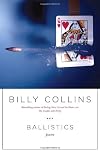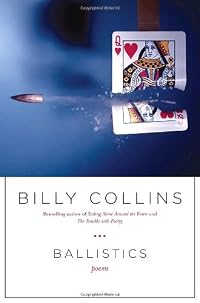
Ballistics: Poems
by Billy Collins
On This Page
Description
The former U.S. poet laureate and best-selling author of Nine Horses and Around the Room presents a new compilation of his acclaimed poems, some of which have never before been published.Tags
Recommendations



























Member Reviews
In this book of poems, former U.S. poet laureate Billy Collins ruminates on the everyday, love, divorce, solitude, and more.
The poems are free verse with two or three lines per stanza and hardly a rhyme, but full of succinct and memorable images such as in "Divorce": "Once, two spoons in bed, / now tined forks // across a granite table / and the knives they have hired." It's not dense, but it's not simple, either, as I ponder the layers of meaning in the imagery. Some of his poems are playful, such as "Adage," which begins, "When it's late at night and branches / are banging against the windows, / you might think that love is just a matter // of leaping out of the frying pan of yourself / into the fire of someone else, / but it's a show more little more complicated than that." He then proceeds to pick apart love and adages, and cleverly turn their meanings to his purposes. Every now and then, he captured a feeling that I instantly understood but could never put into words, such as a reaction of sorrow and guilt "On the Death of a Next-Door Neighbor": "The harmony of this house, not his, / might be missing a voice, / the hallways jumpy with the cry of the telephone --" This was my first collection of Billy Collins' poems, and won't be the last. show less
The poems are free verse with two or three lines per stanza and hardly a rhyme, but full of succinct and memorable images such as in "Divorce": "Once, two spoons in bed, / now tined forks // across a granite table / and the knives they have hired." It's not dense, but it's not simple, either, as I ponder the layers of meaning in the imagery. Some of his poems are playful, such as "Adage," which begins, "When it's late at night and branches / are banging against the windows, / you might think that love is just a matter // of leaping out of the frying pan of yourself / into the fire of someone else, / but it's a show more little more complicated than that." He then proceeds to pick apart love and adages, and cleverly turn their meanings to his purposes. Every now and then, he captured a feeling that I instantly understood but could never put into words, such as a reaction of sorrow and guilt "On the Death of a Next-Door Neighbor": "The harmony of this house, not his, / might be missing a voice, / the hallways jumpy with the cry of the telephone --" This was my first collection of Billy Collins' poems, and won't be the last. show less
Billy Collins can be simultaneously simple and overwrought. His subjects are typical meditations of old-school verse -- nature, art, food and drink, poetry and poets -- but in droll and deceptively spare language that tries not to lose the reader, just stay a teasing step ahead. A lot of this collection is self-referential, first-person, my-life-as-a-poet stuff, but Collins invites you to stay, nap on the couch or watch him rearrange the furniture or chew the scenery. Fun stuff.
This eighth collection by Billy Collins proves once again that poetry can be both intelligent and intelligible. Through his bestselling books and tenure as US Poet Laureate (2001-2003), Collins has blazed a difficult trail to win the reading public back to poetry. The poems he writes and advocates have the reader-friendly quality of "accessibility," much scorned in some academic circles today. Collins himself prefers to call such poetry "easy to enter," maintaining that poems may contain ambiguity and even mystery if only they will first allow the reader a starting point of understanding (i.e., plain English).
Whether in a domestic scene or travelogue, we are given the beckoning portal of universal experience: the pleasures of food, show more foibles, including those of poets; nature's healing balm; and the perennial striving of love to overcome our innate separateness. Themes light or grave are treated with charm, gentleness, and a sense of humor that is by turns sophisticated, childlike, and self abasing.
An excerpt from the poem "Despair" will sell the reader on Collins' irresistible variety of wit. After referring to "So much gloom and doubt in our poetry," the poet wonders what "the ancient Chinese poets/ would make of all this,/ these shadows and empty cupboards?" The poet's answer to his own question is a meditation containing an upbeat and comic resolve:
Today, with the sun blazing in the trees,
my thoughts turn to the great
tenth-century celebrator of experience,
Wa-Hoo, whose delight in the smallest things
could hardly be restrained,
and to his joyous counterpart in the western provinces,
Ye-Hah. show less
Whether in a domestic scene or travelogue, we are given the beckoning portal of universal experience: the pleasures of food, show more foibles, including those of poets; nature's healing balm; and the perennial striving of love to overcome our innate separateness. Themes light or grave are treated with charm, gentleness, and a sense of humor that is by turns sophisticated, childlike, and self abasing.
An excerpt from the poem "Despair" will sell the reader on Collins' irresistible variety of wit. After referring to "So much gloom and doubt in our poetry," the poet wonders what "the ancient Chinese poets/ would make of all this,/ these shadows and empty cupboards?" The poet's answer to his own question is a meditation containing an upbeat and comic resolve:
Today, with the sun blazing in the trees,
my thoughts turn to the great
tenth-century celebrator of experience,
Wa-Hoo, whose delight in the smallest things
could hardly be restrained,
and to his joyous counterpart in the western provinces,
Ye-Hah. show less
In Ballistics, the reader will happily find the Billy Collins of his or her previous acquaintance: whimsical, thoughtful, and hauntingly eloquent. As a collection, the poems of Ballistics flow together nicely, but then, there's always something so clearly Collins about his work that I imagine this effect could be achieved with any grouping of his work.
While I love poetry, I admit that I'm never quite sure how one should "review" a book of it. I tend to be introduced to poets by others and only then do I purchase a book by a single poet, confident that I enjoy their voice and will eagerly listen to whatever it is he or she has to say. Such is the case with Billy Collins, who is one of my favorite living poets. I almost wish he was more show more obscure so that such an observation could be deemed interesting, but Collins is well-respected and rightfully so. Since poetry always feels so personal, I find it hard to write up a true review, so I will simply say that I quite enjoyed this collection and here are three of my favorite poems from this work that will have to represent what I love about Billy Collins's poetry.
"Envoy"
Go, little book,
out of this house and into the world,
carriage made of paper rolling toward town
bearing a single passenger
beyond the reach of this jittery pen,
far from the desk and the nosy gooseneck lamp.
It is time to decamp,
put on a jacket and venture outside,
time to be regarded by other eyes,
bound to be held in foreign hands.
So off you go, infants of the brain,
with a wave and some bits of fatherly advice:
stay out as late as you like,
don't bother to call or write,
and talk to as many strangers as you can.
"Oh, My God!"
Not only in church
and nightly by their bedsides
do young girls pray these days.
Wherever they go,
prayer is woven into their talk
like a bright thread of awe.
Even at the pedestrian mall
outbursts of praise
spring unbidden from their glossy lips.
"The Mortal Coil"
One minute you are playing the fool,
strumming a tennis racquet as if it were a guitar
for the amusement of a few ladies
and the next minute you are lying on your deathbed,
arms stiff under the covers,
the counterpane tucked tight across your chest.
Or so seemed the progress of life
as I was flipping through the photographs
in Proust: The Later Years by George Painter.
Here he is at a tennis party, larking for the camera,
and 150 pages later, nothing but rictus on a pillow,
and in between; a confection dipped
into a cup of lime tea and brought to the mouth.
Which is why, instead of waiting
for our date this coming weekend,
I am now speeding to your house at 7:45 in the morning
where I hope to catch you half dressed--
and I am wondering which half
as I change lanes without looking --
with the result that we will be lifted
by the urgent pull of the flesh
into a state of ecstatic fusion, and you will be late for work.
And as we lie there
in the early, latticed light,
I will suggest that you take George Painter's
biography of Proust
to the office so you can show your boss
the pictures that caused you to arrive shortly before lunch
and he will understand perfectly,
for I imagine him to be a man of letters,
maybe even a devoted Proustian,
but at the very least a fellow creature,
ensnared with the rest of us in the same mortal coil,
or so it would appear from the wishful
vantage point of your warm and rumpled bed. show less
While I love poetry, I admit that I'm never quite sure how one should "review" a book of it. I tend to be introduced to poets by others and only then do I purchase a book by a single poet, confident that I enjoy their voice and will eagerly listen to whatever it is he or she has to say. Such is the case with Billy Collins, who is one of my favorite living poets. I almost wish he was more show more obscure so that such an observation could be deemed interesting, but Collins is well-respected and rightfully so. Since poetry always feels so personal, I find it hard to write up a true review, so I will simply say that I quite enjoyed this collection and here are three of my favorite poems from this work that will have to represent what I love about Billy Collins's poetry.
"Envoy"
Go, little book,
out of this house and into the world,
carriage made of paper rolling toward town
bearing a single passenger
beyond the reach of this jittery pen,
far from the desk and the nosy gooseneck lamp.
It is time to decamp,
put on a jacket and venture outside,
time to be regarded by other eyes,
bound to be held in foreign hands.
So off you go, infants of the brain,
with a wave and some bits of fatherly advice:
stay out as late as you like,
don't bother to call or write,
and talk to as many strangers as you can.
"Oh, My God!"
Not only in church
and nightly by their bedsides
do young girls pray these days.
Wherever they go,
prayer is woven into their talk
like a bright thread of awe.
Even at the pedestrian mall
outbursts of praise
spring unbidden from their glossy lips.
"The Mortal Coil"
One minute you are playing the fool,
strumming a tennis racquet as if it were a guitar
for the amusement of a few ladies
and the next minute you are lying on your deathbed,
arms stiff under the covers,
the counterpane tucked tight across your chest.
Or so seemed the progress of life
as I was flipping through the photographs
in Proust: The Later Years by George Painter.
Here he is at a tennis party, larking for the camera,
and 150 pages later, nothing but rictus on a pillow,
and in between; a confection dipped
into a cup of lime tea and brought to the mouth.
Which is why, instead of waiting
for our date this coming weekend,
I am now speeding to your house at 7:45 in the morning
where I hope to catch you half dressed--
and I am wondering which half
as I change lanes without looking --
with the result that we will be lifted
by the urgent pull of the flesh
into a state of ecstatic fusion, and you will be late for work.
And as we lie there
in the early, latticed light,
I will suggest that you take George Painter's
biography of Proust
to the office so you can show your boss
the pictures that caused you to arrive shortly before lunch
and he will understand perfectly,
for I imagine him to be a man of letters,
maybe even a devoted Proustian,
but at the very least a fellow creature,
ensnared with the rest of us in the same mortal coil,
or so it would appear from the wishful
vantage point of your warm and rumpled bed. show less
h, Billy Collins, the most popular modern poet laureate, the most amusing one. Here's a man who's not afraid to make jokes in verse, not afraid to be branded unserious. Thank goodness.
The first thing I noticed about Ballistics is how many of its poems are about the act of making poems and the life of the poet. Now, this is a pet peeve of mine. Why must so much verse be so very self-referential? Reading such stuff is like watching a DVD that's filled with making-of bonus features but contains no actual movie.
Therefore, I like Collins' other books better, especially Sailing Alone Around The Room. But there are good pieces here, poems that peek through the eyes of others and don't merely rely on Collins' (admittedly charming) show more quirk-schtick. And when he writes things like "love is just a matter / of leaping out of the frying pan of yourself / into the fire of someone else," I forgive him for quite a lot of navel-gazing. show less
The first thing I noticed about Ballistics is how many of its poems are about the act of making poems and the life of the poet. Now, this is a pet peeve of mine. Why must so much verse be so very self-referential? Reading such stuff is like watching a DVD that's filled with making-of bonus features but contains no actual movie.
Therefore, I like Collins' other books better, especially Sailing Alone Around The Room. But there are good pieces here, poems that peek through the eyes of others and don't merely rely on Collins' (admittedly charming) show more quirk-schtick. And when he writes things like "love is just a matter / of leaping out of the frying pan of yourself / into the fire of someone else," I forgive him for quite a lot of navel-gazing. show less
I went to the bookstore today -- not to buy anything, just to have a look around. I came away with my fourth copy of Mudbound, the new paperback, and I was surprised at the amber cover. I also got another novel and a collection of humorous travel stories.
Billy Collins' poetry makes me look at the ordinary, the every day, and see symmetrical beauty in the simple things of everyday life. I sailed through this new volume -- twice already -- and I am not the least bit disappointed.
His simple language, clever phrases, and delightful, humorous, and thought-provoking images give me more pleasure than any poetry I have ever read.
I needed this pick-me-up, because I finished teaching King Lear in class today, and the students were bored. I know show more they didn't read it. They could not see the power of the language, the depth of the characters, the intense fractured relationships.
They would declare the poems too simple and Hillary Jordan's Mudbound too long. They would miss the power of the language, the descriptions, the intense fractured society of Jim Crow Mississippi in 1945. They would be the poorer for it.
But I have another Billy Collins on my shelf, and I can take him and his words for a voyage to a wonderful place -- simple, quiet, reflective. Or I can hunker down with Laura, and Hap, and Ronsel on that mudbound farm in the Mississippi delta anytime I want.
Billy Collins has done it again. I am only going to tease you with a few stanzas from the first poem in the book, "August in Paris." The poet pauses to look over the shoulder of a sidewalk painter and wonders,
"But where are you, reader,
who have not paused in your walk
to look over my shoulder
to see what I am jotting in this notebook?
Alone in this city,
I sometimes wonder what you look like,
if you are wearing a flannel shirt
or a wraparound blue skirt held together with a pin.
But every time I turn around
you have fled through a crease in the air
to a quiet room where the shutters are closed
against the heat of the afternoon,
where there is only the sound of your breathing
and every so often, the tuning of a page" (3).
Now go get your own, because I am looking over Billy's shoulder, seeing the memories of my trips to Paris, stopping to watch a mime, a street performer, or a painter on a folding chair, delicately daubing paint on a small canvas. 5 stars.
--Jim, 3/20/09 show less
Billy Collins' poetry makes me look at the ordinary, the every day, and see symmetrical beauty in the simple things of everyday life. I sailed through this new volume -- twice already -- and I am not the least bit disappointed.
His simple language, clever phrases, and delightful, humorous, and thought-provoking images give me more pleasure than any poetry I have ever read.
I needed this pick-me-up, because I finished teaching King Lear in class today, and the students were bored. I know show more they didn't read it. They could not see the power of the language, the depth of the characters, the intense fractured relationships.
They would declare the poems too simple and Hillary Jordan's Mudbound too long. They would miss the power of the language, the descriptions, the intense fractured society of Jim Crow Mississippi in 1945. They would be the poorer for it.
But I have another Billy Collins on my shelf, and I can take him and his words for a voyage to a wonderful place -- simple, quiet, reflective. Or I can hunker down with Laura, and Hap, and Ronsel on that mudbound farm in the Mississippi delta anytime I want.
Billy Collins has done it again. I am only going to tease you with a few stanzas from the first poem in the book, "August in Paris." The poet pauses to look over the shoulder of a sidewalk painter and wonders,
"But where are you, reader,
who have not paused in your walk
to look over my shoulder
to see what I am jotting in this notebook?
Alone in this city,
I sometimes wonder what you look like,
if you are wearing a flannel shirt
or a wraparound blue skirt held together with a pin.
But every time I turn around
you have fled through a crease in the air
to a quiet room where the shutters are closed
against the heat of the afternoon,
where there is only the sound of your breathing
and every so often, the tuning of a page" (3).
Now go get your own, because I am looking over Billy's shoulder, seeing the memories of my trips to Paris, stopping to watch a mime, a street performer, or a painter on a folding chair, delicately daubing paint on a small canvas. 5 stars.
--Jim, 3/20/09 show less
Having read some of Collins' other collections, I can only say that this work doesn't stand up to his earlier collections. I may be judging this collection slightly more harshly because of my past exposure to his work, but in my defense, I'm also judging it against the many other poetry collections I've read. And, without Collins' name, I don't think many of the previoiusly published poems (in high name journals) would have found nearly such prestigious publications. I can only say, if you're new to Collins: start with his earlier works.
As for this collection, all of the poems come from interesting places, and most give a unique view that stands out, thought-wise, admirably. Yet, the emotion is in many cases absent or distanced. And, show more more bothersome in my own view, few of the lines stand out in such a way as to surprise you or catch your breath. And,still fewer of the poems demand rereading. In other words--I found much of it good, and very little, if any of it, great.
On the whole, this is an interesting collection with interesting thoughts--but, the poetry at the heart of this collection does not stand up to its pedigree, press, or author and publications. I'd like to say otherwise, but in the end, it just felt rather a let-down. show less
As for this collection, all of the poems come from interesting places, and most give a unique view that stands out, thought-wise, admirably. Yet, the emotion is in many cases absent or distanced. And, show more more bothersome in my own view, few of the lines stand out in such a way as to surprise you or catch your breath. And,still fewer of the poems demand rereading. In other words--I found much of it good, and very little, if any of it, great.
On the whole, this is an interesting collection with interesting thoughts--but, the poetry at the heart of this collection does not stand up to its pedigree, press, or author and publications. I'd like to say otherwise, but in the end, it just felt rather a let-down. show less
Members
- Recently Added By
Lists

Books Read in 2016
4,666 works; 197 members
Author Information

42+ Works 12,786 Members
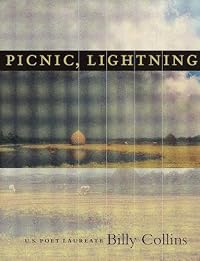
Billy Collins has published six collections of poetry, including Questions About Angels and The Art of Drowning, Picnic, Lightning, his latest, sold more than 25,000 copies in its first year. He teaches at Lehman College of the City University of New York and at Sarah Lawrence College. He was named U.S. Poet Laureate in June 2000. (Bowker Author show more Biography) Billy Collins was born in New York City in 1941. He earned a BA from the College of the Holy Cross, and both an MA and PhD from the University of California-Riverside. Collins conducted summer poetry workshops at University College Galway and is the Poet in Residence at Burren College of Art in Ireland. He is also a professor of English at Lehman College (CUNY). In 1992, Collins was chosen to be the Literary Lion of the New York Public Library. He was named U.S. Poet Laureate in 2001 and held the title until 2003. Collins then served as Poet Laureate for the State of New York from 2004 until 2006. His poetry has appeared in anthologies, textbooks and periodicals including Poetry, The American Poetry Review, The American scholar, Harper's, The Paris Review and The New Yorker. He is the author of six books of poetry including "The Art of Drowning." His poems have also been selected to appear in The Best American Poetry of 1992, 1993 and 1997. His works have won various awards including the Bess Hokin Prize, the Frederick Bock Prize, the Oscar Blumenthal Prize and the Levinson Prize, all awarded by Poetry. He has received fellowships from the New York Foundation for the Arts, the National Endowment for the Arts and the Guggenheim Foundation. His collection of poems entitled Aimless Love made numerous best-seller lists in 2013. (Bowker Author Biography) show less
Awards and Honors
Awards
Distinctions
Common Knowledge
- Original publication date
- 2008
- Epigraph
- Even as a cow she was lovely.
– Ovid, Metamorphoses - Dedication
- For Chris Calhoun
advocate and pal - First words
- August in Paris
I have stopped here on the rue des École
just off the boulevard St-Germain
to look over the shoulder of a man
in a flannel shirt and a straw hat
who has set up an easel and a c... (show all)anvas chaiir
on the sidewalk in order to paint from a droll angle
a side-view of the Church of Saint Thomas Aquinas. - Last words
- (Click to show. Warning: May contain spoilers.)So off you go, infants of the brain,
with a wave and some bits of fatherly advice:
stay out as late as you like,
don't bother to call or write,
and talk to as many strangers as you can.
Classifications
Statistics
- Members
- 717
- Popularity
- 39,271
- Reviews
- 13
- Rating
- (4.06)
- Languages
- English, Italian
- Media
- Paper, Ebook
- ISBNs
- 8
- ASINs
- 3